4 Sources
[1]
Graviton 5 impresses, but please, for the love of all that's holy, stop calling them 'AI chips'
Amazon, along with the rest of the industry, has gotten so used to framing everything that happens through the context of AI that it has lost the plot on their Graviton chip lineup, and along with it their own credibility. Which is a shame, because it's actually a triumph of a chip. First, the Wall Street Journal breathlessly reported that Snowflake's $6 billion AWS commitment was "for agentic computing chips." Then AWS's own press release heralded the release of their latest chips "for the Agentic AI era." In both cases, they were referring to their Graviton line. You could be forgiven for thinking this was some kind of GPU. No, that's Trainium. (Technically, Trainium isn't a GPU, nor is it a CPU, but rather a systolic array. Don't worry; most AI engineering software doesn't know what the hell that is, either.) Graviton is AWS's general purpose Arm CPU, which can be used for AI in much the same way as Excel can be used as a database. But that's far from its only, or even primary, purpose. Let's dive into what Graviton actually is. Price / Performance / Reality For the longest time, Amazon refused to issue benchmarks, competitively positioning its then-nascent Arm line against Intel. Many of us thought this meant that the results would underwhelm -- so you can imagine my surprise when real-world workload tests showed 35 percent to 40 percent better performance in a wide variety of situations. It was as if Amazon had built something amazing, but was somehow embarrassed to admit it. Those days are long behind us; they trumpet in the subhead of their announcement that Graviton 5 means "apps run 35% faster, ML inference is 35% faster, and databases are 30% faster." To their credit, I was expecting those numbers to be against something ancient, but in a refreshing bout of honesty, they're comparing them to Graviton 4, itself no slouch. They are also 9 percent more expensive. Once upon a time, new generations of AWS instances were notably less expensive than their predecessors. Going from a c4.large to a c5.large meant you'd get better performance, and the instance itself was a whopping 15 percent cheaper. Upgrading was a no-brainer! That started changing, and now upgrading means the instance becomes more expensive. AWS's position is that this is an incomplete analysis, since the improved performance means you'd pay less for a given workload. In some cases, this is correct, but in others, it's akin to saying that a Ferrari offers better price performance than my Honda CR-V because I can drive it to work three times faster. Logic, as well as traffic lights, disagree. Amazon's contention is correct for customers who have large fleets of nodes that they run at high degrees of CPU utilization. Switching those fleets to the new hotness will absolutely result in a price performance improvement, provided the workload and the stars both align. However, for customers who need a fixed number of nodes (think database companies, who offer each customer of theirs a set number of replicas, or workloads of the form "each environment gets three nodes, one in each AZ"), this represents a pure 9 percent price hike going from old generations to new ones. That puts many customers in a pickle: upgrade to new instance families, or stay on the old ones and watch availability become constrained in the coming years as AWS stops racking old chips. (Hi, Amazon PR! If you're about to pop into my inbox to tell me that won't happen, I have a customer I'd love for you to have a chat with!) But this price hike isn't happening in a vacuum. It's happening against a backdrop of "an 8GB Raspberry Pi is now $175, over twice its launch price of $85." Components have become fiendishly expensive across the board as giant companies compete for capacity, and AWS has to be feeling that pressure. Two companies each asked to buy all of AWS's Graviton capacity for the year; AWS clearly has room to kick their prices into the stratosphere! Somehow, they're not only resisting the siren song of "please gouge me, business daddy," but also managing to keep availability strong for customers of all stripes; I upgraded my developer node in my tiny unremarkable AWS account yesterday, and it Just Worked. And so... Despite the nonsense marketing, I don't want to detract from just how amazing Annapurna Labs (Amazon's chip division) has been at churning out wildly performant silicon year over year. Their chips are legitimately great, and the Graviton 5 numbers are a triumph. Lost against the backdrop of "Agentic AI," the stuff underpinning all of it continues to work, improve, and largely pass by unremarked.
[2]
AWS Graviton5 Debuts with 192 Arm Cores and PCIe 6.0
AWS has provided a first look at its next-generation Graviton5 processor, a custom server CPU developed by Annapurna Labs for deployment across the company's cloud computing platform and AI inference infrastructure. The new processor represents a significant step forward in AWS's ongoing effort to develop in-house silicon tailored specifically for hyperscale data center workloads. Graviton5 adopts a chiplet-based architecture built around four compute dies manufactured using TSMC's advanced 3 nm process technology. Combined, the package delivers 192 Arm v3 performance cores, making it one of the highest core-count Arm server processors publicly disclosed. Each core includes 1 MB of dedicated cache, helping reduce memory access latency while improving performance consistency across heavily parallelized workloads. A major focus of the design is memory bandwidth. The processor integrates a 12-channel DDR5 memory subsystem supporting speeds up to DDR5-8800. AWS states that the platform is capable of delivering more than 800 GB/s of aggregate memory bandwidth. Such bandwidth is increasingly important for modern cloud services, including large-scale databases, virtualization, analytics, and AI inference applications that depend on rapid data movement between memory and compute resources. Connectivity is provided through a 96-lane PCI Express Gen 6 root complex. The move to PCIe Gen 6 significantly increases available I/O bandwidth for accelerators, GPUs, networking hardware, and storage devices. As AI infrastructure continues to grow in complexity, faster communication between processors and attached devices becomes increasingly valuable. Despite being composed of four separate chiplets, Graviton5 operates as a fully coherent processor. AWS implemented a die-to-die interconnect delivering 420 GB/s of bandwidth, allowing all chiplets to share data while maintaining cache coherency across the package. This approach enables software to view the processor as a unified platform rather than a collection of independent compute dies. Each chiplet contributes an equal share of system resources. A single die contains 48 Arm v3 performance cores, a three-channel DDR5 memory controller, and a 24-lane PCIe Gen 6 root complex. This balanced configuration helps ensure that compute, memory, and I/O resources scale consistently across the entire processor package. AWS indicates that Graviton5 is targeting performance improvements of up to 25 percent over AWS G4 instances currently powered by Intel Xeon Scalable Cascade Lake and AMD EPYC Genoa processors. While detailed benchmark results have yet to be published, the disclosed specifications suggest meaningful gains in compute density, memory throughput, and platform bandwidth. The processor underscores AWS's continued investment in custom silicon as cloud providers increasingly seek to optimize hardware around their own workloads. With 192 Arm cores, DDR5-8800 support, PCIe Gen 6 connectivity, and a high-bandwidth coherent interconnect, Graviton5 appears designed to address the growing demands of large-scale cloud and AI deployments. SpecificationAWS Graviton5 Process TechnologyTSMC 3nm ArchitectureArm v3 Total CPU Cores192 Chiplets4 Cores per Chiplet48 Cache per Core1 MB Memory Channels12x DDR5 Maximum Memory SpeedDDR5-8800 Memory BandwidthOver 800 GB/s PCI Express96 lanes PCIe Gen 6 Die-to-Die Bandwidth420 GB/s Target Performance GainUp to 25%
[3]
Amazon's Graviton5 processor will go head-to-head with Intel and AMD in the cloud
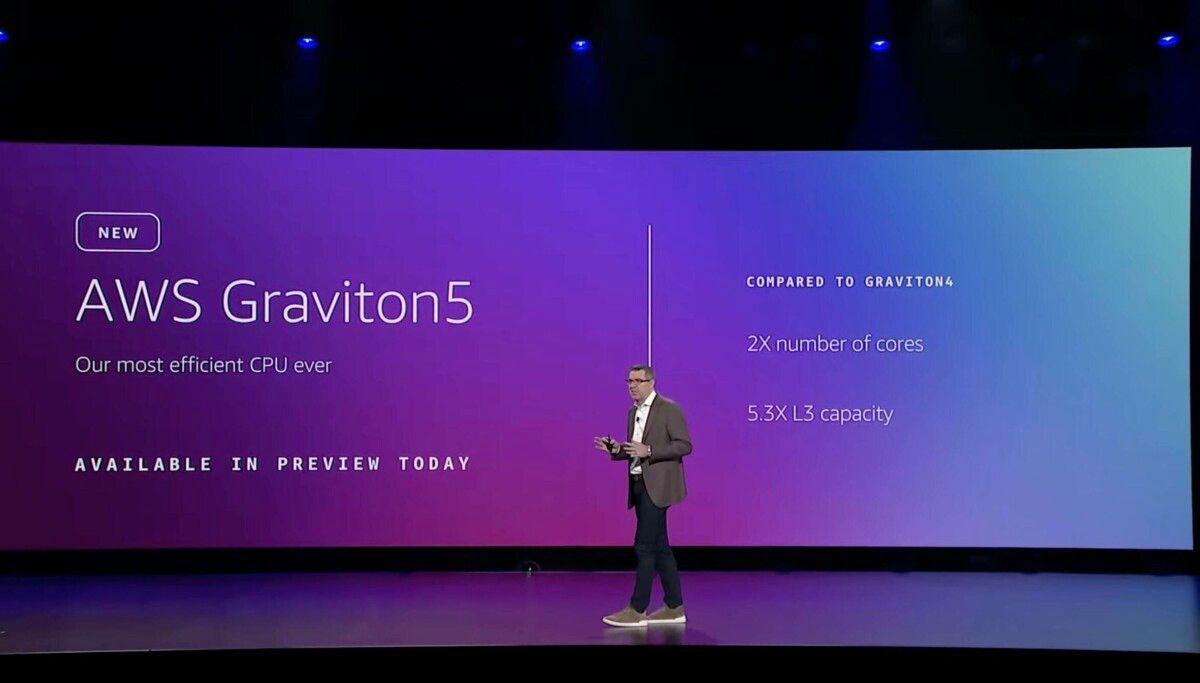
Amazon Web Services (AWS) is one of the largest cloud companies in the world, and for several years it has been developing and deploying AWS Graviton processors for web applications, analytics, databases, machine learning (ML) inference, gaming, video encoding, and more. The latest in-house AWS processor, designed and built in collaboration with Annapurna Labs on TSMC's 3nm process, the AWS Graviton5, is here. The chiplet design features an impressive 192 Arm V3 cores, a 5X increase in L3 Cache, a 33% lower inter-core latency, 420 GB/s die-to-die bandwidth, PCIe Gen6 and DDR5-8800 memory support with a bandwidth of 800+ GB/sec. AWS notes that compared to Graviton4-based instances, the new Graviton5 offers up to 35% faster performance for AI inference, making it an ideal chip for the current agentic era. And when it comes to memory, it delivers the "fastest memory of any processor instances in the cloud." Naturally, this means that Amazon's new M9g instances powered by AWS Graviton5 are outperforming previous-gen AWS instances powered by Intel Xeon "Cascade Lake" and AMD EPYC "Genoa" processors. And with that, AWS confirms that Meta is one of its largest customers, and is deploying Graviton5 "at scale" with tens of millions of CPU cores supporting the company's agentic AI push. AWS has big plans for Graviton and is already deploying new Graviton5 instances across the United States and in parts of Europe. "While many Arm-based instances have been introduced across the industry, no one comes close to the breadth and depth of the AWS Graviton footprint," the announcement reads. "After five generations of custom silicon and eight years of continuous investment, Graviton powers over 350 instance types serving more than 120,000 customers, from startups to large enterprises, a robust ISV partner ecosystem, and a broad set of managed services."
[4]
AWS Graviton5 CPUs Now Available: Purpose-Built For AI With 25% Performance Uplift, 192 Cores, DDR5-8800 & PCIe Gen6 Support
Amazon says that its AWS Graviton5 is the fastest and most efficient CPU it has ever built and is now generally available for AI and other use cases. AWS Graviton5 Starts Rolling Out To Customers, Offering Better Performance With Latest Technologies Including PCIe Gen6 Today marks the official "General" availability of AWS's next big chip, the Graviton5 CPU. The chip is said to be much faster than the existing generation of AWS CPUs, and also expand their capabilities with the latest IO features. * Graviton (2018): Amazon launched its first custom cloud processor, proving that the energy-efficient chip technology behind smartphones could handle serious cloud workloads. * Graviton2 (2019): The second generation delivered a massive leap -- up to 40% better price performance than comparable processors, making it significantly cheaper for companies to run their applications. * Graviton3 (2021): The third generation used 60% less energy for the same performance as comparable Amazon EC2 instances, helping customers reduce their environmental impact while improving performance. * Graviton4 (2023): With triple the processing cores, Graviton4 handled more demanding workloads -- like large databases and analytics -- faster and more efficiently. * Graviton5 (2025): The latest generation doubles core count to 192 and delivers up to 25% better performance than Graviton4, powering the most demanding applications from real-time gaming to AI. Starting off with the performance, Amazon AWS claims that Graviton5 CPUs will offer up to 25% faster performance versus the prior generation, while applications on the same chip will run 35% faster, AI/ML Inferencing will be 35% faster, and databases will be 30% faster. Each CPU packs 192 cores built on a 3nm process technology & also offers 33% lower inter-core latency. Some of those IO upgrades that we mentioned above include faster DDR5 memory support with up to 8800 speeds, the fastest DDR5 in the cloud, and support for PCIe Gen6 protocol. Each chip also offers a cache that is five times larger than the prior generation, with each core having access to 2.6x more cache, adding to the chip's expanded AI inference and ML capabilities. The chip includes a 5x larger L3 cache -- a high-speed memory buffer that keeps frequently accessed data close to the processor. Each Graviton5 core has access to 2.6x more L3 cache than Graviton4, which translates to fewer delays waiting for data and faster application response times. Memory performance has also improved, with Graviton5 providing faster memory speeds, enabling you to process larger datasets and run memory-intensive applications more efficiently. Network and storage bandwidth have also increased, with up to 15% higher network bandwidth and 20% higher Amazon Elastic Block Store (EBS) bandwidth on average across instance sizes, and up to twice the network bandwidth for the largest instances -- resulting in faster data transfers, quicker backups, and improved performance for distributed applications. Amazon AWS Currently, the Graviton5 CPUs are available in Amazon EC2 M9g and M9gd instances. Meta has already committed to deploying tens of millions of Graviton cores for its Agentic AI use, while Uber & Snowflake are also some of the many customers that are leveraging these chips. Amazon says that it has over 120K customers building on Graviton, and the number continues to rise. As for an instance-to-instance comparison, the M9g instance offers 25% better compute performance vs the prior generation, while the M9gd instances are designed for firms that require high-speed local SSD storage with up to 11.4 TB of capacity and 30% higher IOPS versus the previous gen. AWS Graviton5 marks a major leap forward in cloud computing, delivering the company's fastest and most efficient CPU yet. With 192 cores, up to 25% higher performance, significantly larger caches, PCIe Gen6 support, and faster memory, it brings substantial gains for AI inference, databases, high-performance workloads, and general applications -- all while continuing Amazon's tradition of superior price-performance and energy efficiency. Now generally available in M9g and M9gd instances, Graviton5 is already being adopted by major customers like Meta, Uber, and Snowflake. As the fifth generation in a highly successful custom silicon journey, it further strengthens AWS's leadership in delivering powerful, cost-effective, and sustainable cloud infrastructure. Follow Wccftech on Google to get more of our news coverage in your feeds.
Share
Copy Link
Amazon's latest Graviton5 processor features 192 Arm cores built on TSMC's 3nm process, delivering 35% faster AI inference and 30% faster database performance. Meta is deploying tens of millions of cores as AWS positions its custom silicon against Intel Xeon and AMD EPYC processors. The chip marks a significant step in AWS's eight-year custom silicon journey, though the company's marketing push to frame it as an 'AI chip' has drawn criticism from industry observers.

Source: Wccftech
Amazon Web Services has launched AWS Graviton5, its most powerful custom server CPU to date, now generally available across M9g and M9gd instance types. Developed by Annapurna Labs and manufactured using TSMC's 3nm process, the next-generation Graviton5 processor features a chiplet-based architecture comprising four compute dies that collectively deliver 192 Arm cores
2
. Each core includes 1 MB of dedicated cache, with the chip offering five times larger L3 cache compared to its predecessor, giving each core access to 2.6 times more cache than Graviton44
. This general-purpose Arm CPU operates as a fully coherent processor despite its multi-chiplet design, implementing a die-to-die interconnect that delivers 420 GB/s of bandwidth to maintain cache coherency across the package2
.The Graviton5 processor delivers measurable performance improvements across multiple workload categories. Applications run 35% faster, machine learning inference accelerates by 35%, and databases see 30% faster performance compared to Graviton4-based instances
1
. AWS positions these gains as targeting up to 25% better performance versus previous-generation instances powered by Intel Xeon Cascade Lake and AMD EPYC Genoa processors2
. The chip achieves 33% lower inter-core latency, critical for parallelized cloud computing tasks3
. Memory bandwidth reaches over 800 GB/s through a 12-channel DDR5 memory subsystem supporting speeds up to DDR5-8800, which AWS claims represents the fastest memory of any processor instances in the cloud2
3
.Connectivity represents a major focus of the Graviton5 design, with the in-house processor integrating a 96-lane PCIe Gen 6 root complex that significantly increases available I/O bandwidth for accelerators, GPUs, networking hardware, and storage devices
2
. Network bandwidth increases by up to 15% on average across instance sizes, with the largest instances seeing up to twice the network bandwidth of previous generations. Amazon Elastic Block Store bandwidth improves by 20% on average, enabling faster data transfers and improved performance for distributed applications4
. The M9gd instances specifically target customers requiring high-speed local SSD storage, offering up to 11.4 TB of capacity with 30% higher IOPS versus previous generations4
.Related Stories

Source: The Register
AWS confirms that Meta has become one of its largest customers, deploying Graviton5 at scale with tens of millions of CPU cores supporting the company's agentic AI initiatives
3
. Snowflake has committed $6 billion to AWS for computing capacity, while Uber also ranks among major customers leveraging the custom silicon platform1
4
. After eight years of continuous investment across five generations, Graviton now powers over 350 instance types serving more than 120,000 customers ranging from startups to large enterprises3
. AWS is deploying new Amazon EC2 M9g instances across the United States and parts of Europe, with availability remaining strong even for smaller customers1
.The new instances come with a 9% price increase over Graviton4-based offerings, marking a shift from earlier generations when upgrades delivered both better performance and lower costs
1
. AWS maintains that customers running large fleets at high CPU utilization will see net cost savings through improved price-performance, though customers requiring fixed node counts face a direct price increase. This pricing pressure reflects broader industry dynamics, with component costs rising as companies compete for manufacturing capacity. Despite marketing emphasis on AI inference capabilities and the "agentic AI era," industry observers note that Graviton remains fundamentally a general-purpose Arm CPU rather than specialized AI hardware like AWS's Trainium accelerators1
. The processor's actual strengths lie in web applications, analytics, databases, gaming, and video encoding workloads, with AI inference representing one capability among many3
. AWS's continued investment in custom silicon positions the company to optimize hardware specifically for cloud computing workloads while reducing dependence on Intel Xeon and AMD EPYC processors that have traditionally dominated data center infrastructure.Summarized by
Navi
[1]
19 Jun 2025•Technology

24 Apr 2026•Technology

04 Dec 2024•Technology

1
Policy and Regulation

2
Technology

3
Health