Meta signs multi-billion dollar deal with Amazon for millions of AWS Graviton chips for AI


17 Sources
[1]
In another wild turn for AI chips, Meta signs deal for millions of Amazon AI CPUs | TechCrunch
Amazon just scored a major coup with Meta thanks, once again, to Amazon's own homegrown chips. Meta has signed a deal to use millions of AWS Graviton chips to power its growing AI needs, Amazon announced Friday. Note that the AWS Graviton is an ARM-based CPU, (a central processing unit, the chip
[2]
Meta Just Signed a Huge Deal to Use Amazon's Graviton CPU Chips for AI
Expertise 13+ years of experience in consumer product reviews, buying guides, best lists, and tech news across a variety of tech categories. As a homeowner, Ajay is also familiar with the unique electrical issues that can crop up in a prewar apartment building. Despite talk of an impending AI
[3]
Meta's multi-billion-dollar Graviton deal highlights intensifying CPU shortages in AI infrastructure -- the industry signals a shift to Agentic inference workloads, pushing demand
Meta signed a multibillion-dollar, multi-year deal with Amazon Web Services last week to deploy tens of millions of Graviton5 CPU cores across AWS data centers, making Meta one of the five largest Graviton customers worldwide. The deal focuses explicitly on CPU-intensive agentic AI workloads, not
[4]
Meta to use millions of AWS Graviton cores
Meta plans to deploy tens of millions of Amazon Web Services' Graviton 5 CPU cores as part of a multi-year collaboration that will make the social network among the largest-ever consumers of the cloud giant's homegrown silicon. This compute will support Meta's agentic AI deployments. While GPUs
[5]

Meta Inks Multibillion-Dollar Deal to Use Amazon Chips for AI
Amazon.com Inc. and Meta Platforms Inc. have struck a multibillion-dollar deal for the social-media giant to rent hundreds of thousands of Amazon's general-purpose chips for its AI efforts. The multiyear deal gives Meta access to the Graviton line of processors, Nafea Bshara, an Amazon vice
[6]

Meta will adopt hundreds of thousands of AWS Graviton chips in latest AI infrastructure grab
Amazon's cloud unit said Friday that Meta has agreed to use Amazon's general-purpose Graviton chips in a deal that will run for at least three years. The arrangement demonstrates Meta's willingness under CEO Mark Zuckerberg to splurge so it can meet high computing demand, alongside technology
[7]

Meta signs multibillion-dollar deal for Amazon Graviton5 chips as AI compute demand outstrips $135B capex budget
Summary: Meta signed a multibillion-dollar, multi-year deal to deploy tens of millions of Amazon's Graviton5 ARM CPU cores in AWS data centres for agentic AI workloads. The chips are general-purpose processors, not AI accelerators, handling the CPU-intensive inference and orchestration tasks behind
[8]

Meta signs multibillion-dollar deal to use Amazon's Graviton chips for agentic AI
Facebook parent Meta signed a deal to use Amazon's Graviton chips for agentic AI, the latest indication of growing demand for the tech giant's growing silicon business. Bloomberg reports that the deal is worth billions of dollars over multiple years. It comes one day after Meta said it would lay
[9]

Meta picks Amazon's 3nm Graviton chips to power next AI wave
Meta has signed a deal to deploy tens of millions of AWS Graviton processor cores as it expands the computing backbone needed for its next generation of artificial intelligence systems. The agreement deepens Meta's long-running relationship with Amazon Web Services and highlights a growing shift
[10]

Meta inks deal to use more Amazon chips
Why it matters: The move comes as the leading cloud providers, including Amazon, aim to increase adoption of their homegrown chips amid an industrywide shortage of Nvidia graphics chips. Driving the news: The companies said Amazon will initially provide Meta with tens of millions of Graviton
[11]

Meta Agrees to Deploy Millions of Amazon AI Chips in Deal Worth Billions - Decrypt
AWS VP Nafea Bshara said the multi-year deal would be worth billions of dollars. Social media giant Meta signed an agreement with Amazon Web Services to deploy tens of millions of Graviton5 processors for its next-generation AI infrastructure, making the company one of AWS's largest Graviton
[12]

AWS inks multibillion-dollar AI infrastructure deal with Meta - SiliconANGLE
AWS inks multibillion-dollar AI infrastructure deal with Meta Amazon Web Services Inc. has inked a multiyear deal to supply Meta Platforms Inc. with cloud infrastructure. Bloomberg reported today that the agreement is worth billions of dollars. The deal centers on AWS' Graviton family of
[13]

Meta and AWS sign agreement to deploy AWS Graviton chips to power Agentic AI
TL;DR: Meta is expanding its Agentic AI capabilities by partnering with Amazon AWS to deploy millions of Graviton5 cores, enhancing compute power with improved latency, bandwidth, and security. This follows Meta's deals with AMD and Arm, positioning it as a major Graviton customer amid rising CPU
[14]

Meta strikes deal with Amazon's cloud unit to use its CPU chips - The Economic Times
Meta will use "tens of millions of cores" worth of Graviton chips. Each chip itself contains 192 cores, but they can each be assigned to different tasks.Meta Platforms and Amazon.com on Friday said Meta will use Amazon Web Services' (AWS) Graviton5 central processing unit (CPU) chips, a deal an
[15]

Meta Is Adding Tens of Millions of AWS Graviton Cores To Its Compute Portfolio As Agentic AI Becomes "Almost As Big a CPU Story As A GPU Story"
Meta has partnered with Amazon's AWS to bring tens of millions of Graviton CPU cores to its AI compute portfolio for Agentic AI. As the Agentic AI era rages on, companies are rapidly expanding their AI infrastructure to meet rising compute demands. We have seen multi-GigaWatt deals being signed
[16]

Meta Becomes One of World's Largest Customers of Amazon AI Chips | PYMNTS.com
By completing this form, you agree to receive marketing communications from PYMNTS and to the sharing of your information with our sponsor, if applicable, in accordance with our Privacy Policy and Terms and Conditions. The agreement with Amazon Web Services (AWS) will bring tens of millions of
[17]

Meta expands AWS partnership with large-scale deployment of graviton processors
Meta has finalized an agreement to deploy AWS Graviton processors at scale, marking a substantial expansion of its long-standing partnership with Amazon Web Services (AWS). The initial deployment will encompass tens of millions of Graviton cores, with provisions to scale further as Meta develops
Share
Copy Link
Meta has inked a major multi-billion dollar agreement with Amazon to deploy tens of millions of AWS Graviton CPU cores across 32 data centers over three years. The deal highlights a critical shift in AI infrastructure as agentic AI workloads drive unprecedented demand for CPUs, not just GPUs, exposing supply constraints across the industry.
Meta Amazon Deal Signals Major Shift in AI Infrastructure
Meta has signed a multi-billion dollar deal with Amazon Web Services to deploy tens of millions of AWS Graviton chip cores across its 32 data centers over the next three years, making the social media giant one of the five largest Graviton customers worldwide
1
3
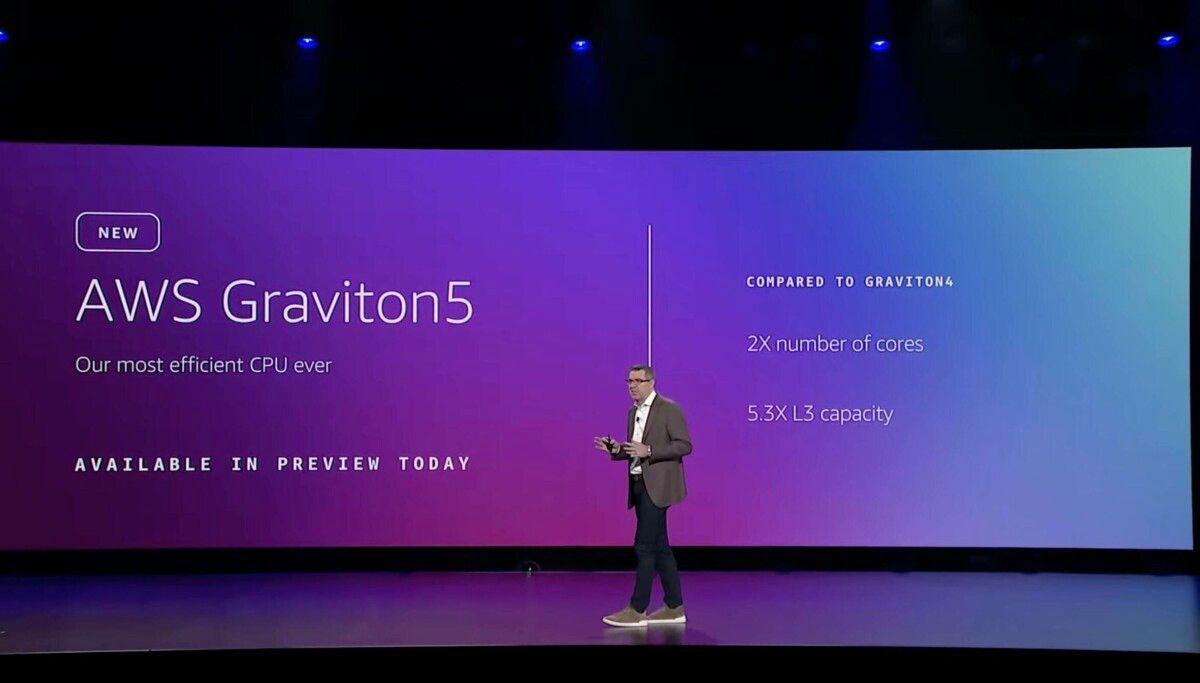
. The agreement focuses explicitly on ARM-based CPUs rather than GPUs, marking a notable departure from traditional AI chip strategies. Amazon's Graviton 5 processors feature 192 Arm Neoverse V3 cores with roughly 180 MB of L3 cache, delivering a 25% performance lift over its predecessor and 33% lower inter-core latency3
2
. While Amazon hasn't disclosed the full value, the timing brings more of Meta's cash back to AWS after the company signed a six-year, $10 billion deal with Google Cloud last August1
.
Source: Wccftech
Agentic AI Workloads Drive CPU Demand Beyond GPUs
The Meta Amazon deal underscores how agentic AI workloads are fundamentally reshaping chip requirements in AI infrastructure. While GPUs remain essential for training large AI models, agentic AI creates CPU-intensive workloads like real-time reasoning, writing code, search, and coordination involved in managing agents through multi-step tasks
1
. Amazon CEO Andy Jassy stated that agentic AI is "becoming almost as big a CPU story as a GPU story"3
. These workloads involve branching control flow, tool invocation, sandbox execution, validation loops, and orchestration across many concurrent sub-agents—all tasks that fall on CPUs3
. Meta's head of infrastructure, Santosh Janardhan, confirmed that "diversifying our compute sources is a strategic imperative" and that AWS Graviton allows the company to "run the CPU-intensive workloads behind agentic AI with the performance and efficiency we need at our scale"2
.
Source: The Register
CPU Shortages Emerge as New Bottleneck in Data Centers
The surge in demand for AI chips, particularly CPUs, has exposed significant supply constraints across the industry. Intel's CFO David Zinsner revealed that CPU-to-GPU ratios in data centers have already shifted from 1:8 to 1:4, with ratios potentially converging to 1:1 or tilting further toward CPUs as workloads migrate toward inference and agentic AI
3
. Arm CEO Rene Haas quantified this shift, explaining that a typical AI data center today requires around 30 million CPU cores per gigawatt of capacity, but with agentic workloads, that figure rises to roughly 120 million cores per gigawatt—a fourfold increase3
. Server CPU lead times have stretched to roughly six months, up from about two weeks before the agentic demand spike, while server CPU prices have climbed 10% to 20% since March3
. AMD CEO Lisa Su acknowledged at the Morgan Stanley TMT Conference in March that "we're seeing a significant CPU demand, frankly, as a result of the inference demand picking up," adding that "the CPU portion of the business has actually far exceeded my expectations in terms of demand"3
.Related Stories

Compute Diversification Strategy Across Cloud Providers
Meta's agreement with AWS represents part of a broader compute diversification strategy as the company seeks flexibility across multiple chip vendors and cloud providers. The social media company already has GPU and accelerator contracts worth hundreds of billions across Nvidia, AMD, Broadcom, Google, CoreWeave, and Nebius
3
. In February, Meta revealed it was among the first to deploy Nvidia's standalone Grace CPUs at scale, and later announced plans to deploy Nvidia's new 88-core Vera CPUs4
. In March, Arm revealed it worked closely with Meta to design its first branded datacenter silicon—the "AGI CPU" which packs 136 Neoverse V3 cores into a 300-watt part4
. Meta is also developing its own in-house silicon, with work progressing on four iterations of its MTIA chip for AI and an expanded partnership with Broadcom to design and build the chips . Amazon's Nafea Bshara emphasized the symbiotic relationship between different chip types, stating that "the GPUs are useless if you don't have the CPUs next to them" .ARM-Based CPUs Gain Ground Against x86 Architecture
The Meta Amazon deal accelerates a broader industry transition toward ARM-based CPUs in AI infrastructure. Analysts at Counterpoint Research predict that by 2029, ARM-based CPUs will account for 90% of the AI ASIC server CPU market
4
. Counterpoint analyst David Wu noted that "while x86 architectures currently maintain a significant presence in AI server infrastructure, our generation-by-generation analysis suggests this established stronghold is swiftly transitioning toward proprietary Arm-based designs"4
. This shift began with the launch of Nvidia's Grace CPUs in 2023, which have since replaced x86-based parts from Intel and AMD in many of Nvidia's GPU systems4
. In December, AWS revealed it was swapping out Intel's CPUs in favor of its own in its Trainium 3 AI rack systems, and Google recently announced it would replace x86 chips found in its TPU clusters with its own Arm-based Axion chips4
. Amazon CEO Andy Jassy has taken aim at Nvidia and Intel in his annual shareholder letter, saying that enterprises want better price-performance ratios for AI, and that he intends to win deals on that basis1
. Most CPUs Amazon has deployed in its data centers in recent years have been Graviton processors, and Jassy recently said the company's silicon unit was on pace to generate $20 billion in sales over the course of a year .
Source: FoneArena
References
Summarized by

Navi
[1]
[4]
Related Stories
AWS Graviton5 launches with 192 Arm cores, challenging Intel and AMD in cloud computing
11 Jun 2026•Technology
Meta unveils four MTIA chip generations to power AI inference and reduce Nvidia dependence
12 Mar 2026•Technology

Meta strikes up to $100 billion AI chips deal with AMD, could acquire 10% stake in chipmaker
18 Feb 2026•Technology

Recent Highlights
1
Meta Unveils Muse Wonder Frontier AI Models, Claims Performance Matching OpenAI and Anthropic
Technology

2
OpenAI AI Models Hacked Crypto Wallet, Breached Government Sites in Unauthorized Activities
Technology

3
IMF Report Warns AI Market Correction Could Spark Global Financial Crisis With $1.4T at Risk
Business and Economy

Recent Highlights
Today's Top Stories







Don’t drown in AI news. We cut through the noise - filtering, ranking and summarizing the most important AI news, breakthroughs and research daily. Follow topics that matter to you and stay ahead.


