2 Sources
[1]
Bernie Sanders stirs DC with AI warnings, call for US-China cooperation
Sen. Bernie Sanders (I-Vt.) has become a stark voice on AI in Washington, D.C., warning of the technology's more severe risks and calling for cooperation with China at a moment when the two superpowers are increasingly at odds over the technology. The 84-year-old senator is one of the few federal lawmakers taking up the cause of the AI skeptics or "doomers," as some have labeled the group, who have voiced concerns about AI's "existential risk to humanity." While both Democrats and Republicans alike have embraced the idea that the U.S. is locked in a fierce competition with China, Sanders is arguing the technology's risks require the opposite approach. "We're building a runaway train here," Sanders told reporters on a call last week. "It's moving down the track at rapidly expanding acceleration, and we don't know where it ends up. We don't know what its impact will be." "Do I think Congress is prepared to deal with it? I do not," he added. "So I'm going to do everything I can to try to generate support for action, bring people together and come up with some rational solutions." Sanders began ramping up his messaging on AI late last year, when he first called for a moratorium on data center construction as a means of giving "democracy a chance to catch up" amid the "unregulated sprint" to develop the technology. He and Rep. Alexandria Ocasio-Cortez (D-N.Y.) introduced legislation in March that would bar construction of all new data centers until "strong national safeguards are in place," such as measures preventing mass job displacement and limiting increases in consumer electricity prices. This comes as data centers have increasingly encountered local pushback and Americans have become more wary about AI. "For Sen. Sanders, I imagine he thinks that taking this more hard-line stance on AI might fit well with his populist political beliefs and expand his appeal to a wider swath of voters," Andrew Lokay, a senior research analyst at Beacon Policy Advisors, told The Hill. The fact that AI has "become kind of an elite-driven phenomenon" also tracks closely with Sanders' views, noted Sarah Kreps, director of the Tech Policy Institute at Cornell University. The progressive politician has repeatedly underscored the prominent role that wealthy tech titans, like Tesla CEO Elon Musk, Amazon founder Jeff Bezos and Meta CEO Mark Zuckerberg, have played in the development of AI. "These technologies right now are of growing concern to the American people," Sanders said on the press call, adding, "It's not because the American people are Luddites. They see positive aspects of AI and robotics." "They worry very much that the people who are investing in this technology, ... the very richest people on Earth, really do not stay up nights worrying about working families, but simply want to get wealthier and more powerful, which is my view as well," he continued His position on AI, particularly the call for a slowdown, stands in sharp contrast to much of the rest of Washington, which has been chiefly focused on ensuring that the U.S. remains ahead of China on the technology. The Trump administration has centered its AI policy heavily on the race with China, pushing to preempt state AI laws that it argues could impede innovation and cause the U.S. to fall behind. While Democrats have largely opposed the preemption push and called for more guardrails on the technology, few have supported the idea of pumping the brakes on AI. Sen. Mark Warner (D-Va.) dismissed the moratorium approach as "idiocy" at an Axios event in late March, warning this "simply means China's going to move quicker" and arguing "this is one where we can't lose." Jennifer Huddleston, a senior fellow in technology policy at the Cato Institute, noted that Sanders' approach to AI was more common several years ago when the technology first became a subject of widespread public discussion. "It's kind of concerning that we're seeing this position come back," Huddleston said, adding, "People were really unsure, but I think very quickly, people started to see the incredibly beneficial applications of this technology." Outside of the nation's capital, Sanders enjoys more support among a contingent of researchers who have long warned of the risks from AI, particularly superintelligence, a form of the technology that surpasses human intelligence. "If we just go ahead and do something that's foolhardy before figuring out how to control this stuff, we're in a worse position than the neanderthals," said Max Tegmark, a professor at the Massachusetts Institute of Technology. Tegmark was joined by fellow AI researchers based in Canada and China at an event organized by Sanders last week on the "existential threat of AI and the need for international cooperation." The decision to include Chinese researchers, who participated via teleconference, drew sharp pushback from Trump officials and allies. Treasury Secretary Scott Bessent slammed Sanders for "inviting foreign nationals to tell the United States how to regulate AI" and argued that the "real threat to AI safety is letting any nation other than the United States set the global standard." Venture capitalist Marc Andreessen simply shared an image of the event invite with the comment, "Concerning." However, Sanders suggested that the AI race bears a resemblance to the nuclear arms race of the Cold War era, pointing to talks between President Ronald Reagan and Soviet leader Mikhail Gorbachev on nuclear disarmament in the 1980s as instructive. "One might think that, given the very real threat to humanity, countries might come together to regulate this technology through an international treaty, like we did with nuclear weapons at the height of the Cold War," Sanders said. "What I believe in what I suspect that most people in the United States, China and around the world believe is that we need international cooperation between the nations of the world to prevent the possibility of a cataclysmic development. We need to cooperate. We need dialogue," he added. The senator noted that he was "surprised and delighted" to see that President Trump and Chinese President Xi Jinping are expected to discuss AI at their meeting in mid-May. But some experts are doubtful of the feasibility of Sanders' push for U.S.-China cooperation. "I think there's a real difference between dialogue and meaningful strategic cooperation," Kreps said in a statement to The Hill. "Of course, the United States and China should talk about AI risks, just as major powers talk about cyber incidents or nuclear stability or climate change," she continued. "But it's much harder to see what substantive cooperation on advanced AI would actually look like in practice." Kreps argued that AI is not like nuclear weapons, underscoring it is "deeply embedded" across everything from commercial infrastructure to civilian industry while noting that verification is "extraordinarily difficult." "If you believe AI will shape economic productivity, military capability, intelligence analysis, and industrial competitiveness, then voluntarily slowing domestic capacity while assuming durable cooperation from Beijing strikes me as wildly optimistic if not naive," she added. Lokay also suggested the event indicates that Sanders is more concerned about "the risks of AI transcending borders than the national security implications of the race with China" -- a stance that could potentially be costly to his cause. "I don't think that's a view that is widely shared in Washington, DC, and could potentially turn off perhaps some could perhaps turn off some people who may otherwise agree with Senator Sanders on some other parts of this AI debate, but are not willing to go that far," he said.
[2]
Bernie Sanders Says Trump Administration Is 'Beginning To Face Reality' On AI Risks After FDA-Style Propo
Sen. Bernie Sanders (I-Vt.) said the Trump administration appeared to be acknowledging growing concerns over artificial intelligence after a senior adviser suggested new AI systems could require FDA-style safety approval before being released to the public. Trump AI Regulation Shift Sparks Debate On Wednesday, in a post on X, Sanders said, "Maybe, just maybe, the Trump administration is beginning to face reality." He added that after resisting regulation, officials have now "acknowledged that out-of-control AI is a danger to humanity and must be regulated." He was responding to comments shared by Diego Areas Munhoz, who cited White House National Economic Council Director Kevin Hassett in an interview with Fox News' Maria Bartiromo. Hassett reportedly said new AI models "should go through a process so that they're released to the wild after they've been proven safe, just like an FDA drug," comparing AI deployment to the approval system used by the U.S. Food and Drug Administration. He added, "Trump admin treating new AI models like FDA drugs def not on many bingo cards." US AI Regulation Debate Grows U.S. leaders and tech executives expressed differing views on how AI should be managed, highlighting tensions between safety concerns, global cooperation and America's leadership in the sector. Earlier, Sanders called for international coordination on AI safety, warning that even a small risk of catastrophic outcomes required urgent action and arguing the focus should be on preventing harm rather than geopolitical competition. Alphabet CEO Sundar Pichai urged the U.S. to lead AI development, calling it a transformative technology while acknowledging risks such as job disruption and the need for regulation and workforce retraining. Sen. Adam Schiff (D-Calif) said public skepticism toward Congress's ability to regulate AI was justified, noting lawmakers must demonstrate effective action as AI increasingly affects jobs and the broader economy. Disclaimer: This content was partially produced with the help of AI tools and was reviewed and published by Benzinga editors. Photo courtesy: Joshua Sukoff on Shutterstock.com Market News and Data brought to you by Benzinga APIs To add Benzinga News as your preferred source on Google, click here.
Share
Copy Link
Sen. Bernie Sanders is emerging as Washington's leading voice on AI risks, warning of existential threats and calling for international cooperation with China. His stance contrasts sharply with most lawmakers focused on beating China in the AI race. Now, the Trump administration appears to be shifting toward his position, with officials suggesting new AI models should require FDA-style safety approval before public release.
Sen. Bernie Sanders has positioned himself as one of the few federal lawmakers willing to embrace the "doomer" perspective on artificial intelligence, warning that AI risks pose an existential risk to humanity
1
. The 84-year-old senator has ramped up his messaging on the technology since late last year, telling reporters that "we're building a runaway train here" that's "moving down the track at rapidly expanding acceleration, and we don't know where it ends up"1
. His stark warnings stand in sharp contrast to the prevailing sentiment in Congress, where both Democrats and Republicans have focused primarily on ensuring the United States maintains its technological edge over China.
Source: Benzinga
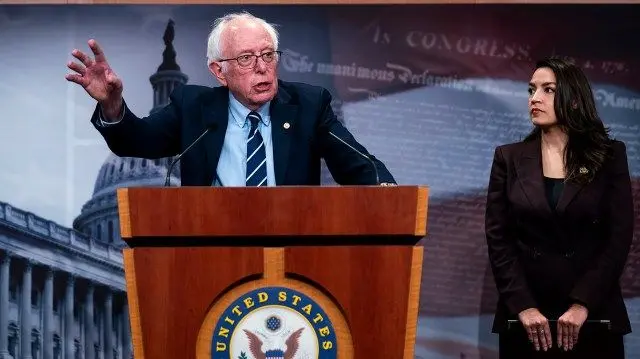
Bernie Sanders and Rep. Alexandria Ocasio-Cortez introduced legislation in March that would halt data center construction until national safeguards are established
1
. The bill aims to prevent mass job displacement and limit increases in consumer electricity prices, addressing concerns that unregulated AI development prioritizes corporate profits over worker protections1
. Sanders first called for a moratorium on data center construction late last year, arguing it would give "democracy a chance to catch up" amid the "unregulated sprint" to develop AI1
. The progressive senator has repeatedly emphasized that tech titans like Elon Musk, Jeff Bezos, and Mark Zuckerberg "really do not stay up nights worrying about working families, but simply want to get wealthier and more powerful"1
.
Source: The Hill
In a surprising development, the Trump administration appears to be moving closer to Sanders' position on AI regulation. White House National Economic Council Director Kevin Hassett suggested that new AI models "should go through a process so that they're released to the wild after they've been proven safe, just like an FDA drug"
2
. Sanders responded on Wednesday, stating that "maybe, just maybe, the Trump administration is beginning to face reality" after previously resisting AI regulation2
. The proposed FDA-style safety approval system would require AI developers to demonstrate their models are safe before public deployment, marking a significant shift from the administration's earlier focus on preventing state-level regulations that could impede innovation1
.Related Stories
Sanders' call for US-China cooperation on AI safety has generated controversy in a capital increasingly focused on technological competition with Beijing. He organized an event last week on the "existential threat of AI and the need for international cooperation," which included Chinese researchers participating via teleconference
1
. The decision drew sharp pushback from Trump officials and allies, with Treasury Secretary Scott Bessent slamming Sanders for "inviting" Chinese participants1
. Sen. Mark Warner dismissed the moratorium approach as "idiocy" at an Axios event in late March, warning that "this simply means China's going to move quicker"1
. Donald Trump's administration has centered its AI policy heavily on the race with China, pushing to preempt state laws that could cause the U.S. to fall behind1
.Sanders enjoys support from AI researchers who have long warned about the dangers of superintelligence, a form of AI that surpasses human intelligence. Max Tegmark, a professor at the Massachusetts Institute of Technology, stated at Sanders' event that "if we just go ahead and do something that's foolhardy before figuring out how to control this stuff, we're in a worse position than the neanderthals"
1
. Jennifer Huddleston from the Cato Institute noted that Sanders' approach was more common several years ago when AI first became widely discussed, but "people started to see the incredibly beneficial applications of this technology"1
. Meanwhile, Alphabet CEO Sundar Pichai urged the U.S. to lead AI development while acknowledging risks such as job disruption and the need for workforce retraining2
. Sen. Adam Schiff noted that public skepticism toward Congress's ability to regulate AI was justified, as lawmakers must demonstrate effective action while the technology increasingly affects jobs and the broader economy2
.Summarized by
Navi
28 Apr 2026•Policy and Regulation

28 Dec 2025•Policy and Regulation

17 Apr 2026•Policy and Regulation

1
Science and Research

2
Technology

3
Technology