BharatGen built a document model that says I don't know. The evidence is all its own


2 Sources
[1]
BharatGen's 7-billion-parameter Patram 1.5 is trained to hold back rather than guess
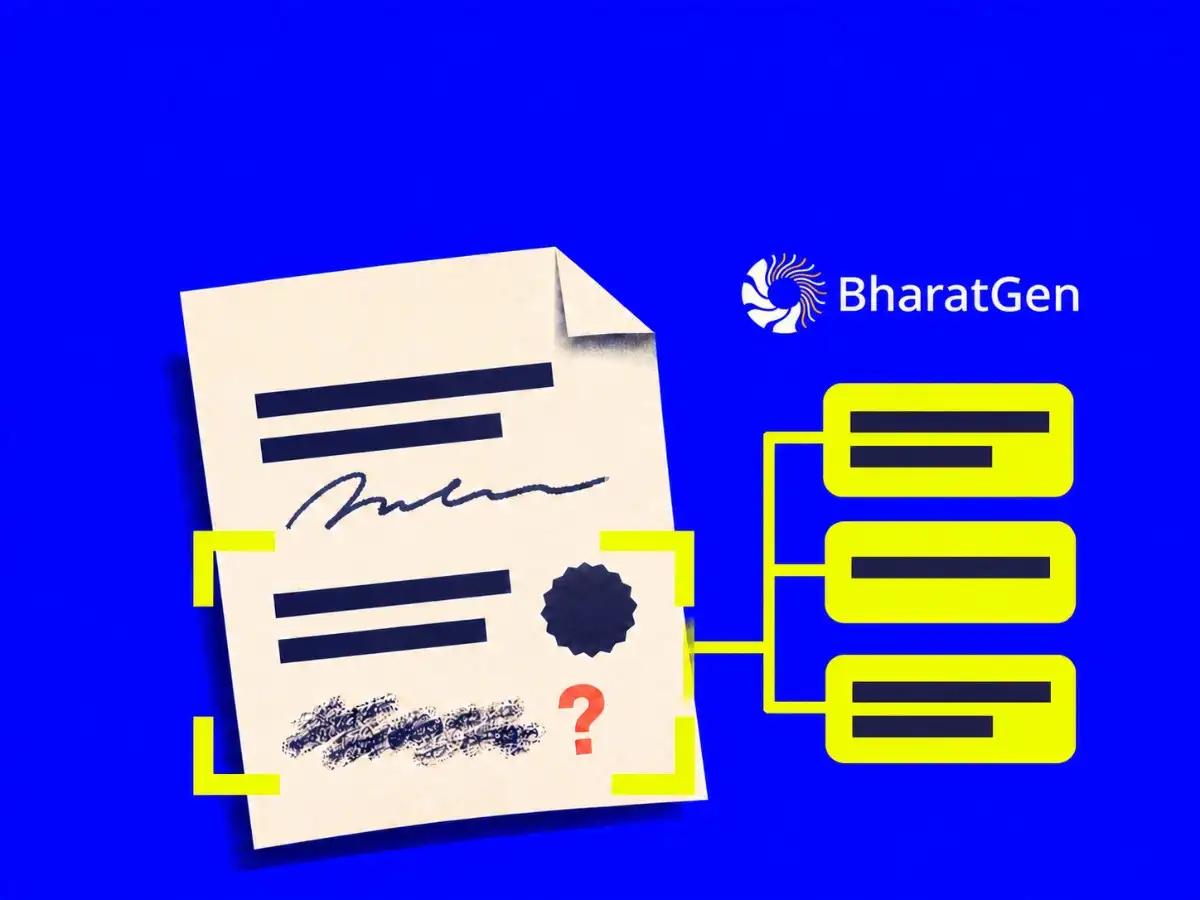
BharatGen has launched Patram 1.5, an artificial intelligence model that reads scanned, handwritten and mixed-language documents, as it looks to automate paperwork in banks, hospitals and government offices while reducing the risk of the system guessing when information is unclear. "India runs on
[2]
BharatGen Launches Patram 1.5 To Target Enterprise Document Processing
BharatGen claims the model matches much larger rivals in its evaluation and generates answers using around one twenty-first of Qwen3.5-9B's output tokens on selected tests. BharatGen has launched Patram 1.5, a vision-language model aimed at automating document processing across banking, financial
Share
Copy Link
BharatGen, a government-backed not-for-profit AI initiative based at IIT Bombay, has launched Patram 1.5, a model built to read scanned, handwritten and mixed-language documents for banks, hospitals and government offices
1
2
.
Source: Inc42
"India runs on documents, and business and government services rely on hard to read documents with critical information," CEO Rishi Bal said. "With Patram 1.5, we wanted a model that reads them well, runs frugally and accelerates business and government"
1
. The model converts pages into structured text, pulls out specific fields and answers questions about them in one system1
. Its predecessor, Patram 1, could only answer questions about a document image1
. The company markets it as a 7-billion-parameter model; its own technical specification puts it at 7.8 billion2
. The weights are downloadable under an Apache 2.0 licence, per Inc42, so organisations can host the model themselves instead of sending records to an outside service1
2
.The numbers are its own
It scored 83 overall in the company's own 49-test evaluation, matching the top score among 21 vision-language models assessed and tying Qwen3.5-397B and DeepSeek-V4.1-Flash
1
2
. BharatGen says DeepSeek-V4.1-Flash, the model Patram matched, is 97 times Patram's size2
. On ten selected question-answering tests, Patram produced answers using about one twenty-first of the output tokens Qwen3.5-9B used, with both models scoring 85, per the company's own evaluation2
. The evaluation includes PatramBench, a test set the company built from Indian documents, alongside public benchmarks1
. Neither outlet reports any independent benchmarking of the model.Built to say I don't know
The design idea Bal emphasises is abstention: the company says the model withholds an answer when information is missing or unreadable and flags possible readings for a human to check
1
. "The ability to actually say, I don't know, instead of making up an answer," is how he puts it2
. The company's pitch is that refusing to answer matters in places like banks, hospitals and government offices, where one wrong answer carries a real cost1
. By the company's own account, it scored 87 out of 100 on PatramBench's abstention task, against 84 for the next model1
. "It is not an add-on. It is a must-have, especially for banks, hospitals and governments, where one wrong answer has real costs," the company said1
. Abstention, it added, would be a design principle in every future model generation. BharatGen itself says abstention is not solved, and a score of 87 leaves room to improve1
.
Source: ET
Related Stories
Open weights, unnamed customers
Running the model in-house is pitched as an advantage for organisations handling sensitive financial, health and citizen data
2
. A public playground lets users upload PDFs or photos and run tasks like splitting a scan of a Permanent Account Number card, an Aadhaar card and an application form. The playground can then check that names and dates match before an officer approves anything, and documents are processed on servers in India1
. Bal says the model is already deployed in live data centres across banking and governance1
2
. Neither outlet could name a client: BharatGen declined to identify partners or share timelines, citing agreements1
2
. The company is also exploring third-party inference partnerships, with partners asking for secure endpoints hosted inside Indian data centres, though nothing has been announced or signed2
. Until a customer is named, there is no check on the deployment claim beyond the company itself.References
Summarized by

Navi
Related Stories
BharatGen's Ambitious AI Plans: From Trillion-Parameter Models to Domain-Specific Solutions
24 Sept 2025•Science and Research

Sarvam AI Launches Sarvam-1: A Breakthrough LLM for Indian Languages
25 Oct 2024•Technology

Sarvam AI Unveils Trillion-Parameter Model Plans, Challenges ChatGPT and Gemini at 5x Lower Cost
30 Jul 2026•Technology

Recent Highlights
1
Anthropic mathematician says Claude helped him prove math's most famous problem
Science and Research

2
Two states sue SpaceX, saying weak Grok safeguards were no accident
Policy and Regulation

3
Jensen Huang is back at Nvidia 11 days after quitting, and the scrutiny came back with him
Business and Economy
Recent Highlights
Today's Top Stories






Don’t drown in AI news. We cut through the noise - filtering, ranking and summarizing the most important AI news, breakthroughs and research daily. Follow topics that matter to you and stay ahead.


