5 Sources
[1]
ICON 2026 -- Blue Yonder CEO Duncan Angove isn't nervous to say 'the agent is the app' (or that the SI industry is about to become a product feature)
The SaaSpocalypse debate has made a lot of enterprise software executives - and investors - very uncomfortable. We at diginomica have written about it from multiple angles this year - including what our CIO network actually thinks - and the pattern appears to be vendors acknowledging the shift whilst also carefully softening its implications. And whilst there is ongoing analyst concern around the impact of the SaaS seat-based model, vendors across the enterprise field keep working hard to protect the core and keep the quarterly numbers steady. Having spent time at Blue Yonder's ICON conference in San Diego this week, it's becoming clear to me that CEO Duncan Angove is less concerned about doing that. He's taking the approach of radical honesty instead. Blue Yonder, for those less familiar, is one of the world's largest supply chain software companies, owned by Panasonic, which has invested over $2.5 billion in R&D into the business. Angove has spent the better part of four years leading a fundamental rebuild of the platform - moving from a collection of point solutions onto a unified cognitive architecture, built on Snowflake's data cloud, underpinned by a supply chain knowledge graph. As I covered earlier this week in the company's NVIDIA Model Training Factory announcement, those foundations are now largely in place. And on the final day of ICON, I sat down with Angove to understand what he intends to do with those foundations. The answer is that he intends to accelerate rather than manage. Part of what makes Blue Yonder's position unusual is there are no quarterly earnings calls and no public share price to defend. It is in a position to be bolder than most and that is clearly feeding into its strategy for customers. When Angove announced the frictionless outcomes manifesto at ICON this week - a commitment to deploying software in 72 hours using forward deployed engineers embedded in customer environments, with agents automating the bulk of technical migration work - I told him my first reaction was that the likes of Accenture were not going to be happy. In fact, I wondered what the reaction from the SIs sitting in the room would be...He was blunt about it: There are two things here. Frictionless outcomes - that manifesto is way bigger than just the supply chain software capital. It should make all the systems integrators sit back and say, what the hell? It's a $480 billion industry that's going to get turned into a product feature. And if we don't do it, someone's going to do it to us. When I asked why Blue Yonder is comfortable making that move, his answer came down to where consulting revenue sits in each vendor's business model: It's 100 per cent of Accenture's revenue. It's 51 per cent of Manhattan's. It can be 20 per cent of ours. So we can disrupt it. Your margin is my opportunity. I have to say, the honesty is refreshing. Whilst the SIs may be reeling after reading that, it's a compelling position and one that does ultimately serve customers. Angove was clear that the motive is not just competitive posturing - it is that removing the cost of implementation is what actually unlocks platform growth and makes life simpler for buyers. He said: Because it's only 20 per cent of our revenue. And we believe it's going to happen anyway. We'd much rather do this and allow customers to deploy faster, consume more. The biggest barrier to buying software is the cost of deploying it. If we can take that from four months to a week, we're going to be able to sell more and consolidate more. It does mean that consulting revenue gets disrupted, but hopefully that gets replaced with faster growth in cloud. And it's actually the right thing to do for customers. He has a term for the artefacts this disruption leaves behind. On statements of work - and the broader model they represent - he said: I use the term "linguistic fossils." When you step back, these are artefacts of a really manual past. It was just time to challenge it. He is investing at least 40 per cent of R&D in frictionless outcomes to back this too. The early evidence he cited at ICON included a customer deployment completed in days, including ML forecasting turned on simultaneously, with a two- to three-times improvement in forecast accuracy. Buzz Balls, an alcoholic beverage brand described as notoriously difficult to forecast, saw accuracy double within the 72-hour window, according to Angove. The SI argument and the agentic/SaaSpocalypse argument are directly connected - and this is where Blue Yonder is again making a bolder claim than most of its peers. There is a significant amount of noise in the market right now about what agentic AI actually means in practice - and on the state of the industry, Angove said: Probably 90 per cent of it isn't real. From Blue Yonder's perspective, every deployment of Cognitive - its unified supply chain platform - is also, from day one, an agentic deployment. And the vendor stopped selling anything but Cognitive at the start of this year. The human interface and the agent co-exist in the same environment from the outset. He described the progression: Every Cognitive project is also an agentic project. When you're deploying it, you're deploying it for human users - but you also have a swim lane where you're deploying agents as part of that. Where we started was a side pane - the human user, and [the agent] pops up like a copilot. It's working alongside the human. But that side pane can actually go full screen - you're not in the app anymore, it's just the human working with the agent. A company deploying this can decide the pace at which they want to do that. That framing - the agent is the app - is one that plenty of vendors are privately working toward but few are prepared to state directly, because of what it implies for per-seat SaaS economics and the value of proprietary interfaces. When I raised the "SaaSpocalypse" framing - a term I use reluctantly - and asked why Blue Yonder is comfortable saying out loud what others aren't, Angove connected it explicitly to the platform's openness, contrasting it with decisions made by other vendors to take a garden-walled approach: I understand why they made the decisions they did. It's fear. Where does value accrue in the stack? If someone else builds an agent that uses your system, you're commoditized and all the value goes there. So they've closed it - I understand why they did it for their own reasons. But it's wrong. His counterargument is that supply chain, by its nature, cannot function in a closed ecosystem: Supply chain needs to work together. [Consider a] system of record for a purchase order. That purchase order needs to be turned into a load in TMS, it needs to be cross-docked in a warehouse. You actually want it to be open. If you're Pepsi and you're building a Pepsi agent to orchestrate Pepsi's supply chain, and it wants to use Blue Yonder's tools - great. But then it goes to your DRP and there's a wall. How is it going to work? These platforms need to be open. It's critically important in an agentic world. One thread running through a lot of what Angove said at ICON this week is the centrality of the Blue Yonder Network to making any of this work. The planogram announcement that came out yesterday is a useful illustration. Category management in retail has operated on roughly the same model for 20 years - each retailer and supplier maintaining their own planogram in a proprietary file format, exchanging updates by email, with thousands of conflicting versions proliferating across the supply chain. It's a mess. Blue Yonder has moved to a single planogram sitting on the network, with synchronous real-time collaboration. Angove described the move as straightforward in concept and long overdue in practice: There should be one planogram, sitting on the Blue Yonder platform. And when you want to make changes, you go to that version. Now it's like Google Sheets - you can see everyone in the planogram at the same time. The same logic is being applied to WMS in the second half of this year. On what connecting the warehouse to the network actually enables, he said: How can you actually orchestrate inbound and outbound if you can't see what's inbound? A truck is late, you've got demurrage fees, it's got frozen product in it. All the chaos that happens at the dock. When something's coming in, it's not just changing the dock schedules. It's understanding which truck you actually want at which door, because of the lane inside the warehouse where it's going to be put away. On the impact for customers, I asked Angove directly whether they understand yet what's coming and the consequently changes that agentic AI will have on their organizations? His answer: No. They don't. He was making a broader point about how supply chain organizations have been built up over the years and are structured to cater to the needs of human constraints. Planning departments, logistics planning, inventory planning - these exist because of human limitations, not because they are the natural shape of the problem. He said: Planning exists because of limitations of the human - our ability to coordinate, to see things at scale, to communicate. As a result, we broke planning into different functions: logistics planning, inventory planning, and so on. But those are artificial constructs - made up by humans to help organise and manage at scale. In a world with machine-level intelligence, you don't need those artificial constructs. Why do you have planning cycles? Why do we have meetings? Those things exist because we're humans. In the next generation, planning and the decisions it makes will ultimately collapse into the execution layer - as things happen, the system is just constantly deciding and acting. That has significant change management implications - and Angove was open about the incentive structures inside most organizations that actively work against end-to-end optimization. On the tension between local and whole-system incentives, he said: If I'm the warehouse manager, I want to ship full pallets. The transport person likes full trucks - but that means smaller stores don't get serviced because they can't take a full pallet of that product. And building a shelf-ready pallet costs more in the warehouse. So all these incentives work against each other. You need to change the incentive structures across the whole system when you put this in, because if you don't, everyone's working at cross purposes. This is an area where Angove believes consultancies could continue to play a role - helping customers navigate this organizational change. The work that survives is the business consulting - the expertise to sit down with a customer and rethink the warehouse, understand the right approach to cross-docking or flow-through. What goes away is the integration plumbing. He reached for the Otis elevator analogy to describe what he sees happening: When you look at lifts in the old days - elevators - they used to be really dangerous. You had an operator; they didn't stop automatically at the floor. You actually had to control the speed, brake correctly, pull aside the metal cage. Otis turned that into a button. They took a human service and turned it into a button. That same thing is going to happen with technical consulting. I have been covering Blue Yonder's transformation closely for several years now - the foundational work covered in March, the ICON 2025 platform milestone, and this week's NVIDIA announcement. Angove told me they did not see the agentic shift coming - much like everyone else - but they built the platform architecture for the cloud era and found themselves well positioned for the agentic one. Fortuitous, as he put it. What I observe at ICON this week is that rather than managing that position carefully, he is choosing to press into it. Many vendors out there are not having this honest conversation with their customers about where things are going. Blue Yonder is, in part because it can afford to, but also because it sees the writing on the wall, and because it believes it can deliver real, significant change for its customers. It would rather lead its customers towards the art of the possible - which is evidenced by its commitment to place Blue Yonder FDEs into customer environments to facilitate the change - rather than pretend this is a small shift that is nonconsequential. That honesty can be sometimes painful - but the cat is out the bag now as it relates to agentic and Blue Yonder isn't going to wait for others to beat it to the punch. As for me, I am grateful for the honesty. Angove is a refreshing interviewee in a field of CEOs that are attempting to manage a bunch of stakeholders in precarious market conditions. One thing I know about enterprise buyers though is that they respond best to honesty too - they don't mind a painful road ahead if their vendor partners are willing to be clear about what the changes actually mean for them and are willing to give them the tools and support to get there. There's still lots of work to do - on both Blue Yonder and the customer side - but at least everyone knows clearly what they're working towards.
[2]
ICON 2026 - Blue Yonder's cognitive platform keeps taking shape, and customers are starting to see results
Those of us who have been following Blue Yonder's transformation closely will be familiar with the platform change story by now - namely a $2.5 billion investment in rebuilding the technology stack from the ground up. The executive team has been focused on building a unified data architecture and an interoperable cloud-native platform, which has proven to be fortuitous, given that this has allowed Blue Yonder to pursue a meaningful agentic AI strategy. In recent months, Blue Yonder has launched a variety of domain agents, covering everything from inventory, to logistics and warehouse - and more recently in manufacturing and transportation Day one at ICON 2026, the vendor's annual user conference, focused on the operating model shift and the NVIDIA model factory - but today we saw an extension of the agentic product strategy, as well as customers on stage pointing to real-world outcomes (which is always more valuable than simply leading with the product demos). Blue Yonder is trying to ground its agentic product development in a key constraint that supply chain managers and operators have struggled with for decades - moving from knowledge to action. On what connects every announcement at ICON this year, Gurdip Singh, Blue Yonder's EVP and Chief Product Officer, said: Every solution and update we are announcing today comes back to the same question. Can the person using this system get to a better decision faster? Auditability, scenario modeling, agents that help users act instead of just reporting. These are not just new features. They close the gap between knowing something and doing something about it. That "knowing to doing" gap Singh speaks about has been a persistent problem in enterprise supply chain - data itself has never been the issue (in that there is often more of it than most organizations can process). What has been missing is the ability to act on it in time - as well as trusting it. Andrea Morgan Vandome, Blue Yonder's EVP and Chief Innovation Officer, framed this change on stage by saying: In the old model, you planned it, you committed it, and by the time you came around to correct it, the moment had passed. In the new model, the plan moves with reality. The first significant announcement at ICON 2026 is the launch of Cognitive Solutions for Space Planning and Category Management - which closes out the retail planning suite Blue Yonder has been assembling. Merchandise financial planning, assortment, allocation, replenishment and demand planning have all been on the cognitive platform for some time - but category management was the outstanding piece. To understand why it matters, Morgan Vandome outlined a scenario to the audience: consider a supplier increases the size of a chocolate product by 30 per cent for a promotion, but the change never makes it to the retailer in time. The product doesn't fit on the planogram and as a result the eye-level shelf ends up empty while the product sits overstocked above it. It is a routine, expensive coordination failure - and it is the kind of exception the new capability is designed to eliminate. What the new solution adds is store-specific planogramming grounded in category strategy, space constraints and commercial priorities. The network also plays a key role here, as for the first time, retailers, suppliers and store teams can co-create planograms in real time on a shared live system, rather than exchanging files over email. For instance, a supplier updates a pack size - the change flows through the entire network. A promotion goes live - the store knows before the product arrives. A line is discontinued - it comes off the planogram and out of the replenishment cycle automatically. That upstream data problem is what is driving a new partnership with Syndigo - the product experience platform used by 15,000 brands and 3,500 retailers globally - announced jointly today at ICON. The integration brings validated, GS1-aligned product content directly into Blue Yonder's supply chain and space planning workflows. On what that means in practice, Stephen Kaufman, Chief Strategy and Alliances Officer at Syndigo, said: With Syndigo, when a supplier updates the product content and dimensions one time, it's available in near real time across the supply chain - website data, supply chain data, the shelf. It's one single update, networked product data synced instantly. No lag time, no misalignment. There is an agentic commerce dimension worth flagging here too. As Morgan Vandome said during the keynote: if product data is incomplete or inaccurate, the agent moves on. The Syndigo integration is, in part, an attempt to rectify that constraint. On the manufacturing side, Blue Yonder launched its Cognitive Solution for Production Planning and Scheduling. In a pre-ICON briefing with diginomica, Singh described it as: The last leg of that stool, and we've got it now. Blue Yonder already had demand planning, supply planning and integrated business planning on the platform - production planning and scheduling closes the loop to the factory floor. The new solution connects demand-driven supply planning to production, with the aim of generating feasible plans that account for real material and capacity availability. Blue Yonder said that dynamic constraint management capabilities allow planners to understand the financial impact of even temporary supply disruptions - on customers, channels and finished goods - in near real time. Product announcements are one thing, but it's always welcome when a vendor puts customer voices front and center - and that's been a consistent theme at ICON this year. The customer presentations were the most valuable part of the day two keynote - as they pointed to how buyers are adopting the roadmap Blue Yonder has laid out and the results that are beginning to materialize. For instance, Kelly Maher, SVP E2E Planning at Under Armour - the $5 billion global performance apparel and footwear brand - described a starting point that will be familiar to anyone who lives and works in enterprise supply chain. She outlined how Under Armour was dealing with planning processes that were disconnected across regions and channels, Excel-heavy - and with sales, margin and inventory planned in parallel rather than together. Teams were spending too much time reconciling numbers rather than making decisions. On what the transformation has changed, Maher said: Moving to a single end-to-end platform has shifted us from a very linear supply chain to a more connected planning continuum - one that's anchored in informed decision making, not just execution. Demand, financial intent, supply, and inventory are now connected and not just planned in isolation. She was careful about where Under Armour is in the journey - having built the foundation and moving towards the next stage of results - but she said: What excites me most is that we're now moving into the phase where we can really accelerate the value. We've done a lot of the hard work in getting the data right, aligning the processes, and building a truly unified end-to-end foundation. So this next chapter is less about adding new tools and more about optimizing what we've already built and fully realising the value of that investment. We're also beginning to explore some of the more advanced, innovative capabilities with Blue Yonder - like data diagnostics and size and pack optimization. It's early, but we're excited, and we know we have that solid planning foundation that we can continue to build on. We've made a strong commitment to the partnership, and it feels like we're entering the optimization and innovation phase together - where we can continue to learn, evolve, and scale the impact of the platform in a very practical and sustainable way. Elsewhere, Jason Booth, CTO of Crate & Barrel - a US home furnishings retailer operating across four brands, spanning fast-moving housewares on one side and custom furniture with white-glove delivery on the other - spoke about why point solutions eventually become a problem for the retailer: Point solutions are more about today's problems. Platforms solve the next ten, twenty, fifty problems. There's a lot of innovation out there, but ultimately the cost of that is complexity, and that complexity compounds over time - so it actually slows you down. His focus was on order management as the bridge between customer expectations and operational reality - and he is now moving into agents for order health and inventory health, using everything built on the platform to identify emerging risks and act before a missed shipment becomes a customer problem. Booth said: Order health is what I'm particularly excited about. If you think about what's needed to really drive OMS, we understand in real time every single supply chain event that's happening across the company. Using an agent to understand what are the patterns in that, where are the emerging risks, and what recommendations might help us mitigate those risks and keep our promise to our customer - for us, that feels like the power of the platform realized. The ability to move at speed, but with the right context, observability, and governance, so that agents can act both effectively and responsibly. In addition to these customers, Dr. Martin Brown, Chair of the Group SCM Committee at Knauf - one of the world's largest building materials manufacturers, operating more than 300 production sites across over 90 countries with revenues above 15 billion euros - provided a look at the use of AI and ML in practice. Knauf has been live on Blue Yonder's cognitive planning solutions for around three months. Brown said: We're still very early. These are first real outcomes, not a finished transformation. What AI and ML are doing for us today is quite simple. They are taking over a large part of the routine demand signal and data processing that used to consume most of our planners' time. He set ambitious public targets - 80 per cent touchless orders and an on-time-in-full goal of 95 per cent. On his hope for the future supply chain at Knauf, Brown said: When you're sitting in a meeting and new information comes in, you cannot afford to say, 'I'll take this back to supply chain and come back to you later.' You need to see the impact right there. That is the concurrent planning argument that Blue Yonder has been highlighting for the past few years - finance, sales, marketing and supply chain working from one plan rather than reconciling separate ones - and it's a very difficult organizational challenge to take on. However, on the impact on teams thus far and on changing nature of what work looks like at Knauf, Brown said: Before, planners were spending the majority of their time reconciling data and trying to understand which numbers to trust. We're actively moving away from that. The focus is shifting. Planners are starting to spend more time on what actually requires judgment - understanding market movements, testing scenarios, managing real exceptions that matter. We're also learning that the value is not just in the model itself. A big part of our focus right now is having teams trust the system and fully use it, rather than falling back into old habits. What we're already seeing is more standardized demand signals, fewer last-minute changes, and better alignment into production. But I would call this the beginning of the journey. The real impact will come as we scale usage and build confidence across all teams. A strong day two for Blue Yonder as it takes its platform argument and places it with the people that best place to make the case for change: its customers. I've spoken to a couple of customers today - including Knauf - that will appear as fuller case studies on diginomica over the coming days. However, there are a few themes emerging already. Customers are starting to see the benefit of a cloud-native, interoperable platform (and that's before they even consider agentic AI). This is a sector that has suffered from the challenges of point solutions more than most and is trying to build trust in a system that looks at operations more fully and can guide and advise on how to optimize. This is a big change for the teams operating these tools and assessing this data, but as we saw from the customers on stage today - the results are starting to follow the roadmap ambition. I will have more from ICON 2026, including my conversation with CEO Duncan Angove, later this week.
[3]
ICON 2026 - Blue Yonder bets everything on Cognitive. The agent is the app and the new operating model is the product.
CEO Duncan Angove opened the vendor's annual user conference in San Diego this morning by telling Blue Yonder customers and attendees that at the start of this year the company stopped selling anything other than its cognitive portfolio - its suite of AI driven, cloud-based supply management tools. That's quite a significant shift and it feels like a culmination of the work that has been undertaken by Angove and his leadership team to get to this point. It's also a clear line in the sand for how the supply chain leader - and its customers - are thinking about the future platform. And for those of us that have been following Blue Yonder's transformation journey closely, the requirement to get to a 'nothing but cognitive' stage has been significant - with more than $2 billion in R&D over five years being invested and a commitment to rebuilding the technology stack from the ground up under Panasonic's ownership. Taking to the stage today for his opening keynote, Angove told ICON attendees that whilst there has been a lot of change in recent years, the harder work is still ahead - not in the product, but in how organizations choose to use it. The argument he opened with was about the operating model problem. This was a point I was pleased to see addressed on a mainstage at a technology conference, as it's something I've been pressing customers and vendors on. Whilst a lot of the attention with agentic and generative AI has been focused on efficiency and productivity gains, few have been willing to speak about changes in operating models and how this new technology will change the structure of businesses and society. Whilst living in America now, Angove is British-born and picked up on a uniquely British analogy to highlight the point. He described coming across a roundabout near his Atlanta home and watching people treat it like a four-way stop, which defeated the point and negated all efficiencies that it could bring. Angove also (somehow) managed to connect this to what's happening with AI in supply chain: Driving through a roundabout like a four-way stop is exactly the same thing - the technology changed, but the operating model didn't. When factories first adopted electricity, many simply replaced the steam engine with an electric motor and kept all the same belts, pulleys, and layouts. They treated electricity like a slightly better steam engine, and productivity barely improved. The danger with applying AI in supply chain is that we bolt intelligence onto yesterday's workflows instead of reimagining how supply chain should operate in an AI-first, autonomous world. The vision he set out to replace that model drew on network science - specifically the "price of anarchy," the mathematically provable gap between decentralised optimisation and coordinated network performance (in other words, don't optimize for individual users, optimize for the network as a whole). Pointing to Waze as an example of this and discussing where supply chains need to go, Angove said: Millions of independent drivers start behaving more like a coordinated system than isolated actors - not through command and control, but through intelligence, visibility, and orchestration. That's exactly where supply chains need to be headed. From fragmented local optimization to intelligent network-level coordination, operated at machine speed. Over the past year, Blue Yonder's domain agents - warehouse ops, logistics ops, inventory ops, and a growing portfolio across category management, replenishment, commerce fulfilment, returns management and more - have evolved from proactive monitoring tools into operational agents that can take autonomous action. They build context over time, Angove said, becoming "sharper, faster, and more operationally fluent with every single interaction." Despite predominantly being a SaaS vendor in recent years, and ignoring any concern that this may draw from the SaaSpocalypse fanboys, the phrase Angove returned to throughout was the "agent is the app". It's clear from Angove's keynote that Blue Yonder isn't going to be afraid to cannibalize its current business model to head towards where customers need to be. The benefits of being a subsidiary of Panasonic is that Blue Yonder doesn't face the same quarterly pressure as other SaaS vendors and can make the big decisions that benefit over the long term - and it's clear that Angove views agentic AI as a fundamentally different operating model. On what that means for how people work, Angove said: Workflows no longer live inside static screens and rigid navigation. The user escapes the interface and engages the intelligence. Humans are elevated from firefighting, swivel-chair coordination, and manual operational tedium to strategic decision-making, collaboration, and agent supervision - all amplified with machine speed and precision. On where organizations tend to focus their attention, Angove said the question is usually wrong from the start: We believe people are focused on the wrong unit of transformation. The question shouldn't be: how many planners or logistics coordinators can I replace with agents? That's the wrong unit. The question should be: how can we use AI and agents to drive better business outcomes? What does it allow us to do today that we couldn't do before? And at ICON 2026, attendees got a formal commitment around deployment that makes the argument harder to put simply under as 'roadmap ambition'. On that point, Angove announced a new manifesto commitment this morning - focused on frictionless outcomes. His argument is that the software implementation lifecycle, currently built around human-powered services, statements of work, and time-and-materials contracts, should itself become a product feature. On the old model, Angove said: The traditional implementation model relies on teams of technical and business consultants delivering against a statement of work under a time-and-materials contract. Even the language tells the story - linguistic fossils, terms borrowed from the trades in the industrial era, reflecting a fundamentally manual model of deploying software. We believe almost all of it can be automated through AI and agents. That's a big pitch and the numbers the company is putting against this are very interesting. WMS migration initiation timelines have been reduced, it claims, by 87 per cent - from eleven weeks to seven days. Data ingestion has dropped from two weeks to as little as eight hours. In planning, Angove cited a major North American beverage distributor with around 326,000 demand forecast units across a complex multi-echelon network, migrated to cognitive allocation and replenishment in 72 hours - not a pilot, the entire forecasting and replenishment engine. On the broader implication, and where the constraint on transformation ultimately shifts to, Angove said: When agents collapse effort, there's nothing left to manage in the same way. The constraint shifts from human implementation capacity to the scale of customer ambition. One aspect of the deployment model worth noting is what Angove described as forward-deployed engineers - Blue Yonder's own people embedded directly inside customer operations alongside planners, supervisors and logistics teams, translating tribal knowledge and operational behaviour into agentic intelligence. Angove was candid about why: Supply chain is a messy operational frontier. Operational truth is often hidden inside tacit workflows and tribal knowledge. That's why every major deployment of a Blue Yonder agent includes forward-deployed engineers - FTEs who work directly inside your operations. Putting its own engineers inside the outcome rather than handing it to a systems integrator is a meaningful commitment. On the one hand it can be seen as a customer success initiative - but on the other, and this is my guess, is that Blue Yonder is committed to overhauling how customers operate entirely with agentic AI and is placing its own employees in customer environments to both avoid common mistakes but also break down any inertia against the change. This only succeeds for Blue Yonder if its customers start to think differently about their own operating models. Two CEOs on stage provided grounding for Blue Yonder's platform argument - which is always welcome. Simon Roberts, Chief Executive Officer of UK supermarket giant Sainsbury's, described a deliberate choice to transform the retailer's end-to-end supply chain around specific outcomes - better availability, lower waste, simpler processes for colleagues. On the results of that investment, Roberts said: Our product availability is now regularly at 98% - across around 30,000 SKUs - and our Blue Yonder platform is driving a real positive impact in the availability we're delivering day in, day out. We've achieved our highest volume market share in a decade. The retailer has moved ahead of the UK grocery market for six consecutive years - and in a sector where, as Roberts noted, every 0.1 per cent of market share is "incredibly hard fought for," that is not a soft outcome. On the partnership model itself, Roberts added: When you lean in with each other at 45 degrees, committed to each other's success, all in together - nothing can go wrong. That's the way we're approaching WMS, our next step. Paul Graham, Group Chief Executive Officer and Managing Director of Australia Post, spoke about a 217-year-old organization running 12,000 vehicles a day across more than 12.8 million delivery points, handling 2.2 billion articles a year. On the current state of coordination across that operation, Graham said: We have 12,000 trucks on the road every day. We have no central brain. Your brain regulates your body every second - blood pressure, heart rate, nervous system. Imagine running a business where you do 2.2 billion deliveries a year with no central brain. That's what we face every single day. TMS with Blue Yonder, he said, will become that central brain. Graham also flagged a significant shift in customer expectations - same-day delivery, projected at 5 per cent of volume by 2030, has since been revised to 20 per cent. On the scale of what the organization is facing, he said: For us it's not an evolution of technology, it's a revolution. Judson Althoff, Chief Executive Officer of Microsoft's Commercial Business, described what he called a "true 360 partnership" - Blue Yonder supplying to Microsoft, both companies working with customers jointly, and Microsoft underpinning the Blue Yonder platform with Azure. Althoff noted that Microsoft added two gigawatts of data center capacity last year and still could not meet demand, and was specific about Blue Yonder's value to Microsoft's own operations - the TMS deployment and logistics ops agents had made, he said, a "material difference." On what he sees as the foundation of any credible AI solution, Althoff said: The two most important things in any AI solution are intelligence and trust. It's worth keeping the broader market context in mind here. A lot of vendors are going all-in on agentic AI right now - but most of them are navigating a tension between pushing customers towards a fundamentally different operating model and protecting a customer base that has spent years building businesses around the SaaS models those same vendors sold them. That tension tends to produce more cautious messaging than the rhetoric suggests. Blue Yonder feels more aggressive than most in this regard - and my guess is that being a wholly-owned Panasonic subsidiary, free from the quarterly pressure that shapes decisions at publicly traded SaaS companies, has something to do with it. Angove isn't hedging. The cognitive-only pivot at the start of this year was a clean break, and the frictionless outcomes manifesto - still a work in progress, as Angove acknowledged - is a statement that the implementation services model itself is the next thing to be disrupted (much to the dismay of the big SIs and consultancies, I'm sure). The more interesting thing to me that Angove highlighted is the forward-deployed engineers. That's not a customer success programme in the conventional sense. My guess is that Blue Yonder has worked out that it can't hand this technology to customers and expect them to operate differently - the operating model change is the hard part, and it requires Blue Yonder's own people to be inside it. The frictionless outcomes numbers - eleven weeks to seven days, a full planning migration in 72 hours - are partly a proof point about agent capability. But they're also a way of showing customers that the barrier to change is lower than they think. Blue Yonder doesn't just want to sell customers new technology, it wants to get its customers operating in the same way it's thinking about agentic AI.
[4]
ICON 2026 - Blue Yonder partners with NVIDIA for its model factory, as it targets owned - not rented - intelligence
Blue Yonder has announced a partnership with NVIDIA to build what it is calling a Model Training Factory - a repeatable system for developing and deploying specialized AI agents for the autonomous supply chain, built on NVIDIA's Nemotron open-source models and NeMo Agent Toolkit. The announcement, made this morning at ICON 2026 in San Diego, represents what CEO Duncan Angove framed as a fundamental position on where enterprise AI for supply chain needs to go - away from dependency on generic frontier models, and towards domain-trained intelligence that companies can call their own. For those of us who have been following Blue Yonder's transformation closely, the company has spent the better part of four years rebuilding its technology stack from the ground up - investing over $2.5 billion in R&D under Panasonic's ownership to create an interoperable cognitive platform. The domain agents launched at ICON 2025 were a clear example of that investment paying off, following years restructuring the platform around an interoperable data mode. Today's announcement is about what powers those agents - and why the answer, in Blue Yonder's view, cannot simply be a frontier model API call. Angove made the case from the main stage this morning, arguing that supply chain especially needs agentic AI that is fit for purpose: Generic frontier models - Claude, Gemini, OpenAI - are incredibly powerful. But supply chain is not a generic reasoning problem. It's a deeply operational environment with hard constraints, real-time execution, physical consequences, extreme scale, and thousands of interconnected decisions happening across warehousing, transport networks, suppliers, factories, stores. The point he was building to is what he called "return on tokens" - a framing that will resonate with any CIO currently scrutinizing their AI infrastructure costs (and what is a growing concern in the industry). Every token consumed in a frontier model call has a cost in compute, latency, and energy. For supply chain, where high-frequency warehouse decisions need to run continuously across every data center, every shift, every day, that economics problem is significant. In a pre-brief with diginomica ahead of ICON, Chief Product Officer Gurdip Singh said: The reality is that frontier models are not the right answer for every single problem. It's a polyglot set of tools and LLMs that you're going to use. Supply chain is all about speed and precision, and from a customer standpoint, also cost. Singh described the work Blue Yonder has done to prove the point - demonstrating that a Nemotron model, one of NVIDIA's smaller open-weights models, could outperform larger frontier and open-weights alternatives for a specific set of warehouse use cases. That proof of concept is what has become the Model Training Factory. The model factory is, as the name suggests, less a single model and more a production system - a repeatable pipeline for fine-tuning, evaluating, and deploying supply chain-specific models at scale. Angove summarized the position in the company's announcement materials as targeting "owned intelligence, not rented intelligence - supply chain models trained on the workflows, telemetry, and decision logic that actually run a warehouse or a planning system." Crucially, models are trained on synthetic data rather than customer data. Blue Yonder is using NVIDIA AI Enterprise for the infrastructure layer, combining the NeMo Agent Toolkit for building and evaluating agents with the Nemotron model family - which spans from compact models suited to high-frequency warehouse decisions through to larger models for complex multi-step planning scenarios. On the strategic direction, Angove said: The future is not one giant model trying to do everything in supply chain. It's specialized, fine-tuned supply chain models working alongside frontier models: frontier models where broad reasoning is required; domain-trained specialized models where operational precision, latency, and economics matter most. Blue Yonder shared first results from the factory this morning, focused on a warehouse management use case - specifically the problem of allocation shorts, where there is insufficient inventory to fulfil every order as planned. The team evaluated the model against three criteria: whether it could reason like an experienced warehouse operator; whether it understood how to use Blue Yonder's own systems and tools; and whether it could communicate in the operational language of the warehouse. Using LoRA fine-tuning on a Nemotron Nano 30-billion-parameter model, trained on 20,000 synthetic data samples, Blue Yonder reported best-in-class performance across all 30-billion-parameter models tested. It is an early result and Angove was clear this is only the beginning - but it is a concrete data point rather than a roadmap promise. NVIDIA's representative on stage, Karie Riske, VP Generative AI Solutions, described the Nemotron family as built around a hybrid model architecture designed to reach answers faster and more token-efficiently than conventional approaches. On the question of why specialized models matter alongside frontier ones, Riske said: Specialized models and agents really help with accuracy. You're able to control your data and keep it private while maintaining intelligence within your domain. We're not saying it's either/or - you need to use both together. She added that NVIDIA's view is increasingly that "systems of models working together" outperform any single model approach - a position that aligns directly with what Blue Yonder is building. On the ongoing improvement question, she pointed to what NVIDIA calls the data flywheel: The more you put a system out into the world, the more you learn about it and the more you can optimise it with feedback. With agents now, these systems are able to autonomously recognise issues, fix them, and react - keeping the system moving forward. This is a more consequential announcement than it might first appear. Blue Yonder is not simply announcing a model partnership - it is taking a position on the future of enterprise AI economics that has real implications for how buyers should be thinking about vendor dependency. The "owned versus rented intelligence" framing is particularly pointed. As we are hearing more broadly across the diginomica network of CIOs, the early enthusiasm for frontier model access is beginning to give way to harder questions about cost at scale, precision in operational contexts, and what happens when the model you have built workflows around gets updated, deprecated, or priced differently. Blue Yonder's argument - that supply chain intelligence should be proprietary, domain-trained, and owned rather than accessed via API from a third party - is one that may well land well with buyers who have lived through the consequences of platform dependency before. The NVIDIA partnership also signals something about Blue Yonder's positioning in the broader AI infrastructure landscape. Choosing Nemotron's open-weights models rather than a closed frontier model is a deliberate architectural choice - it keeps the intelligence layer open and portable in a way that a dependency on a proprietary model would not. That is consistent with the open architecture position Angove has been articulating, including the contrast he drew this morning with what he described as SAP's walled garden approach. As diginomica noted after ICON 2025, Blue Yonder's advantage has historically come from doing the unglamorous foundational work while others moved faster. The model factory looks like more of the same instinct, applied to the AI layer. We will have more coverage from ICON 2026 this week, including on the frictionless outcomes announcement and the broader agent portfolio expansion.
[5]
Blue Yonder Develops Model Training Factory To Power The Autonomous Supply Chain With NVIDIA
Blue Yonder, the AI company for supply chain, today announced its Model Training Factory, built on NVIDIA Nemotron, to accelerate the development of specialised AI agents for the autonomous supply chain. Unveiled at ICON, Blue Yonder's annual customer conference, the Model Training Factory is a repeatable system for fine-tuning and testing highly specialised supply chain models. Trained to consistently perform high-value tasks at the level of supply chain subject matter experts, these models are fine-tuned and built to execute complex, multi-step supply chain workflows, working alongside human operators and then graded to ensure high-quality outcomes. Accessed via agentic AI, they will ultimately enable supply chain processes to run autonomously, driving decisions across warehouse management, supply and demand planning, transportation, merchandising and network operations. Blue Yonder and NVIDIA are working together, fine-tuning Nemotron open-source models for agent development, to build and deploy a system that combines NVIDIA's Nemotron open-source models and NeMo AI tools with Blue Yonder's four decades of supply chain decisioning, data and operational expertise. Supply chain decisioning is extremely complicated, demanding real-time analysis and coordination across globally distributed teams. It requires extreme precision at very low latency across thousands of warehouses, lanes and stores. The next generation of AI assistants will help organizations analyze what is happening in the supply chain faster, with more advanced and precise AI, and faster speed only possible with agentic AI. Enterprises are moving from AI assistants to teams of specialised agents that can perceive, reason, use tools and act alongside human operators at machine speed. The economics of doing that at scale are shifting fast. As coding agents drive a surge in demand for inference, the cost of running large frontier models in production keeps climbing. The model factory addresses these problems with a hybrid approach: frontier models where their breadth is needed, and custom supply chain models trained to work alongside them, delivering the precision and speed individual workflows demand at a fraction of the cost. "Supply chain has always been an AI domain. Our research into how agentic models perform on real warehouse and planning decisioning is exactly why we know where frontier models hit a wall," said Duncan Angove, CEO, Blue Yonder. "Working with NVIDIA, we're building owned intelligence, not rented intelligence -- supply chain models trained on the workflows, telemetry, and decision logic that actually run a warehouse or a planning system. This isn't a one-off fine-tuned model. It's a factory, and it produces purpose-built agents at the speed, precision and cost the autonomous supply chain demands." Blue Yonder is using NVIDIA's agentic AI stack to build the Model Training Factory: Nemotron open models as the foundation and the NVIDIA NeMo Agent Toolkit for building, evaluating and orchestrating agents. Nemotron's family of model sizes lets Blue Yonder match model size to the job, from compact models tuned for high-frequency warehouse decisions to larger models built for complex multi-step planning. Each model is trained to become an expert in specific tasks, deliver specific outcomes of agentic decisioning and is held to strict evaluation criteria before deployment and as it improves over time. Models are trained on synthetic data, not customer data. Blue Yonder is also using NVIDIA AI Enterprise for the Model Training Factory, combining the microservices, frameworks and libraries for AI development with advanced GPU orchestration and infrastructure management in a fully supported, production-ready commercial software solution. "The next phase of enterprise AI for supply chains requires specialised, affordable and accurate domain-trained agents that can operate within the workflows that run a business," said Azita Martin, Vice President and General Manager, Retail and CPG, NVIDIA. "Blue Yonder is leveraging NVIDIA Nemotron, the NVIDIA NeMo Agent Toolkit and NVIDIA AI Enterprise to build a Model Training Factory that fine-tunes models with proprietary supply chain data, enabling them to build agentic AI systems for some of the world's largest and most complex supply chains." Blue Yonder plans to roll out the first models against warehouse management workflows, including WMS allocation shorts, inventory exceptions, due-time urgency and inventory across yard and receiving trailers. These are high-frequency warehouse decisions where speed and accuracy directly drive on-time performance, inventory shortages and order cycle times. Subsequent models will extend to the broader Blue Yonder solution portfolio. Inside a warehouse, a shift can fall apart fast. A plan set in the morning is routinely upended by late trucks, equipment failures and shifting priorities, forcing constant reallocation against the clock. A specialized agent can weigh hundreds of trade-offs in seconds, where a human typically considers a handful, and do it cheaply enough to run continuously across every warehouse, every day. The model factory turns operational expertise into reusable AI training signals, encoding that intelligence across domains in a repeatable way that can scale across the supply chain. Blue Yonder's advantage lies in the loop itself: workflows, decision logic, telemetry, subject-matter experts, evaluations, and governed retraining that competitors cannot easily recreate. The first models are expected to enter customer production through Blue Yonder Cognitive Solutions later this year. NVIDIA is helping Blue Yonder build the foundation for a new generation of supply chain AI: open at the model layer, specialized at the workflow layer and built to scale across the enterprises that move the world's goods.
Share
Copy Link
Blue Yonder announced its Model Training Factory with NVIDIA at ICON 2026, promising 72-hour software deployments and declaring the $480 billion systems integration industry will become 'a product feature.' CEO Duncan Angove says the company has stopped selling anything except its cognitive portfolio, signaling a major shift toward specialized AI agents that operate at machine speed.
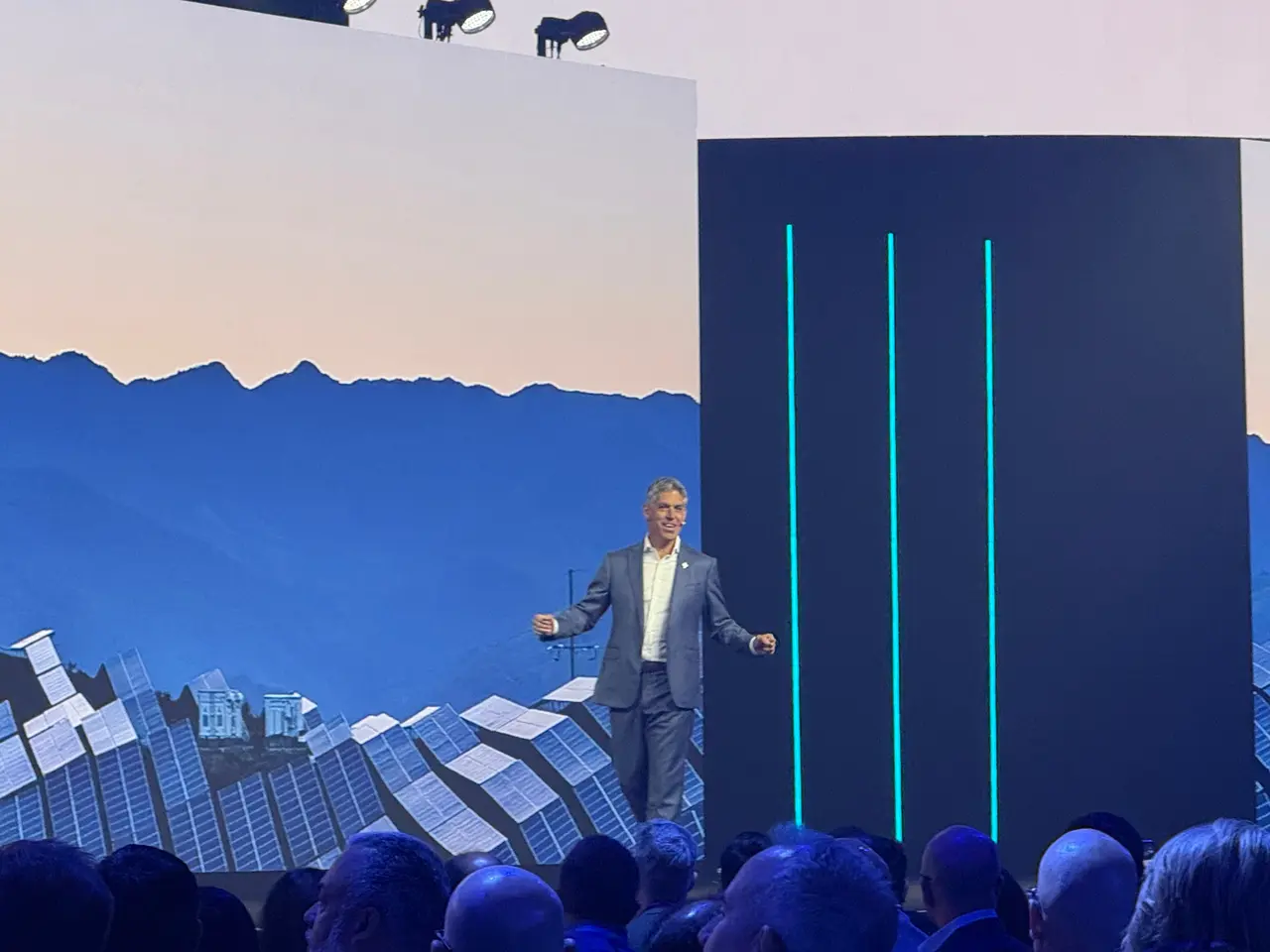
Blue Yonder CEO Duncan Angove opened ICON 2026 in San Diego with a striking announcement: the company has stopped selling anything other than its cognitive portfolio
1
. This marks a definitive shift for the supply chain management leader, which has invested over $2.5 billion in R&D under Panasonic ownership to rebuild its technology stack from the ground up3
. The unified cognitive architecture, built on Snowflake's data cloud and underpinned by a supply chain knowledge graph, represents four years of fundamental platform transformation1
.
Source: diginomica
Angove told conference attendees that while significant product changes have occurred, the harder work lies ahead in how organizations use these tools. He framed the challenge around operating model transformation rather than technology alone, drawing an analogy to factories that replaced steam engines with electric motors but kept the same inefficient layouts
3
. The vision centers on network-level coordination operated at machine speed, moving supply chains from fragmented local optimization to intelligent orchestration.Blue Yonder unveiled its Model Training Factory, developed in partnership with NVIDIA, to build specialized AI agents for the autonomous supply chain
4
. The system uses NVIDIA Nemotron open-source models and the NeMo Agent Toolkit to create what Angove calls "owned intelligence, not rented intelligence"5
. This approach addresses a critical economics problem: the cost of running large frontier models in production for high-frequency supply chain decisions.Chief Product Officer Gurdip Singh explained that frontier models are not the right answer for every problem, particularly in supply chain where speed and precision matter
4
. Blue Yonder demonstrated that a Nemotron Nano 30-billion-parameter model, fine-tuned using LoRA on 20,000 synthetic data samples, achieved best-in-class performance for warehouse management use cases. The Model Training Factory trains models on synthetic data rather than customer data, addressing privacy concerns while building domain expertise5
.Angove introduced the concept of "return on tokens" to describe the cost-benefit analysis enterprises must conduct when deploying agentic AI at scale
4
. For supply chain operations running continuously across data centers, the economics of frontier model API calls become unsustainable.
Source: diginomica
Angove repeatedly emphasized that "the agent is the app," signaling Blue Yonder's willingness to cannibalize its traditional SaaS business model
3
. The company's domain agents across warehouse operations, logistics, inventory, and manufacturing have evolved from monitoring tools into operational agents capable of autonomous action3
. Every deployment of Cognitive, Blue Yonder's unified platform, is now an agentic deployment from day one1
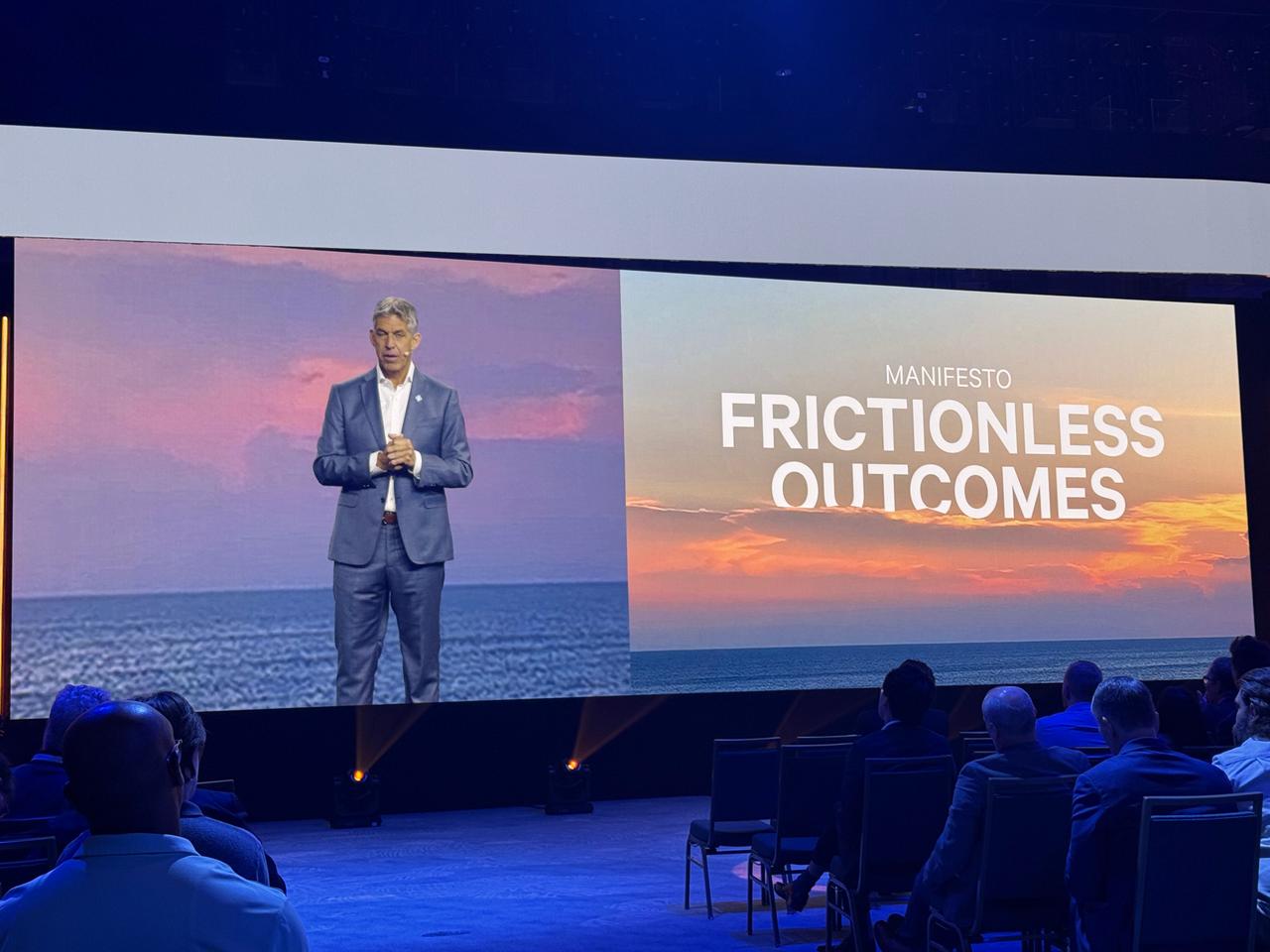
.The company announced its frictionless outcomes manifesto, committing to deploy software in 72 hours using forward-deployed engineers embedded in customer environments, with agents automating technical migration work
1
. Angove was blunt about the implications for systems integration firms: "It's a $480 billion industry that's going to get turned into a product feature"1
. He noted that consulting revenue represents 100 percent of Accenture's business and 51 percent of Manhattan's, but only 20 percent of Blue Yonder's, giving the company room to disrupt the model.Angove is investing at least 40 percent of R&D in frictionless outcomes, citing early evidence including a customer deployment completed in days with ML forecasting achieving two- to three-times improvement in accuracy
1
. He called traditional statements of work "linguistic fossils" that represent artifacts of a manual past.Related Stories
At ICON 2026, Blue Yonder launched Cognitive Solutions for Space Planning and Category Management, completing its retail planning suite
2
. The solution addresses coordination failures where supplier changes to product dimensions never reach retailers in time, resulting in empty shelves and overstocked inventory. The system enables store-specific planogramming grounded in category strategy, with retailers, suppliers, and store teams co-creating planograms in real time on a shared network2
.
Source: diginomica
A new partnership with Syndigo brings validated, GS1-aligned product content from 15,000 brands and 3,500 retailers directly into Blue Yonder's supply chain workflows
2
. Stephen Kaufman, Chief Strategy and Alliances Officer at Syndigo, explained that when a supplier updates product content once, it becomes available in near real time across the supply chain.Blue Yonder also launched its Cognitive Solution for Production Planning and Scheduling, which Singh described as "the last leg of that stool" for manufacturing
2
. EVP Andrea Morgan Vandome framed the shift by noting that in the old model, by the time organizations corrected their plans, the moment had passed. In the new model, the plan moves with reality2
.Blue Yonder's aggressive stance reflects a unique position: as a Panasonic subsidiary, it faces no quarterly earnings calls or public share price pressure, allowing bolder long-term decisions
1
. The company's approach addresses what EVP Gurdip Singh calls the gap between knowing and doing—supply chain managers have never lacked data, but the ability to act on it in time while trusting it has been the persistent challenge2
.The Model Training Factory rollout will begin with warehouse management workflows including WMS allocation shorts, inventory exceptions, and due-time urgency
5
. These high-frequency decisions directly impact on-time performance and order cycle times. NVIDIA's Azita Martin, Vice President and General Manager for Retail and CPG, noted that the next phase of enterprise AI for supply chains requires specialized, affordable, and accurate domain-trained agents operating within business workflows5
.Angove's willingness to state that 90 percent of agentic AI claims in the market aren't real, combined with concrete deployment timelines and cost reduction commitments, signals a shift from vendor caution to operational clarity
1
. The question for enterprises becomes whether they can adapt their operating models fast enough to capture the value these specialized AI agents promise to deliver.Summarized by
Navi
[2]
[3]
[4]
02 Dec 2025•Technology

29 Jan 2026•Technology

18 Mar 2026•Business and Economy