China AI Bubble Bursts as Markets Lose $2.4 Trillion in Four Months


10 Sources
[1]
The AI bubble already popped -- in China
Good morning. Anthropic's prospectus appears to have injected new life into the AI trade. The Nasdaq is up almost 2 per cent this week, and the semis, in particular, are leading the charge. Meta, whose spending plans spooked markets just last week, managed to sell $25bn of new equity (admittedly at
[2]
Chinese markets lose trillions as race for AI supremacy with US takes its toll
Lack of profits and the threat posed by western countries are raising concern about the sustainability of Beijing's AI boom Trillions of dollars have been wiped from China's stock markets in recent months amid increasing anxiety about the future of artificial intelligence, as Beijing races against
[3]
It Appears That the AI Bubble Has Just Burst in China
As economists in the rest of the world look at the billions being poured into the AI industry with their hands over their eyes, the fate of China's AI industry may be a sign of things to come. A report from Reuters suggests that the AI bubble in China "has already burst." Or it might be more apt
[4]
China's Stock Market Has Lost $2.4 Trillion as Investors Doubt Its AI Boom Will Ever Pay Off
In brief * Stocks on China's mainland have lost about $2.4 trillion in market value since May, and the STAR 50 index of tech and chip companies is down 40% in under four months. * AI companies make up 42% of the market value of Chinese shares and 57% of trading, per Goldman Sachs, while U.S.
[5]

In China, the AI Bubble Has Already Burst
While global tech stocks teeter, in China they have already crashed as lofty valuations collapse under worries about AI demand and curbs on Chinese exports. The meltdown, tanking the mainland STAR50 index of AI and semiconductor leaders by 40 percent in less than four months and vaporising some
[6]

In China, the AI bubble has already burst
While global tech stocks teeter, in China they have already crashed as lofty valuations collapse under worries about AI demand and curbs on Chinese exports. The meltdown, tanking the mainland STAR50 index of AI and semiconductor leaders by 40% in less than four months and vaporising some $480
[7]

What If China's AI Crash Was A Feature, Not A Bug? - State Street SPDR S&P 500 ETF Trust (ARCA:SPY), Inve
The great artificial intelligence debate of our time usually focuses on who will win the race for the most powerful model. A far more revealing question sits underneath the surface. Which country is building a healthier, more durable market structure around this technology? On that front, the
[8]

In China, the AI bubble has already burst
Oct 26 (Reuters) - While global tech stocks teeter, in China they have already crashed as lofty valuations collapse under worries about AI demand and curbs on Chinese exports. The meltdown, tanking the mainland STAR50 index of AI and semiconductor leaders by 40% in less than four months and
[9]

US vs China AI race: What the Chinese stock crash really changes
But a $480 billion collapse in the stock prices of Chinese AI and chip stocks marks the end of China's threat to America. It does not. The algorithms continue to come, the top laboratories remain funded, and what gets shaken by this collapse is the easy financing that fueled the rise of the
[10]
China AI Bubble Burst explained: What caused the $480 billion stock crash
We have seen many CEOs, world leaders, AI pundits and even our neighbours talk about the AI bubble and when and how it will eventually burst. Well, the AI bubble in China has burst and it did not take very long. The STAR50, the index filled with Chinese AI and semiconductor leaders, has seen about
Share
Copy Link
China's AI boom has turned to bust. The STAR 50 index plunged 40% since June, erasing $480 billion as investor skepticism over profitability and US technology bans crushed valuations. With AI stocks accounting for 42% of market value, the collapse dragged China's stock market down $2.4 trillion since May.
China AI Bubble Collapse Erases Trillions in Market Value
The China AI bubble has burst spectacularly, wiping $2.4 trillion from the stock market since May and sending shockwaves through global technology markets
2
. The STAR 50 index, tracking AI and semiconductor companies on the Shanghai stock exchange, plunged 40% in less than four months, erasing approximately $480 billion in market value3
4
. This dramatic downturn marks a stark reversal from the frenzied optimism that characterized China's AI boom just months earlier.
Source: Futurism
AI stocks now represent 42% of the market value of Chinese shares listed on the mainland and in Hong Kong, with 57% of trading volume according to Goldman Sachs
4
. When AI stocks fall, the entire market falls with them. The CSI 300 index of China's 300 biggest listed companies entered a bear market on October 22, dropping at least 20% from its peak4
. The Hang Seng Tech index, which tracks 30 major technology companies listed in Hong Kong, is down 30% year to date1
.Profitability Concerns Drive Investor Skepticism
Weak consumer demand and thin profit margins have fueled investor skepticism about whether the AI investment bubble can sustain itself. "The stock market later evolved into a speculative crazy bull, and now we see the bubble bursting," said Beijing-based fund manager Dong Baozhen
5
. Chinese consumers have proved stubbornly reluctant to spend on technology products, meaning many tech companies struggle to turn a profit despite massive government backing2
.Robot-maker Unitree exemplifies this volatility. Despite being 8,000 times oversubscribed by retail buyers at its August listing, shares have halved in value
4
5
. Chipmaker CXMT has lost more than a quarter of its value in the past month5
. Dan Wang, China director for the Eurasia Group, noted that demand for robotics is being driven by government agencies and research institutions rather than everyday consumers, for whom products remain too expensive and impractical for home use2
.
Source: Market Screener
US Technology Bans Amplify Market Pressures
Geopolitical tensions and trade restrictions have intensified pressure on China's AI market. The US Federal Communications Commission banned imports of new foreign-made humanoid robots in July on national security grounds
4
. Washington is also moving to ban Chinese-made optical parts from US data centers, devastating companies like Zhongji Innolight and Eoptolink, whose shares are down roughly 60% from their peaks4
5
.China faces constant efforts from the US to ice it out of global competition through tariffs and potential bans on Chinese companies supplying equipment to data centers
3
. Beijing's internet regulator reportedly told companies including ByteDance and Alibaba to stop buying Nvidia chips in September 2025, pushing tech giants toward homegrown chips from manufacturers like Huawei4
. The role of economic hostility by the US and other western countries in the Chinese market downturn may be understated, with the collapse as much a consequence of China being blocked from selling AI products overseas as market arrogance3
.
Source: Decrypt
Related Stories
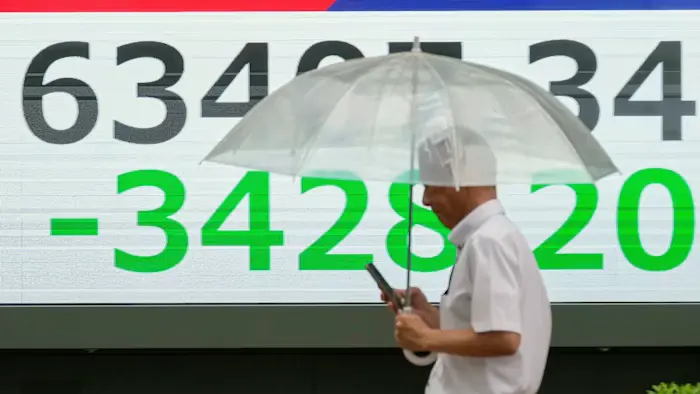
Divergent Business Models Create Price Competition
Chinese AI companies have adopted fundamentally different business models compared to their US counterparts. While US AI labs focus on charging for access to models, Chinese labs are more comfortable giving away open weight models and charging for access to processing power
1
. This approach has created intense price competition in both China and the US, raising questions about whether AI revenues can support the level of investment required to develop ever more powerful models.DeepSeek, one of China's top AI companies, recently raised $15 billion in one of the largest funding rounds in the country's history, while Huawei clinched a $2.3 billion loan from Chinese banks to spend on more AI chips
3
. However, the scale of money being poured into AI and AI-related industries hasn't translated into sustainable returns. The STAR50 index still trades at around 100 times trailing earnings, down from a high of nearly 250, but still dwarfs the Nasdaq 100's multiple of 305
.Government Intervention Fails to Stabilize Markets
Despite the Chinese government investing heavily into AI, including a 60 billion yuan state-backed AI investment fund that started pumping money into domestic developers this month
2
, authorities have struggled to prevent the AI stock bubble from deflating. State-backed investors sold into market rallies to keep gains in check as part of a push to dampen volatility3
. However, this tactic couldn't mask the fundamental problem that demand for AI products simply isn't materializing.China has restricted overseas investment in recent months, with more regulations taking effect from December 1, attempting to push local investors toward domestic markets
2
. Yet these moves have not led to greater investment in Chinese markets. With top Communist Party officials gathering for the fifth plenum this week to lay groundwork for next year's 21st Party Congress, no major stimulus measures are expected during this politically sensitive period2
. Any stimulus measure would be "high risk," Wang noted, as policymakers fear accountability if interventions fail to deliver results.References
Summarized by

Navi
[4]
[5]
Related Stories
AI Infrastructure Boom Hits $10 Trillion Wall as Debt-Fueled Growth Faces Reality Check
17 Oct 2026•Business and Economy
Tech Sell-Off Shakes Markets as Investors Question AI Spending and Profitability
23 Jun 2026•Business and Economy
Big Tech Sheds Nearly $900 Billion as Soaring AI Spending Triggers Market Rout
23 Oct 2026•Business and Economy
Recent Highlights


Recent Highlights
Today's Top Stories







Don’t drown in AI news. We cut through the noise - filtering, ranking and summarizing the most important AI news, breakthroughs and research daily. Follow topics that matter to you and stay ahead.


