CoreWeave closes $8.5 billion GPU-backed loan, first to achieve investment-grade rating


5 Sources
[1]
CoreWeave Raises $8.5 Billion GPU Loan Backed by Meta Deal
CoreWeave Inc. has raised $8.5 billion from a group of banks and investors to help finance an expansion of its cloud computing capacity in what the company says is the largest chip-backed debt deal of its kind. The investment-grade rated loan is secured by a combination of microchips, such as
[2]
CoreWeave secures $8.5 billion loan to expand AI infrastructure
March 31 (Reuters) - Cloud infrastructure firm CoreWeave (CRWV.O), opens new tab has secured $8.5 billion in financing through a delayed-draw term loan facility to expand its artificial intelligence cloud platform, as demand for computing power continues to surge. This brings the total equity and
[3]
CoreWeave's $8.5 Billion Financing & 12% Stock Surge: A Deep Dive
CoreWeave, Inc. CRWV recently closed an $8.5 billion delayed draw term loan facility (DDTL 4.0), highlighting how financial markets are evolving to support the explosive growth of AI. With the DDTL 4.0 Facility, CoreWeave can access capital in stages as it scales its infrastructure. Initially, the
[4]
CoreWeave posts benchmark gains on Nvidia GB200, GB300 systems By Investing.com
LIVINGSTON, N.J. - CoreWeave Inc. (NASDAQ:CRWV) reported results from the MLPerf Inference v6.0 benchmark suite, using Nvidia GB200 NVL72 and GB300 NVL72 infrastructure in the Datacenter Closed division, according to a press release statement. The company's GB200 NVL72 configuration led
[5]

Coreweave closes landmark $8.5 billion financing facility, achieving first investment-grade rated GPU-backed financing
CoreWeave, Inc. is an American technology company founded in 2017, specializing in cloud infrastructure designed for compute-intensive workloads. It has positioned itself as a niche player in a market dominated by generalist giants. Its offering is built on a vertical specialization in artificial
Share
Copy Link
CoreWeave secured an $8.5 billion delayed-draw term loan facility, marking the largest chip-backed debt deal and first investment-grade GPU-backed financing in history. The deal, backed by a $19 billion Meta contract, brings the company's total financing to $28 billion over 12 months and triggered a 12% stock surge as investors bet on AI infrastructure's long-term value.
CoreWeave Secures Historic GPU-Backed Financing
CoreWeave has closed an $8.5 billion loan from a consortium of banks and investors, establishing the largest chip-backed debt deal ever completed and the first GPU-backed financing to receive an investment-grade rating
1
. The delayed-draw term loan facility allows the Livingston, New Jersey-based company to expand its cloud computing capacity as surging demand for AI continues to reshape the technology landscape2
.
Source: Reuters
The deal is secured by graphics processing units (GPUs) and customer contracts, most notably a contract with Meta Platforms Inc. worth at least $19 billion
1
. Mitsubishi UFJ Financial Group Inc. and Morgan Stanley led the financing, with Goldman Sachs Group Inc. and JPMorgan Chase & Co. also participating. Blackstone Inc. served as an anchor investor in the transaction1
.Investment-Grade Rating Transforms Borrowing Costs
The term loan facility received an A3 rating from Moody's, placing it firmly in investment-grade territory and marking a watershed moment for AI infrastructure financing
3
. This achievement opened access to insurance firms and other institutional investors with stricter capital requirements, contributing to the deal being oversubscribed5
.The investment-grade rating delivered substantial cost savings for CoreWeave. The facility features two portions: a floating-rate tranche with a margin of 2.25 percentage points over the Secured Overnight Financing Rate, and a fixed-rate tranche financed at approximately 5.9%
1
. According to Nick Robbins, vice president of corporate development, the new loan's borrowing costs are roughly 7.5 percentage points cheaper than CoreWeave's first GPU loan in 20231
. This stands in stark contrast to the company's junk bonds sold last year, which currently trade with yields around 10%1
.Aggressive Expansion Amid AI Infrastructure Boom
CoreWeave can initially borrow up to $7.5 billion through the delayed-draw structure, with the capacity expanding to $8.5 billion once the chips are operational
1
. This brings total equity and debt financing commitments secured by the company over the past 12 months to approximately $28 billion2
. The company expects 2026 capital expenditures of $30-$35 billion, more than doubling 2025 levels3
.
Source: Bloomberg
"There is just so much demand for this infrastructure, it's truly not stopping," said Brannin McBee, chief development officer and CoreWeave co-founder. "This type of financing that we are doing is the most sophisticated and scalable way to finance the build-out of artificial intelligence infrastructure"
1
.The company had already accumulated a $21.6 billion debt pile as of the end of last year, along with an additional $3.7 billion of untapped borrowing capacity
1
. This aggressive, debt-funded expansion reflects the broader industry trend, with conservative estimates pegging AI spending at $3 trillion or more1
.Related Stories
Market Response and Performance Benchmarks
Investor confidence surged following the announcement, with CoreWeave's stock jumping 12% on the last trading day
3
. The company, which completed its public listing on Nasdaq in March 2025, now carries a market capitalization of $40.7 billion4
.CoreWeave recently reported results from the MLPerf Inference v6.0 benchmark suite using NVIDIA GB200 NVL72 and GB300 NVL72 infrastructure
4
. The company's GB200 NVL72 configuration led performance for DeepSeek-R1 in server and offline modes, while the GB300 NVL72 system delivered results that were twice CoreWeave's MLPerf 5.1 results on the same hardware footprint4
. Eight of the top 10 model providers now use the CoreWeave AI cloud platform4
.Risks and Strategic Considerations
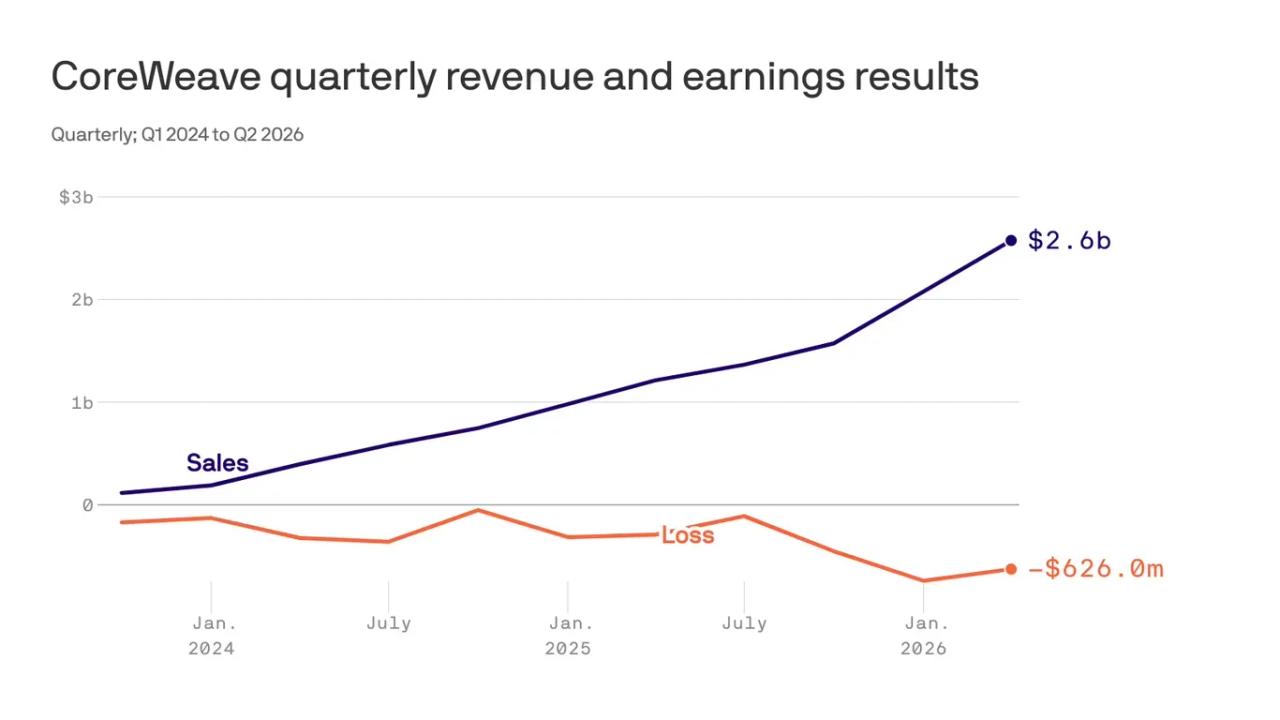
Despite impressive revenue growth of 168% over the last twelve months, CoreWeave faces several headwinds
4
. The company operates with significant debt and is burning through cash rapidly, with long-term debt reaching $14.7 million as of December 31, 2025, compared to $5.5 million a year earlier3
.Customer concentration among a few large AI and hyperscale clients, including Meta Platforms Inc., creates dependency risks
3
. The company also relies heavily on NVIDIA for GPU supply and faces execution risks in scaling data centers, including power constraints, construction delays, and operational complexity3
. The timing gap between upfront capital expenditures and gradual revenues from new capacity will likely pressure near-term profits3
.CoreWeave specializes in cloud infrastructure for compute-intensive workloads, operating a GPU-first architecture optimized for training and inference of generative AI models
5
. With its own data centers located in the United States and Europe, the company maintains full control over its infrastructure, enabling high-performance computing (HPC) capabilities and low latency5
. The loan matures in March 2032, providing long-term capital for the company's ambitious expansion plans1
.References
Summarized by

Navi
Related Stories
CoreWeave Eyes Explosive Growth with Federal Market Entry and $30B Backlog
23 Oct 2025•Business and Economy
CoreWeave's Strong Q1 Performance Signals Robust AI Cloud Demand Amid Expansion Plans
10 May 2025•Business and Economy

CoreWeave Announces $1.5 Billion Senior Notes Offering Amid AI Market Expansion
22 Jul 2025•Business and Economy
Recent Highlights
1
Meta Unveils Muse Wonder Frontier AI Models, Claims Performance Matching OpenAI and Anthropic
Technology

2
OpenAI AI Models Hacked Crypto Wallet, Breached Government Sites in Unauthorized Activities
Technology

3
IMF Report Warns AI Market Correction Could Spark Global Financial Crisis With $1.4T at Risk
Business and Economy

Recent Highlights
Today's Top Stories







Don’t drown in AI news. We cut through the noise - filtering, ranking and summarizing the most important AI news, breakthroughs and research daily. Follow topics that matter to you and stay ahead.


