Datacentre emissions are on course to rise 70% by 2030 as AI's power hunger doubles


3 Sources
[1]
Data center electricity use could double by 2030, IEA says
* Data center electricity use could double to about 1,000 terawatt-hours a year by 2030 under the IEA's Stated Policies Scenario. * The IEA's Stated Policies Scenario includes 26 million kilometers of new grid lines by 2035 and replacement or refurbishment of about 16 million kilometers of
[2]
Datacentres to create 70% more carbon emissions by 2030, IEA report warns
Global energy watchdog forecasts huge rise as US and China turn to fossil fuels to power AI growth agendas The world's datacentres will create 70% more carbon emissions within the next four years as the US and China turn to fossil fuels to power their AI growth agendas, according to the world's
[3]
IEA warned data center electricity use could double by 2030
The agency said at least 25 million kilometers of new power lines are needed over the next 10 years to keep up with demand The International Energy Agency warned in its World Energy Outlook 2026 on Thursday that data centers around the globe could use twice as much power by 2030, putting pressure
Share
Copy Link
The world's data centres are on track to burn roughly twice as much electricity by 2030, and their carbon emissions are projected to rise about 70% in the same span, according to the International Energy Agency's World Energy Outlook published Thursday
2
1
.AI is the driver
The IEA credits the surge to AI rather than to ordinary data centre growth. AI accounts for roughly three-quarters of the projected increase in data centre electricity demand, per the IEA
2
. AI datacentres alone would burn an extra 350 TWh a year within four years, more than Great Britain's total annual electricity consumption2
. The surge is already visible: data centre electricity use grew 17% in 2025, against 3% for global demand overall1
.The IEA built the forecast from annual AI server shipments, up eighteen-fold since 2020, plus satellite images used to count 93 large AI factories worldwide
2
. The money behind them is large too. The biggest operators are expected to spend more than $700 billion in 2026, largely on new infrastructure1
. Total data centre investment is projected to reach $4 trillion globally by 2030, up from $565 billion last year, per Bloomberg figures3
.Fossil power fills the gap
Datacentre developers already buy more renewable energy than any other companies
2
. Yet the International Energy Agency expects their use of fossil power to grow faster, most of all in the US and China2
. By 2030, about half the electricity for China's AI datacentres is expected to come from coal, per the IEA2
. US data centres are expected to draw roughly 60% of their power from gas2
. The US gas buildout is concentrated. As of August 2026, about 180GW of new gas plants tied to datacentres were planned in the US, per the IEA2
. Canada had 11GW planned and the rest of the world 4GW2
. The EU is the counterpoint, with its datacentres expected to draw about 70% of their electricity from renewables by 2030, per the IEA2
.Related Stories

The grid is the bottleneck
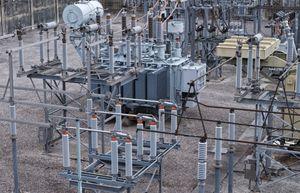
Generation is half the problem. In several regions, the data centre capacity waiting to connect to the grid already exceeds current peak demand, per the IEA
1
3
. It names large queues in Texas, Virginia, Finland and the UK1
3
. Meeting the demand means building at least 25 million kilometres of new power lines over the next decade and refurbishing 15 to 16 million more1
3
. Copper, cable and transformer supplies are already tight1
3
. Without upgrades, the agency warns networks could become congested and less reliable, with longer connection waits1
3
.
Source: Quartz
The buildout already faces political resistance in the US. New York froze most new large-scale data centre construction in July, and Texas directed regulators to pause approvals in August
3
. Governors who campaigned on pausing projects then won elections in Texas, Ohio and Georgia in the November midterms3
. The IEA's own hedges point the same way: tight supply chains, local opposition and scarce grid capacity could each slow construction1
3
.References
Summarized by

Navi
Related Stories
AI-Driven Data Center Energy Consumption Set to Double by 2030, Raising Climate Concerns
11 Apr 2025•Technology
Data center power demand surges 26% in 2026 as AI workloads push grid supply to breaking point
10 Jun 2026•Technology

AI surge pushes data centers to consume 20% of US electricity by 2035 as demand skyrockets to 194GW
22 Jul 2026•Business and Economy
Recent Highlights


Recent Highlights
Today's Top Stories












Don’t drown in AI news. We cut through the noise - filtering, ranking and summarizing the most important AI news, breakthroughs and research daily. Follow topics that matter to you and stay ahead.


