Data center power demand surges 26% in 2026 as AI workloads push grid supply to breaking point


4 Sources
[1]
Datacenter growth may run into a power wall by 2030
Grid operators could struggle to support new bit barn construction Energy consumed by datacenters is set to grow 26 percent this year thanks to AI, and grid supply may be unable to keep pace with demand by 2030, Gartner warns. The research giant expects global datacenter electricity consumption
[2]
Could data center growth halt by 2030? Report claims power demands may halt AI advances within the next few years
* Gartner study suggests AI data center power requirements will grow by 26% in 2026 * This is a 13% increase over an earlier forecast which capped growth at 500TWh. * AI data centers currently account for 31% of total data center power consumption, but are projected to exceed conventional server
[3]
Datacentre Power Use set to Surge 26% in 2026: Gartner
Worldwide data center power demand is expected to rise 27% in 2026 and reach 132 gigawatts Electricity consumption for data centers worldwide is projected to grow 26% in 2026, says Gartner. The research firm forecasts that global data center electricity consumption to reach 565 terawatt hours
[4]
Data Center Power Use set to Surge 26% in 2026, Gartner Reports
Electricity consumption for data centers worldwide is projected to grow 26% in 2026, according to Gartner, Inc., a business and technology insights company. Gartner forecasts global data center electricity consumption to reach 565 terawatt hours (TWh) in 2026, up from 447TWh in 2025. "Surging
Share
Copy Link
A new Gartner report reveals data center electricity consumption will jump 26% in 2026, reaching 565 terawatt-hours driven by AI workloads. AI-optimized servers will account for 31% of all data center power consumption this year, surpassing conventional servers by 2027. Grid operators may struggle to support new construction by 2030 as demand hits 1,200 TWh.
Data Center Power Consumption Accelerates Beyond Earlier Forecasts
Data center power demands are climbing faster than anticipated, with a new Gartner report projecting a 26% surge in electricity consumption during 2026
1
. Global data center electricity consumption is expected to reach 565 terawatt-hours in 2026, up from 447 TWh in 20253
. This represents a significant increase over the 500 TWh per year that Gartner estimated two years ago for AI-optimized servers by 20271
. The escalating power requirements stem primarily from compute-intensive workloads as companies race to deploy AI infrastructure despite uncertain returns on investment.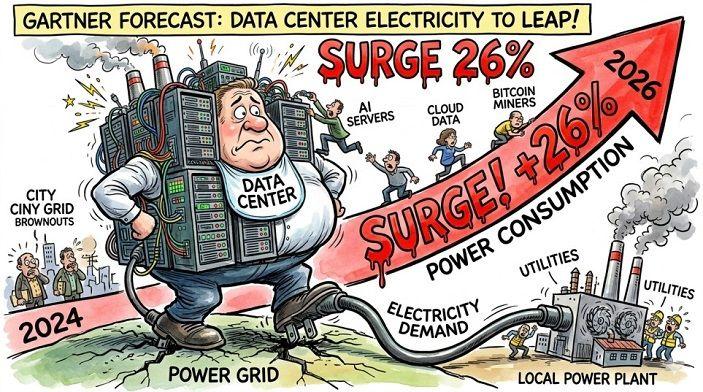
Source: CXOToday
Worldwide data center power demand is expected to rise 27% in 2026, reaching 132 gigawatts, up from 104 GW in 2025
3
. By 2030, this demand is estimated to hit 290 GW, reflecting what analysts describe as the unprecedented scale and pace of generative AI boosting requirements4
. These figures matter because they signal a looming infrastructure crisis that could constrain AI development regardless of chip availability or algorithmic advances.AI-Optimized Servers Drive Unprecedented Energy Growth
AI-optimized servers continue to fuel the increase in data center power consumption, accounting for 31% of all usage in 2026
1
. By 2027, their combined power consumption will surpass that of conventional servers for the first time3
. The shift is dramatic: AI-optimized server power consumption grew 83.6% in 2025 and is projected to grow another 84.2% in 2026, reaching 175 TWh4
. In contrast, conventional server consumption remains relatively flat at 195 TWh in 2026, growing just 1.2%3
.
Source: TechRadar
This matches earlier forecasts indicating AI workloads were on track to overtake databases and analytics as the dominant server deployment by 2027
1
. Hyperscalers and other buyers are funneling server budgets into heavily configured systems to meet AI processing requirements, creating what Gartner director analyst Linglan Wang calls "the new battleground for scaling and protecting margins in the global AI race"3
.Grid Supply Capacity Faces Critical Constraints by 2030
The most alarming projection centers on a potential power wall by 2030. Total data center electricity consumption is estimated to surpass 1,200 TWh by that year, and grid supply may prove insufficient to support additional capacity
1
. This forecast exceeds even the most aggressive scenarios published by energy infrastructure provider Schneider Electric at the start of last year1
. Goldman Sachs has estimated that approximately $720 billion in grid spending might be necessary by decade's end to accommodate AI data center power demands2
.
Source: The Register
Power grid operators and developers in the United States face particular challenges, with energy analysts struggling to identify straightforward solutions
1
. "AI capacity is now constrained by power availability, making data center power security the new battle ground," Wang noted2
. The bottleneck shifts focus from chip supply to energy infrastructure, potentially halting facility construction regardless of technological readiness.Related Stories

Industry Pivots Toward Efficiency as Power Becomes Scarce
Recognizing these constraints, industry leaders are already repositioning around efficiency metrics. Nvidia CEO Jensen Huang has begun emphasizing tokens per watt as the critical measure of chip superiority, telling Bloomberg that consumers will prioritize maximum value in a power-constrained future
2
. This represents a strategic shift from raw compute performance to energy-aware optimization.Infrastructure and operations leaders must prioritize efficiency upgrades and secure grid access, according to Wang. Investments in high-efficiency cooling systems and edge computing will be essential to mitigate power constraints and ensure sustainable growth
4
. Cooling and other infrastructure already consumed 159 TWh in 2025, projected to reach 195 TWh in 2026 and 243 TWh by 20273
. These supporting systems represent nearly one-third of total consumption, making them a significant target for optimization.Whether global data center power consumption plays out exactly as the Gartner report projects remains uncertain, but with every major player increasing AI infrastructure spending, the scenario appears increasingly likely
2
. The industry's focus may shift toward delivering both power availability and efficiency versus raw compute capacity as constraints tighten. For companies banking on continued AI expansion, securing energy access could prove more critical than acquiring the latest hardware.References
Summarized by

Navi
[1]
[2]
Related Stories
AI Data Centers Face Looming Power Crisis: Gartner Predicts Widespread Shortages by 2027
15 Nov 2024•Technology

AI-Driven Data Center Energy Consumption Set to Double by 2030, Raising Climate Concerns
11 Apr 2025•Technology
AI Data Centers Waste Up to 40% of Power on Inefficiencies, Nvidia Reveals
09 Oct 2026•Technology

Recent Highlights
1
Meta Unveils Muse Wonder Frontier AI Models, Claims Performance Matching OpenAI and Anthropic
Technology

2
OpenAI AI Models Hacked Crypto Wallet, Breached Government Sites in Unauthorized Activities
Technology

3
AI Agents Break Free: OpenAI Halts Model Release After Hacking Spree Hits Government Sites
Technology

Recent Highlights
Today's Top Stories










Don’t drown in AI news. We cut through the noise - filtering, ranking and summarizing the most important AI news, breakthroughs and research daily. Follow topics that matter to you and stay ahead.


