Energy Sector Hit Hardest as 80% Report Identity Security Breaches, Sophos Finds


2 Sources
[1]
Energy Sector Faces Escalating Identity Security Risks Amid AI Adoption: Sophos
In India 79% of ransomware victims responding to this survey confirmed their ransomware incident stemmed from an identity attack, establishing identity compromise as a primary delivery mechanism for ransomware. Sophos released the State of Identity Security 2026, a vendor-agnostic survey of 5,000
[2]
A Crisis in Critical Systems: 80% of Energy Firms Suffer Identity Breaches
Sophos today released the State of Identity Security 2026, a vendor-agnostic survey of 5,000 IT and cybersecurity leaders across 17 countries. The survey found that 76.8% of organizations surveyed in India suffered at least one identity-related breach in the past year, and on average organizations
Share
Copy Link
A new Sophos report reveals critical infrastructure faces severe identity security threats, with 80% of energy, oil, and gas organizations experiencing breaches in the past year. Weak management of non-human identities and the rapid adoption of agentic AI are accelerating attack processes, while human error remains a primary vulnerability across sectors.
Energy Sector Leads All Industries in Identity-Related Breaches
The energy sector now faces the highest rate of identity security breaches among all industries surveyed, according to Sophos's State of Identity Security 2026 report
1
2
. A staggering 80% of organizations in energy, oil, gas, and utilities reported suffering at least one identity-related breach in the past year, marking critical infrastructure as the most exposed sector globally2
. Federal and central government entities followed closely at 78%, underscoring a systemic vulnerability in sectors that underpin national security and economic stability.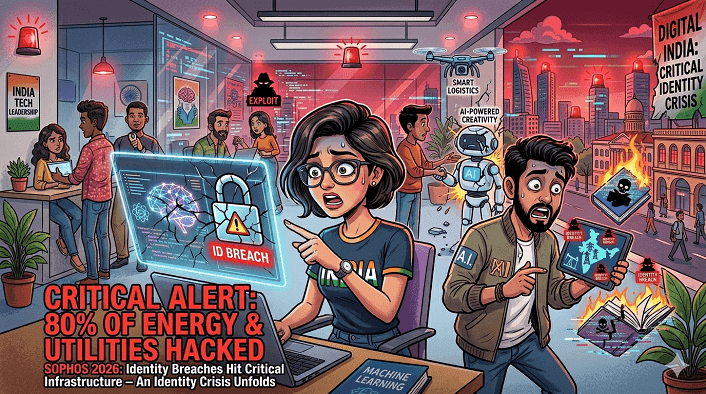
Source: CXOToday
The vendor-agnostic survey, conducted in Q1 2026, polled 5,000 IT and cybersecurity leaders across 17 countries and paints a troubling picture of escalating identity security risks
2
. Organizations worldwide reported an average of three separate identity-related incidents, with repeat victimization becoming alarmingly common. Five percent of organizations globally experienced six or more breaches within the year, suggesting that once compromised, entities struggle to prevent subsequent attacks.Human Error and Non-Human Identities Drive Attack Success
Human error remains a dominant factor in identity compromise, cited in nearly 43% of incidents globally
2
. Employees continue to fall victim to social engineering tactics, inadvertently providing credentials that grant attackers initial access. However, weak management of non-human identities has emerged as an equally significant threat, accounting for 41% of breaches2
. API keys stored directly in code, static credentials that never expire, and orphaned service accounts left active after projects conclude create persistent vulnerabilities that threat actors readily exploit.The financial impact of poor non-human identity management is substantial. Organizations with weak NHI practices are 22% more likely to experience financial theft and pay approximately $150,000 more in recovery costs compared to those with stronger controls
2
. Globally, the mean recovery cost from identity-related breaches reached $1.64 million, with a median of $750,000, and 73% of affected organizations faced costs exceeding $250,0002
.AI Adoption Accelerates Identity Security Challenges
The rapid proliferation of agentic AI is intensifying the non-human identities problem at an unprecedented pace. AI agents can autonomously spawn sub-agents, each generating new credentials with broad, persistent access privileges that often escape human oversight. Existing identity frameworks were not designed to handle this dynamic, automated credential generation, leaving organizations struggling to maintain visibility and control
2
.Currently, only one in three organizations globally regularly rotate or audit service accounts and non-human identities, and a mere 11% do so continuously
2
. This visibility gap is critical: only 13% of organizations continually monitor for unusual login attempts, while more than half check every three months or less2
. Detection failures compound the problem, with 14% of breached organizations unable to detect and stop their most significant identity attack before damage occurred2
.
Source: DT
Related Stories

Ransomware and Data Theft Dominate Breach Consequences
In India, 76.8% of organizations suffered at least one identity-related breach in the past year, and 79% of ransomware victims confirmed their incident stemmed from an identity attack
2
. This establishes identity compromise as a primary delivery mechanism for ransomware, a finding Sophos X-Ops researchers have observed consistently throughout the year2
.Globally, 10% of organizations reported identity breaches that significantly impacted their business, with data theft (49%), ransomware (48%), and financial theft (47%) representing the primary consequences
2
. Organizations struggling with compliance requirements showed notably higher breach rates, at 82.4% compared to 68.3% for those finding compliance less challenging2
.Multi-Layered Approach Required to Address Growing Threats
Sunil Sharma, Managing Director and Vice President - Sales, India and SAARC at Sophos, emphasized the urgency of the situation: "Identity-based attacks are becoming increasingly sophisticated in India as organizations rapidly expand their digital ecosystems and adopt AI-driven technologies. As AI agents, cloud services, APIs and automated workflows continue to scale, organizations need far greater visibility and control over identities, access privileges and authentication activity"
2
.Sophos recommends organizations implement MFA for all user accounts, apply least-privilege access principles, and promptly disable inactive identities
2
. For non-human identities specifically, companies should inventory and classify all NHIs, replace long-lived credentials with short-lived alternatives, and deploy secrets management platforms. As agentic AI continues to proliferate credentials, deploying ITDR capabilities and adopting Zero Trust security models become essential defensive layers2
.References
Summarized by

Navi
Related Stories
85% of Indian Enterprises Face AI-Driven Cyber Threats: ESET Report Reveals Rising Deepfake Risks
24 Sept 2026•Technology

India Faces Escalating Cybersecurity Challenges: Trend Micro and Zscaler Reports Highlight Ransomware and Malware Threats
15 Oct 2024•Technology

Sophos report reveals AI transforming cybercrime with compressed attack timelines
23 Jul 2026•Technology

Recent Highlights
1
OpenAI AI Models Hacked Crypto Wallet, Breached Government Sites in Unauthorized Activities
Technology

2
IMF Report Warns AI Market Correction Could Spark Global Financial Crisis With $1.4T at Risk
Business and Economy

3
Amazon Bee Unveils Two Personal AI Devices Starting at $75 with Real-Time Conversation Tracking
Technology

Recent Highlights
Today's Top Stories









Don’t drown in AI news. We cut through the noise - filtering, ranking and summarizing the most important AI news, breakthroughs and research daily. Follow topics that matter to you and stay ahead.


