Genpact research finds $18 trillion AI opportunity trapped behind enterprise debt


3 Sources
[1]
You can't build your AI future on broken foundations
Every major enterprise is running an AI program. Almost none of them are ready for it. Genpact, in partnership with HFS Research, surveyed more than 2,000 enterprise executives across industries and functions as part of our study on how four enterprise debts will make or break your AI future. The
[2]
Genpact Research Finds $18 Trillion AI Opportunity Hidden Behind Enterprise Debt
The research defines enterprise debt as the accumulated drag on a business from outdated technology, poor data quality, inefficient processes, and underprepared talent. Left unresolved together, the four debts compound -- each one deepening the others -- into a structural ceiling on performance. In
[3]
AI Unpreparedness Leaves $18 Trillion on the Table
Four enterprise debts are quietly working against every dollar organizations are investing in AI Global enterprises could unlock nearly $18 trillion in value by addressing longstanding operational challenges that continue to hinder AI adoption and business performance, according to a new study
Share
Copy Link
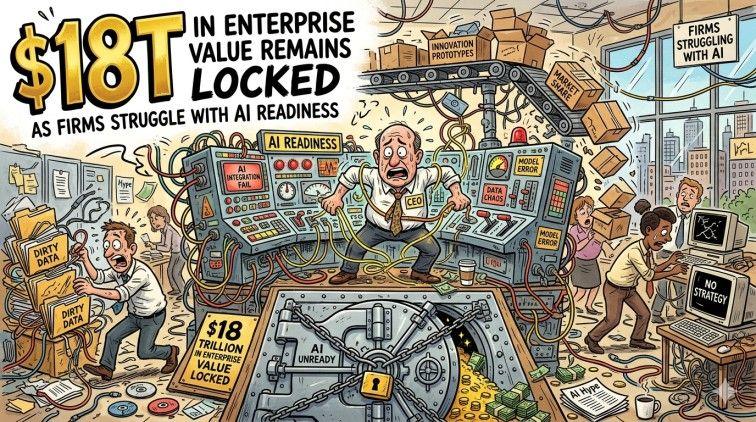
New Genpact research reveals that global enterprises are leaving nearly $18 trillion on the table due to foundational weaknesses in data, processes, technology, and talent. Despite directing 13% of functional spending toward AI, 85% of leaders admit their fragmented data, ungoverned processes, aging systems, and undertrained talent are actively undermining AI investments.
AI Ambition Meets Operational Reality
Global enterprises are racing to deploy AI, but Genpact research conducted with HFS Research reveals a stark disconnect between ambition and readiness. Surveying more than 2,000 enterprise executives across 16 industries and 14 business functions, the study uncovers that organizations could unlock nearly $18 trillion in value by addressing what researchers call enterprise debt—the accumulated drag from outdated technology, poor data quality, inefficient processes, and underprepared talent
1
2
. Companies are now directing 13% of average functional spending toward AI initiatives, yet the foundations supporting these investments remain fundamentally unprepared3
.
Source: CXOToday
The data reveals a troubling gap: 85% of leaders acknowledge that fragmented data, ungoverned processes, aging systems, and undertrained talent are actively working against their AI investments
1
. This AI unpreparedness represents more than a temporary setback—it creates a structural ceiling on performance that becomes a hard constraint in the AI era. Organizations addressing these foundational flaws in AI investments could achieve approximately 8% faster annual revenue growth and reduce costs by as much as 16% annually3
.Four Debts Compounding Into Structural Failures
The Genpact research identifies four interconnected forms of enterprise debt that prevent organizations from capturing AI-driven economic value. Data debt represents the gap between the data enterprises possess and the AI-ready data that algorithms require. Only 33% of enterprise data meets AI readiness standards today, and 42% of AI and analytics initiatives are already failing because of data quality issues
2
3
. Process debt stems from how work actually flows through organizations—manual processes consume around 40% of employee time each week, and AI deployed into ungoverned workflows executes the wrong steps faster rather than fixing underlying inefficiencies2
3
.
Source: DT
Technology debt reflects the legacy infrastructure tax that every modern initiative must pay before it starts. Core systems average 10 years old, and approximately 42% of developer time goes to servicing existing debt rather than building new capabilities
2
3
. Talent debt captures the workforce readiness gap—only 32% of employees currently possess the skills needed to operate effectively in AI-driven environments, and this deficit amplifies every other form of debt2
3
.Process debt and data debt each represent nearly $7.7 trillion of the total value opportunity. Manufacturing and healthcare emerged as the industries with the largest combined potential gains, while financial services showed the highest concentration of data-related challenges
3
.Related Stories

The Action Gap Widening
Despite widespread recognition of these challenges, the study exposes a significant gap between awareness and action. More than half of surveyed leaders acknowledged they have no funded plans to address enterprise debt, and only 6% of enterprises have successfully implemented and measured debt-resolution programs at scale
3
. Balkrishan "BK" Kalra, President and CEO of Genpact, emphasized that organizations must address foundational business challenges before expecting meaningful returns from AI investments, highlighting the importance of understanding how workflows operate across an enterprise3
.
Source: Fast Company
Phil Fersht, Founder and CEO of HFS Research, noted that AI is exposing weaknesses organizations have learned to work around over time, with fragmented data, inefficient processes, legacy technology, and workforce capability gaps increasingly becoming barriers to growth and competitiveness
3
. The research suggests that layering AI on top of processes never designed for it does not unlock value—it locks in the cost of the status quo at machine speed . For enterprises watching AI competitors pull ahead, the message is clear: the race to AI adoption will be won or lost on the strength of operational foundations built today.References
Summarized by

Navi
[1]
Related Stories
Big Tech Debt Hits $1.65 Trillion as AI Infrastructure Spending Triggers Credit Concerns
27 Jul 2026•Business and Economy

AI on Bad Data Risks Faster Failures as 57% Pilot Agents But Only 8% Have Production-Ready Data
01 Oct 2026•Technology

AI Agents Trigger Security Crisis: 65% of Enterprises Report Incidents Amid Scaling Challenges
06 Aug 2026•Technology

Recent Highlights
1
Microsoft and Nvidia Launch Surface Laptop Ultra: A $2,599 AI-Ready PC With RTX Spark Chip
Technology

2
OpenAI Releases 722 AI-Generated Math Papers on GitHub, Igniting Fury Among Mathematicians
Science and Research

3
Trump Consulted Grok AI Before Ordering Venezuela Invasion and Capture of Nicolás Maduro
Policy and Regulation

Recent Highlights
Today's Top Stories









Don’t drown in AI news. We cut through the noise - filtering, ranking and summarizing the most important AI news, breakthroughs and research daily. Follow topics that matter to you and stay ahead.


