Google Plans Space Data Centers to Power AI with Solar Energy, Targets 2027 Launch


10 Sources
[1]
Space-Based Data Centers Could Power AI with Solar Energy -- at a Cost
Space-based computing offers easy access to solar power, but presents its own environmental challenges To hear Silicon Valley tell it, artificial intelligence is outgrowing the planet that gave birth to it. Data centers will account for nearly half of U.S. electricity demand growth between now and
[2]
Google CEO: Data Centers in Space Could Be the Norm in About a Decade
Running data centers in space might sound like science fiction, but Google's CEO is betting it'll become a practical way to handle AI's soaring energy demands, possibly within a "decade or so." "We want to put these data centers in space, closer to the Sun," allowing them to harness the solar
[3]
Google's proposed data center in orbit will face issues with space debris in an already crowded orbit
University of Michigan provides funding as a founding partner of The Conversation US. The rapid expansion of artificial intelligence and cloud services has led to a massive demand for computing power. The surge has strained data infrastructure, which requires lots of electricity to operate. A
[4]
Startup announces 'Galactic Brain' project to put AI data centers in orbit
California-based company Aetherflux wants to make space-based solar power a reality. (Image credit: Aetherflux) Aetherflux, a space-based solar technology company hoping to beam power down to Earth, is now throwing its hat into the orbital data center ring. The company's new "Galactic Brain"
[5]
Data centres in space: will 2027 really be the year AI goes to orbit?
Anglia Ruskin University (ARU) provides funding as a member of The Conversation UK. Google recently unveiled Project Suncatcher, a research "moonshot" aiming to build a data centre in space. The tech giant plans to use a constellation of solar-powered satellites which would run on its own TPU
[6]

Sundar Pichai says Google will deploy solar-powered data centers in space by 2027
Serving tech enthusiasts for over 25 years. TechSpot means tech analysis and advice you can trust. Looking ahead: Google may not be taking as many audacious moonshots as it did in its early years, but it remains at the forefront of global technological transformation, shaping how people work,
[7]

Google, Amazon, and xAI want to launch AI into space
Having AI overhead could enhance connectivity for everything from remote internet access to disaster response. In the span of just a few months, the push to put artificial intelligence in space has progressed from a long-term dream to an immediate, very real strategic priority. Google's Project
[8]

Google's plan to put data centers in the sky faces thousands of (little) problems: space junk | Fortune
The rapid expansion of artificial intelligence and cloud services has led to a massive demand for computing power. The surge has strained data infrastructure, which requires lots of electricity to operate. A single, medium-sized data center here on Earth can consume enough electricity to power
[9]

Google CEO Sundar Pichai says data centers in space are coming
"We are taking our first step in '27," Pichai told Fox News. "We'll send tiny, tiny racks of machines, and have them in satellites, test them out, and then start scaling from there." The space pitch arrives when Earth is starting to look like a bad long-term landlord for the AI build-out. A 2024
[10]

Google's Project Suncatcher could make the space debris problem a lot worse
Over the past few years, tech leaders have increasingly advocated for space-based AI infrastructure as a way to address the power requirements of data centers. In space, sunshine -- which solar panels can convert into electricity -- is abundant and reliable. On November 4, 2025, Google unveiled
Share
Copy Link
Google unveiled Project Suncatcher, planning to launch solar-powered satellites carrying AI chips by 2027 to address artificial intelligence's soaring energy demands. The tech giant joins a growing wave of companies exploring orbital data centers, but experts warn of significant challenges including space debris risks, cooling systems in vacuum, and launch costs that need to drop below $200 per kilogram to become viable.
Google's Orbital Data Center Initiative Takes Shape
Google CEO Sundar Pichai believes space data centers could become "a more normal way to build data centers" within a decade, signaling a major shift in how tech companies approach artificial intelligence infrastructure
2
. The company's Project Suncatcher represents the most concrete step yet toward this vision, with plans to launch two prototype satellites carrying custom AI server chips into low Earth orbit by early 20271
. The initiative aims to tackle a pressing problem: data centers will account for nearly half of U.S. electricity demand growth between now and 2030, with global power requirements potentially doubling by decade's end as companies train larger AI models1
.
Source: Fast Company
Why Solar-Powered Satellites Make Sense for AI
The appeal of AI data centers in orbit lies in their access to practically unlimited solar energy without interruption from cloudy skies or nighttime darkness
1
. Google's orbital data center concept envisions an 81-satellite constellation in sun-synchronous orbit, positioned at approximately 400 miles above Earth where spacecraft always fly over places at sunset or sunrise3
. This positioning means solar arrays receive nearly continuous sunlight and gain efficiency advantages outside Earth's atmosphere5
. When someone asks a chatbot how to bake sourdough bread, instead of firing up a data center in Virginia, the query would be beamed to the constellation in space, processed by chips running purely on solar energy, and the recipe sent back down3
.
Source: TechSpot
Growing Competition in Space Computing
Google isn't alone in pursuing this vision. Startup Starcloud successfully launched a 60-kilogram satellite carrying an NVIDIA H100 GPU and expects to require five gigawatts of electric power by 2035
1
. The satellite is operational and undergoing commissioning to verify all functions work properly2
. Meanwhile, Aetherflux announced its "Galactic Brain" project, aiming to launch the first node of its constellation in the first quarter of 20274
. China has begun launching spacecraft for a Xingshidai "space data center" constellation, and the European Union is studying similar ideas under a project known as ASCEND1
. SpaceX CEO Elon Musk stated that "satellites with localized AI compute, where just the results are beamed back from low-latency, sun-synchronous orbit, will be the lowest cost way to generate AI bitstreams in <3 years"4
.Technical Hurdles: Cosmic Radiation and Cooling in a Vacuum
The increasing energy demands of AI push companies toward space, but significant engineering challenges remain. Computing hardware must be protected from cosmic radiation through either shielding or error-correcting software
1
. Google's approach uses the same TPU chips deployed in its Earth data centers rather than heavily shielded space-grade hardware. Laboratory tests exposing these chips to proton beam radiation suggest they can tolerate almost three times the dose they'll receive in space5
. However, maintaining reliable performance for years amidst solar storms, debris, and temperature swings presents a far harder test.Cooling in a vacuum poses another major obstacle. On Earth, servers are cooled with air or water, but in space there's no air to carry heat away
2
. Orbital platforms need large radiators that can dump heat into the vacuum of space through thermal dissipation, adding significant mass that must be launched on rockets1
. NASA studies show radiators can account for more than 40% of total power system mass at high power levels5
. Starcloud says it's developing "a lightweight deployable radiator design with a very large area -- by far the largest radiators deployed in space"2
.The Economics: Launch Costs Must Plummet
Rocket launch costs alone pose a significant challenge to building large orbital data centers, not to mention the need to replace onboard chips every five to six years
1
. "Launch costs are dropping with reusable rockets, but we would still require a very large number of launches to build orbital data centers that are competitive with those on Earth," says Benjamin Lee, a computer architect at the University of Pennsylvania1
. Google's Suncatcher team estimates that liftoff costs would need to fall to under $200 per kilogram by 2035 for their vision to make economic sense—seven or eight times cheaper than today1
5
.Related Stories

Space Debris Threatens the Crowded Highway
Project Suncatcher targets sun-synchronous orbit, the single most congested highway in low Earth orbit where objects are most likely to collide with other satellites or debris
3
. Space debris travels at hypersonic speeds of approximately 17,500 miles per hour, meaning collision with a piece the size of a blueberry would feel like being hit by a falling anvil3
. The U.S. Space Force actively tracks over 40,000 objects larger than a softball, representing less than 1% of lethal objects in orbit3
. Google's proposed satellite constellation would fly 81 units within a one-kilometer radius, each spaced less than 200 meters apart—like cars racing at 17,500 miles per hour separated by highway braking distances3
. As new objects arrive and existing ones break apart, low Earth orbit could approach Kessler syndrome, where collisions generate cascading debris that renders certain orbits unusable3
.
Source: The Conversation
Environmental Trade-Offs Remain Unclear
While Starcloud estimates that a solar-powered space data center could achieve 10 times lower carbon emissions compared with a land-based data center powered by natural gas generators, researchers at Saarland University calculated that an orbital data center could still create an order of magnitude greater emissions than one on Earth
1
. Most extra emissions come from burning rocket stages and hardware on reentry, says Andreas Schmidt, a computer scientist and co-author of the "Dirty Bits in Low-Earth Orbit" paper1
. The process forms pollutants that can further deplete Earth's protective ozone layer1
. Aetherflux's powerbeaming capabilities aim to enable energy collected in space to support not only compute in orbit but also power delivery on Earth through infrared lasers transmitted to ground stations4
.References
Summarized by

Navi
[1]
[3]
[5]
Related Stories
AI Trained in Space as Tech Giants Race to Build Orbiting Data Centers Powered by Solar Energy
11 Dec 2025•Technology
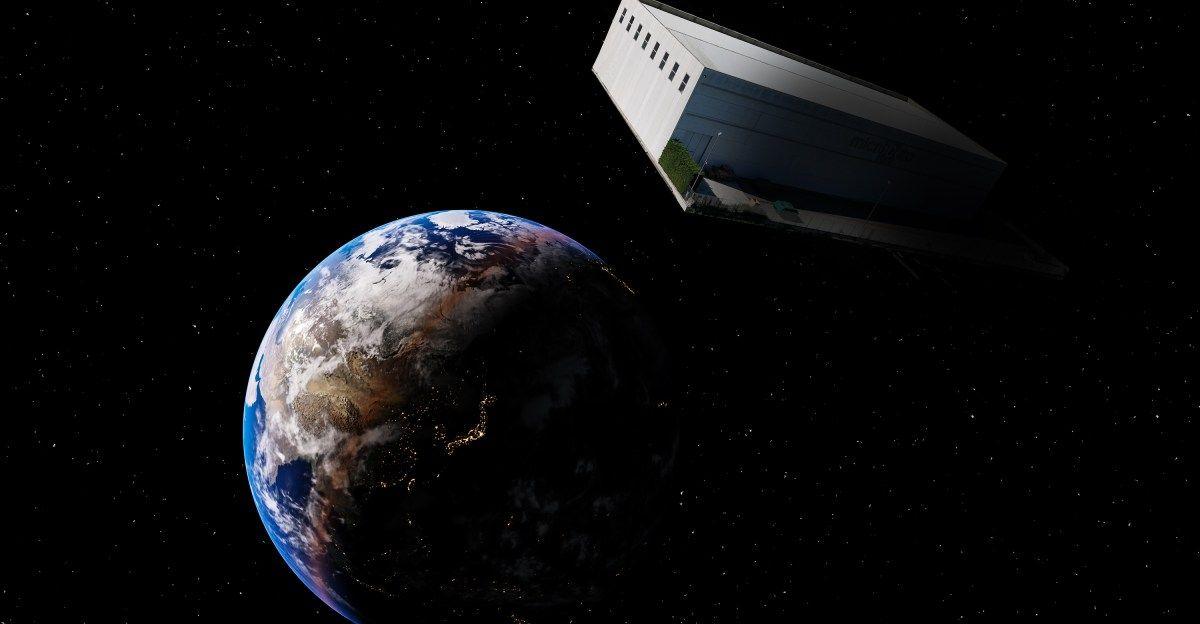
Google Announces Project Suncatcher: Ambitious Plan for AI Data Centers in Space
04 Nov 2025•Technology

Tech Giants Push Space Data Centers as AI Demands Outpace Earth's Resources
02 Jan 2026•Technology

Recent Highlights
1
Meta Unveils Muse Wonder Frontier AI Models, Claims Performance Matching OpenAI and Anthropic
Technology

2
IMF Report Warns AI Market Correction Could Spark Global Financial Crisis With $1.4T at Risk
Business and Economy

3
OpenAI Releases 722 AI-Generated Math Solutions, Triggering Existential Crisis in Mathematics
Technology

Recent Highlights
Today's Top Stories










Don’t drown in AI news. We cut through the noise - filtering, ranking and summarizing the most important AI news, breakthroughs and research daily. Follow topics that matter to you and stay ahead.


