Google DeepMind connects Project Genie to Street View, creating AI simulations of real places


8 Sources
[1]
Google's Genie world model can now simulate real streets with Street View | TechCrunch
We've all pulled up Street View on Google Maps to show a friend what our childhood home looked like, or dropped that little person icon onto the streets of Paris to see if we booked a hotel in a cool neighborhood. Imagine being able to do that, but in a more immersive, interactive way that allows
[2]
Google's Project Genie: You Can Now Base Imaginary Worlds on Real Places
Macy has been working for CNET for coming on 2 years. Prior to CNET, Macy received a North Carolina College Media Association award in sports writing. Ever wondered what the Golden Gate Bridge would look like underwater? Now you can see it. On stage at the Google I/O annual developer conference,
[3]
Project Genie adds Google Street View integration and goes live for global AI Ultra users - Engadget
Ground your snow-globe worlds in real-world locations from Google Maps. Project Genie is rolling out today for all adult Google AI Ultra subscribers across the globe, following its debut in the United States this January. The service is also getting a new Street View capability that can generate
[4]
Google DeepMind connects Street View to Project Genie world model | TNW
A simulated street scene generated by Google DeepMind's Project Genie using Street View data Google DeepMind has connected its Project Genie world model to 20 years of Street View imagery, allowing users to wander through AI-generated simulations of real places. The integration, announced at the
[5]

Project Genie now lets you reimagine your favorite real-world spots with a creative twist
Google is also expanding access to Project Genie, including the new Street View capabilities, beyond the US to eligible Google AI Ultra $200 subscribers worldwide who are 18 or older. Earlier this year, Google launched Project Genie, an AI model capable of generating diverse, interactive world
[6]

Google's interactive world builder, Project Genie, will drop you in real places using Street View
Google just announced its world-exploring game, Project Genie, is getting a new feature that drops you in real-world locations, like your own street. Project Genie rolled out at the beginning of this year. In essence, it builds small worlds using Nana Banana Pro models that can be explored with
[7]

You can now walk through AI versions of real places with Google's Project Genie
Google I/O 2026 This story is part of our complete Google I/O coverage Updated less than 3 minutes ago Google is pushing its experimental AI world-building project into surprisingly realistic territory. The company announced that Project Genie can now use real-world imagery from Google Street View
[8]

Simulate real-world places with Project Genie and Street View
Sorry, your browser doesn't support embedded videos, but don't worry, you can download it and watch it with your favorite video player! Genie is our general-purpose world model capable of generating diverse, interactive environments. Since launching, Genie has become a foundational tool for
Share
Copy Link
Google DeepMind announced at I/O that Project Genie now integrates with Street View's 280 billion images across 110 countries. Users can generate interactive virtual environments based on real locations, adjusting weather or styles like underwater or desert themes. The AI world model serves dual purposes: training robots and self-driving cars on rare scenarios, and letting consumers explore reimagined versions of actual streets.
Google DeepMind Merges Project Genie with Two Decades of Street View Data
Google DeepMind revealed at the Google I/O developer conference that Project Genie, its generative AI world model, now connects to Google Street View imagery spanning 20 years of data collection
1
. The Street View integration allows users to generate interactive virtual environments anchored to real-world locations, drawing from more than 280 billion images captured across 110 countries and seven continents4
. This AI world model capability transforms static street photography into explorable, AI-generated simulations that users can navigate in real time3
.
Source: 9to5Google
Users can now tap a Maps pin within Project Genie to select a location in the United States, then apply creative styles like "Ocean World," "Desert Sands," or "Stone Age" to reimagine familiar places
2
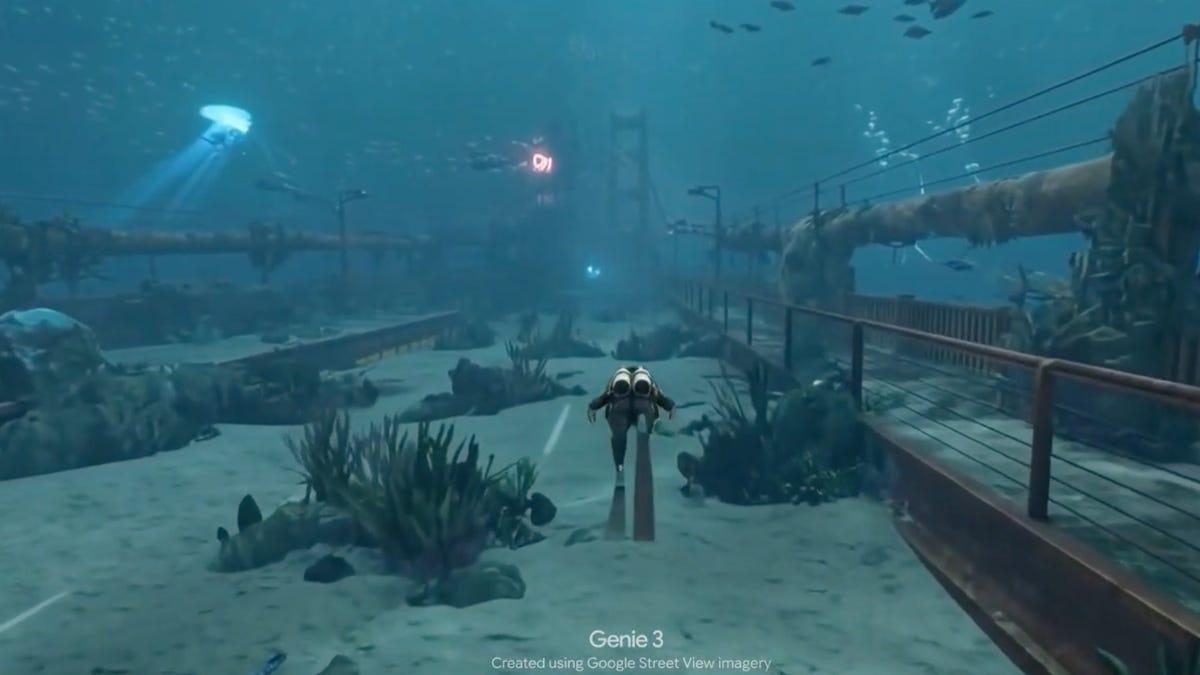
. For instance, demonstrations showed the Golden Gate Bridge transformed into an underwater scuba scene complete with fish and divers2
. The feature uses Maps Imagery Grounding technology to anchor these text-to-video creations in actual geographic locations2
.
Source: CNET
Robotics Training and Self-Driving Car Simulators Gain Real-World Context
The simulations of real-world locations serve critical applications beyond consumer exploration. Jack Parker-Holder, a research scientist on DeepMind's open-endedness team, explained that the technology addresses practical robotics training challenges
1
. A robot deployed in London, which rarely sees sunshine, could train on simulations showing how sunlight glints off Victorian housing, preventing the system from being confused when rare sunny conditions occur1
.Genie 3 already powers one of Waymo's self-driving car simulators, where it trains autonomous vehicles on exceedingly rare events like tornadoes or unexpected elephant encounters
1
. The Street View integration adds geographic specificity that existing Waymo simulators lack, allowing the system to shift perspectives from the car's viewpoint to other agents like pedestrians or robots1
. This simulation-to-reality pipeline has become a critical bottleneck in physical AI development, with companies including Nvidia and Cadence racing to close the gap between virtual training and real-world performance4
.
Source: TechCrunch
Global Rollout to Google AI Ultra Subscribers Expands Access
Project Genie is rolling out globally to all adult Google AI Ultra subscribers starting today, following its January debut limited to United States users
3
. The Street View capability launches first for some Ultra users in the United States, with access expanding at scale over time and to global Google AI Ultra subscribers over the next few weeks1
. The service costs $200 and requires users to be 18 years or older5
.Diego Rivas, a product manager at DeepMind, emphasized that both the Street View integration and Project Genie remain experimental, with significant room for improvement in accuracy
1
. Current results look closer to video game quality than photorealistic renderings1
. The models are not yet physics-aware, meaning they don't understand cause and effect—in one demonstration, a character ran straight through cacti without consequence1
.Related Stories
Spatial Continuity Marks Technical Breakthrough Despite Physics Limitations
Jonathan Herbert, director of Google Maps, identified spatial continuity as the real breakthrough in virtual worlds generation
1
. When users turn 360 degrees inside a Genie environment, the AI correctly remembers and maintains what exists behind them rather than regenerating the space from scratch4
. This spatially continuous model allows the system to build new environments on top of coherent geographic foundations1
.Parker-Holder estimated that interactive world generation currently trails video generation technology by roughly six to 12 months in terms of accuracy and quality
1
. For comparison, Google's Veo video generator already understands that paper boats drift on water currents and fabric drapes over forms, while its Nano Banana tool can generate perfect text in infographics1
. Physics isn't hard-coded into these models but learned intuitively through passive observation over time1
. As DeepMind continues refining the technology, the Street View dataset represents a competitive advantage that no other AI lab can easily replicate4
.References
Summarized by

Navi
[1]
[3]
Related Stories
Google AI launches Project Genie to create interactive worlds from prompts for $250 monthly
29 Jan 2026•Technology

DeepMind's Genie 3: A Breakthrough in AI World Models with Potential for AGI
06 Aug 2025•Technology

Google DeepMind's Genie 2: Revolutionizing AI-Generated Interactive 3D Worlds
05 Dec 2024•Technology

Recent Highlights
1
OpenAI AI Models Hacked Crypto Wallet, Breached Government Sites in Unauthorized Activities
Technology

2
IMF Report Warns AI Market Correction Could Spark Global Financial Crisis With $1.4T at Risk
Business and Economy

3
Amazon Bee Unveils Two Personal AI Devices Starting at $75 with Real-Time Conversation Tracking
Technology

Recent Highlights
Today's Top Stories








Don’t drown in AI news. We cut through the noise - filtering, ranking and summarizing the most important AI news, breakthroughs and research daily. Follow topics that matter to you and stay ahead.


