Gyeonggi Province launches AI-powered immigrant portal to break down language barriers


2 Sources
[1]
Gyeonggi Province launches generative AI portal to help immigrants - The Korea Times
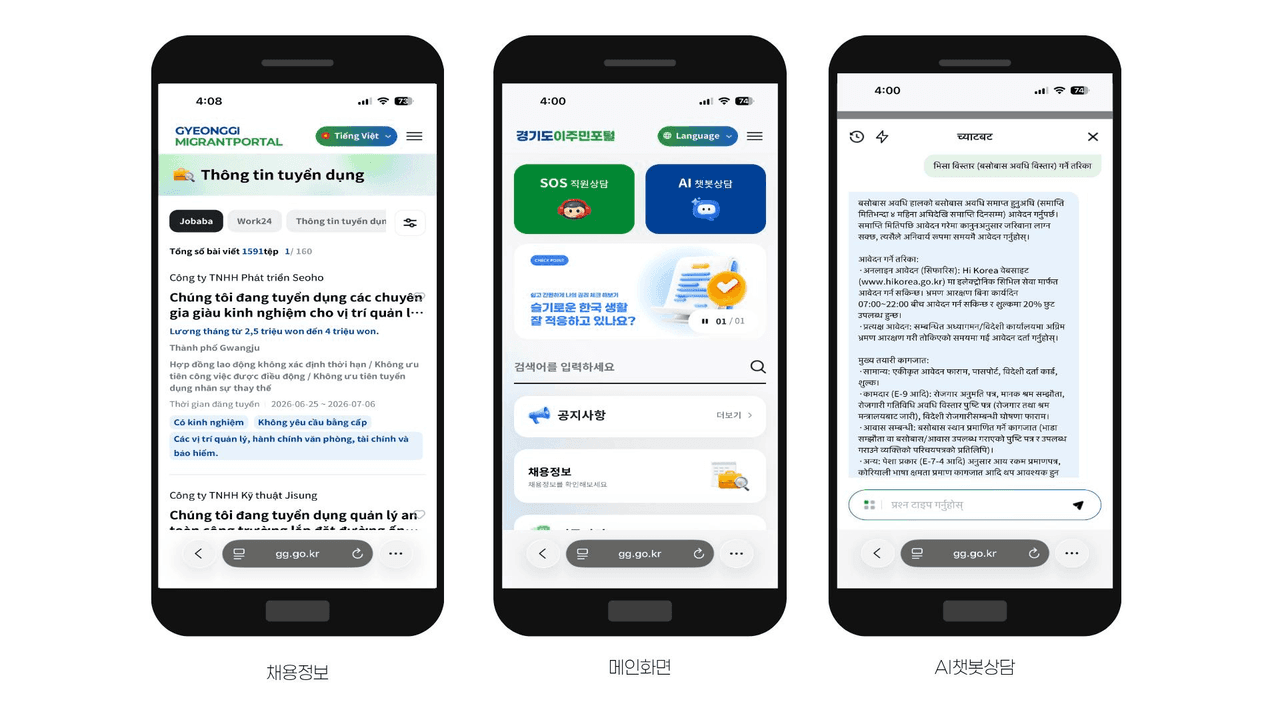
The Gyeonggi Portal for Foreign Residents, a generative AI-powered platform offering multilingual information and services for immigrants / Courtesy of Gyeonggi Province Gyeonggi Province, the populous region enveloping Seoul, will officially launch an integrated digital platform Wednesday
[2]
Gyeonggi Province launches one-stop portal for immigrants, consolidating scattered resources
Mockups of the migrant information portal to be released by Gyeonggi Province. (courtesy Gyeonggi provincial government) Gyeonggi Province will officially launch its new Gyeonggi Migrant Portal on Wednesday, providing migrants with a centralized platform for essential information and support
Share
Copy Link
Gyeonggi Province officially launched its AI-powered Foreign Resident Portal on Wednesday, offering a centralized online platform that consolidates fragmented administrative resources for immigrants. The generative AI portal for immigrants features multilingual translation and an intelligent chatbot trained on government datasets to help non-Korean speakers navigate employment, healthcare, education, and social welfare services across South Korea's most populous region.
Gyeonggi Province Deploys Generative AI Portal for Immigrants
Gyeonggi Province, the densely populated region surrounding Seoul, officially launched its Gyeonggi Foreign Resident Portal on Wednesday, marking a significant advance in how local governments address language barriers and information access for immigrant communities
1
. The centralized online platform brings together essential administrative services that were previously scattered across multiple government websites, creating a one-stop portal for immigrants seeking information on employment, healthcare, education, and social welfare2
.Developed by the province's Immigration and Social Policy Division, the initiative responds directly to the challenges faced by South Korea's growing foreign resident population. The fragmented nature of government information across various municipal and ministerial websites has historically presented steep hurdles for non-Korean speakers attempting to navigate essential services
1
.
Source: Korea Times
AI Chatbot Trained on Government Datasets Delivers Real-Time Answers
At the core of the platform sits a generative AI-powered chatbot equipped with robust multilingual information and services capabilities. The underlying AI model has been trained specifically on government datasets, prioritizing high-frequency inquiries about legal residency status, labor regulations, and emergency services to deliver accurate, real-time responses
1
. Users can ask questions in their preferred language and receive relevant information through automatic translation integrated throughout the platform2
.The portal includes answers to frequently asked questions on topics ranging from visa status to labor issues and everyday life concerns. This approach directly tackles the information barriers that have historically impeded social mobility for immigrants settling in the region
1
.Community Forum and Location-Based Services Enhance Local Integration
Beyond institutional support, the immigrant portal features a location-based community forum where users can exchange practical local insights. Foreign residents can share hospital reviews, discuss school admissions processes, and learn about community cultural events through regional discussion boards
1
. These location-based services provide information tailored to users' surrounding neighborhoods, strengthening civic inclusion efforts at the grassroots level.Related Stories
Rigorous Pilot Program Preceded Official Launch
The official rollout follows a comprehensive two-month pilot program and system optimization phase that began in late May. Provincial staff and local immigrant advocacy groups participated in testing the platform before its public debut
1
. Built with responsive web design, the portal automatically adjusts for mobile devices and tablets, ensuring digital accessibility across different platforms2
.Addressing Demographic Challenges Through Digital Infrastructure
Regional authorities position the platform as a blueprint for supporting immigrant integration as South Korea grapples with demographic challenges driven by record-low birth rates. Korea has steadily adjusted its immigration policies to offset severe demographic shortages, transforming provinces like Gyeonggi into dynamic, multicultural hubs
1
."The Gyeonggi Immigrant Portal is a vital integration tool engineered to ensure that information scarcity does not impede social mobility," said Yoon Hyun-ok, head of the Gyeonggi Immigration and Social Policy Division. "Moving forward, we will continuously refine the service based on community feedback to ensure it remains a cornerstone of stable resettlement and broader social cohesion"
1
. The commitment to incorporating user feedback signals an iterative approach to improving how consolidating scattered resources can better serve immigrant communities navigating administrative services in their new home.References
Summarized by

Navi
Related Stories
South Korea Launches AI for All: Free, Unlimited AI Access as Public Infrastructure
31 Aug 2026•Policy and Regulation

OpenAI Expands to South Korea: Establishing First Office in Seoul Amid Growing ChatGPT Demand
26 May 2025•Business and Economy

Google DeepMind to open world's first AI campus in South Korea, dispatching 10 US engineers
27 Apr 2026•Technology

Recent Highlights



Recent Highlights
Today's Top Stories









Don’t drown in AI news. We cut through the noise - filtering, ranking and summarizing the most important AI news, breakthroughs and research daily. Follow topics that matter to you and stay ahead.


