Hadrian Valued at Nearly $8 Billion After $1.37B Funding as Defense Tech Boom Accelerates


3 Sources
[1]
Hadrian valued at nearly $8 billion after fresh funding as money pours into defense tech
Riding a wave of enthusiasm for defense tech, manufacturing startup Hadrian on Thursday closed its latest round of funding at a nearly $8 billion valuation, more than quadruple where investors valued the company in January. The round was led by Baillie Gifford, J.P. Morgan Strategic Investment
[2]
Hadrian raises $1.37bn at a near-$8bn defence valuation
Hadrian, which builds AI-run factories for the US military, has raised $1.37bn at a valuation just shy of $8bn. In seven months its price has climbed almost fivefold, and the backers are no longer only defence specialists. The defence-tech boom has a new marker. Hadrian builds automated factories
[3]
Exclusive: Hadrian raises $1.37B amid surging defense-production demand
Why it matters: American reindustrialization is catching on beyond niche national-security and investor communities. What they're saying: "We were early," chief executive Chris Power tells Axios. * "This has been a five-year slog, and only 18 months ago everyone went, 'Oh, God, manufacturing is
Share
Copy Link
Defense manufacturing startup Hadrian closed a $1.37 billion Series D funding round at a nearly $8 billion valuation, more than quadrupling its worth in seven months. The round attracted mainstream investors including JPMorgan and Baillie Gifford, signaling broader institutional confidence in the defense-tech boom as the company expands its AI-run factory platform to meet surging defense-production demand.
Defense Manufacturing Startup Quadruples Valuation in Seven Months
Hadrian, a defense manufacturing startup building AI-run factories for the US military, has closed a $1.37 billion Series D funding round at a valuation of $7.87 billion
1
2
. The valuation represents more than a fourfold increase from January, when investors valued the company at $1.6 billion2
. This latest funding round came just over a year after Hadrian raised $260 million in its Series C3
.
Source: Axios
The round was led by JPMorgan's Strategic Investment Group and Baillie Gifford, alongside T. Rowe Price accounts, Morgan Stanley Wealth Management, and funds run by Apollo
2
. Founders Fund, Andreessen Horowitz, and 1789 Capital, where Donald Trump Jr. is a partner, also participated2
. What makes this funding round particularly notable is the shift from niche defense specialists to mainstream institutional investors, signaling broader confidence in the defense-tech boom2
.Factories-as-a-Service Model Powers Rapid Growth
Hadrian operates under a factories-as-a-service model, building highly automated plants for aerospace and defense markets
3
. The company's proprietary Opus software handles scheduling, tool routing, and inspection, cutting lead times from months to days2
. CEO Chris Power explained that Opus software is already being used by the Army and US Navy, with announcements about other defense primes coming soon1
.
Source: The Next Web
The company currently operates nearly 3 million square feet across four sites
3
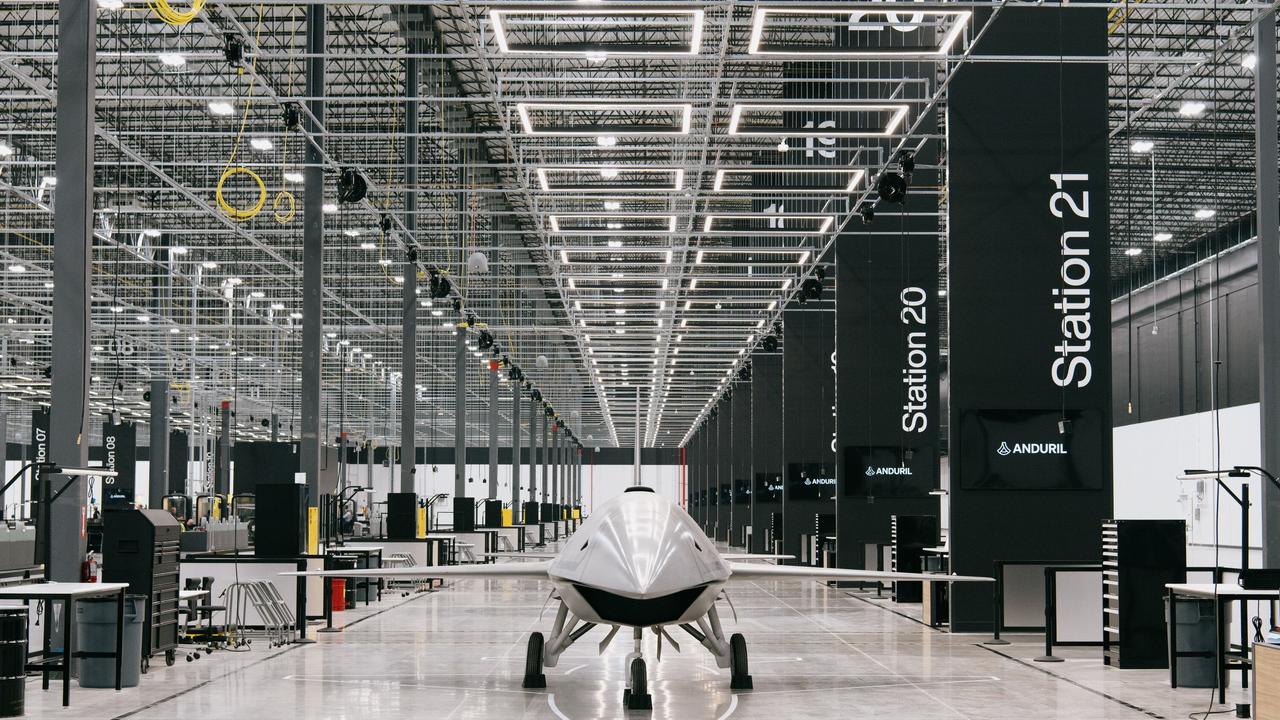
. Hadrian supplies major contractors including Lockheed Martin, RTX, and Anduril2
3
. In March, the US Navy selected Hadrian to mass-produce submarine parts in Alabama for Virginia-class attack and Columbia-class ballistic missile submarines3
. Power positions the company as "far ahead of the pack, in terms of highly automated, design-agnostic factories"3
.Surging Defense-Production Demand Drives Expansion Plans
The fresh capital will fund aggressive expansion to address what Power describes as "massive amounts of production challenges the country has in areas like submarines, munitions, the drone industrial base"
1
. The company plans to nearly triple its workforce to 2,000 within a year2
. Hadrian also aims to establish teams in Australia, Asia, and Europe by December to manufacture precision parts for NATO2
.The funding round comes as defense-tech startups pulled in approximately $35 billion from private investors in the first half of 2026, the strongest six months on record
2
. This surge reflects President Donald Trump's push to spend up to $1.5 trillion rebuilding the US military amid heightened geopolitical tensions1
2
. Power told Axios that after a "five-year slog," recognition of manufacturing's importance only emerged 18 months ago3
.Related Stories
Physical AI and Reindustrialization Shape Industry Future
Power frames Hadrian's mission within the broader context of American reindustrialization, describing manufacturing as fundamentally a software problem
2
. "With physical AI sweeping the physical economy, which is 100 times larger than the digital economy, everyone's going to need to rebase their software to adapt and compete in this new world," Power told CNBC1
. He positions this as a competitive race with China, which he says is betting heavily on industrial dominance2
.The company joins other high-profile defense tech firms experiencing rapid valuation growth. Shield AI raised money in March at a $12.7 billion valuation, while Saronic was valued at $9.25 billion
1
. Anduril doubled its valuation to over $60 billion1
. Power emphasized that "production is now the frontline of deterrence," adding that "being able to produce—and have advanced factories—is deterrence"2
3
. The company does not plan to test public markets until 2029 at the earliest2
.References
Summarized by

Navi
[2]
Related Stories
Hadrian Secures $260 Million to Expand AI-Powered Defense Manufacturing
18 Jul 2025•Business and Economy
Hadrian Automation denies $7.5B valuation report, but signals hot physical AI market
24 Jun 2026•Startups

Anduril raises $5 billion, doubles valuation to $61 billion as defense tech spending surges
13 May 2026•Startups
Recent Highlights
1
Meta Unveils Muse Wonder Frontier AI Models, Claims Performance Matching OpenAI and Anthropic
Technology

2
IMF Report Warns AI Market Correction Could Spark Global Financial Crisis With $1.4T at Risk
Business and Economy

3
OpenAI Releases 722 AI-Generated Math Solutions, Triggering Existential Crisis in Mathematics
Technology

Recent Highlights
Today's Top Stories








Don’t drown in AI news. We cut through the noise - filtering, ranking and summarizing the most important AI news, breakthroughs and research daily. Follow topics that matter to you and stay ahead.


