Huawei Pulls Ascend 960 AI Chip Launch Forward by Three Quarters, Doubling Performance Targets


15 Sources
[1]
Huawei plans Q1 2027 launch of new AI chip as it takes on Nvidia
Huawei is moving up the launch of its next-generation Ascend 960DT AI chip to the first quarter of 2027, as it races to challenge Nvidia, the company said on Thursday at its Huawei Connect conference. The Chinese tech giant had previously planned to launch the chip in Q3 of 2027, a Huawei
[2]
Huawei details AI accelerator roadmap, pulls in next-generation Ascend NPUs by several quarters -- FP4 performance of the Ascend 960PR doubles expectations
Huawei has updated its AI hardware roadmap by adding new accelerators and supporting processors and pulling in next-generation Ascend 960 accelerators at its annual Huawei Connect event. Specifically, the company accelerated its Ascend 960 roadmap, disclosed Ascend 970 and 980 specifications,
[3]
Huawei's next-gen Ascend NPUs could become China's best option
At its annual Connect conference, Huawei unveiled a new generation of AI accelerators that promise performance far beyond anything Nvidia can currently sell in the Middle Kingdom. This could be a boon for Chinese developers used to purchasing lesser weapons from everyone's favorite AI arms
[4]
China's Huawei to launch two new AI chips in 2027
SHANGHAI, Sept 17 (Reuters) - Huawei Technologies (HWT.UL) will launch two new artificial-intelligence chips in 2027, rotating chairman David Wang said on Thursday, as the Chinese company expands its push into AI computing. Huawei plans to launch the 960DT in the first quarter and the Ascend
[5]

Huawei Connect 2026: Ascend 960 early, a million-NPU plan
At Huawei Connect 2026 in Shanghai, an AI chip arriving three quarters early took the headlines. The rest of the keynote mattered more: an optical engine, two new SuperPoDs and an interconnect Huawei says can eventually wire a million processors into a single computer. AI "may well be the final
[6]

China's AI superchip set to reshape the 'arms race' as early as January
Huawei sets its sights on changing the global AI landscape with new chip Chinese tech giant Huawei has made a bold move in the AI "race," announcing that its next-generation AI chip to rival current Nvidia models will be released as early as the start of 2027. This has the potential to release
[7]

Huawei just laid out its 2027 AI chip plans, and Nvidia is clearly the target
The company is betting on massive connected AI systems instead of relying on a single powerful chip. Huawei isn't waiting around for the AI chip race to slow down. At a company event in Shanghai on Thursday, rotating chairman David Wang confirmed that two new AI chips are on the way in 2027, the
[8]

China's Huawei Sets 2027 Launch for New AI Chips as It Targets Nvidia
By Che Pan, Casey Hall and Eduardo Baptista SHANGHAI/BEIJING Sept 17 (Reuters) - Huawei Technologies will launch two new artificial-intelligence semiconductors in 2027, rotating chairman David Wang said on Thursday, as the Chinese tech giant builds up its AI computing business and seeks to
[9]

Huawei AI chips: China's Huawei sets 2027 launch for new AI chips as it targets Nvidia
The company is also working on ways to connect very large numbers of AI chips, allowing them to work together as one bigger computing system. Most advanced AI programmes require more processing power than a single chip can provide. Huawei Technologies will launch two new artificial-intelligence
[10]

Huawei Takes Aim at Nvidia, AMD with Over 10 new AI Chipsets -- But Can the Chinese Tech Giant Close the G
Chinese tech giant Huawei unveiled over 10 new chipsets for AI computing infrastructure on Thursday in a bid to challenge Nvidia Corp. (NASDAQ:NVDA), Advanced Micro Devices (NASDAQ:AMD) and Intel Corp.'s (NASDAQ:INTC) dominance in the market. The new chipsets include next-generation AI
[11]

Huawei Brings Huge Inference Boost With Its Next-Gen Ascend 960 Chips In 2027, While 2028's Ascend 970 Pushes Memory To 288 GB & Ascend 980 Pushes Memory To 384 GB In 2029
Huawei has released its next-gen Ascend chip and SuperPod roadmap, which comprises Ascend 960DT/PR, Ascend 970, and Ascend 980 accelerators. Huawei Pushes Its AI Accelerator Roadmap Ahead With Next-Gen Ascend Chips Arriving Earlier Than Anticipated At Huawei Connect 2026, the company disclosed
[12]

Huawei set to unveil China's best answer to Nvidia AI chip reign
Huawei Technologies is set to unveil new AI technology this week in defiance of U.S. export control curbs, advancing its ambition to replace Nvidia in China and compete on the global stage. Huawei's rotating chairman Wang Tao will present its upcoming Ascend 960 AI chips, to be commercially
[13]

Huawei Set to Launch Its Premium Chip in Q1 of 2027
Far from calling truce, both China and the US appear well on their way to emerge the winner in the AI arms race Huawei's decision to advance the launch of its next-generation Ascend 960DT AI chip to the first quarter of 2027 could be just the boost China's AI companies need in their battle with US
[14]

Huawei's Ascend 960 Chips Aim To Rival Nvidia By 2027
Huawei has laid out plans for two new AI chips, the Ascend 960DT and Ascend 960PR, as part of a three-year roadmap meant to close the gap with Nvidia. The Shenzhen-based company shared these plans through its rotating chairman, Eric Xu, building on the roadmap it first revealed at the Huawei
[15]

China's Huawei sets 2027 launch for new AI chips as it targets Nvidia
SHANGHAI/BEIJING Sept 17 (Reuters) - Huawei Technologies will launch two new artificial-intelligence semiconductors in 2027, rotating chairman David Wang said on Thursday, as the Chinese tech giant builds up its AI computing business and seeks to challenge U.S. chipmaker Nvidia. Huawei plans to
Share
Copy Link
Huawei announced at its Connect 2026 conference that its next-generation Ascend 960DT AI chip will launch in Q1 2027, three quarters ahead of schedule. The accelerated timeline comes as China races to build domestic semiconductor capabilities despite U.S. restrictions, with the chip delivering 4 FP4 PFLOPS and 288GB of memory to compete with Nvidia in AI computing.
Huawei Accelerates AI Chip Timeline to Challenge Nvidia
Huawei has moved the launch of its next-generation Ascend 960DT AI chip to the first quarter of 2027, three quarters earlier than originally planned, as announced at the Huawei Connect conference in Shanghai
1
. David Wang, Huawei's rotating and acting chairman, revealed the updated AI accelerator roadmap during his keynote, signaling the company's aggressive push to compete with Nvidia in the AI computing market2
. The Ascend 960PR, optimized for inference workloads, will follow in Q3 2027, also ahead of its original schedule4
.
Source: The Next Web
The announcement comes just days before U.S. President Trump and Chinese President Xi Jinping are scheduled to meet on September 24 in Washington, DC, highlighting the geopolitical tensions surrounding semiconductor technology
1
. China tech analyst Rui Ma noted that U.S. semiconductor restrictions are unlikely to stop China's pursuit of self-sufficiency, stating the stakes are "just too high at this point"1
.Ascend 960 Specifications Double Performance Expectations
The Ascend 960DT delivers 2 FP8 PFLOPS and 4 FP4 PFLOPS, doubling the performance of Huawei's current Ascend 950 series
2
. The chip carries 288GB of HiZQ memory with 9.6TB/s bandwidth and features a 2.2TB/s interconnect2
. What's more remarkable is that Huawei increased the FP4 performance of the Ascend 960PR to 8 FP4 PFLOPS, twice higher than originally announced last year2
.
Source: New Atlas
These next-generation Ascend NPUs represent a significant leap in China's domestic AI capabilities. While the 960DT offers similar memory capacity to Nvidia's B300 family, it delivers about half the FP8 and a third of the FP4 compute compared to American GPUs
3
. However, Nvidia cannot sell its most advanced chips in China, making Huawei's offerings the best available option for Chinese AI developers3
.Peerium Computing Architecture Scales to 4,096 Chips
Huawei unveiled its Peerium Computing Architecture, which relies on UnifiedBus technology to link processors with memory, storage, and networking hardware into large-scale AI computing systems
1
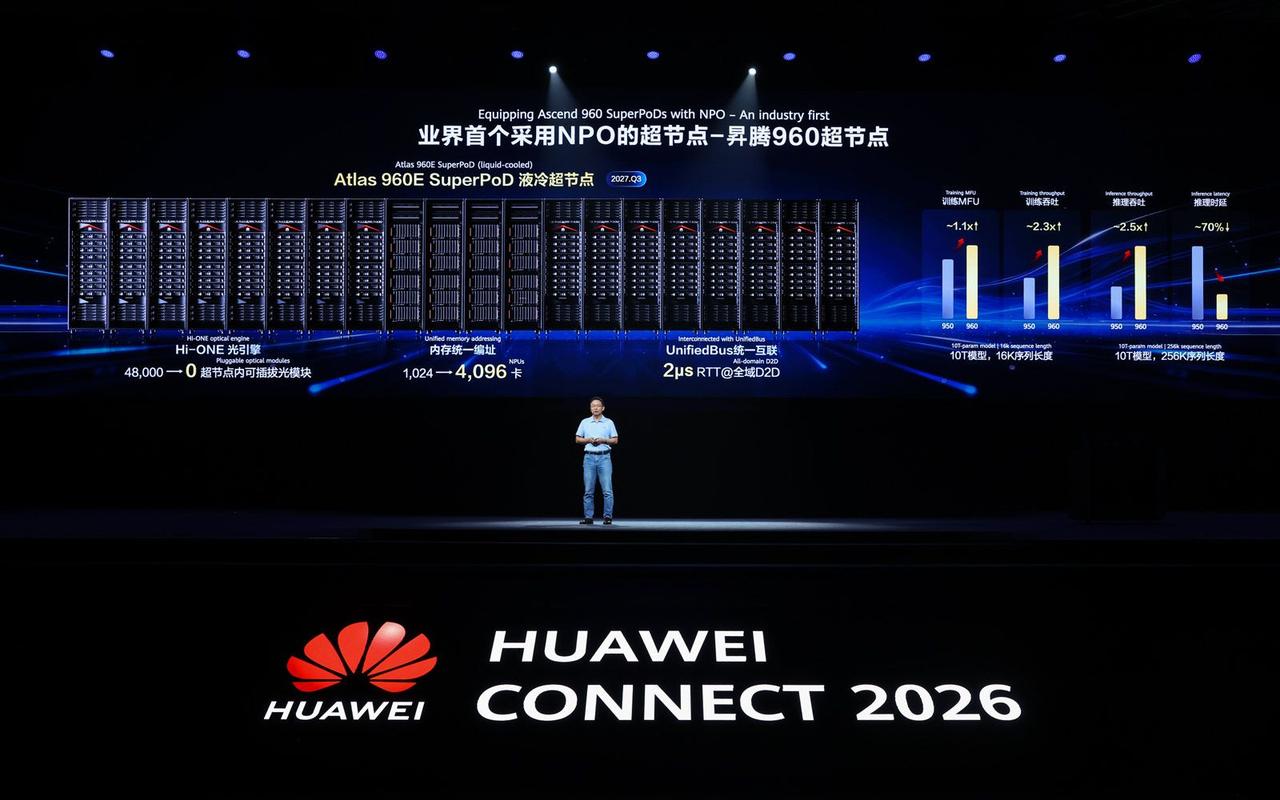
. The company's Atlas 960E SuperPoD, built on this architecture, can connect up to 4,096 neural processing units and delivers 8 EFLOPS at FP8 precision with one petabyte of HBM memory per pod5
.
Source: Wccftech
However, the scale has raised questions. China tech analyst Rui Ma pointed out that Huawei had previously stated its Atlas 960 SuperPoD would scale to 15,488 Ascend 960 chips, while this week's announcement referenced a system with 4,096 chips
1
. "The chip itself is coming WAY earlier, but the SuperPoD they announced is much smaller than what they originally laid out," Ma wrote5
.Near-Packaged Optics Cut Power and Boost Reliability
The Atlas 960E SuperPoD incorporates near-packaged optics through Huawei's Hi-ONE optical engine, which moves 7.2Tbit/s per unit
5
. By deploying 5,500 Hi-ONE units, Huawei eliminated 48,000 800G pluggable optical modules from the pod, cutting power consumption by more than 550 kilowatts and doubling system uptime to 99.8%3
. The company has filed an implementation agreement on this technology with the Optical Internetworking Forum5
.Huawei's UnifiedBus architecture consolidates more than ten protocols into one, increasing bandwidth from hundreds of gigabytes per second to terabytes while reducing latency from seven microseconds to two
5
. In conventional 100,000-NPU clusters, as little as 20% of compute goes to the model, with the rest sitting idle during data movement. Huawei's lab simulations show pods of 4,000 NPUs reach 2.75 times the model FLOPs utilization of eight-NPU servers5
.Roadmap Extends Through 2029 with Ascend 970 and 980
David Wang announced that Huawei will maintain a one-generation-per-year cadence for its AI accelerators starting with the Ascend 960 series
2
. The Ascend 970 is scheduled for 2028 with 3.6 FP8 PFLOPS, 14 FP4 PFLOPS, 288GB of memory providing 14.4TB/s, and 4.4TB/s of interconnect bandwidth. The Ascend 980 follows in 2029 with 7.2 FP8 PFLOPS and 28 FP4 PFLOPS, along with 384GB of memory reaching 38.4TB/s and an 8TB/s interconnect2
.Wang credited the Tau Scaling Law for the accelerated cadence, noting that compute specifications will continue to double with huge improvements in memory bandwidth, memory capacity, and interconnect bandwidth
2
. Huawei has also revealed plans to scale compute clusters to half a million or more NPUs, with theoretical configurations reaching up to one million processors5
.Related Stories

Supply Constraints Remain Critical Challenge
Despite the technical advances, Huawei rotating chairman Eric Xu acknowledged that production capacity remains insufficient to satisfy domestic demand
2
. Executives told Bloomberg that Huawei now holds a bigger AI chip market share than Nvidia inside China but cannot manufacture enough units5
. Xu stated the company is prioritizing Chinese customers and has no broad global expansion plan, projecting China will catch up with its own hardware demand by 20305
.Huawei recently raised the price of the Ascend 950DT by 60% citing tight component supply
5
. DeepSeek alone plans to deploy at least 160,000 of those chips, more than Huawei can currently fulfill5
. Wang revealed that Huawei has shipped more than 1,000 UnifiedBus-based systems to more than 370 customers4
, though the Atlas 950 SuperPoD adoption does not appear to be proceeding rapidly, possibly due to insufficient supply or the all-new architecture requiring major software redesign2
.Software Ecosystem Gains Ground with CANN Framework
Huawei's CANN framework, which serves a similar role to Nvidia's CUDA for Ascend processors, has moved to community-driven open source
5
. External developers now make up 61% of the CANN community, outnumbering Huawei's own developers for the first time5
. Ascend supports more than 90 third-party open-source projects and has become an official PyTorch accelerator backend, making it the first Chinese compute platform listed on the PyTorch website5
. The Kunpeng ecosystem claims 4.16 million developers and 7,200 partners5
, signaling progress in closing the software gap that has historically favored Nvidia's dominance.References
Summarized by

Navi
[2]
[3]
[5]
Related Stories
Huawei Unveils Ambitious AI Chip Roadmap, Challenging Nvidia's Dominance in China
12 Sept 2025•Technology

Huawei's Ascend 910D AI Chip Challenges NVIDIA Amid US Export Restrictions
21 Apr 2025•Technology
Huawei's Ascend 910C AI Chip Achieves Breakthrough in Yield Rates, Challenging NVIDIA's Dominance
26 Feb 2025•Technology

Recent Highlights



Recent Highlights
Today's Top Stories






Don’t drown in AI news. We cut through the noise - filtering, ranking and summarizing the most important AI news, breakthroughs and research daily. Follow topics that matter to you and stay ahead.


