Humanoid robot Pemba summits volcano at 20,341 feet, prepares for Mount Everest challenge


3 Sources
[1]
Unitree's G1 humanoid robot eyes challenging Mount Everest summit
A Unitree G1 humanoid robot is being prepared for a planned Mount Everest expedition later this year after taking part in a high-altitude test on Mount Chimborazo in Ecuador. The robot, named Pemba, was provided by Eastworlds Labs, the AI robotics initiative of Virtuals Protocol. It was part of a
[2]
Robot mountaineer reaches 6,200-meter peak in Ecuador
A humanoid robot has successfully reached the summit of Ecuador's Chimborazo volcano. This is a new milestone in efforts to push legged robots beyond controlled environments into some of the world's harshest environments. The robot, a modified Unitree G1 named "Pemba," recently completed an
[3]
A humanoid robot climbed a volcano, with some very human help
A modified Unitree G1 reached Chimborazo's summit, but the hardest parts still needed people. A humanoid robot named Pemba has reached the summit of Ecuador's Chimborazo volcano, a 20,341-foot peak that gives the whole robots-are-coming line a much colder backdrop. The climb is impressive, but
Share
Copy Link
A Unitree G1 humanoid robot named Pemba reached Ecuador's Mount Chimborazo summit at 20,341 feet in a groundbreaking high-altitude test. The expedition marks the first stage of an ambitious plan to send the robot mountaineer to Mount Everest later this year, testing whether robots in extreme environments can support conservation and research in places too dangerous for humans.
Humanoid Robot Reaches Extreme Altitude in Groundbreaking Test
A Unitree G1 humanoid robot named Pemba has successfully completed a high-altitude test on Ecuador's Mount Chimborazo, reaching the 20,341-foot (6,200-meter) summit in what represents a significant milestone for robots in extreme environments
2
. The robot mountaineer was placed at 20,312 feet on June 5, 2026, during an expedition led by Geologic Dome and supported by Eastworlds Labs, the AI robotics initiative of Virtuals Protocol . Mount Chimborazo holds a unique geographical distinction as the summit farthest from Earth's center and the closest point to the Sun on Earth, making it an ideal testing ground before the planned Mount Everest expedition in the fall.Climbing a Volcano Required Both Machine and Human Effort

Source: Interesting Engineering
While the achievement marks progress in humanoid robotics, Pemba didn't complete the 16-hour summit push entirely on its own
3
. The humanoid robot walked independently on terrain sections with inclines below 30 degrees, but expedition members carried it through steeper, more technically demanding portions. The Unitree G1 weighs 77 pounds (35 kg) and can fold down to 690 mm, which made transport through difficult terrain more manageable1
. During the Ecuador mission, the team disassembled the robot and carried it between camps, then reassembled it at different stages of the journey. This mixed approach transforms the climb from a fully autonomous robot conquest into a serious field test that exposes weaknesses and strengths in both hardware and AI systems.AI Autonomy System Faces Brutal Conditions
Mount Chimborazo presented conditions that most lab demonstrations never encounter. Temperatures can plummet to 5 degrees Fahrenheit (-15°C), while wind gusts reach 55 miles per hour (90 km/h)
1
. To help Pemba handle these conditions, engineers fitted the Unitree G1 humanoid robot with custom cold-weather jackets, gated enclosures, and composite feet. The robot's AI autonomy system was trained in NVIDIA Isaac Sim at 1,620 times real-time speed, achieving 85 percent sim-to-real transfer on uneven terrain. The system was also pretrained to respond to wind turbulence and recover balance on technical alpine terrain. Communication during the expedition relied on a proprietary mesh relay across camps, with satellite internet at each camp delivering 25 ms latency, staying below the 50 ms limit needed for live teleoperation with Reflex's latency software.Environmental Monitoring Drives Conservation Mission
The project extends beyond mountaineering spectacle. Engineer Pablo Berlanga Boemare, founder of Geologic Dome and former conservation specialist with the World Wildlife Fund, conceived the concept to address a practical challenge
2
. Many protected areas rely on extensive networks of stationary cameras and sensors to monitor wildlife, illegal logging, poaching, and environmental changes. A humanoid robot equipped with cameras, sensors, satellite connectivity, and onboard AI could patrol large areas autonomously while collecting environmental data, offering a more flexible alternative to installing thousands of fixed cameras across remote regions. Geologic Dome is currently testing this approach across three sites: equatorial forest in the Democratic Republic of Congo, montane cloud forests in Ecuador, and the full Himalayan altitude gradient in Nepal1
. The organization is building autonomous infrastructure for conservation zones, including communication relays, AI-powered ecological monitoring, and energy-independent robotic platforms.Related Stories

Mount Everest Plans Hit Regulatory Obstacles
Geologic Dome and Nepal-based Fourteen Peaks Expedition have proposed deploying Pemba on Mount Everest as part of a research mission, testing the humanoid robot between Everest Base Camp and Camp IV at nearly 8,000 meters (26,247 feet)
2
. The team is working with the production crew behind Netflix 14 Peaks: Nothing Is Impossible to document the expedition1
. Researchers hope to collect data on battery performance, locomotion, joint stress, thermal management, and environmental resilience. Future robotic systems could potentially assist with waste collection, glacier monitoring, search-and-rescue operations, and environmental surveying in the Everest region. However, Nepal currently lacks a legal framework governing robotic expeditions on Everest, with officials requesting new regulations covering non-human climbers before any mission can proceed . The Unitree G1 humanoid robot will be donated to the local Sherpa community for the Everest expedition, connecting the project's legacy to the region where the next mission will take place1
. The regulatory delay may sound absurd, but fragile, heavily managed environments need rules before robots start joining the queue, as a machine that fails on a mountain can become an obstacle, a rescue problem, or expensive debris.What Legged Robots Must Prove in Disaster Zones

Source: Interesting Engineering
The significance of the Pemba project reaches beyond climbing achievements. Humanoid robotics companies increasingly claim their machines will operate in warehouses, factories, construction sites, disaster zones, and remote environments, yet proving those capabilities requires testing outside carefully controlled settings
2
. Mountain environments offer a uniquely demanding proving ground where robots must cope with unstable terrain, extreme temperatures, limited communications, power constraints, and unpredictable weather. The team plans to gradually expand the robot's autonomous capabilities through reinforcement learning systems trained to handle increasingly difficult terrain. Eastworlds Labs said it sponsored the Chimborazo expedition and is contributing funding toward Geologic Dome's nature conservation work1
. Whether Pemba ultimately reaches Mount Everest remains uncertain, but its successful ascent of Mount Chimborazo demonstrates that the next frontier for humanoid robots may be some of the most challenging terrain on Earth, where they could eventually reduce human risk while advancing conservation and research objectives.References
Summarized by

Navi
[1]
[2]
[3]
Related Stories
Unitree G1: The Versatile Humanoid Robot Pushing Boundaries in AI and Robotics
14 Oct 2025•Technology

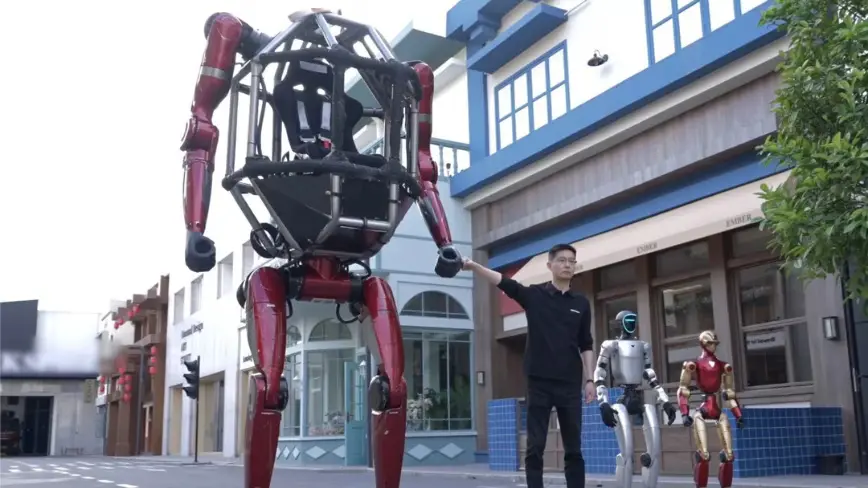
Unitree unveils $650K giant rideable mecha robot as company files for $7 billion IPO
15 May 2026•Technology
Unitree's R1: The $5,900 Humanoid Robot Pushing Boundaries in Affordability and Capability
25 Jul 2025•Technology

Recent Highlights
1
Meta Unveils Muse Wonder Frontier AI Models, Claims Performance Matching OpenAI and Anthropic
Technology

2
IMF Report Warns AI Market Correction Could Spark Global Financial Crisis With $1.4T at Risk
Business and Economy

3
OpenAI Releases 722 AI-Generated Math Solutions, Triggering Existential Crisis in Mathematics
Technology

Recent Highlights
Today's Top Stories






Don’t drown in AI news. We cut through the noise - filtering, ranking and summarizing the most important AI news, breakthroughs and research daily. Follow topics that matter to you and stay ahead.


