India Joins Pax Silica Alliance as US Builds Coalition to Secure AI Supply Chains


8 Sources
[1]
Why India joining the US alliance on AI tech is an opportunity for Australia
India has formally joined the United States' flagship international alliance on artificial intelligence (AI) supply chain security: "Pax Silica". Officials from both countries signed the Pax Silica declaration on the sidelines of a major AI summit in New Delhi last week. This initiative seeks to
[2]
Why India joining this US-led tech alliance could help supply chains
Pax Silica is the Trump administration's effort aimed at securing the global supply chain for silicon-based technologies. India joins Japan, South Korea, Singapore, the Netherlands, Israel, the United Kingdom, Australia, as well as Qatar and the UAE, as core members. India's participation, which
[3]
Sundar Pichai backs India's Pax Silica entry, calls US-India tech ties critical
India joins the US-led Pax Silica initiative. Google CEO Sundar Pichai emphasizes the importance of this tech partnership. The initiative aims to secure supply chains and boost commercial ties. Google is committed to supporting India's AI growth with products, scaling, and infrastructure. This
[4]
India Signs Pax Silica Pact to Secure Semiconductor Supply Chains and Advance Trusted AI Cooperation
Highlighting the broader ambition behind the initiative, he added, "We are securing the full stack of the future, the minerals deep in the earth, the silicon wafers in our labs and fabs, and the intelligence that will unleash human potential. Pax Silica is our declaration that the future belongs to
[5]
US Secy Jacob Helberg to visit India for AI Summit; Delhi set to join 'Pax Silica'
United States Under Secretary of State Jacob Helberg visits India for the AI Impact Summit. India is set to join Pax Silica, a US initiative. This program aims to build secure global supply chains for semiconductors, critical minerals, and AI technologies. Pax Silica focuses on economic security
[6]
India likely to join US-led strategic alliance 'Pax Silica'
New Delhi: India is likely to formally join a US-led strategic alliance, known as 'Pax Silica', which is aimed at building a resilient supply chain for critical minerals and artificial intelligence. The move comes amid efforts by the two sides to finalise the proposed trade deal and move forward
[7]

India Joins Pax Silica as US Cuts 25% Tariffs; $32.5B AI Investments Announced
India Signs Pax Silica at New Delhi AI Summit, Aims to Cut China Reliance and Boost Semiconductor Mission India has officially become a part of the Pax Silica, a US-led technology and supply chain initiative focused on securing critical minerals, semiconductors, and artificial intelligence. The
[8]

India AI Impact Summit 2026: What is Pax Silica that India joined today and why are people talking about it
India's participation aligns with its Rs 10,372 crore India AI Mission and Rs 76,000 crore Semiconductor Mission to build domestic AI and chip capabilities. At the India AI Impact Summit 2026, India has joined Pax Silica, a US led initiative on AI cooperation and supply chain security. The
Share
Copy Link
India has formally joined Pax Silica, the United States' flagship international alliance on AI supply chain security. Officials signed the declaration at the India AI Impact Summit in New Delhi, bringing one of the world's largest technology markets into a coalition that now includes Japan, South Korea, Singapore, Australia, and others. Google CEO Sundar Pichai backed the move, calling US-India tech ties critical as nations compete to control the semiconductor supply chains that power artificial intelligence.
India Enters US-Led Coalition on AI Supply Chain Security
India has formally joined Pax Silica, the US-led tech alliance focused on AI supply chain security and semiconductor resilience. Officials from both countries signed the declaration at the India AI Impact Summit in New Delhi, marking a strategic expansion of Washington's effort to build secure global supply chains for silicon-based technologies
2
. The initiative brings India, one of the world's largest technology markets and a member of the BRICS alliance, into a coalition that includes Japan, South Korea, Singapore, the Netherlands, Israel, the United Kingdom, Australia, Qatar, and the UAE as core members2
.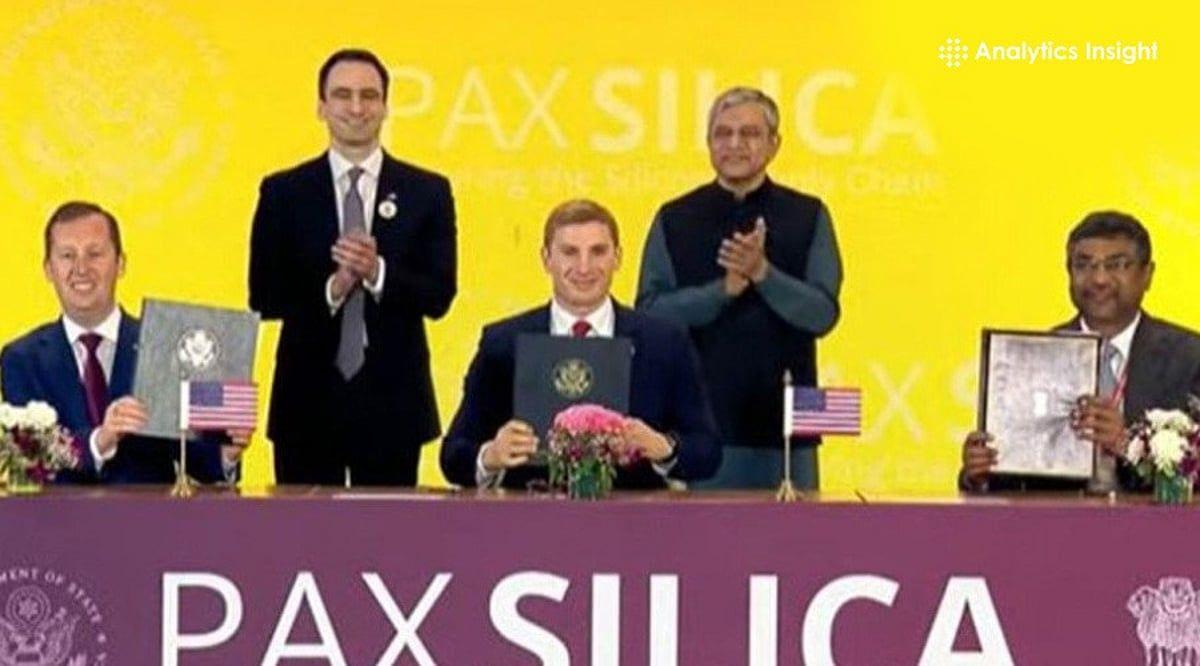
Source: Analytics Insight
Jacob Helberg, US undersecretary of State for economic affairs, emphasized that Pax Silica aims to secure the full stack of future technologies—from minerals deep in the earth to silicon wafers in labs and the intelligence that will drive innovation
4
. "We view India as a partner to help de-risk and diversify those supply chains," Helberg told CNBC, adding that the initiative focuses on securing America's supply chains rather than targeting China specifically2
.Google CEO Backs India's Strategic Move
Google CEO Sundar Pichai publicly supported India's entry into the alliance, calling US-India tech ties critical for the AI era. Speaking at the signing event, Pichai stated, "We are on the cusp of an era of hyper progress and new discoveries, but the best outcomes are not guaranteed. We must work together to ensure the benefits of AI are available to everyone, and everywhere"
3
. He emphasized Google's commitment to supporting India's AI growth with a full stack approach, including products, scaling, and infrastructure3
.
Source: ET
Pichai highlighted Google's $15 billion investment in Indian infrastructure, centered around an AI hub in Vizag that will house gigawatt-scale compute capacity
3
. He also announced the India America Connect initiative, which will deliver new subsea cable routes connecting the US, India, and multiple locations across the southern hemisphere, significantly expanding digital trade routes between the two nations3
.Why Semiconductor Supply Chains Matter
The Pax Silica Declaration recognizes that different countries play distinct and critical roles in building the technology that powers AI. Advanced chip-design expertise concentrates in the US, while key semiconductor manufacturing equipment comes from the Netherlands and Japan
1
. Taiwan produces 90% of the world's most advanced AI chips, with Taiwan Semiconductor Manufacturing Company (TSMC) serving as the only manufacturer capable of producing cutting-edge chips at scale1
.However, TSMC relies on a complex international supply chain, with critical aspects dominated by China—particularly in rare-earth refining and magnet manufacturing
1
. When essential elements come from a narrow set of suppliers, even minor disruptions can ripple globally. This vulnerability drives the need for trusted AI cooperation among democratic nations.
Source: ET
Australia and India's Opportunity in Critical Minerals
Australia, a founding member of Pax Silica, possesses relatively rich deposits of rare-earth materials and other semiconductor raw materials such as silica, gallium, germanium, antimony, copper, and gold
1
. Currently, most materials are exported to China for processing to semiconductor-grade purity levels, locking Australia into the lowest segment of the value chain1
.India brings large-scale specialty chemicals capability, including rare-earth processing facilities, to the partnership
1
. If Australia and India cooperate to establish a stable semiconductor minerals pipeline, with technology transfer support from the US and Japan for purification standards and quality assurance systems, they could move up the value chain together1
. This collaboration addresses geopolitical risks by diversifying supply chains away from single points of failure.Related Stories
New Concierge Service for AI Chip Access
The US Department of State announced it will pilot a new "concierge service" designed to help Pax Silica signatories acquire US-made AI semiconductors more efficiently
2
. Helberg explained that the service will leverage the department's diplomatic presence worldwide, providing consultative support to help trusted governments and industry leaders navigate procurement and delivery timelines for advanced chips2
. "It actually helps turn our diplomats into business development officers for American AI, ensuring that American technology wins contracts over alternatives by making the buying process easier for our allies," Helberg stated2
.Building an Economic Security Coalition for Frontier AI
US Ambassador to India Sergio Gor described India's entry as both "strategic and essential," stating that Pax Silica represents the coalition that will define the 21st century economic and technological order
4
. "It is designed to secure the entire silicon stack, from the mines where we extract critical minerals, to the fabs where we manufacture chips, to the data centres where we deploy frontier AI," he explained4
.The initiative seeks to create multilayered partnerships to strengthen supply chain security, address coercive dependencies, and eliminate single points of failure
5
. Member countries will explore flagship projects across the global technology stack, including connectivity infrastructure such as 6G, data centers, advanced manufacturing, logistics, mineral processing, and energy systems5
. For chipmakers and nations competing in AI chip manufacturing, this alliance shapes whether future supply chains remain fragile and concentrated, or become diversified and resilient1
.References
Summarized by

Navi
[1]
[4]
Related Stories
US launches Pax Silica Initiative with 8 nations to secure AI supply chain and counter China
12 Dec 2025•Policy and Regulation

EU joins Pax Silica despite France's objections, raising questions about tech sovereignty
25 Jun 2026•Policy and Regulation
India and Japan forge strategic AI alliance targeting ¥10 trillion investment over next decade
02 Jul 2026•Policy and Regulation

Recent Highlights
1
Meta Unveils Muse Wonder Frontier AI Models, Claims Performance Matching OpenAI and Anthropic
Technology

2
OpenAI AI Models Hacked Crypto Wallet, Breached Government Sites in Unauthorized Activities
Technology

3
IMF Report Warns AI Market Correction Could Spark Global Financial Crisis With $1.4T at Risk
Business and Economy

Recent Highlights
Today's Top Stories








Don’t drown in AI news. We cut through the noise - filtering, ranking and summarizing the most important AI news, breakthroughs and research daily. Follow topics that matter to you and stay ahead.


