India's back office built the world's tech hub. Artificial intelligence is now shrinking it.


2 Sources
[1]
India Built the World's Back Office. A.I. Is Starting to Shrink It.
Steven Lee Myers reported from New Delhi, Gurugram, Ghaziabad and Mumbai. Paul Mozur reported from Taiwan. In Gurugram, the sprawling tech suburb outside New Delhi, Krishna Khandelwal is using artificial intelligence to build an army of chatbots designed to eliminate the kind of jobs that once
[2]
India built the world's back office. AI is starting to shrink it
India's IT outsourcing sector faces a significant challenge as artificial intelligence automates jobs. Companies like Hunar.AI are using AI to streamline hiring and onboarding. This shift threatens the employment of millions, impacting graduates and the nation's economic model. While the government
Share
Copy Link
Artificial intelligence is disrupting India's $300 billion IT outsourcing sector, threatening millions of jobs that fueled economic growth. Companies like Tata Consultancy Services have cut over 20,000 workers since 2022, while startups deploy AI voice agents to automate hiring and onboarding. As the cost of AI agents approaches electricity prices, India faces a critical challenge to transform from service provider to AI power.
Artificial Intelligence Reshapes India's Back Office Economy
India's back office, a $300 billion industry employing more than 6 million people and accounting for over 7 percent of the country's gross domestic product, faces an existential threat from artificial intelligence
1
. For 25 years, India positioned itself as the world's outsourcing hub, providing educated, English-speaking workers to handle tasks more affordably than in the United States or Europe. Now, AI-driven transformation is poised to do to India what its outsourcing model did globally: automate and eliminate white-collar positions at scale.
Source: ET
In Gurugram, Krishna Khandelwal's startup Hunar.AI exemplifies this shift by deploying AI voice agents that manage virtually every stage of the hiring process, from résumé screening through onboarding
1
. "For onboarding, you don't need humans at all," Khandelwal stated, capturing the stark reality of automating office worker tasks. This technology directly threatens employment in an industry that has been central to India's economic ascent and global positioning in the tech boom.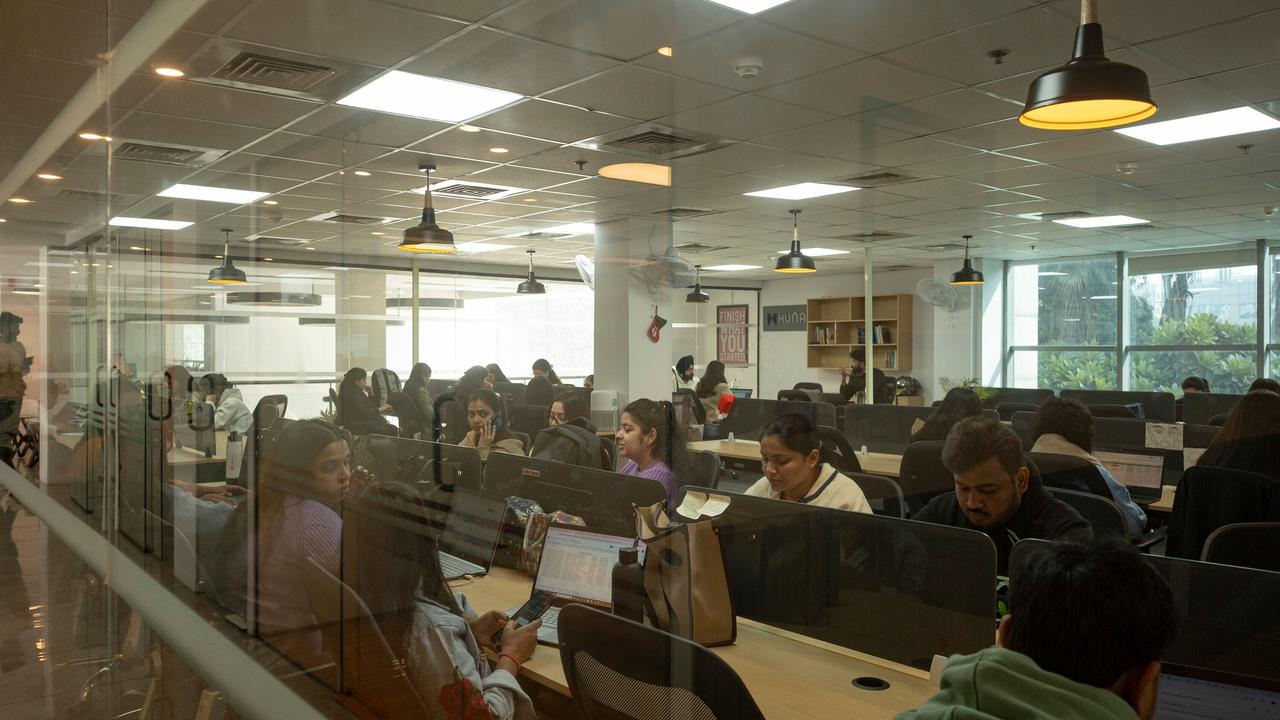
Source: NYT
IT Outsourcing Sector Slowdown Accelerates Workforce Reductions
The impact on India's outsourcing is already visible across major IT firms. Tata Consultancy Services, one of India's largest employers, reduced its workforce to 580,000—a decline of more than 20,000 from its 2022 peak when it hired 100,000 new workers in a single year
2
. Infosys has similarly experienced a slowdown in hiring, while dozens of smaller startups laid off workers throughout 2025, according to Inc42, a digital economy news outlet1
.Deedy Das, a partner at Menlo Ventures who closely tracks AI developments, warned that job disruption is inevitable. "Markets are pretty efficient. If a tool exists that does a job cheaper, it will be adopted," Das explained
2
. A February 22 report by Citrini Research painted a particularly dire scenario, noting that "the entire model was built on one value proposition: Indian developers cost a fraction of their American counterparts," but predicted that by 2028, the marginal cost of an AI coding agent would collapse to essentially the cost of electricity1
.Automating Hiring and Onboarding Creates Threat to Employment
The automation wave extends beyond coding to fundamental business processes. AI systems now handle tasks traditionally performed by call centers and administrative staff, with automating hiring and onboarding representing just the beginning. University graduates and technical college students face fewer job openings, forcing them to "upskill"—learning AI skills to remain relevant in a rapidly transforming industry
2
.The threat to employment carries significant political implications. While 6 million tech workers may seem modest in a population nearing 1.5 billion, they represent a politically vocal middle class concentrated in dynamic cities like Bengaluru, Hyderabad, and Pune
1
. Unemployment among educated young people reached 65 percent of total unemployed in 2022, according to the International Labor Organization2
. Additional job losses could intensify labor unrest and economic instability, potentially undermining support for Narendra Modi's government, which already lost parliamentary seats in 2024 elections1
.Related Stories

India as an AI Power Faces Infrastructure Challenges
Narendra Modi has recognized the urgency, pledging to position India as an AI power through international partnerships and encouraging software engineers to develop and export new technologies
2
. "These turning points set the direction of civilization and transform the pace of development. Artificial intelligence is one such transformation in history," Modi stated at an AI conference in New Delhi1
.However, India's transformation faces substantial obstacles. Despite having a highly educated workforce, the country lacks critical infrastructure and natural resources needed to power AI products. At the New Delhi conference, India's largest outsourcing firms announced deals with Anthropic and OpenAI to expand product use and develop data center capacity
2
. While welcomed as foreign investment, these announcements highlighted India's continued dependence on the United States for microchips and foundational models driving the AI revolution1
. The question remains whether India can transition from service provider to technology innovator before AI fundamentally reshapes its economic foundation.References
Summarized by

Navi
Related Stories
AI job shock threatens India's economy as IT jobs face automation and real estate slumps
29 Apr 2026•Business and Economy

AI's Dual Impact on India's Job Market: Disruption and Creation in Tech Sector
31 Jul 2025•Business and Economy
AI Bubble Fears Intensify as Tech Giants Commit $1.5 Trillion to Infrastructure
22 Dec 2025•Business and Economy

Recent Highlights
1
Microsoft and Nvidia Launch Surface Laptop Ultra: A $2,599 AI-Ready PC With RTX Spark Chip
Technology

2
OpenAI Releases 722 AI-Generated Math Papers on GitHub, Igniting Fury Among Mathematicians
Science and Research

3
Trump Consulted Grok AI Before Ordering Venezuela Invasion and Capture of Nicolás Maduro
Policy and Regulation

Recent Highlights
Today's Top Stories








Don’t drown in AI news. We cut through the noise - filtering, ranking and summarizing the most important AI news, breakthroughs and research daily. Follow topics that matter to you and stay ahead.


