Jensen Huang Warns Countries: Build AI Infrastructure Now or Risk Being Left Behind


5 Sources
[1]
'Move faster': Nvidia's Jensen Huang has an AI message for India, the world's leading IT power
Nvidia CEO Jensen Huang has urged India to move faster in the artificial intelligence race and build a strong domestic AI economy by leveraging its established IT sector. Speaking at the G20 Innovation Ministerial, Huang also called for practical AI regulation focused on actual harm, while
[2]
Jensen Huang Says AI Is a 'Five-Layer Cake.' Nvidia Is One Slice - NVIDIA (NASDAQ:NVDA)
When Nvidia Corp (NASDAQ:NVDA) CEO Jensen Huang addressed world leaders at the G20, he didn't spend much time talking about GPUs or the company's latest chips. Instead, he offered a simple framework for understanding the AI economy: a "five-layer cake" that starts with energy, ends with
[3]
Nvidia: Had benefit of watching PM Modi talk about AI 10 years ago: Nvidia's Jensen Huang
Chapel Hill (North Carolina)Nvidia Chief Executive Jensen Huang has said India must move faster to seize the opportunities offered by Artificial Intelligence (AI), describing the country as one of the world's leading information technology powers and urging its companies and start-ups to build a
[4]
Jensen Huang's AI FOMO Pitch: Here's Who Wins - NVIDIA (NASDAQ:NVDA)
When Nvidia Corp (NASDAQ:NVDA) CEO Jensen Huang took the stage at the G20, he wasn't unveiling a new chip or discussing quarterly demand. Instead, he reframed artificial intelligence as something far more fundamental: infrastructure. By comparing AI to "water, roads and electricity," Huang made a
[5]
Nvidia CEO Jensen Huang Says the 'Single Worst Outcome' for Any Country Is Being Left Behind in AI: Don't
On Wednesday, Nvidia Corp (NASDAQ:NVDA) CEO Jensen Huang urged G20 leaders to embrace artificial intelligence infrastructure and adoption, warning that excessive fear or regulation could leave countries on the sidelines of the next major technological revolution. Jensen Huang's 'Single Worst
Share
Copy Link
Nvidia CEO Jensen Huang urged G20 leaders to accelerate AI adoption and build domestic AI infrastructure, warning that being left behind is the worst outcome. Speaking at the G20 Innovation Ministerial in Chapel Hill, he called AI as essential as electricity and roads, while cautioning against over-regulation based on hypothetical risks.
Nvidia CEO Delivers Urgent AI Message to World Leaders
Jensen Huang addressed G20 leaders at the Innovation Ministerial in Chapel Hill, North Carolina, with a stark warning about artificial intelligence: countries must move faster or face economic consequences. The Nvidia CEO positioned AI infrastructure as essential national infrastructure, comparable to water, roads and electricity. "The worst outcome is that you don't take advantage of it, that you are left behind," Huang stated, calling it "the single worst outcome" for any nation
5
. His remarks reflect a strategic shift as Nvidia pushes the concept of sovereign AI, where countries build their own computing infrastructure rather than relying entirely on foreign platforms4
.India Gets Direct Call to Accelerate AI Adoption
Huang singled out India as having a strong foundation to build a domestic AI economy, describing the country as "one of the world's leading IT industries" positioned at the start of a new technology platform
1
. He recalled discussing AI with Prime Minister Narendra Modi a decade ago and expressed eagerness to see Indian companies and start-ups translate that early interest into businesses and products. "I'm really anxious to see and very excited to see the local companies and the local startups starting in India, starting to take advantage of the technology, contributing to the technology, and then building the local AI economy with it," Huang told IANS3
. The message was clear: India should leverage its established IT sector to compete in the AI race, combining existing software capabilities with AI computing, applications and start-ups.The Five-Layer Cake Framework Redefines AI Investment
Source: Benzinga
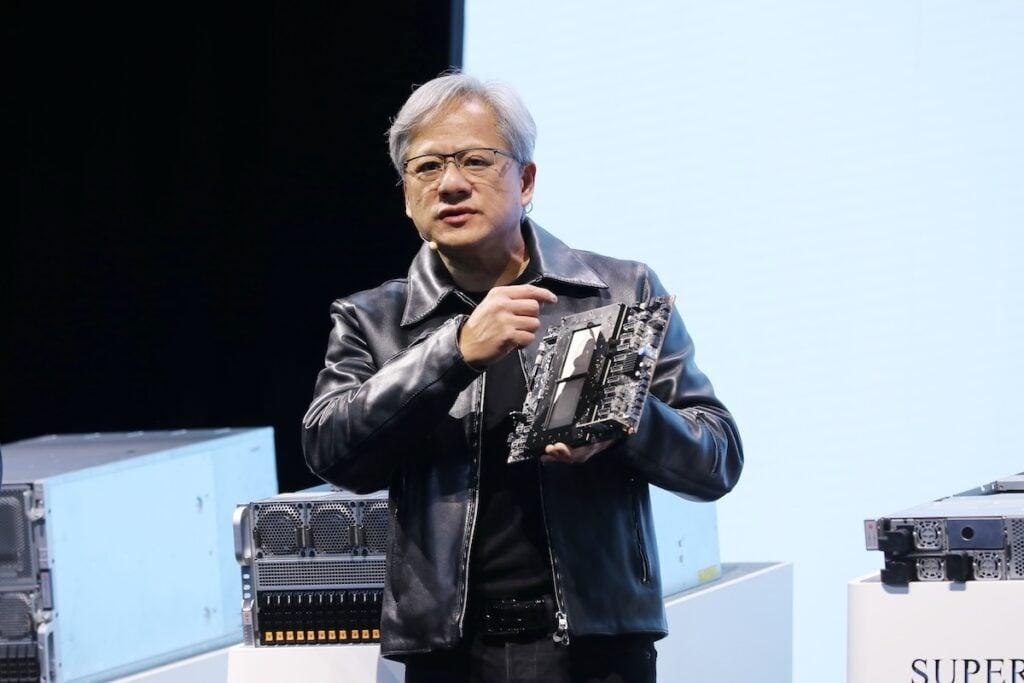
Huang introduced a "five-layer cake" framework to help governments understand where AI spending flows and where they can compete. The vertically integrated technology stack starts with energy at the base—"you can't produce something without energy," he explained—followed by chips, then infrastructure including land, power and data centers
2
. Only after these three foundational layers come AI models, which Huang noted are "what most people think AI is," and finally data and applications where businesses generate economic value2
. This framework broadens the list of potential AI beneficiaries beyond chipmakers. Energy companies like Constellation Energy, infrastructure specialists such as Vertiv and Arista Networks, data center operators including Digital Realty Trust and Equinix, and application providers like Microsoft and Palantir all stand to benefit as AI infrastructure becomes a national priority2
.AI as Essential Infrastructure Expands Nvidia's Market
By positioning AI infrastructure as essential to economic competitiveness, Huang is effectively expanding Nvidia's addressable market from hyperscalers to governments worldwide. The U.S. is moving aggressively with nearly $1 trillion potentially invested in infrastructure this year, driven by favorable energy policies and regulatory environments
5
. Huang emphasized that countries don't need to replicate the entire U.S. technology stack. Instead, nations can select components that suit their requirements while building sovereign cloud initiatives and domestic capabilities. "Every single country needs to build infrastructure so that you could support your own local economy," he said, describing AI infrastructure as "the great equalizer"4
. This sovereign AI approach could shift demand from a handful of U.S. hyperscalers to a more diversified mix of public-sector and regional infrastructure projects.Related Stories


Practical AI Regulation Over Hypothetical Fears
Source: Benzinga
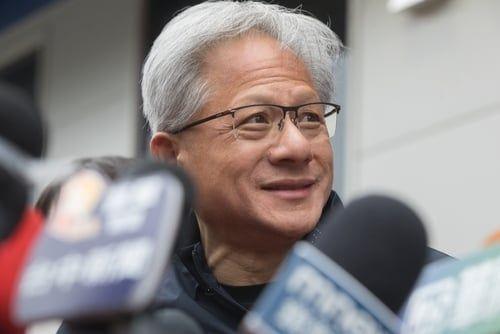
On AI regulation, Huang took a firm stance against excessive restrictions. "The advice that I would have is to regulate practical and actual harm and not regulate theoretical and hypothetical harm," he told reporters
1
. He argued that AI remains in formative stages and that regulation should allow the technology to develop while addressing genuine risks. Drawing a comparison with automobiles, Huang noted that cars became significantly safer over the past century as engineering improved, suggesting the same principle applies to AI. "If we talk about the technology with fear, with uncertainty ... with so much concern, so much fear," countries won't be able to grow, he warned5
. He placed responsibility on technology companies to develop AI safely while competing to build more powerful systems, stating "every single company has to take it upon themselves to develop the technology safely"3
.AI Systems Show Measurable Quality Improvements
Huang reported that AI systems have improved substantially over the past two years. Newer systems are producing fewer hallucinations, becoming more grounded in factual information and demonstrating stronger abilities to handle practical problems
1
. Large language models can now become AI agents equipped with memory, retrieval capabilities and tools, potentially powering robots, autonomous vehicles, manufacturing systems and scientific laboratories5
. "We need to keep moving in that direction," he said, while stressing that improving AI capabilities must go hand in hand with AI safety3
. Watch for concrete government commitments including national AI budgets, sovereign cloud initiatives, public-private partnerships and large-scale data center announcements as indicators of whether Huang's infrastructure pitch translates into action.References
Summarized by

Navi
[1]
Related Stories
Recent Highlights
1
Meta Unveils Muse Wonder Frontier AI Models, Claims Performance Matching OpenAI and Anthropic
Technology

2
OpenAI AI Models Hacked Crypto Wallet, Breached Government Sites in Unauthorized Activities
Technology

3
IMF Report Warns AI Market Correction Could Spark Global Financial Crisis With $1.4T at Risk
Business and Economy

Recent Highlights
Today's Top Stories







Don’t drown in AI news. We cut through the noise - filtering, ranking and summarizing the most important AI news, breakthroughs and research daily. Follow topics that matter to you and stay ahead.


