Major Banks Warn AI Agents Could Trigger Shopping Scams and Fraud Spike


18 Sources
[1]
Could AI Agents Cause a Spike in Shopping Scams? These Banks Think So
Personal AI agents are often sold to customers as a way to take the pain out of online shopping by helping you find the right product, the best possible deal, and even handling payment and shipping. While AI companies push agentic tools, some of the world's biggest banks have expressed concerns
[2]
Banks warn AI shopping bots raise scam, fraud and data-privacy risks
But the very features that make a new wave of AI devices useful, More Videos 0 of 2 minutes, 35 secondsVolume 0% Press shift question mark to access a list of keyboard shortcuts Keyboard ShortcutsEnabledDisabled Shortcuts Open/Close/ or ? Play/PauseSPACE Increase Volume↑ Decrease
[3]
Big Banks Say They're Uneasy About People Shopping via AI Agents
In a paper published Tuesday, six major global banks, including Bank of America and Capital One, warned that agentic shopping has "risks spanning transparency, safety, privacy & data, choice, and interoperability" that increase "as greater autonomy is given to AI agents." AI developers, as well as
[4]
Mastercard Is Giving AI Agents Virtual Cards to Handle Your Shopping
Mastercard is getting ready to unveil an agentic payment option later this week. The payment behemoth will partner with the startup Alchemy, which makes virtual cards for AI agents to use in e-commerce, and has confirmed the reporting. "The checkout button is dying," Alchemy wrote in an X post.
[5]
Big banks warn that AI agents could lead to uptick in scams
Financial institutions are sharing their concerns about AI chatbots making purchases for users. Credit: Cheng Xin/Getty Images While AI true believers worry about doom-and-gloom scenarios of AI destroying the world, some major financial institutions are sounding the alarm over a more grounded
[6]

'Know your agent': Banks face a new compliance challenge as AI agents shop and pay on their own | Fortune
Financial firms have spent decades perfecting "know your customer" rules. Their next compliance challenge: "know your agent." That was the warning from Zhuoqun Bian, president of Ant Digital Technologies, the enterprise arm of Ant Group, at the Fortune Leaders Forum in Macau on Sept. 8. "From the
[7]

Banks warn AI shopping agents outpace fraud protections
"Consumers are unclear if AI will act in their interests," the report said. "They are concerned that AI agents may buy the wrong thing or spend too much -- or even worse, lose their money to scams and fraud. They are not sure whether they will be protected or who they will need to go to if things
[8]
Mastercard and Visa want AI bots at checkout. Shoppers still want the final click | Fortune
Credit card companies are racing to claim a place at the checkout when AI agents start shopping on behalf of consumers -- even as shoppers remain skeptical of letting bots spend their money. Mastercard rolled out a payment option Thursday that lets people give an AI agent a virtual card and allow
[9]

AI Agents Have Won Product Discovery. They Still Can't Close the Sale.: By Swapnali Dashrath
AI agents are already deciding what you're probably going to buy. They're just not the ones buying it. A market analysis published in August 2026 by Research and Markets found that AI agents now drive roughly 62% of product-comparison activity in online shopping. Actual checkout completion tells a
[10]
Global banks take on agentic commerce scam and fraud concerns
A group of six global banks, including Bank of America and NatWest, has put together a set of principles designed to address concerns about scams, fraud and data privacy in agentic commerce. 0 Be the first to comment Agentic commerce has emerged as the next great fintech gold rush, with payments
[11]

Banks Call for Audit Trail From AI Shopping Instructions to Payment Outcome | PYMNTS.com
The proposal addresses the issue of whether an agent bought what its customer actually intended. It's a problem that a routine payment authorization may not resolve. In a paper published Tuesday (Sept. 22) called "Building Trust in Agentic Commerce," ASB Bank, Bank of America, Capital One,
[12]
Banks Say Consumers Unsure AI Agents Are on Their Side | PYMNTS.com
That warning came as part of a set of principles published Tuesday (Sept. 22) by six banks -- ASB Bank, Bank of America, Capital One, Commonwealth Bank of Australia, ING and NatWest -- and designed to create a framework for artificial intelligence (AI) agents in commerce. "With banks sitting at
[13]
Agentic Commerce Is Coming for Fintech's Human-First Assumptions: By Muralidharan Lakshmanan
For the last decade, the fintech industry has optimized for one thing above all else: making it as easy as possible for a human to click "Buy." From frictionless checkout options to one tap payment options to biometric login, there has never been so much focus on the human experience when it comes
[14]

AI Shopping Bots May Buy the Wrong Products or Expose Card Data, Banks Say
AI shopping assistants are being positioned as a faster way to search for products, compare options, and complete purchases, but major banks warn that handing more control to these systems could create new risks for consumers. A group including NatWest, Bank of America, ING, Capital One, ASB Bank
[15]
AI Agents Are Getting Their Own Bank Accounts | PYMNTS.com
Account for Agent sits inside WorldFirst, Ant's global account brand, according to a Friday (Sept. 18) press release. The account runs on know your agent smart contracts, with live monitoring and the ability to intervene in an agent's activity. The account arrived with nearly 100 AI products
[16]
AI Agents Become the Next Payments Customer | PYMNTS.com
The payments industry has devoted much effort to making sure a bot can't pass for a customer. Agentic commerce brings a new complication, as some bots are supposed to buy things. SolvaPay, a Stockholm-based FinTech, is building payment infrastructure for artificial intelligence agents. Its work
[17]
Mastercard and Alchemy Partner to Enable Everyday Agentic Payments | PYMNTS.com
The offering will be powered by Alchemy's AgentCard, according to the post. Alchemy introduced AgentCard in March, saying in a post on X that the product lets the user's agent buy anything, including inference and APIs; DoorDash, Amazon and Uber orders; marketing; and trades on Polymarket. In the
[18]
Mastercard Says Consumer Choice at the Center of Agent Pay | PYMNTS.com
It's no secret that artificial intelligence is already becoming part of how consumers search and shop, giving agentic commerce a large base from which to develop. But there's a challenge when it comes to convincing consumers that agents can act on their behalf without sacrificing the preferences
Share
Copy Link
Six global banks including Bank of America and Capital One released a principles paper warning that AI agents making purchases could increase scams, fraud, and data-privacy risks. The report highlights concerns about liability, consumer protections, and safety as agentic commerce advances faster than industry standards.
Banks Sound Alarm on AI Shopping Bots
Six major global banks have issued a stark warning about AI agents in e-commerce, cautioning that these automated shopping assistants could trigger a significant increase in shopping scams and fraud.
1
The collaboration between Bank of America, Capital One, NatWest Group, ING Group, Commonwealth Bank of Australia, and ASB Bank published a principles paper titled "Building Trust in Agentic Commerce" on Tuesday, detailing multiple risks spanning transparency, safety, data-privacy risks, and consumer protections.2
3
Source: Gizmodo
The report comes as technology companies including OpenAI, Anthropic, Google, and Meta increasingly promote AI shopping bots as tools that can select products and make purchases on behalf of consumers. British retailer John Lewis reported that searches originating from AI agents had risen to 2.5% from 0.3% a year earlier, with the trend accelerating.
2
However, banks warn the technology is advancing faster than industry standards and consumer protections can keep pace.Scam and Fraud Risks Escalate with Agentic Commerce
The principles paper highlights that agentic commerce has "potential for higher rates of scams, fraud and disputes" as AI agents making purchases gain greater autonomy.
1
Banks expressed concern that malicious actors may attempt new attack vectors, including compromising or impersonating AI agents and merchants, and engaging in new forms of social engineering.1
Source: Finextra Research
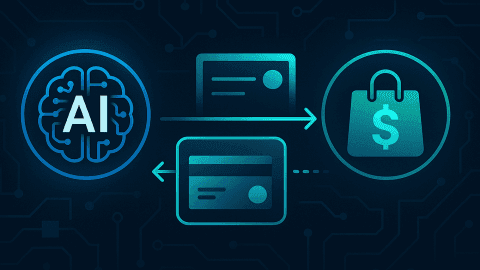
The report specifically warns that AI agents could request customers' card details and enter them directly into websites, or steer users towards payment methods that offer weaker payment protections.
2
Financial institutions are particularly concerned about websites that average users might recognize as unsafe, but an AI agent wouldn't spot.1
Liability Questions Remain Unresolved
A critical concern outlined in the report centers on liability when AI-driven e-commerce goes wrong. Banks question who bears responsibility if an AI agent purchases the wrong item or exceeds its authority. "Consumers are unclear if AI agents will act in their interests," the report states. "They are concerned that AI agents may buy the wrong thing or spend too much - or even worse, lose their money to scams and fraud. They are not sure whether they will be protected or who they will need to go to if things go wrong."
2
5
The financial institutions also voiced concerns for merchants and business owners, as the rise of AI shopping bots could likely lead to an uptick in credit card disputes and chargebacks due to the actions of AI agents.
5
Banks argue that agentic tools need to make themselves known to retailers and payment integrations to help address potential issues.1
Related Stories

Industry Moves Forward Despite Safety Concerns
Despite these warnings, the financial industry continues developing infrastructure for agentic commerce. Mastercard announced a partnership with startup Alchemy to provide virtual cards for AI agents to use in e-commerce, allowing cardholders to authorize AI agents to independently buy products within specific parameters like price ranges.
4
Mastercard, along with Visa and Ant International, also announced they were working together to develop common standards to verify trusted AI agents in online purchases.4

Source: PYMNTS
The timing of the banks' principles paper proved significant, released within 24 hours of the reported discovery of a zero-day vulnerability within Meta's Muse agentic AI assistant.
5
The paper also dropped within hours of Amazon announcing it would block Muse from making purchases on its platform, citing safety and privacy concerns about how Meta's agent failed to identify itself while shopping and how Amazon handles customer credentials.1
3
Five Principles for Building Trust in Agentic Commerce
The consortium outlined five core principles they want AI companies to follow: transparency, safety, privacy and data protection, choice, and interoperability.
5
The banks plan to discuss a series of proposals with policymakers, including requiring disclosure when an AI agent is involved in a transaction, greater transparency over how AI agents make decisions, and safeguards to protect customer data.2
Consumers and merchants should remain free to choose which AI-powered e-commerce services they use, while different systems should be interoperable, the report emphasized.
2
The collaboration aims to "establish a framework for a future where AI agents could play a greater role" in product purchasing, with the partnership hoping to encourage other stakeholders, such as AI firms, to join in planning for the future.1
The consortium is working on a subsequent paper to detail how these principles can actually be implemented to ensure safe deployment of agentic commerce.3
References
Summarized by

Navi
Related Stories
AI Agents Transform Payments Landscape as Meta Clashes With Amazon Over Autonomous Shopping
03 Oct 2026•Technology
AI Agents Handle Shopping Autonomously, But Experts Warn of Privacy and Control Risks
23 Apr 2026•Technology

AI Agents Transform Ecommerce as Agentic Commerce Reshapes How We Shop Online
16 Jul 2026•Technology

Recent Highlights



Recent Highlights
Today's Top Stories






Don’t drown in AI news. We cut through the noise - filtering, ranking and summarizing the most important AI news, breakthroughs and research daily. Follow topics that matter to you and stay ahead.


