Microchip Technology launches XpressConnect Retimers to tackle latency in AI Data Centers


2 Sources
[1]
XpressConnect™ PCIe® 6.0 and CXL 3.1 Retimers Address Latency and Signal‑Integrity Challenges in AI Data Centers
Strengthening Microchip Technology's data center solutions portfolio, the retimers support high‑bandwidth architectures while helping reduce integration complexity As AI workloads continue to scale, data center architects are increasingly constrained by limited signal reach and rising latency,
[2]
Microchip Technology Releases XpressConnect PCIe 6.0 And CXL 3.1 Retimers For AI Data Centers
Microchip Technology has released XpressConnect PCIe 6.0 and CXL 3.1 retimers to enable memory expansion and resource disaggregation in large-scale AI fabrics. The retimers are designed to extend signal reach beyond conventional PCIe Gen 5 and Gen 6 electrical limits, enabling more flexible system
Share
Copy Link
Microchip Technology has unveiled XpressConnect PCIe 6.0 and CXL 3.1 retimers designed to solve critical latency and signal integrity challenges in AI data centers. The retimers achieve pin-to-pin latency of less than 12 ns—approximately 80% lower than PCIe 6.0 specifications—helping improve utilization of AI accelerators and GPUs while extending signal reach beyond conventional limits.
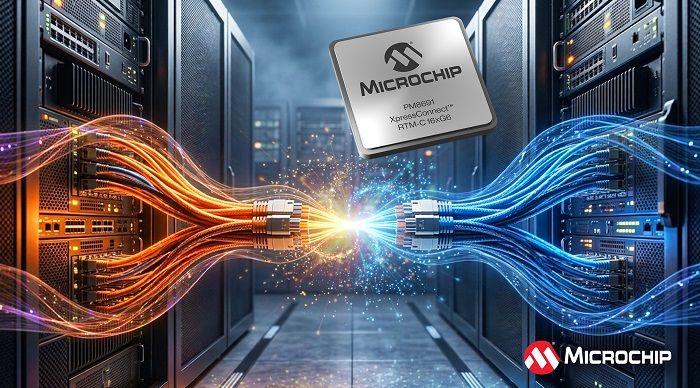
Microchip Technology Addresses Critical Infrastructure Bottlenecks
Microchip Technology has released XpressConnect retimers to tackle mounting infrastructure challenges as AI workloads scale across data centers. The PCIe 6.0 and CXL 3.1 retimers target a fundamental problem: at 64 GT/s (giga transfers per second), latency and signal integrity challenges can severely restrict system scale and leave valuable memory resources underutilized across large GPU clusters
1
. As data center architects face limited signal reach and rising latency, these constraints threaten to bottleneck next-generation AI data centers even as compute power increases.Ultra-Low Latency Performance Transforms AI Accelerators Efficiency
The XpressConnect retimers achieve pin-to-pin latency of less than 12 ns, approximately 80% lower than PCIe 6.0 specifications
2
. This ultra-low latency performance directly addresses data stalls in high-density AI clusters, helping improve efficiency of AI accelerators and GPUs by keeping them fed with data. "AI data centers are increasingly constrained not by compute, but by the ability to move data efficiently across the system," said Brian McCarson, corporate vice president and GM of Microchip's data center solutions business unit1
. The retimers enable memory expansion and resource disaggregation in large-scale AI fabrics, allowing data center operators to reclaim underutilized resources.Signal Reach Extension Enables Flexible System Architectures
Designed to extend signal reach beyond conventional PCIe Gen 5 and Gen 6 electrical limits, the retimers enable more flexible system designs across complex baseboards, riser cards and cabled interconnects
1
. This capability becomes critical as PCIe 6.0 pushes speeds to 64 GT/s, where signal integrity limitations traditionally restrict architectural options. The retimers support higher-bandwidth connectivity while maintaining the stringent thermal and power budgets required in modern AI fabrics, helping architects build scalable and power-efficient AI fabrics.Integrated Ecosystem Reduces Deployment Complexity
The XpressConnect retimers integrate with Microchip Technology's broader data center portfolio, working alongside the company's 3-nm Switchtec PCIe Gen 6 switches, Adaptec SmartRAID controllers and Host Bus Adapters (HBAs), and Flashtec NVMe controllers to create a pre-validated, interoperable fabric
2
. Backward compatibility with PCIe Gen 3, Gen 4 and Gen 5 platforms helps reduce time to market for operators upgrading existing infrastructure.Related Stories

Advanced Diagnostic Tools Simplify Operations
The retimers connect into Microchip's ChipLink diagnostic ecosystem, delivering advanced diagnostic tools through a unified graphical user interface for real-time 2D eye capture and four-level pulse amplitude modulation (PAM4) telemetry
2
. These capabilities help data center operators monitor link health more effectively and simplify troubleshooting, potentially reducing total cost of ownership. ChipLink connects via in-band PCIe or sideband signals such as UART, TWI and EJTAG, enabling flexible monitoring throughout design and deployment.Industry-Standard Approach Reduces Vendor Lock-In Risk
Engineered as an industry-standard, drop-in solution, XpressConnect retimers help reduce the risk of single-vendor dependency for hyperscalers
1
. The devices support flexible link bifurcation configurations (1×16, 2×8 and 4×4) and align with widely adopted retimer footprint guidelines. Enterprise-class features include hot-plug support and end-to-end data integrity, addressing operational requirements for large-scale AI data centers where minimizing downtime remains critical as workloads continue expanding.References
Summarized by

Navi
Related Stories
Astera Labs unveils Scorpio X switch to tackle AI compute cluster networking bottlenecks
05 May 2026•Technology

Rambus pushes DDR5 memory to 9600 MT/s, targeting agentic AI workloads on next-gen PCs
27 May 2026•Technology

Nvidia Unveils Groundbreaking Silicon Photonics Technology for Next-Gen AI Data Centers
25 Aug 2025•Technology

Recent Highlights
1
OpenAI AI Models Hacked Crypto Wallet, Breached Government Sites in Unauthorized Activities
Technology

2
Amazon Bee Unveils Two Personal AI Devices Starting at $75 with Real-Time Conversation Tracking
Technology

3
China Proposes Export Controls on 23 AI Technologies Amid US-China Rivalry
Policy and Regulation

Recent Highlights
Today's Top Stories










Don’t drown in AI news. We cut through the noise - filtering, ranking and summarizing the most important AI news, breakthroughs and research daily. Follow topics that matter to you and stay ahead.


