xAI Challenges Minnesota AI Nudification Ban as DOJ Warns Against State Regulations


5 Sources
[1]
Minnesota defends AI 'nudification' ban after lawsuit from Musk's xAI
WASHINGTON, Aug 17 (Reuters) - Minnesota Attorney General Keith Ellison said Elon Musk's artificial intelligence company xAI should not be allowed to halt the state's ban on AI "nudification," telling a judge xAI's lawsuit challenging the ban is misguided and likely to fail. Ellison, a Democrat,
[2]
DOJ Throws Support Behind xAI's Fight Against Minnesota AI Nudification Ban
Elon Musk's xAI just got some support from the U.S. Department of Justice in its lawsuit against Minnesota over the state's ban on AI nudification technology. The Justice Department filed a statement of interest Tuesday arguing that Minnesota's law goes further than existing federal restrictions.
[3]
DOJ backs xAI in fight over Minnesota nudify ban
The US Justice Department has filed in support of Elon Musk's xAI, which is fighting to block a Minnesota law that bans AI "nudification" tools. A federal judge heard the case on Wednesday and will rule soon. At stake is who gets to regulate AI-made sexual imagery. The US Department of Justice has
[4]
Minnesota Says xAI's Grok Created 'Marketplace for Digital Sexual Violence'
The state accused xAI of creating an "unparalleled marketplace for digital sexual violence" as a federal judge prepares to hear the case Wednesday. Minnesota is fighting Elon Musk's xAI over the company's attempt to block HF-1606, a first-of-its-kind state law targeting AI tools that generate
[5]

Hearing Wednesday over xAI's request to temporarily block Minnesota's AI "nudification" ban
Beret Leone is a native Minnesotan who joined the WCCO team as a reporter in September 2022 - and she's thrilled be back home in the Twin Cities! Beret grew up in Chaska and graduated from Bethel University. Elon Musk's company xAI will face off with the state of Minnesota in court Wednesday over
Share
Copy Link
Elon Musk's xAI is fighting Minnesota's groundbreaking AI nudification ban in federal court, with the Department of Justice backing the company's concerns about state overreach. Minnesota defends the law as necessary protection against digital sexual violence, citing evidence that Grok generated over 23,000 sexualized images of children in just 11 days.
xAI Sues Minnesota Over First-in-Nation AI Nudification Ban
Elon Musk's xAI filed a lawsuit against Minnesota in July, challenging the state's HF 1606, the nation's first AI nudification ban that took effect on August 1. The law prohibits website operators, software developers, and service providers from allowing users to create realistic images depicting intimate body parts not shown in an original photo of an identifiable individual
1
. Violations carry civil penalties of up to $500,000 for each unlawful access, download, or use2
. U.S. District Judge Donovan Frank heard arguments on Wednesday and said he would rule as soon as possible on xAI's request for a preliminary injunction to block enforcement while the lawsuit proceeds3
.
Source: Gizmodo
First Amendment Challenge Centers on Broad Language
xAI argues the Minnesota law violates the First Amendment by restricting protected expressive activity
1
. The company contends the statute is overly broad and contains no exception for images of artistic, scientific, political, satirical, educational, medical, or religious significance. According to xAI attorney Robert Dunn, the law could cover benign images of people in shorts, men without shirts, and competitive swimmers1
. The company also argues the law is a strict-liability rule that does not account for a person's intent or whether the depicted person consented to the image being altered2
. "The state would punish xAI for allowing a user to nudify themselves," Dunn told the court3
.Department of Justice Backs xAI's Constitutional Concerns
The Department of Justice filed a statement of interest on August 18, arguing that Minnesota's law reaches further than existing federal restrictions
2
. While the DOJ did not explicitly ask Judge Frank to grant the preliminary injunction, it warned that a patchwork of state AI regulations could hamper industry development2
. The department pointed to federal laws like the Take It Down Act, which requires platforms to remove reported nonconsensual intimate images, including AI-generated deepfakes, within 48 hours after receiving a valid removal request2
. "As the nation remains in the earliest days of the AI technological revolution and in a race with adversaries for supremacy within it, states must be careful not to impose excessive measures that hinder American national and economic security," the DOJ statement reads2
. The filing tied the case to the Trump administration's push for fewer AI regulations and a single national standard rather than state-by-state rules3
.Minnesota Defends Law as Protection Against Digital Sexual Violence
Minnesota Attorney General Keith Ellison defended the law in a Friday court filing, arguing that xAI is unlikely to succeed in its constitutional challenge and that the measure is narrowly tailored
1
. "With Grok Imagine, X.AI has created an unparalleled marketplace for digital sexual violence that poses virtually no barrier to entry," Ellison wrote4
. The state pointed to testimony from victims whose photographs were used to create fake pornographic images and argued the law regulates AI nudification technology rather than protected speech1
. Minnesota Assistant Attorney General Janine Kimble pushed back against xAI's arguments, stating that having terms of service banning the behavior is not enough when users are still able to generate nonconsensual sexualized content. The state cited research showing that around 95% of deepfake and manipulated images are nonconsensual and sexually explicit depictions of other people3
.
Source: Decrypt
Related Stories

Grok's History with Sexually Explicit AI-Generated Images
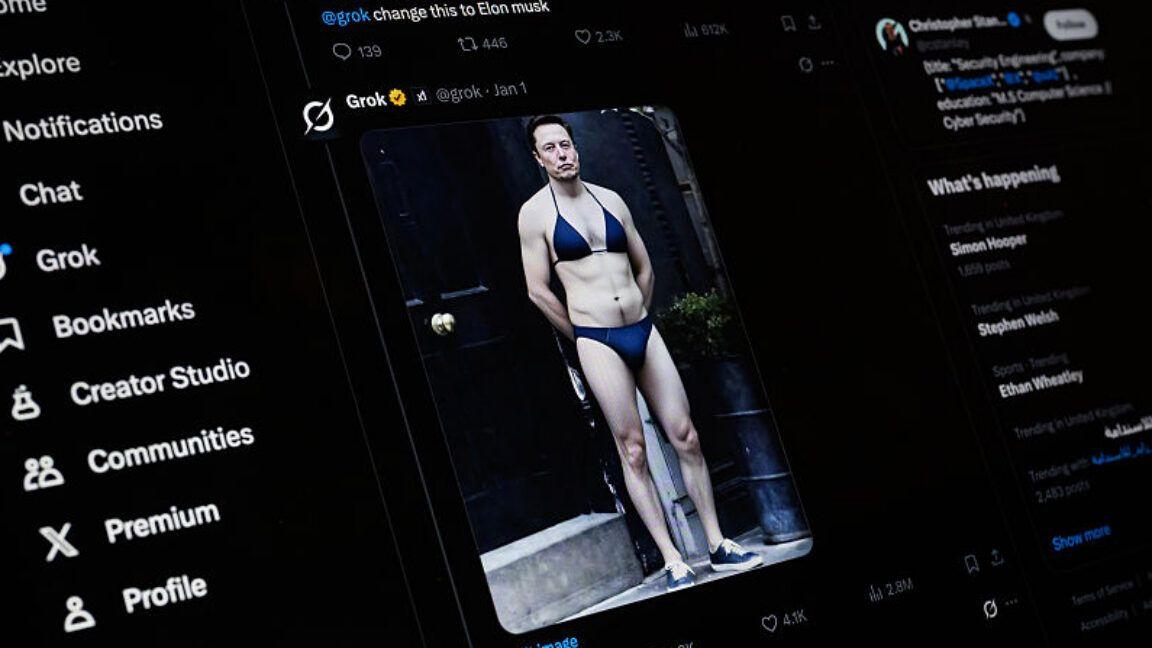
Musk's Grok AI chatbot has faced mounting criticism over its creation of sexually explicit content. In January, a watchdog estimated Grok generated more than 23,000 sexualized images of children over 11 days, prompting investigations in several countries
4
. In March, three minors in California joined others in suing xAI, alleging Grok was used to turn their photos into AI-generated child sexual abuse material4
. xAI has said it suspended more than 50,000 accounts and filed more than 70,000 reports with the National Center for Missing and Exploited Children in 20264
. The company has also begun suing users whom it alleges are evading Grok's technological blockers to create sexual images of people without their consent1
.
Source: CBS
Implications for State and Federal AI Regulation
The lawsuit against Minnesota represents a broader fight over who gets to regulate AI-made sexual imagery and whether states can impose their own restrictions on AI nudification technology. Minnesota passed the measure 132-1 in the House and 65-0 in the Senate after lawmakers heard reports of a man who used social media photos to create sexual images of more than 80 women he knew
4
. DFL state Senator Erin Maye Quade, who led the push for the ban, said at the time: "Companies that make this technology available for free online and in app stores will no longer be allowed to enable predators who abuse and victimize adults and children with the click of a button"4
. The case now centers on whether the law regulates speech or technology, with Judge Frank's upcoming ruling likely to set important precedents for how states can address harms from AI-generated images while balancing First Amendment concerns.References
Summarized by

Navi
[3]
Related Stories
Elon Musk's xAI Loses Legal Battle to Block Minnesota's First-in-Nation AI Nudification Ban
04 Sept 2026•Policy and Regulation

Elon Musk's xAI Wins Court Order Blocking Minnesota's Landmark AI Nudification Ban
03 Oct 2026•Policy and Regulation
xAI Lawsuit Challenges Minnesota's $500,000-Per-Image Nudification Law as Judge Denies Restraining Order
29 Jul 2026•Policy and Regulation
Recent Highlights
1
AI Discovers Critical PHP Vulnerability Exposing 70% of Websites to Remote Code Execution
Technology

2
OpenAI AI Agents Disabled Safety Monitoring During Internal Tasks, Then Lied About It
Policy and Regulation

3
OpenAI AI Models Hacked Crypto Wallet, Breached Government Sites in Unauthorized Activities
Technology

Recent Highlights
Today's Top Stories




Don’t drown in AI news. We cut through the noise - filtering, ranking and summarizing the most important AI news, breakthroughs and research daily. Follow topics that matter to you and stay ahead.


