5 Sources
5 Sources
[1]
Mozilla launches Thunderbolt AI client with focus on self-hosted infrastructure
Mozilla is the latest legacy tech brand to make a play for the enterprise AI market. But the company behind Firefox and Thunderbird isn't releasing its own standalone AI model or agentic browser. Instead, the newly announced Thunderbolt is being sold as a front-end client for users and businesses who want to run their own self-hosted AI infrastructure without relying on cloud-based third-party services. Thunderbolt is built on top of Haystack, an existing open source AI framework that lets users build custom, modular AI pipelines from user-chosen components. Thunderbolt acts as what Mozilla calls a "sovereign AI client" on top of that underlying infrastructure. The combo promises to let users easily plug into any ACP-compatible agent or OpenAI-compatible API (including Claude, Codex, OpenClaw, DeepSeek, and OpenCode). The system can also integrate with locally stored enterprise data through open protocols and use an offline SQLite database as a local "source of truth" for the model to reference. In conjunction with a locally run model that promises to let users control the entire stack of AI services, which could be an important consideration for businesses concerned about leaking their data to outside providers. Mozilla says Thunderbolt also offers "optional end-to-end encryption, and device-level access controls" for additional security. Mozilla says the Thunderbolt client supports many of the now-familiar AI interfaces and use cases, including "chat, search, research, automation, and cross-device workflows." Native apps for Windows, Mac, Linux, iOS, Android, and the web are available for direct download or can be built from React source code via a GitHub repository. Mozilla is already encouraging potential enterprise clients to reach out to coordinate paid licensing and on-site deployments, even as the GitHub page warns that Thunderbolt is "under active development, currently undergoing a security audit, and preparing for enterprise production readiness." Thunderbolt is funded by a grant from Mozilla and is operated by the MZLA Technologies subsidiary that was formed in 2020 to manage the Thunderbird email client. It builds on Mozilla's existing efforts in the AI space through the Mozilla Foundation's Mozilla.ai, which backs open source tooling for external AI models and agents. In late 2025, Mozilla announced its aim to "do for AI what we did for the web" by offering AI services with more agency, diversity, and choice through a "decentralized open source AI ecosystem that matches the capabilities of Big AI."
[2]
Mozilla Announces "Thunderbolt" As An Open-Source, Enterprise AI Client
Thunderbolt is designed as a sovereign AI client - an open-source, extensible workspace where users can interact with AI through chat, search, and research, connect to enterprise data, and choose the models and tools that fit their needs. It allows organizations to: - Run AI with their choice of models, from leading commercial providers to open-source and local models - Connect to systems and data: Integrate with pipelines and open protocols, including: deepset's Haystack platform, Model Context Protocol (MCP) servers, and agents with the Agent Client Protocol (ACP) - Automate workflows and recurring tasks: Generate daily briefings, monitor topics, compile reports, or trigger actions based on events and schedules - Work seamlessly across devices with native applications for Windows, macOS, Linux, iOS, and Android - Maintain security with self-hosted deployment, optional end-to-end encryption, and device-level access controls
[3]
Mozilla takes on enterprise AI providers with Thunderbolt
Mozilla has declared war on OpenAI, Microsoft, and other firms flogging enterprise AI platforms with an open-source alternative it says provides data privacy guarantees proprietary products never could. Mozilla Foundation subsidiary MZLA, mostly known for maintaining the Thunderbird email client, on Thursday announced the launch of the Thunderbolt AI client, which can tie into German company deepset's Haystack platform for AI orchestration and infrastructure. According to MZLA, Thunderbolt is designed for businesses that want an open-source, self-hosted alternative to Microsoft Copilot, ChatGPT Enterprise, Claude Enterprise, and all of the lock-in and data security concerns that come with using them. "The problem we are solving today is one of sovereignty and control," MZLA CEO Ryan Sipes told The Register in an email conversation. "Do you really want to build your AI workflows on top of a proprietary service from OpenAI or Anthropic ... not to mention having all your internal company data flowing through their systems?" Enter Thunderbolt. According to the product announcement, Mozilla envisions Thunderbolt as "a sovereign AI client" that's open source, extensible, and can be used to access AI chatbots for things like research, data analysis, and all the other things you can do with enterprise AI tools. Thunderbolt can connect to Model Context Protocol (MCP) servers and Agent Client Protocol (ACP) compatible agents, and also integrates with the Haystack AI platform from German firm deepset, which enterprises use to build AI agents, multimodal apps, and retrieval-augmented generation (RAG) systems. Haystack lets enterprises connect these apps to most of the major LLMs, and has tools for orchestration, testing, and various other nuts and bolts required to run AI tasks at production scale. Thunderbolt itself lets users employ the AI model of their choice, and Sipes told us that it can be configured to run in environments as small as a single machine if sensitive data needs to be kept secure. Thunderbolt is available on GitHub now for anyone that wants to bang around with it. For those that prefer a more guided approach, Sipes told us that signups are available for smaller teams and individuals looking for hosted Thunderbolt, which he said MZLA is working on right now. "With the release of the source code, we are encouraging these organizations to deploy Thunderbolt within their own infrastructure," Sipes explained. "We can help folks get it deployed and set up agents, but if they just want to use it internally without any relationship to us - that's great too." Viva la revolucAIón So why does the world need another enterprise AI platform, and why is Mozilla choosing now to enter what's quickly becoming a market crowded by massive, influential companies? Sipes told us that he sees the current era as analogous to the early days of the internet. "Think about Internet Explorer's 95% market share before Firefox came onto the market," the MZLA CEO explained. "We, collectively, beyond just Mozilla, have to create alternatives to Copilot and ChatGPT so that the future of AI isn't just us renting it from a few gigantic companies." Everyone should have an ownership stake in their own AI, and each person using it should get to control how they do so, he added. It's that early Firefox-era gusto that Sipes seems to be attempting to impart into Thunderbolt. "When you rely on these big proprietary providers, you're just renting a critical part of your organization's operations," the Thunderbird/-bolt boss told us. "Whereas if you deploy Thunderbolt and use open source agents like what can be created via deepset's Haystack platform - you own your AI stack, end-to-end." Mozilla has taken a similar line outside Thunderbolt, recently adding AI Controls to Firefox with a single switch that blocks current and future generative AI features. Again, Mozilla frames it as a matter of user choice. It's clear what Sipes, and by extension Mozilla, are trying to accomplish here: They want Thunderbolt to be ... well ... a thunderbolt that incites a larger change in the enterprise AI space. "It can't just be Mozilla, but we are part of the rebel alliance we see forming, those trying to build alternatives," Sipes told us. "I don't want to use these big AI platforms, and I know there are many like me out there." ®
[4]
Mozilla pushes privacy-first AI with Thunderbolt release
Mozilla has unveiled Thunderbolt, a new product aimed at the enterprise AI market that allows users to run self-hosted AI infrastructure without relying on third-party cloud services. Thunderbolt serves as a front-end client rather than a standalone AI model or agent browser, enabling businesses to operate their own AI services securely. This move aligns with current trends in enterprise technology, where data privacy and control are growing concerns. Built on the Haystack open-source AI framework, Thunderbolt facilitates the creation of custom AI pipelines by integrating with any ACP-compatible agent or OpenAI-compatible API, including brands like Claude, Codex, OpenClaw, DeepSeek, and OpenCode. This versatility allows users to leverage various AI capabilities tailored to their specific needs. The system can connect with locally stored enterprise data using open protocols and utilizes an offline SQLite database to maintain a local "source of truth" for its AI model. This feature is particularly significant for enterprises aiming to maintain complete control over their entire AI service stack, mitigating concerns related to data security. According to Mozilla, Thunderbolt includes "optional end-to-end encryption and device-level access controls" to enhance security for users managing sensitive data. This aspect adds a layer of trust for businesses considering the deployment of AI technologies in their operations. Thunderbolt represents Mozilla's strategic effort to penetrate the growing enterprise AI sector, responding to an increasing demand for solutions prioritizing data sovereignty and security.
[5]
Mozilla announces 'Thunderbolt,' an AI execution environment for enterprises that allows users to host and manage their own AI client platform.
Mozilla announced Thunderbolt , an open-source enterprise AI client emphasizing control and independence, on April 16, 2026. Targeting organizations looking to build self-hosted AI infrastructure, it's designed as an AI client that allows users to select their own models and tools. Thunderbolt -- AI You Control The intended uses include automating ongoing tasks such as generating daily briefings, monitoring topics, compiling reports, and executing actions based on events and schedules. In addition to a web application, native apps for Windows, macOS, Linux, iOS, and Android will be available, allowing for use across multiple devices. In terms of security, it features self-hosted deployment, arbitrary end-to-end encryption, and device-level access control. However, it is stated that it is still in the early stages of development and is primarily targeted at enterprise customers who prefer on-premises deployments. Thunderbolt is being developed with the goal of being completely offline-first in the future, but currently relies on authentication and search functions. The search function can be disabled from the integrated screen within the app, and local testing is also possible by running a custom backend with Docker. Regarding model execution, as of the time of writing, Mozilla does not provide a public inference endpoint, and users need to add their own model providers. For free local inference, using Ollama or llama.cpp is recommended, and other OpenAI-compatible model providers can also be used by setting an API key. Thunderbolt itself is currently undergoing a security audit and is described as being in the preparation stage for enterprise production use. The Thunderbolt public repository is available on GitHub, and the code is released under the MPL (Mozilla Public License)-2.0 license . thunderbird/thunderbolt: AI You Control: Choose your models. Own your data. Eliminate vendor lock-in. https://github.com/thunderbird/thunderbolt Meanwhile, the IT news site Phoronix commented, 'While this is an interesting AI initiative from Mozilla, the name is terrible. It seems to be a play on the email client Thunderbird, but Thunderbolt is already a well-known technology interface in other fields. It's very surprising that Mozilla chose this name for a new AI initiative.'
Share
Share
Copy Link
Mozilla unveiled Thunderbolt, an open-source enterprise AI client that lets organizations run self-hosted AI infrastructure without relying on cloud providers like OpenAI or Microsoft. Built on the Haystack framework, it promises data sovereignty, end-to-end encryption, and freedom from vendor lock-in while supporting multiple AI models and platforms.
Mozilla has entered the enterprise AI market with Thunderbolt, a new open-source AI client designed for organizations seeking control over their AI infrastructure. Unlike competitors offering cloud-based services, Thunderbolt positions itself as a privacy-focused, self-hosted alternative to enterprise AI platforms like Microsoft Copilot, ChatGPT Enterprise, and Claude Enterprise. The product is being developed by MZLA Technologies, the Mozilla Foundation subsidiary formed in 2020 to manage the Thunderbird email client
1
.

Source: The Register
Rather than releasing a standalone AI model, Mozilla built Thunderbolt as a front-end client that operates on top of self-hosted AI infrastructure. MZLA CEO Ryan Sipes framed the launch as addressing fundamental questions of sovereignty and control. "Do you really want to build your AI workflows on top of a proprietary service from OpenAI or Anthropic ... not to mention having all your internal company data flowing through their systems?" Sipes told The Register
3
.Thunderbolt is built on top of Haystack, an existing open-source AI framework from German company deepset that enables users to build custom, modular AI pipelines from user-chosen components
1
. Acting as what Mozilla calls a "sovereign AI client," Thunderbolt can plug into any Agent Client Protocol (ACP)-compatible agent or OpenAI-compatible API, including Claude, Codex, OpenClaw, DeepSeek, and OpenCode1
.
Source: Ars Technica
The AI execution environment integrates with locally stored enterprise data through open protocols and uses an offline SQLite database as a local "source of truth" for the model to reference
1
. This architecture allows organizations to maintain complete control over their entire AI service stack, addressing concerns about data leaking to outside providers. For free local inference, Mozilla recommends using Ollama or llama.cpp, though other OpenAI-compatible model providers can be configured by setting an API key5
.Data privacy and security features distinguish Thunderbolt in the crowded enterprise AI landscape. Mozilla says the platform offers "optional end-to-end encryption, and device-level access controls" for additional security
1
. Sipes emphasized that the system can be configured to run in environments as small as a single machine if sensitive data needs protection3
.The emphasis on data sovereignty reflects growing enterprise concerns about vendor lock-in and data control. "When you rely on these big proprietary providers, you're just renting a critical part of your organization's operations," Sipes explained. "Whereas if you deploy Thunderbolt and use open source agents like what can be created via deepset's Haystack platform - you own your AI stack, end-to-end"
3
.Related Stories

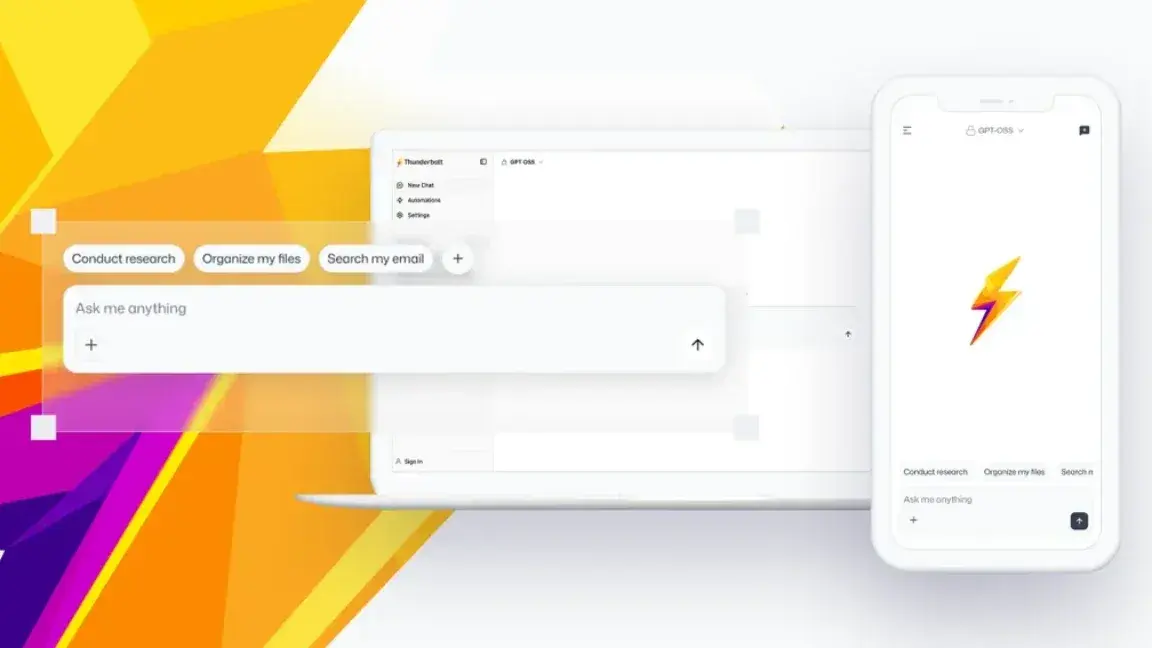
Thunderbolt supports familiar AI interfaces including chat, search, research, automation, and cross-device workflows
1
. Native applications for Windows, macOS, Linux, iOS, and Android are available for direct download or can be built from React source code via a GitHub repository2
. Organizations can automate workflows and recurring tasks such as generating daily briefings, monitoring topics, compiling reports, or triggering actions based on events and schedules5
.Source: Phoronix
Mozilla is already encouraging potential enterprise clients to coordinate paid licensing and on-site deployments, though the GitHub page warns that Thunderbolt is "under active development, currently undergoing a security audit, and preparing for enterprise production readiness"
1
. While designed to be completely offline-first in the future, the current version still relies on authentication and search functions, though search can be disabled and local testing is possible by running a custom backend with Docker5
.Thunderbolt builds on Mozilla's existing AI efforts through Mozilla.ai, which backs open source tooling for external AI models and agents. In late 2025, Mozilla announced its aim to "do for AI what we did for the web" by offering AI services with more agency, diversity, and user choice through a "decentralized open source AI ecosystem that matches the capabilities of Big AI"
1
.Sipes drew parallels to Firefox's challenge against Internet Explorer's 95% market share in the early 2000s. "We, collectively, beyond just Mozilla, have to create alternatives to Copilot and ChatGPT so that the future of AI isn't just us renting it from a few gigantic companies," he explained
3
. The MZLA CEO positioned Mozilla as "part of the rebel alliance" attempting to build alternatives in what's becoming a market dominated by massive companies. The code is released under the Mozilla Public License (MPL)-2.0 license5
, reinforcing Mozilla's commitment to open-source principles and giving organizations the freedom to deploy Thunderbolt within their own infrastructure without ongoing vendor relationships.Summarized by
Navi
[3]
[4]
1
Policy and Regulation

2
Policy and Regulation

3
Technology