Anti-Grammarly AI Tool Adds Typos to Emails to Make Them Appear Human-Written


4 Sources
[1]
The 'Anti-Grammarly' Helps People Hide Their Participation in the AI Slop Era
Now that the human race has developed a tool that lets everyone write emails that sound like a pitch deck written by Bryce, who everyone knows is the worst person in the office, the next great leap forward is a tool that makes those emails sound like... let's say Jill, the normal person in the
[2]
New Browser Plugin Adds Typos to Your AI-Generated Emails to Make Them Look Real
Can't-miss innovations from the bleeding edge of science and tech The advent of large language model-based writing tools have given lazy or unconfident writers incredible new shortcuts that can spit out everything from glossy work emails to crispy school papers. The problem, of course, is that
[3]
I never thought AI would add typos - but it kind of makes sense
"Anti-Grammarly" tool uses AI to make writing imperfect on purpose A new AI tool is flipping one of the oldest rules of digital communication on its head: perfect grammar is no longer the goal. Instead, the latest trend is to make emails look deliberately human - even if that means adding
[4]
This 'anti-Grammarly' AI tool adds typos to your emails on purpose
From signing my emails with "bet" instead of "best" or sometimes writing "felt" instead of "left", living with dyslexia and choosing a career that requires me to write on the daily has turned typos into my biggest nightmare. After all, I've been taught that typos signal carelessness,
Share
Copy Link
A new browser plugin called Sinceerly does the opposite of Grammarly—it intentionally adds typos to AI-generated emails to hide their machine origins. Created by Ben Horwitz using Claude AI, the tool offers three settings from subtle errors to CEO-style casual writing. The satire project highlights a shift in digital communication where flawless writing now signals automation rather than professionalism.
Anti-Grammarly Browser Plugin Intentionally Adds Typos to AI-Generated Emails
A new AI tool is challenging decades of digital communication norms by deliberately introducing imperfections into writing. Called Sinceerly, this browser plugin functions as an anti-Grammarly, intentionally adding typos to emails to make AI-generated text appear more human
1
. Created by Ben Horwitz, a Harvard Business School MBA student and investment partner at venture capital firm Dorm Room, the tool was coded using Anthropic's Claude AI2
.The software promises to eliminate telltale signs of AI composition from emails with features like "Kill the emdash! No more 'not just...'! Add some typos!"
1
. Users can select from three severity settings: "Subtle," "Human," and "CEO"—a tongue-in-cheek reference to how little care high-ranking executives often put into their communications2
. The tool goes as far as undoing capitalization at sentence beginnings and appending phrases like "sent from my iPhone" to enhance believability.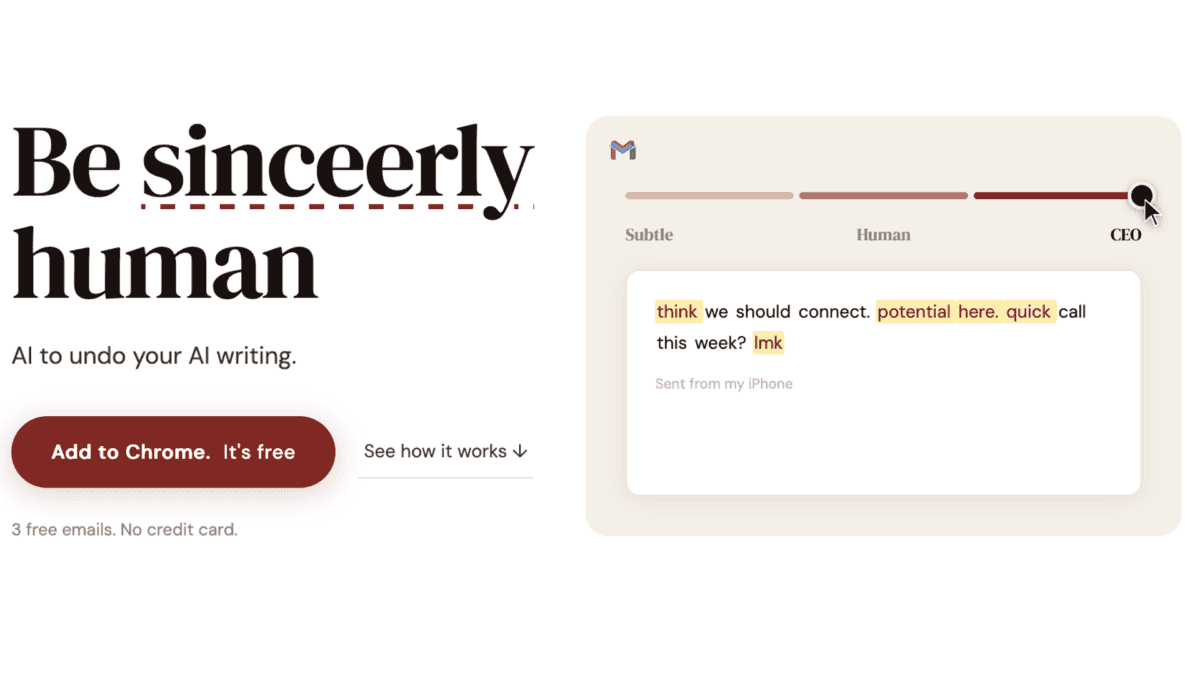
Source: Gizmodo
How Flawless Writing Became a Red Flag in Digital Communication
The emergence of this anti-Grammarly reflects a fundamental shift in how polished writing is perceived. For years, tools like Grammarly helped eliminate errors and improve clarity. But in the age of generative AI, flawless writing has started to carry a different implication—it often signals that a machine may have written it
3
. Perfect grammar, once a marker of professionalism, can now feel artificial and raise suspicion about authenticity."My email inbox is filled with AI slop," Horwitz told Business Insider, explaining his motivation for creating the tool
2
. He tested Sinceerly by cold emailing five Fortune 500 CEOs, and four replied—each response under ten words, with two containing typos2
. This real-world experiment underscores how imperfection has become a marker of human authenticity in professional communication.Satire or Serious Solution to AI Writing Tropes?
When asked whether the project was serious, Horwitz clarified that it's "tongue-in-cheek" and "closer to satire"
1
. The deadpan website presentation makes people do a double-take, which is precisely the point—to make users think twice about their reliance on AI writing tools. However, the irony runs deeper. The tool uses AI to correct mistakes made by another AI, creating a scenario where LLMs are deployed to hide LLM usage1
.Despite its satirical origins, some users may adopt it seriously. As one writer noted, typos that once signaled carelessness or unprofessionalism are now "signatures of our humanity" that demonstrate actual care rather than mindless reliance on an LLM
4
. This inversion is significant—AI isn't just changing how we write, but what "good writing" even means3
.
Source: Fast Company
Related Stories

What This Means for Trust and the Future of AI Writing
This trend toward intentional imperfection raises questions about trust in digital communication. If both polished and imperfect writing can be generated by AI tools, distinguishing between human and machine becomes increasingly difficult
3
. Users may find themselves adjusting their tone—intentionally or not—to appear more genuine, incorporating shorter sentences, casual phrasing, or minor errors into professional emails.The evolution suggests that future AI writing tools will shift focus from correctness to believability, adapting tone, style, and even mistakes based on context and audience
3
. The goal will be making communication feel natural rather than flawless. For everyday users, this could subtly change how emails are written and interpreted, with perfect grammar increasingly signaling automation rather than competence. Watch for how organizations and individuals navigate this new landscape where adds typos on purpose becomes a strategy to make AI text appear human, fundamentally altering expectations around professional digital communication.References
Summarized by

Navi
[3]
Related Stories
Grammarly Unveils AI Agents to Revolutionize Writing Assistance for Students and Professionals
18 Aug 2025•Technology

AI and writing clash as studies reveal how generative AI erodes the human voice in creative work
17 Mar 2026•Entertainment and Society

The Hidden Cost of AI Communication: Why 40% of Workers Now Deal With 'Workslop'
23 Sept 2026•Technology

Recent Highlights
1
Microsoft and Nvidia Launch Surface Laptop Ultra: A $2,599 AI-Ready PC With RTX Spark Chip
Technology

2
Trump Consulted Grok AI Before Ordering Venezuela Invasion and Capture of Nicolás Maduro
Policy and Regulation

3
Scientists Build AI Model That Reconstructs Images From Brain Scans in Record Time
Science and Research

Recent Highlights
Today's Top Stories




Don’t drown in AI news. We cut through the noise - filtering, ranking and summarizing the most important AI news, breakthroughs and research daily. Follow topics that matter to you and stay ahead.


