Nokia Expands AI-RAN Trials With Microsoft and Nvidia, Stock Surges 70% Year-to-Date


6 Sources
[1]
Can NOK's Network Automation Progress With MSFT Boost Profits?
Nokia Corporation NOK is advancing its network automation capabilities through an expanded partnership with Microsoft $MSFT Corporation MSFT, developing an agentic, unified data foundation to help telecom providers scale artificial intelligence (AI)-driven operations. The collaboration is designed
[2]
Nokia stock jumps as Microsoft AI data partnership expands
Nokia Data Suite and Microsoft Fabric will be combined to help telecom operators access network data in minutes instead of weeks Nokia announced an expansion of its partnership with Microsoft $MSFT on Thursday to build a unified data foundation for telecom network automation, sending Nokia stock
[3]
Why Is Nokia Stock Trading Higher Today? - Microsoft (NASDAQ:MSFT), Nokia (NYSE:NOK)
Nokia Stock Jumps as Microsoft Deal Deepens Its AI Network Push Nokia Corporation (NYSE:NOK) shares rose nearly 5% in Thursday premarket trading after the company expanded its Microsoft partnership around AI-driven network automation. The move came against a risk-on backdrop, with S&P 500 futures
[4]
Nvidia AI Moves Into Cell Towers With Nokia - NVIDIA (NASDAQ:NVDA), Nokia (NYSE:NOK)
Nvidia's AI Is Moving Into Cell Towers -- and Nokia Is Already Testing It Nvidia Corp's (NASDAQ:NVDA) AI expansion is reaching a part of the technology stack investors rarely associate with GPUs: the radio network. Nokia Corp (NYSE:NOK) says eight global telecom operators are now advancing AI-RAN
[5]
Nokia stock jumps on expanded AI-RAN trials with global carriers By Investing.com
Investing.com -- Nokia Corp ADR (NYSE:NOK) shares rose 5.3% in premarket trading Wednesday following the company's announcement of expanded AI-RAN trials with telecommunications operators across multiple regions. The Finnish network equipment maker said it is advancing AI-RAN proofs of concept and
[6]
Nokia Shares Jump as Microsoft Partnership Expands Data Offering
Nokia shares jumped after the Finnish company said it would partner with Microsoft to expand its data offering to telecommunications providers. Shares were 6.3% higher at 9.39 euros in midday European trade, taking their year-to-date rise to nearly 70%. Nokia said Thursday that the collaboration
Share
Copy Link
Nokia announced expanded partnerships with Microsoft and Nvidia to accelerate AI-driven network automation. Eight global telecom operators are advancing AI-RAN trials using Nokia's platform powered by NVIDIA Aerial RAN Computer, demonstrating over 20% spectral efficiency gains. The developments sent Nokia stock up 6.3% in European trading.
Nokia Strengthens AI-Driven Network Automation Through Strategic Partnerships
Nokia is accelerating its AI-driven network automation capabilities through two major partnership expansions that sent its stock surging 6.3% in European trading.
2
The Finnish network equipment maker announced an expanded partnership with Microsoft to build a unified data foundation for telecom network automation, while simultaneously advancing AI-RAN trials with eight global telecom operators using Nvidia technology. These developments have contributed to Nokia's remarkable 70% year-to-date stock gain in 2026.2
Microsoft Partnership Transforms Network Data Access
The collaboration integrates Nokia Data Suite with Microsoft Fabric, Microsoft's unified analytics and AI platform, creating what Nokia describes as an "agentic, unified data foundation" for telecom operators.
1
This expanded partnership addresses a critical bottleneck in network operations by cutting the time telecom operators need to access usable network data from multiple weeks down to minutes.2
The platform supports agent-based AI operations across the network stack, enabling automated root-cause analysis and closed-loop operations to improve service quality across multi-vendor, cross-domain networks.Vivek Jaiswal, senior vice president of autonomous networks at Nokia, stated that "Nokia and Microsoft are bringing the right data, at the right time, for the right reason to telecom operators worldwide."
2
The solution supports cloud, hybrid, and on-premises environments, making it adaptable to diverse operator infrastructure needs.AI-RAN Platform Delivers Measurable Spectral Efficiency Gains
Nokia's AI-native radio access network platform, powered by NVIDIA Aerial RAN Computer, is now being tested by eight global telecom operators including A1 Group, Chunghwa Telecom, du, e&, Mobily, stc, TPG Telecom, and Zain Saudi across Europe, Asia-Pacific, and the Middle East.
4
The AI-RAN platform has already demonstrated more than 20% spectral efficiency gains, with advanced AI models targeting over 2x efficiency improvements over time.4

Source: Benzinga
Higher spectral efficiency enables operators to move more data through their existing spectrum without relying solely on additional spectrum or hardware investments. Nokia combines its anyRAN software with Nvidia accelerated computing to run AI models at radio-network timescales, with further software-driven efficiency gains planned for 2027 and 2028.
5
Practical Use Cases Drive Autonomous Network Operations
Nokia is deploying three initial use cases that demonstrate the practical value of its AI-driven network automation. The autonomous VoNR assurance capability uses AI agents to detect service anomalies, run root-cause analysis, and recommend corrective actions for voice over new radio services.
2
The geo-experience feature combines subscriber, network, and radio-frequency data to identify coverage and capacity issues and provide actionable recommendations.1
Predictive maintenance capabilities analyze historical and real-time data to anticipate network issues before they affect customers.2
Silvia Candiani, corporate vice president of worldwide telco and media at Microsoft, noted that telecom operators are ready to move AI from experimentation into everyday network operations but need trusted data, strong governance, and scalable platforms to do so.
2
Related Stories

Strategic Positioning for AI Infrastructure Expansion
Nvidia CEO Jensen Huang has described the radio access network as "the next AI infrastructure," framing the opportunity as a shift from using AI to simply optimize networks toward making the network itself an AI computing platform.
4
For Nokia, this represents a potential transformation of its existing network footprint into a software-driven growth opportunity. The AI-native RAN platform is expected to begin pilots later this year and reach commercial availability in 2027.4
Emma Falck, President of Mobile Infrastructure at Nokia, emphasized that "together with NVIDIA and our growing ecosystem of partners, we are helping operators transform their networks into intelligent, programmable platforms that can support both connectivity and AI services."
5
The technology aims to reduce reliance on traditional hardware refresh cycles while supporting increased uplink demand driven by AI applications.Market Response and Analyst Outlook
Nokia shares rose nearly 5% in premarket trading following the Microsoft partnership announcement, with the stock trading at $10.71, about 4% above its 50-day moving average.
3
The stock carries a Buy consensus rating with an average price target of $17. Rosenblatt recently initiated coverage with a Buy rating and $15 target, while JPMorgan maintains an Overweight rating with a $21 target.3

Source: Benzinga
Nokia is scheduled to report earnings on October 22, with analysts expecting earnings per share of 8 cents, up from 7 cents a year earlier, on revenue of $5.81 billion versus $5.64 billion.
3
The Wall Street Journal noted that Nokia has pursued a strategy of adding data-center infrastructure to its offerings as AI spending grows, even as it maintains its core telecom equipment business.2
The convergence of AI infrastructure with telecommunications networks positions Nokia to capture value as AI workloads spread from centralized data centers toward the network edge, potentially making cell towers another critical component of the AI infrastructure ecosystem.References
Summarized by

Navi
Related Stories
Nvidia Invests $1 Billion in Nokia, Signaling Major AI Infrastructure Partnership
29 Oct 2025•Business and Economy

Nokia earnings beat estimates as artificial intelligence and cloud demand fuel data center pivot
23 Apr 2026•Business and Economy

Nokia Stock Surges 8.7% as AI Technology Orders Reach 6.3 Times Quarterly Revenue
13 Aug 2026•Business and Economy
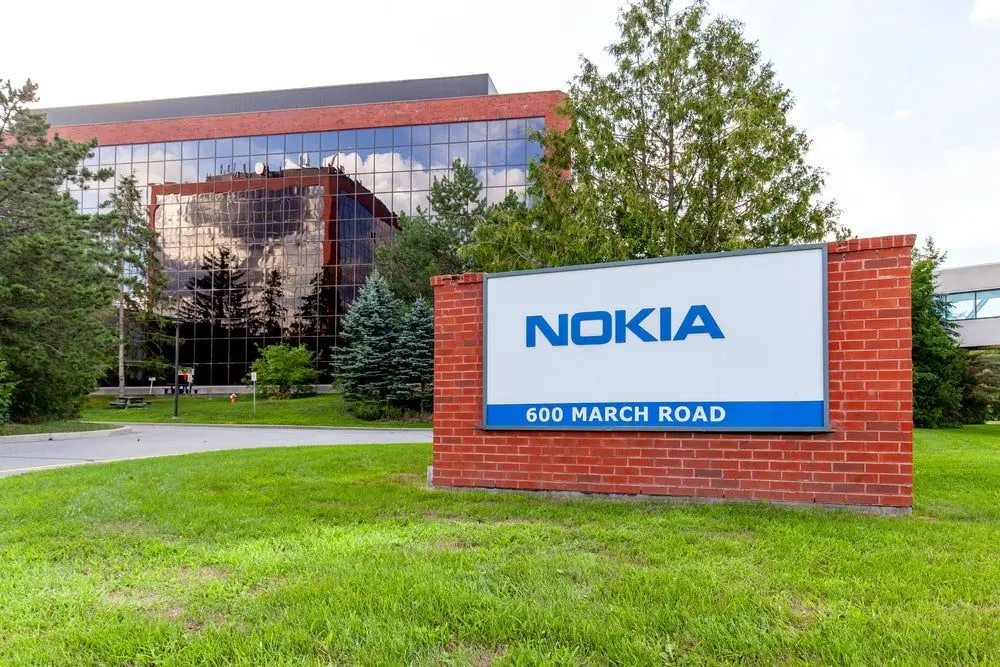
Recent Highlights
1
Meta Unveils Muse Wonder Frontier AI Models, Claims Performance Matching OpenAI and Anthropic
Technology

2
IMF Report Warns AI Market Correction Could Spark Global Financial Crisis With $1.4T at Risk
Business and Economy

3
OpenAI Releases 722 AI-Generated Math Solutions, Triggering Existential Crisis in Mathematics
Technology

Recent Highlights
Today's Top Stories








Don’t drown in AI news. We cut through the noise - filtering, ranking and summarizing the most important AI news, breakthroughs and research daily. Follow topics that matter to you and stay ahead.


