8 Sources
[1]
The tech that could make Marvell the next trillion dollar company
COMPUTEX 2026 The sun is slowly but surely setting on copper interconnects, Marvell CEO Matt Murphy claimed in his Computex keynote this week. Within the next decade the IP house expects photons to take the place of electrons and change the way datacenters are built and run in the process. And, if Nvidia CEO Jensen Huang is right, the widespread transition to silicon photonics technologies could make Marvell the next trillion dollar company. With a market cap of $191 billion, Marvell still has a long way to go, not that stopped Wall Street investors from sending the company's share price on a 30 percent rally on the proclamation. However, Huang's prediction, made during Marvell's Computex keynote this week, may be more than flattery. The large-scale deployment of AI infrastructure for training, inference, and agentic systems is already reshaping datacenter networks and pushing copper interconnects to the limit. "The distance a signal can travel over a copper cable is inversely proportional to the bandwidth, so every time you double the bandwidth, you have to cut the distance in half," Murphy explained. Today the fastest network interconnects operate at 200 Gbps per lane, but at these speeds copper cables can only carry a signal about 2.5 meters, effectively limiting interconnects. With the launch of its next-gen NVSwitch silicon in its Vera Rubin platform, Nvidia will double this again to 400 Gbps, halving copper's reach once again. There's a reason the NVL72's switches are located in the middle of the rack. "Going forward, even the connections within the rack will become optical," Murphy said. "The whole industry knows this is coming. So, we've been preparing for this moment, not just Marvell, but the industry." Optics offer much greater reach, but the tech isn't without compromise. Pluggable optics are not only power hungry but they also fail. Power consumption is one of the reasons why Nvidia first revealed its NVL72 rack systems, Huang explained that using optics would have added another 20 kilowatts to the system's then monstrous 120 kilowatt load. "You use optics wherever you must, you use copper wherever you can," Huang said during Marvell's keynote. While Huang expects copper interconnects to remain relevant for a while longer, Marvell is preparing for a future in which even PCB traces will be replaced by fiber optic cables. In 2020 Marvell acquired Inphi, which specialized in building optoelectrical interconnects, and more recently the company dropped billions to acquire Celestial AI's silicon photonics interconnect tech. Then in March, Nvidia invested $2 billion in Marvell to, among other things, advance its silicon photonics interconnect tech. "We build optical modules that contain all the electronics needed to drive and modulate the laser and transmit data over long distances," Murphy said. At copper's end "Think about 10 years in the future and it's a world where a lot of the copper connections are gone," Murphy said. "This is a world where then distance doesn't matter... that's a profound change." All modern datacenter infrastructure and software has been designed around the constraints of distances. "With optics, distance doesn't matter. So now we can change the size of the scale up domain from 72 or 144 XPUs or GPUs to 1,000 or more, all optically interconnected," he said. "The implications for workloads are enormous." But it's not just GPUs. Murphy explains that when everything from CPUs and GPUs to memory and storage are optically interconnected, they will no longer need to be in the same box. "Modern AI servers are composed of a certain number of CPUs, XPUs, memory, and network interfaces, and the reason they're all on the same system is because of distance," he explained. "Imagine a completely disaggregated architecture, XPUs in one system, memory in another, agentic CPUs in another." This means these resources can be reconfigured on the fly to achieve the ideal ratio of CPU to GPUs to system memory for a specific workload. Google is already doing this to a lesser extent with its TPU clouds. While the ratio of CPUs and memory to GPUs can't be reconfigured on the fly, the use of optical circuit switches means the number and shape (topology) of Google's TPUs can be adjusted to maximize inference or training performance. This also has implications beyond AI. Even if the bubble collapses and AI infrastructure demand evaporates, one can imagine AWS and other major cloud providers using silicon photonics or co-packaged optics to disaggregate compute resources and then reassemble them a la carte. Battling Broadzilla Marvell is a long way from a trillion dollar market cap and getting there assumes a certain other IP house doesn't eat their lunch. Broadcom, whose market cap already surpasses $2 trillion, and whose customers include some of the largest hyperscalers in the world, including Google and Meta, has also been amassing a broad portfolio of silicon photonics and optics tech over the past several years. These technologies include co-packaged optics for switches and XPUs, as well as DSPs for high bandwidth pluggables. Much like Murphy, Broadcom's CPU Hock Tan expects that photonics will replace most copper interconnects eventually, just not tomorrow. "I can see a point in time in the future when it matters as the only way to do it," Tan told analysts late last year. "we are not quite there yet." "The final, final, straw is when you can't do it well in pluggable optics," Tan said. "Then you go to silicon photonics." ®
[2]
Nvidia and Marvell CEOs highlight role of connectivity in powering next-generation AI infra
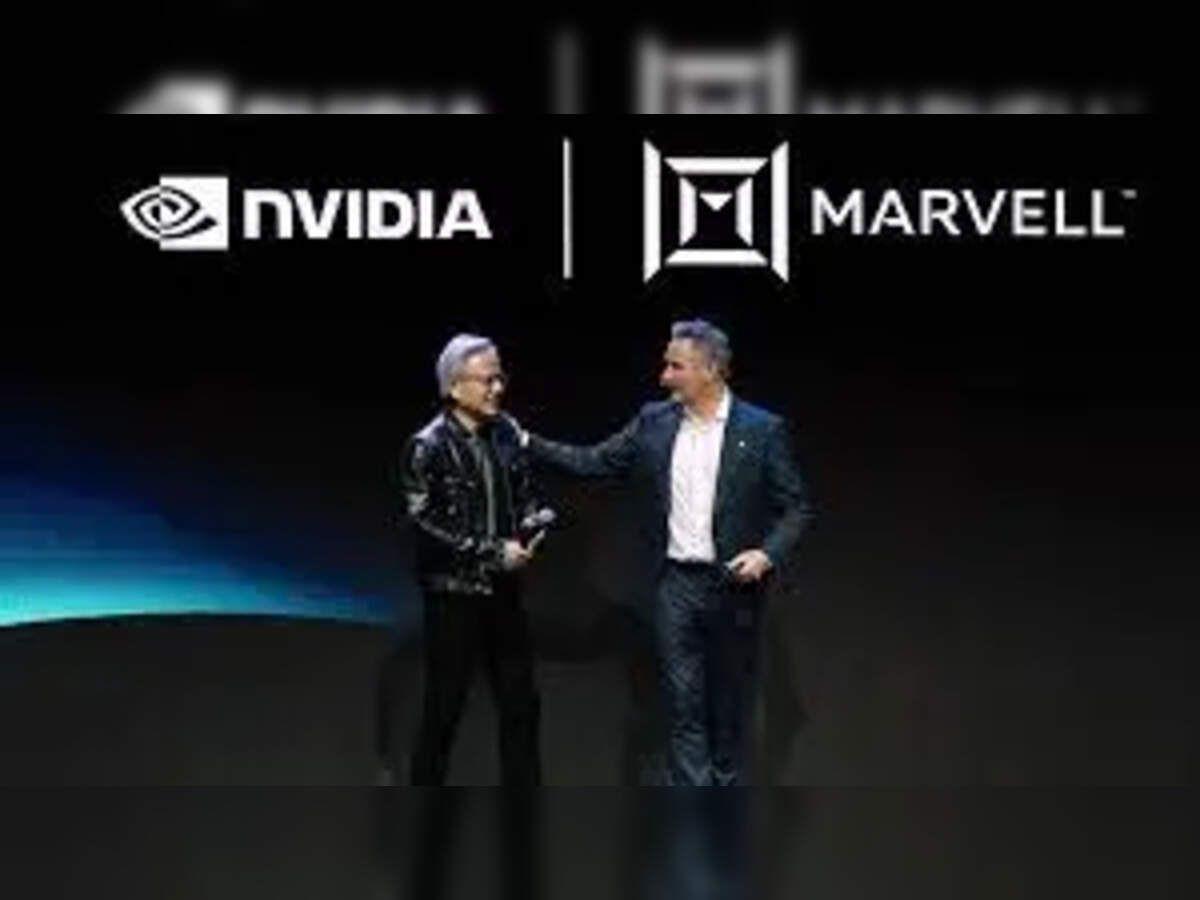
Marvell stocks soared over 30% after the Nvidia chief's announcement, according to various media reports. Earlier this year, Nvidia announced $2 billion investment in Marvell Technology to deepen their strategic partnership. Nvidia CEO Jensen Huang has highlighted the growing importance of connectivity in powering next-generation artificial intelligence infrastructure as he joined Marvell chief Matt Murphy on stage at Computex 2026 and described the semiconductor company as a potential "trillion-dollar company". "The next trillion-dollar company, ladies and gentlemen," said Jensen Huang, as soon as he arrived on the stage, drawing applause from the audience on Tuesday. Marvell stocks soared over 30% after the Nvidia chief's announcement, according to various media reports. Earlier this year, Nvidia announced $2 billion investment in Marvell Technology to deepen their strategic partnership. Huang on Tuesday highlighted the importance of connectivity in enabling AI infrastructure, with Marvell's technology playing a crucial role in scaling and interconnecting data centres. "Useful AI has arrived. It's the reason why your demand is going through the roof. It's the reason why my demand is going through the roof," said Huang at the global technology event organised by the Taiwan External Trade Development Council. He said that the new computing pattern that makes it possible is called agents, and these agents have a particular computing platform, a computing pattern that is disaggregated and distributed. "When you take a computing problem, and you disaggregate it into a lot of parts, and you distribute it across the entire data centre. What's necessary is connectivity. That's the reason why Matt's doing so well. That's the reason why Marvell is so essential," he said. Agentic AI acts as a digital worker rather than merely responding to queries under conventional generative AI. The model relies on large-scale computing infrastructure, making connectivity a critical component of AI deployment. Murphy said the industry is facing growing challenges in scaling connectivity using conventional copper-based technologies inside data centres. Copper cables are hitting a hard ceiling because the interconnects face severe signal degradation, escalating power requirements, and extreme heat generation at terabit data speeds. Murphy - whose company established its largest global research and development hub in India outside its California headquarters - emphasised that the traditional use of copper cabling within server racks is reaching its physical limits. "Going forward, even the connections within the rack will become optical, and the whole industry knows this is coming. So, we've been preparing for this moment, not just Marvell, but the industry," he said, adding: "The future of AI data centres is all optically connected infrastructures." Marvell said its silicon solutions connect everything from server components inside a rack to geographically distributed networks, helping scale AI clusters without sacrificing performance.
[3]
Nvidia CEO: Marvell Is 'Next Trillion-Dollar Company' -- Stock Explodes 20% - Marvell Technology (NASDAQ:M
* MRVL stock is climbing today. See the chart and price action here. Shares of Marvell surged as much as 22% in premarket trading Tuesday, with the stock changing hands around $258.58 as of early morning. The move adds to an already extraordinary 2026 run -- MRVL has climbed more than 158% year-to-date, with a 52-week range stretching from $61.15 to $225.14. Jensen Hypes MRVL Huang made the comments while sharing the stage with Marvell CEO Matt Murphy at the annual Computex trade show. After Murphy wrapped a keynote presentation on AI infrastructure, Huang turned to the crowd and said: "The next trillion-dollar company, ladies and gentlemen." The remark was no throwaway -- Huang followed it with a detailed explanation of why Marvell's networking and connectivity chips are central to the AI buildout. "When you take a computing challenge, and you break it down into numerous components, distributing it throughout the entire data center, connectivity becomes crucial," Huang said. "This is why Matt is performing so well, and why Marvell is so vital." The thesis centers on a structural shift in AI infrastructure. As training and inference workloads scale across hundreds of thousands of interconnected chips, Huang argued the bottleneck is no longer raw compute power -- it's data movement. Marvell's optical interconnects, silicon photonics, and custom ASIC business sit in the middle of the bottleneck. Huang also reiterated Nvidia's previously announced $2 billion strategic investment in Marvell, framing the partnership as ecosystem complementarity rather than dependency under the NVLink Fusion platform. The Bottom Line Marvell's data center segment accounts for roughly 76% of total revenue, and the company has raised its revenue outlook through fiscal 2027 and 2028, with analysts projecting its custom chip business to double by fiscal 2028. Wall Street was already bullish heading into Tuesday. The analyst consensus sits at Buy with an average price target of $208 and a street-high of $300 from HSBC, according to Benzinga data. Marvell's current market cap is roughly $192 billion -- meaning it would need to nearly quintuple to hit the $1 trillion threshold Huang envisions. MRVL Stock Price Activity: Marvell Technology stock was up 18.40% at $259.80 during premarket trading Tuesday, according to Benzinga Pro. Over the past month, MRVL has gained about 57.0% versus a 5.3% rise in the S&P 500 and is up roughly 200% year-to-date compared to the index's 10.6% gain. The stock is trading at new 52-week highs. This content was partially produced with the help of AI tools and was reviewed and published by Benzinga editors. Market News and Data brought to you by Benzinga APIs To add Benzinga News as your preferred source on Google, click here.
[4]
Beyond GPUs: Why Marvell is capturing Wall Street's attention - Marvell: The Next AI Trillion-Dollar Contender?
Beyond GPUs: Why Marvell is capturing Wall Street's attention 1/11 Marvell: The Next AI Trillion-Dollar Contender? Nvidia CEO Jensen Huang has sparked excitement across the technology sector after suggesting that Marvell Technology could one day become a trillion-dollar company. The comments have brought renewed attention to Marvell's growing role in the artificial intelligence infrastructure ecosystem and its strategic partnership with Nvidia. (Sources: Reuters, CNBC, Yahoo Finance) 2/11 The Big Statement Speaking at Computex 2026 in Taipei, Jensen Huang described Marvell as a company with the potential to join the exclusive trillion-dollar club. His comments underscored the increasing importance of networking and connectivity technologies in the AI era. While Nvidia supplies the computing power, Huang emphasized that moving vast amounts of data efficiently across AI systems is becoming equally critical. 3/11 Market Reaction Investors reacted swiftly to Huang's endorsement. Marvell's stock surged more than 25% in a single trading session, adding billions of dollars to the company's market value. The rally reflected growing confidence that Marvell could emerge as one of the key beneficiaries of the global AI infrastructure boom. 4/11 Why Marvell Matters in AI Marvell plays a crucial role behind the scenes of modern AI systems. The company develops networking chips, custom silicon solutions, and connectivity technologies that help link processors, memory, and data centers together. As AI workloads become increasingly complex, the ability to move data efficiently is becoming just as important as raw computing power. 5/11 The Next AI Bottleneck According to Marvell CEO Matt Murphy, connectivity is emerging as one of the biggest challenges facing the AI industry. While tremendous progress has been made in developing powerful AI processors, data transfer between those processors is becoming a growing constraint. Marvell believes solving this challenge will be essential for the next generation of AI infrastructure. 6/11 Partnership with Nvidia Marvell's close relationship with Nvidia has become a major growth catalyst. The two companies are working together on advanced networking technologies, custom AI chips, and silicon photonics solutions. Their collaboration reflects a shared belief that future AI systems will require far more sophisticated infrastructure than today's data centers. 7/11 Marvell's Growth Ambitions The company has outlined ambitious targets for its AI business. Marvell expects its custom AI chip segment to generate more than $10 billion in annual revenue by fiscal 2029. Growing demand from hyperscale cloud providers for specialized AI processors is expected to be a key driver of this expansion. 8/11 Optical Networking Opportunity One of Marvell's most promising growth areas is optical networking. As AI data centers become larger and more power-intensive, traditional copper connections are approaching their limits. Optical technologies can deliver faster data transmission and greater efficiency, making them increasingly important for next-generation AI infrastructure. 9/11 Can Marvell Really Reach $1 Trillion? While Huang's prediction has generated enthusiasm, achieving a trillion-dollar valuation remains a significant challenge. Marvell would need to sustain strong revenue growth, expand profitability, and continue benefiting from rising AI investments for many years. Nevertheless, the rapid rise of AI leaders such as Nvidia has demonstrated how quickly market values can expand when companies occupy critical positions within the technology ecosystem. 10/11 Investment Takeaways Marvell's investment case is built on its central role in AI networking, connectivity, and custom silicon. The company is benefiting from strong industry tailwinds, growing demand for AI infrastructure, and a deepening partnership with Nvidia. Its opportunities in optical networking and custom AI chips could further accelerate growth over the coming years. At the same time, investors should be mindful of risks. Expectations for the company have increased sharply following the recent rally, making future execution particularly important. Any slowdown in AI spending, increased competition, or challenges in scaling new businesses could affect long-term performance. 11/11 Key Takeaway Jensen Huang's endorsement has elevated Marvell's profile across global markets. The company's technologies are becoming increasingly important as AI systems grow larger and more interconnected. If connectivity proves to be the next critical frontier in artificial intelligence, Marvell could become one of the industry's biggest winners and potentially move much closer to the trillion-dollar milestone over the next decade.
[5]
A company founded around a kitchen table could be world's next trillion-dollar company, says Nvidia CEO Jensen Huang. Who was Marvell's co-founder, who became a certified radio technician at the age of 13?
Nvidia CEO Jensen Huang has predicted that Marvell Technology could become the world's next trillion-dollar company, highlighting its crucial role in connecting the thousands of chips that power modern AI data centres. The spotlight has also turned to Marvell co-founder Sehat Sutardja, who became a certified radio repair technician at just 13 years old before helping launch the semiconductor company around a kitchen table in 1995. Marvell Technology, a semiconductor company that started around a kitchen table nearly three decades ago, has suddenly found itself in the spotlight after Nvidia CEO Jensen Huang suggested it could become the world's next trillion-dollar company. His comments, made during Computex Week in Taipei, sent Marvell's shares soaring and renewed attention on the company's remarkable journey from a startup founded by a small family team to a major player in the artificial intelligence infrastructure race. Speaking alongside Marvell CEO Matthew Murphy, Huang praised the company's role in powering modern data centres, where thousands of chips must communicate with each other at extremely high speeds. "Marvell is set to be the next trillion-dollar company as its networking and connectivity chips are essential to data centres where computing tasks are spread across thousands of connected chips that need to share data quickly," Huang said. The remarks had an immediate impact on Wall Street. Marvell's stock jumped more than 20 per cent, adding tens of billions of dollars to its market value in a single trading session. While the company remains far from the $1 trillion valuation Huang mentioned, investors appeared encouraged by its growing position in the AI ecosystem. Why Marvell matters in the AI boomUnlike Nvidia, which is best known for making the powerful graphics processors used to train artificial intelligence models, Marvell focuses on the technology that connects those processors together. Its products are widely used across cloud computing, enterprise networking, AI infrastructure, 5G networks and automotive systems. You Might Also Like: 'I earn Rs 2 lakh a month': Engineer cab driver's answer leaves Bengaluru influencer stunned, his business model gave 'goosebumps' Huang explained that connectivity has become one of the most important parts of modern computing. "When you take a computing problem, and you disaggregate it into a lot of parts, and you distribute it across the entire data center, what's necessary is connectivity. That's the reason why Matt's doing so well. That's the reason why Marvel is so essential," he said. He added, "We've distributed and disaggregated computing so that it runs across these enormous clusters, so that we could get aggregating the total compute, the total memory, the total bandwidth that we have, and what makes it possible is connectivity." You Might Also Like: Employee worked endless overtime and got no raise despite promise. Years later, he showed his boss the cost of broken trust The company's business has benefited from the rapid expansion of AI data centres around the world. Marvell recently reported quarterly revenue of $2.4 billion and projected continued growth driven by demand from its data centre operations. It has also forecast that its custom chip business could generate more than $10 billion in annual revenue by fiscal 2029. Earlier this year, Nvidia invested $2 billion in Marvell as part of efforts to help customers combine Marvell's custom AI chips with Nvidia's processors and networking technologies. The man who helped build MarvellBehind the company's success story was co-founder Sehat Sutardja, an engineer whose fascination with electronics began long before Silicon Valley took notice. Born and raised in Jakarta, Indonesia, Sutardja spent his childhood experimenting with spare parts from his parents' auto parts store. He built devices such as Van de Graaff generators and other electronics while still young. His technical abilities became evident early. By the age of 13, he had already qualified as a certified radio repair technician. His interest in engineering eventually took him to the United States. He earned a bachelor's degree in electrical engineering from Iowa State University before completing both a master's degree and a PhD in electrical engineering at the University of California, Berkeley. Former classmate Stephen Lewis later recalled Sutardja's determination to improve designs even when a working solution already existed. According to Lewis, Sutardja continually searched for better and more efficient engineering approaches rather than settling for acceptable results. From a kitchen table to a global technology companyIn 1995, Sutardja founded Marvell Technology alongside his wife Weili Dai and his brother Pantas Sutardja. The company was launched around a kitchen table, a modest beginning for a business that would later become one of the semiconductor industry's most influential firms. The founders chose the name Marvell because they wanted to create products they considered "marvelous." Their first major innovation was a silicon-based read channel for hard drives. At the time, many industry observers doubted the concept would succeed. However, the technology reduced power consumption and manufacturing costs while improving performance, helping Marvell gain credibility with major technology companies. Over the course of his career, Sutardja accumulated more than 440 patents as an inventor or co-inventor. He was recognised by the Silicon Valley Intellectual Property Law Association as Inventor of the Year, became an IEEE Fellow and received the Indonesian Diaspora Lifetime Achievement Award for Global Pioneering and Innovation. Even with those achievements, colleagues often remembered him for his willingness to mentor young engineers and share his knowledge. Today, as Marvell benefits from the AI boom and receives praise from one of the technology industry's most influential leaders, the story of its co-founder remains a reminder of how a childhood passion for electronics helped build a company that is now being talked about as a future trillion-dollar giant.
[6]
Marvell Technology surges after Nvidia's Huang calls it 'next trillion-dollar company'
Marvell Technology's shares surged more than 24 per cent in premarket trading on Tuesday after Nvidia CEO Jensen Huang called the chipmaker the next "trillion-dollar company." Huang and Marvell CEO Matt Murphy were speaking at the Computex week in Taipei on Tuesday. Marvell's market capitalization, as of last close, was just short of $192 billion, far below the one-trillion mark that Huang touted. Earlier this year, Nvidia invested $2 billion in Marvell, as part of its efforts to make it easier for customers to use the custom artificial intelligence chips that the smaller company designs with Nvidia's networking gear and central processors. Marvell last week forecast that its custom chips business would surpass $10 billion in revenue in fiscal 2029, as cloud companies expand AI data centers. The surge in AI adoption has fueled demand for specialized chips, which along with Marvell's interconnect technologies, play a critical role in advanced data centers by linking thousands of processors used to train and run AI models. Marvell shares were last up 24.7% at $273.70, set to add more than $47.2 billion in market capitalization if gains hold. Nvidia NVDA.O shares also gained 1.8%. (Reporting by Shashwat Chauhan in Bengaluru; Editing by Subhranshu Sahu, Janane Venkatraman and Shinjini Ganguli)
[7]
Marvell Technology: All Systems Go
Long recognized for its ASIC expertise, notably through its involvement in developing Amazon's Trainium chips, Marvell is increasingly being associated with silicon photonics - a technology deemed strategic for future AI infrastructure. This evolution was bolstered earlier this year when Nvidia invested nearly $2bn to facilitate the integration of Marvell-developed AI chips with its own networking equipment and processors. This partnership has helped place the company at the heart of discussions surrounding next-generation AI infrastructure. As memory specialists have now crossed the symbolic 1 trillion dollar market capitalization threshold, driven notably by Micron's surge, Jensen Huang identified Marvell as a potential "1 trillion dollar company" during Computex in Taipei. This statement had an immediate market impact. Marvell Technology shares jumped more than 32% during Monday's session before extending gains the following day. With a market capitalization now exceeding $265bn, Marvell ranks among the world's largest technology companies and currently holds the 62nd position in global market cap rankings. The enthusiasm displayed by Jensen Huang echoes the already highly positive commentary from several semiconductor analysts. On the occasion of the quarterly results published on May 27, JPMorgan analyst Harlan Sur had already highlighted the strength of the investment case. "We are impressed by the multi-year revenue outlook as well as the diversity of customer programs currently in the ramp-up phase. We anticipate a particularly favorable setup for fiscal years 2026 and 2027," he noted. Analysts at Deutsche Bank also share this constructive outlook. According to them, Marvell possesses a rare competitive advantage thanks to the combination of its technological intellectual property and commercial flexibility. "We continue to believe that Marvell possesses a relatively rare combination of technological expertise and execution capability that should allow it to take full advantage of the enduring AI megatrend," the bank concluded.
[8]
Nvidia's Huang Says Marvell May Join $1 Trillion Club as AI Hardware Demand Soars
By Yang Jie and Sherry Qin Nvidia's Jensen Huang says Marvell Technology could be the next chip firm to join the trillion-dollar club, predicting a surge in demand for artificial-intelligence hardware fueled by the emergence of autonomous models. Speaking at a trade show in Taipei alongside Marvell CEO Matt Murphy, Huang mapped out the future of AI infrastructure, highlighting a strategic transition from copper cables to optical communications. "Useful AI has arrived," Huang said, citing the rise of autonomous AI agents that can run workflows and solve problems as the reason why demand for Marvell and Nvidia's respective products is "going through the roof." The high-profile joint appearance at Computex in Taiwan on Tuesday underscored the critical role of next-generation network fabrics in the AI era. Murphy, whose Santa Clara, Calif.-based company specializes in data infrastructure semiconductors and high-speed networking technology for data centers, opened his keynote by asserting that the next major wave of AI innovation will be driven by interconnection. Focusing solely on processor or memory fails to capture the full picture of hardware efficiency, said Murphy. Addressing the technical challenges of scaling massive AI data centers, Huang said that computing is becoming increasingly disaggregated and distributed, and to tie these sprawling systems together, the industry must rely heavily on advanced connectivity. "That's the reason why Marvell is so essential," the Nvidia CEO said, telling Murphy: "That's why you're going to be the next trillion-dollar company." Nvidia announced a strategic partnership with Marvell in March, saying that it has invested $2 billion in the company. Marvell's stock, which finished 7% higher on Monday, surged in off-hours trading on the Blue Ocean alternative system, climbing over 15%. Speaking on the industry's shift from copper wiring to silicon photonics for data transmission, Huang advocated for a pragmatic, cost-effective way to maximize the lifespan of existing copper architecture within AI systems while deploying more expensive optical links only where technically essential. As AI workloads become more complex, copper is hitting its physical limits, gradually pushing companies to turn more to optoelectronics. "You use optics wherever you must, [and] you use copper wherever you can," said Huang.
Share
Copy Link
Nvidia CEO Jensen Huang declared Marvell Technology could become the next trillion dollar company during Computex 2026, sending the stock soaring over 30%. The endorsement highlights Marvell's critical role in AI infrastructure through connectivity chips and silicon photonics as copper interconnects reach their physical limits in modern data centers.
Nvidia CEO Jensen Huang made headlines at Computex 2026 in Taipei when he took the stage alongside Marvell CEO Matt Murphy and proclaimed the semiconductor company as "the next trillion dollar company, ladies and gentlemen." The dramatic endorsement sent Marvell Technology stock surging more than 30% in a single trading session, adding billions to its market capitalization and bringing renewed attention to the company's expanding role in AI infrastructure
1
. With a current market cap of $191 billion, Marvell would need to nearly quintuple its valuation to reach the threshold Jensen Huang envisions, but the Nvidia chief's prediction appears grounded in structural shifts reshaping how AI data centers are built and operated3
.
Source: ET
Huang's endorsement wasn't mere flattery but reflected a fundamental thesis about the evolution of AI infrastructure. "When you take a computing problem, and you disaggregate it into a lot of parts, and you distribute it across the entire data center, what's necessary is connectivity," Huang explained during the keynote . As training and inference workloads scale across hundreds of thousands of interconnected chips, the bottleneck is no longer raw compute power but data movement. Marvell's optical interconnects, silicon photonics, and custom AI chips sit directly in the middle of this data movement bottleneck
3
. Matt Murphy emphasized that connectivity is emerging as one of the biggest challenges facing the semiconductor industry, noting that "the distance a signal can travel over a copper cable is inversely proportional to the bandwidth, so every time you double the bandwidth, you have to cut the distance in half"1
.

Source: The Register
The fastest network interconnects today operate at 200 Gbps per lane, but at these speeds copper cables can only carry a signal about 2.5 meters, effectively limiting data center interconnects
1
. With Nvidia's next-gen NVSwitch silicon in its Vera Rubin platform doubling speeds to 400 Gbps, copper's reach will be halved again. Murphy predicted a profound transformation ahead: "Think about 10 years in the future and it's a world where a lot of the copper connections are gone. Going forward, even the connections within the rack will become optical, and the whole industry knows this is coming"1
. Marvell has been preparing for this moment through strategic acquisitions, including Inphi in 2020, which specialized in optoelectrical interconnects, and more recently Celestial AI's silicon photonics interconnect technology. In March, Nvidia invested $2 billion in Marvell Technology to advance these optical networking capabilities1
.The shift to optical interconnects enables a fundamental reimagining of data center design. Murphy explained that when everything from CPUs and GPUs to memory and storage are optically interconnected, they no longer need to be in the same box. "With optics, distance doesn't matter. So now we can change the size of the scale up domain from 72 or 144 XPUs or GPUs to 1,000 or more, all optically interconnected," he said
1
. This disaggregated data center approach means resources can be reconfigured on the fly to achieve the ideal ratio of CPU to GPUs to system memory for specific workloads. Google is already implementing this to a lesser extent with its TPU clouds, using optical circuit switches to adjust the number and topology of TPUs to maximize inference or training performance1
.
Source: Benzinga
Marvell's data center segment accounts for roughly 76% of total revenue, and the company has raised its revenue outlook through fiscal 2027 and 2028
3
. Analysts project its custom chip business to double by fiscal 2028, with the company forecasting that its custom AI chips segment could generate more than $10 billion in annual revenue by fiscal 20293
. Wall Street sentiment has turned decidedly bullish, with the analyst consensus sitting at Buy and an average price target of $208, with a street-high of $300 from HSBC3
. The stock has climbed more than 158% year-to-date in 2026, with a 52-week range stretching from $61.15 to $225.143
.Related Stories
While Marvell's prospects appear strong, the company faces formidable competition from Broadcom, whose market cap already surpasses $2 trillion
1
. Broadcom's customers include some of the largest hyperscalers in the world, including Google and Meta, and the company has been amassing its own broad portfolio of silicon photonics and optical technologies. The race to dominate connectivity chips and optical networking in AI data centers will likely determine whether Marvell can achieve the valuation Jensen Huang envisions or whether competitors will capture a larger share of this emerging market.Huang's comments reflect a broader recognition that AI infrastructure extends far beyond GPUs. As agentic AI systems require disaggregated and distributed computing patterns, the ability to move data efficiently becomes as critical as processing power itself. "Useful AI has arrived. It's the reason why your demand is going through the roof," Huang told the Computex audience . Even if AI infrastructure demand moderates, major cloud providers could use silicon photonics and co-packaged optics to disaggregate compute resources and reassemble them a la carte, suggesting applications beyond the current AI boom
1
. Marvell, which was founded around a kitchen table in 1995 by Sehat Sutardja, his wife Weili Dai, and his brother Pantas Sutardja, now finds itself positioned at the center of a technological transition that could reshape how data centers operate for the next decade .Summarized by
Navi
[3]
06 Mar 2026•Business and Economy

31 Mar 2026•Technology

15 Dec 2024•Technology

1
Technology

2
Technology

3
Policy and Regulation