7 Sources
[1]
Chipmaker Nvidia seeks to raise over $25B in first bond deal since 2021
Chipmaker Nvidia is planning to sell $25 billion of investment-grade debt in the US on Monday, its first bond sale in five years, in a test of investor appetite for further exposure to the AI sector. In a marquee seven-part bond offering, the company will issue a wide range of maturities from two years to 30 years, according to a term sheet seen by the FT. The issuance was upsized from $20 billion after receiving more than $85 billion in orders by early afternoon in New York, according to people familiar with the deal. Thanks to robust demand, the 10-year portion of the bond was expected to yield 0.5 percentage points above US Treasuries, down from 0.75 percentage points during initial discussions, one of the people said. Favorable market conditions after the US-Iran deal are allowing Nvidia to raise debt at a relatively low cost, said Lauren Wagandt, a portfolio manager at T Rowe Price. "It's a very high-quality company at the end of the day," said Wagandt. "And it doesn't come to the market as often as the other tech names." The issuance by the semiconductor group, the biggest beneficiary of Big Tech's trillion-dollar spending spree on AI infrastructure, comes as tech groups race to secure funding amid an intensifying AI arms race, but also as Wall Street faces a torrent of new equity and debt issuance, including SpaceX's record $75 billion initial public offering. "We intend to use the net proceeds from this offering for general corporate purposes, including repayment and refinancing of outstanding notes," Nvidia said. Monday's offering is at least three times larger than Nvidia's previous bond sale in 2021 during the coronavirus pandemic, when it raised about $5 billion. When completed, it will more than triple Nvidia's debt outstanding to about $30 billion from the current level of $8.5 billion. Early signs of market fatigue have prompted some tech companies to find alternative avenues for financing. Anthropic has turned to private credit investors to seal a $35 billion deal backed by Broadcom. Google's parent Alphabet decided to issue equity for the first time in more than two decades, bringing in $85 billion in fresh capital earlier this month. Nvidia's position as the AI industry's go-to supplier of the powerful chips needed to build large language models such as OpenAI's GPT has proven extremely lucrative for the Silicon Valley company, with its free cash flow in the year to January leaping 59 percent to $96.6 billion. However, after its valuation peaked at about $5.7 trillion in May, its shares have fallen alongside the wider semiconductor market in recent weeks, with its market capitalization dropping below $5 trillion at the end of last week. While reaping huge profits from AI spending, Nvidia has also become a significant investor in AI companies, committing a total of more than $90 billion to developers, including OpenAI, Anthropic, and xAI, and suppliers, including Coherent, Marvell, Lumentum, and Corning. In some cases, it has also agreed to act as a backstop or financial guarantor to customers building cloud computing services using its chips, including CoreWeave and Nscale. The increasing use of financial guarantees and the interdependence of AI companies have raised concerns about concentrated risks among bond investors, said Tom Murphy, global head of investment-grade credit at Columbia Threadneedle Investments. "The market has started to get worried about these circular financings, because if somebody in that ecosystem is having a problem, then the whole thing could be a problem," Murphy said. Nvidia has a double-A credit rating, the third-highest score. More indebted AI player Oracle sits just two notches above a junk rating. Goldman Sachs, JPMorgan, and Morgan Stanley are active bookrunners of the transaction.
[2]
Nvidia to raise $20 billion, source says, in first corporate bond issuance in five years
June 15 (Reuters) - Nvidia (NVDA.O), opens new tab will raise $20 billion through a U.S. bond issuance, a source told Reuters on Monday, tapping the debt market to fund the massive capital requirements to produce cutting-edge AI chips. The AI chip leader has not accessed investment grade bond market in five years, previously raising $5 billion in June 2021, the source familiar with the matter said, declining to be named as the plan was still private. The bond consists of seven tranches of notes, maturing as late as 2056, according to a term sheet seen by Reuters. Nvidia did not immediately respond to a request for comment. Big Tech companies have signaled that spending on AI would not slow down, with combined outlays set to surpass $700 billion this year, up from around $400 billion in 2025. Meta (META.O), opens new tab in October filed for its largest bond offering of up to $30 billion, while Alphabet (GOOGL.O), opens new tab last month disclosed its plans to sell Japanese yen-denominated bonds for the first time. While Nvidia has not been building large-scale data centers, its chips, which are used in those servers, are seeing red-hot demand from companies looking to train, and run increasingly advanced models. In order to keep pace with the fast-evolving AI sector, Nvidia has been investing heavily in building the most advanced processors, now releasing a new family of chips every year, each with higher AI capabilities than the last. The company has $13.24 billion in cash and cash equivalents as of quarter ended April 2026. It intends to use the proceeds for general corporate purposes, including the repayment and refinancing of outstanding notes, the term sheet said. Goldman Sachs, J.P. Morgan and Morgan Stanley are the bookrunners. Nvidia shares were up 2.5% in early trading. Reporting by Zaheer Kachwala in Bengaluru; Editing by Shilpi Majumdar and Arun Koyyur Our Standards: The Thomson Reuters Trust Principles., opens new tab * Suggested Topics: * Disrupted Saeed Azhar Thomson Reuters Saeed Azhar is a Reuters financial journalist and part of the U.S. banking team, which covers Wall Street's biggest banks. He focuses on Goldman Sachs and Bank of America, and also writes about regional banks. Before moving to New York in July 2022, he led the finance team in the Middle East from Dubai, and also worked in Singapore, covering Southeast Asia finance.
[3]
Nvidia plans to raise about $20 billion in first debt sale since start of AI boom
Nvidia is aiming to raise about $20 billion in debt, according to sources with knowledge of the matter, in the chipmaker's first bond sale since the start of the AI boom. In a filing with the SEC on Monday, Nvidia disclosed plans for the capital raise but didn't include the dollar amount. Earlier this year, the chipmaker said it could raise up to $25 billion through issuance of unsecured commercial paper notes. Sources confirming the $20 billion figure asked not to be named because the numbers aren't public. Nvidia shares rose 3% on Monday and are up about 13% this year. The chipmaker is the latest tech company tied to the artificial intelligence trade to tap the capital markets. Alphabet announced plans earlier this month to raise $85 billion in equity-related offerings after securing more than $55 billion in fresh debt since November. And last week, Super Micro announced $7 billion in equity-related financing deals to help to cover the cost of hardware component purchases. Amazon, meanwhile, raised roughly $54 billion in debt earlier this year in U.S. and European bond sales, and announced plans last week to raise about $10 billion in a Canadian debt sale Nvidia has about $7.5 billion in long-term debt and another $1 billion in short-term debt. In its last debt raise in 2021, Nvidia brought in $5 billion, with notes maturing as late as 2031. But Nvidia was a much smaller company then, generating revenue in fiscal 2022 of about $27 billion, compared to sales of $216 billion in fiscal 2026. The launch of OpenAI's ChatGPT in late 2022 was a major catalyst for Nvidia's historic rate of growth that followed, as AI model companies and hyperscalers started gobbling up as many of the company's graphics processing units as they could. An Nvidia spokesperson said that the company intends to use the proceeds from the offering for general corporate purposes, including repayment and refinancing of existing debt. Nvidia announced an aggressive capital return program in May, when it raised its dividend from a penny a share to 25 cents and said it planned to repurchase $80 billion in shares. Nvidia generated $49 billion in free cash flow in the latest quarter, up from $35 billion in the same period a year earlier, and reiterated plans in its latest earnings call to "return roughly 50% of free cash flow to shareholders this year."
[4]
AI debt boom ramps up with Nvidia bond sale
Why it matters: Nvidia's bond sales are part of an AI-related wave of change now sweeping through both bond and stock markets, as the world's largest and most cash-rich companies find that they too need investors to finance the AI buildout. Driving the news: Nvidia set out to sell $20 billion in corporate bonds Monday. * It was Nvidia's first debt sale since 2021 and is four times the size of its last two offerings, Bloomberg reported. Context: Axios' Emily Peck reported last week that Wall Street has already showered twice as much capital this year on the AI hyperscalers -- the giant companies building the AI data centers -- as in all of 2025. * Elsewhere, growth in issuance of new shares of stock -- most recently SpaceX -- after decades in which the stock market has essentially shrunk could change the balance of supply of, and demand for, shares of stock. * That could be a big deal for prices. What they're saying: "Consensus estimates suggest the hyperscalers will spend $770 billion on capex in 2026, equivalent to 100% of cash flows from operations. In order to fund continued capex growth, the companies have increasingly turned to debt and equity issuance and pulled back on buybacks," Goldman Sachs analysts wrote in a note Friday. Yes, but: As a chipmaker, Nvidia isn't in the same capex league as others in its AI cohort -- the large hyperscalers spending hundreds of billions of dollars on data centers. * Nvidia is projected to spend just $7.95 billion this fiscal year. * And with $62.6 billion in cash and cash equivalents as of the end of last year -- more than Apple's cash pile -- $20 billion in new debt is nothing to worry about. The bottom line: Still, Nvidia's expected capital expenditure is 150% higher than it was two years ago.
[5]
Nvidia raises €21.5bn in first bond sale since 2021 on AI demand
Nvidia has returned to the corporate debt market for the first time in five years, pricing a $25 billion (€21.5bn) bond sale that drew roughly $85 billion (€73.2bn) in orders, a sign of investors' strong appetite for exposure to AI. The world's most valuable company, the chipmaker Nvidia, priced a $25 billion (€21.5bn) bond offering on Monday, marking its first issuance since 2021 and one of the largest by a technology company this year. The deal was originally pencilled in at around $20 billion (€17.2bn) but was enlarged after demand ran more than three times the size of the bond, according to a person familiar with the matter cited by Bloomberg. Investor appetite was the headline of the sale. Orders reached as high as $85 billion (€73.2bn), allowing Nvidia to upsize the transaction and tighten its borrowing costs in the process. The timing was also favourable. The announcement of a US-Iran framework deal to end the conflict in the Middle East steadied credit markets, pushing investment-grade spreads to their narrowest levels since early February, before the Iran war began. That backdrop helped Nvidia lock in relatively cheap long-term financing. According to Bloomberg Intelligence analyst Robert Schiffman, inexpensive long-dated debt lowers Nvidia's weighted average cost of capital and helps bankroll its AI investments without threatening its AA credit rating. A company spokesperson stated that the proceeds would be used for general corporate purposes, including repaying and refinancing existing notes. Nvidia last tapped the investment-grade market in June 2021, when it sold $5 billion (€4.3bn) of notes across four maturities, according to a regulatory filing. The contrast in scale underscores how quickly its financing needs have grown alongside the data centre build-out and increased demand from hyperscalers. A wider borrowing frenzy Nvidia joins a queue of technology giants raising vast sums to fund AI infrastructure. Meta and Oracle have each issued $25 billion (€21.5bn) in bonds this year, while Amazon completed a single $37 billion (€31.8bn) deal, the largest US investment-grade offering of this year before Nvidia's issuance on Monday. For Nvidia, the raise also keeps share dilution off the table, giving it greater flexibility as capital commitments mount. The firm has invested $5 billion (€4.3bn) in Intel, pledged up to $10 billion (€8.6bn) to Anthropic and contributed $30 billion (€25.8bn) to OpenAI's latest funding round. Nvidia shares closed up 3.5% at $212.45 after the deal, valuing the company at about $5.14 trillion (€4.42tn). On the other hand, Alphabet, Google's parent company, opted for equity instead, pricing an upsized $84.75 billion (€73bn) capital raise earlier this month, after originally seeking around $80 billion (€68.9bn), according to a company filing. The transaction, which includes a $10 billion (€8.6bn) private placement from Berkshire Hathaway, ranks as the largest equity capital raise on record and is intended to fund the group's AI compute expansion. Management has guided 2026 capital expenditure to between $180 billion (€155.1bn) and $190 billion (€163.7bn). However, the equity move came on top of an already heavy borrowing run. According to its own filing, Alphabet raised more than $85 billion (€73.2bn) of debt across six major currencies and markets in the first quarter of 2026, taking its total debt balance above $100 billion (€86.1bn). That included a US dollar bond round early in the year, leaving Google relying on both debt and equity financing to bankroll its AI ambitions.
[6]
Nvidia to raise $20 billion in US bond issuance
Nvidia is set to raise a massive $20 billion through a bond issuance. This move signals the company's significant investment in artificial intelligence infrastructure. Big technology firms are increasingly turning to debt markets to finance their ambitious AI projects. This bond issuance, with maturities extending to 2056, highlights the substantial capital required for AI advancements. Goldman Sachs, J.P. Nvidia will raise $20 billion through a US bond issuance, a source told Reuters on Monday, joining a growing number of technology companies turning to the debt market as investments into AI accelerate. The bonds consist of seven tranches of notes, maturing as late as 2056, according to a term sheet seen by Reuters. Expensive AI infrastructure buildouts require a significant amount of capital, pushing big tech firms to use debt as a method of fulfilling their multi-billion dollar AI ambitions. Goldman Sachs, J.P. Morgan and Morgan Stanley are the bookrunners for the raise.
[7]
Nvidia Aims to Raise $20 Billion to Continue AI Chip Production | PYMNTS.com
The company has not accessed the investment-grade bond market since raising $5 billion 2021, a source familiar with the matter told Reuters in a report published Monday (June 15). The bond is comprised of seven tranches of notes, maturing as late as 2056, the report added, citing a term sheet seen by Reuters. A Nvidia spokesperson told the news outlet that the company wants to use the proceeds for general corporate purposes, such as the repayment and refinancing of outstanding notes. The report also pointed out that Big Tech firms have shown no plans to slow their spending on AI projects, with total investments expected to exceed $700 billion for 2026, compared to around $400 billion in 2025. According to the report, Meta filed in October for its largest bond offering of up to $30 billion, while Google recently revealed plans to sell Japanese yen-denominated bonds for the first time. Reuters noted that although Nvidia has not been constructing large-scale data centers, it does make the chips used in those centers, and is thus witnessing strong demand from companies seeking to train and run increasingly advanced AI models. To keep up with the fast-moving industry, the report added, Nvidia has spent heavily to develop the most advanced processors, rolling out a new family of chips every year, each with greater AI capabilities than its predecessor. In other Nvidia news, PYMNTS wrote last week about the launch of Cosmos 3, an open world foundation model for physical AI trained using 20 trillion tokens of multimodal data -- including almost one billion images, 400 million real and synthetic videos, audio and action data from humans and robots. The model is designed for machines that need to understand the physical world before acting in it. Nvidia founder and CEO Jensen Huang noted during the product's launch that "the big bang of physical AI is just around the corner thanks to breakthroughs in multimodal reasoning language, vision and world models." "The distinction matters for anyone building or deploying physical AI," PYMNTS wrote. "An LLM learns from text. A world foundation model learns from physical environments: how objects move, collide, fall and interact over time." Cosmos is different from a video generator, the report added, in that it doesn't only generate realistic scenes, "it predicts what a robot or vehicle should do next within them."
Share
Copy Link
Chipmaker Nvidia completed a $25 billion bond offering, its first debt issuance in five years, drawing over $85 billion in investor orders. The upsized deal reflects surging AI demand and marks a shift as even cash-rich tech giants turn to capital markets to fund the AI infrastructure buildout and chip production needs.
Chipmaker Nvidia completed a $25 billion bond offering on Monday, marking its first return to the debt market since 2021 and signaling a fundamental shift in how even the most profitable tech companies finance their operations
1
. The seven-part bond offering, which spans maturities from two years to 30 years, was initially planned at $20 billion but was upsized after drawing more than $85 billion in orders by early afternoon in New York1
5
. The robust demand allowed Nvidia to tighten pricing, with the 10-year portion yielding 0.5 percentage points above US Treasuries, down from initial discussions of 0.75 percentage points1
.

Source: Euronews
The Nvidia debt issuance comes as Big Tech companies signal that spending on AI infrastructure growth would not slow down, with combined outlays set to surpass $700 billion this year, up from around $400 billion in 2025. Goldman Sachs analysts noted that consensus estimates suggest hyperscalers will spend $770 billion on capital expenditures in 2026, equivalent to 100% of cash flows from operations
4
. This AI arms race has forced companies to increasingly turn to debt and equity issuance while pulling back on buybacks. Nvidia's position as the AI industry's go-to supplier of powerful GPUs needed to build large language models such as OpenAI's GPT has proven extremely lucrative, with its free cash flow in the year to January leaping 59 percent to $96.6 billion1
.
Source: Reuters
Nvidia joins a queue of technology giants raising vast sums through AI-driven financing. Meta and Oracle have each issued $25 billion in bonds this year, while Amazon completed a single $37 billion deal, the largest US investment-grade offering before Nvidia's issuance
5
. Alphabet opted for equity instead, pricing an upsized $84.75 billion capital raise earlier this month after securing more than $55 billion in fresh debt since November3
5
. Super Micro announced $7 billion in equity-related financing deals to cover hardware component purchases3
. Early signs of market fatigue have prompted some companies like Anthropic to turn to private credit investors, sealing a $35 billion deal backed by Broadcom1
.
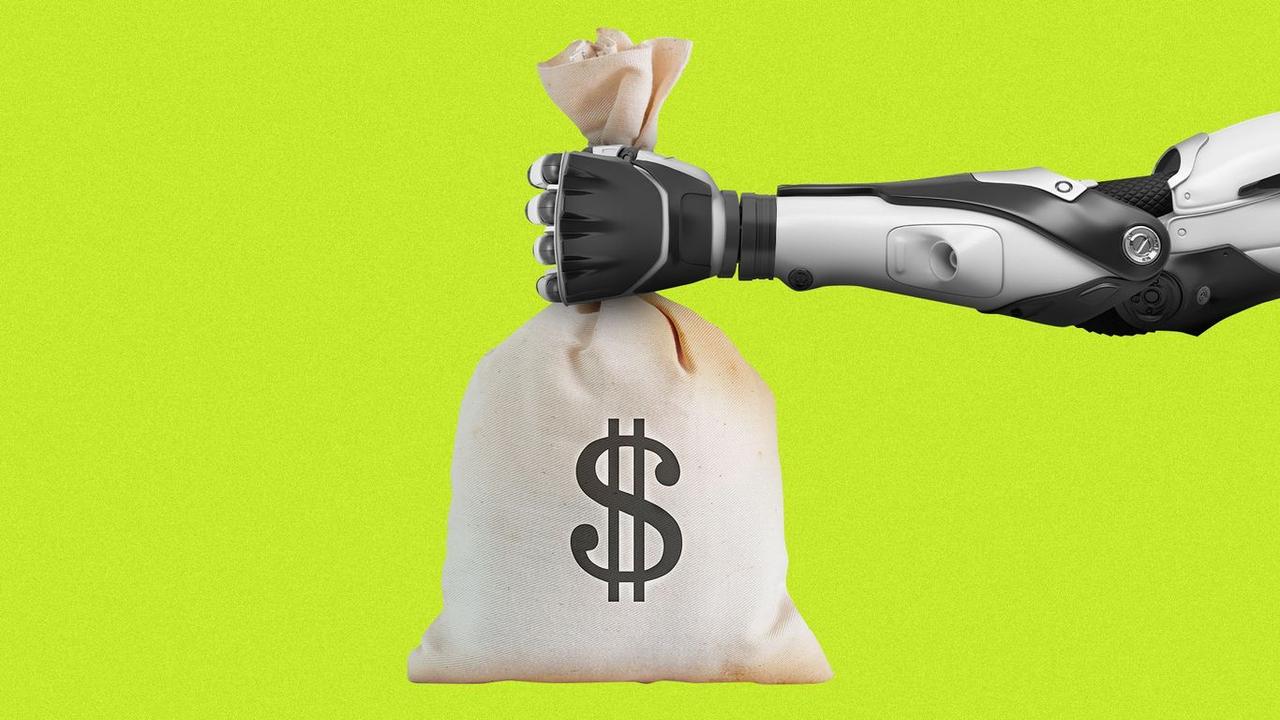
Source: Axios
Related Stories
Nvidia stated it intends to use the net proceeds for general corporate purposes, including repayment and refinancing of outstanding notes
1
. Monday's offering is at least three times larger than Nvidia's previous bond sale in 2021, when it raised about $5 billion1
. When completed, it will more than triple Nvidia's debt outstanding to about $30 billion from the current level of $8.5 billion1
. The company has $13.24 billion in cash and cash equivalents as of the quarter ended April 2026. Despite the massive raise, Nvidia maintains a double-A credit rating, the third-highest score1
.While reaping huge profits from AI demand, Nvidia has become a significant investor in AI companies, committing more than $90 billion to developers including OpenAI, Anthropic, and xAI, and suppliers including Coherent, Marvell, Lumentum, and Corning
1
. In some cases, it has agreed to act as a backstop or financial guarantor to customers building cloud computing services using its chips, including CoreWeave and Nscale1
. Tom Murphy, global head of investment-grade credit at Columbia Threadneedle Investments, noted that the increasing use of financial guarantees and interdependence of AI companies have raised concerns about concentrated risks in credit markets: "The market has started to get worried about these circular financings, because if somebody in that ecosystem is having a problem, then the whole thing could be a problem"1
. Goldman Sachs, JPMorgan, and Morgan Stanley served as active bookrunners of the transaction1
. Nvidia shares closed up 3.5% at $212.45 after the deal, valuing the company at about $5.14 trillion5
. To keep pace with AI chip production demands, Nvidia has been releasing a new family of chips every year, each with higher AI capabilities than the last.Summarized by
Navi
02 Jan 2025•Business and Economy

20 Nov 2025•Business and Economy

04 Nov 2025•Business and Economy

1
Policy and Regulation

2
Business and Economy

3
Technology