5 Sources
[1]
A tech worker-backed PAC is bringing a $5M knife to Big Tech's $100M gunfight
A grassroots movement is forming among everyday tech workers who are demanding their companies develop and deploy AI responsibly. And the Guardrails Alliance, a new super PAC dedicated to supporting AI legislation, aims to leverage that discontent. Democratic operatives Shaunna Thomas and Leah Hunt-Hendrix launched the Guardrails Alliance on Thursday with backing from tech employees, labor unions, and other groups, according to The New York Times. "Our fundamental belief here is that people still do have the power to stop this autocratic takeover of the Trump administration and the tech sector," Thomas told the NYT. Guardrails positions itself as a populist political movement that runs on small donations from people in the trenches of the AI boom. The PAC has about $5 million at its disposal today and plans to raise $15 million this cycle -- small potatoes compared to deep-pocketed adversaries like Leading the Future, which has more than $100 million from tech leaders like OpenAI President Greg Brockman. Guardrails will buy ads to support Alex Bores, a New York congressional candidate who became Leading the Future's first target and is running in the primaries next week. On Thursday, Bores shared an ad featuring the parents of Adam Raine, the teenager who died by suicide after months of prolonged conversations with ChatGPT. Bores is also receiving support from another pro-legislation super PAC, Public First Action, which has backing from Anthropic. While OpenAI has tried to distance itself from Brockman's donations, many employees are reportedly unconvinced, and several have voiced concerns on social media about Leading the Future's attacks on Bores. This year, tech workers have also mobilized to demand their chiefs end contracts with U.S. Immigration and Customs Enforcement (ICE) and urge the Pentagon to withdraw its designation of Anthropic as a supply chain risk -- a label critics say was imposed without due process in retaliation for Anthropic's limits on its technology being used for mass surveillance and autonomous warfare. "This is not about matching [Leading the Future] dollar for dollar," Thomas said. "What this vehicle is meant to do is be a political home for people who are concerned about the way the anti-regulation AI tech sector is trying to manipulate elections." TechCrunch has reached out to the Guardrails Alliance.
[2]
A New York House primary has become an AI industry family feud with millions in corporate spending
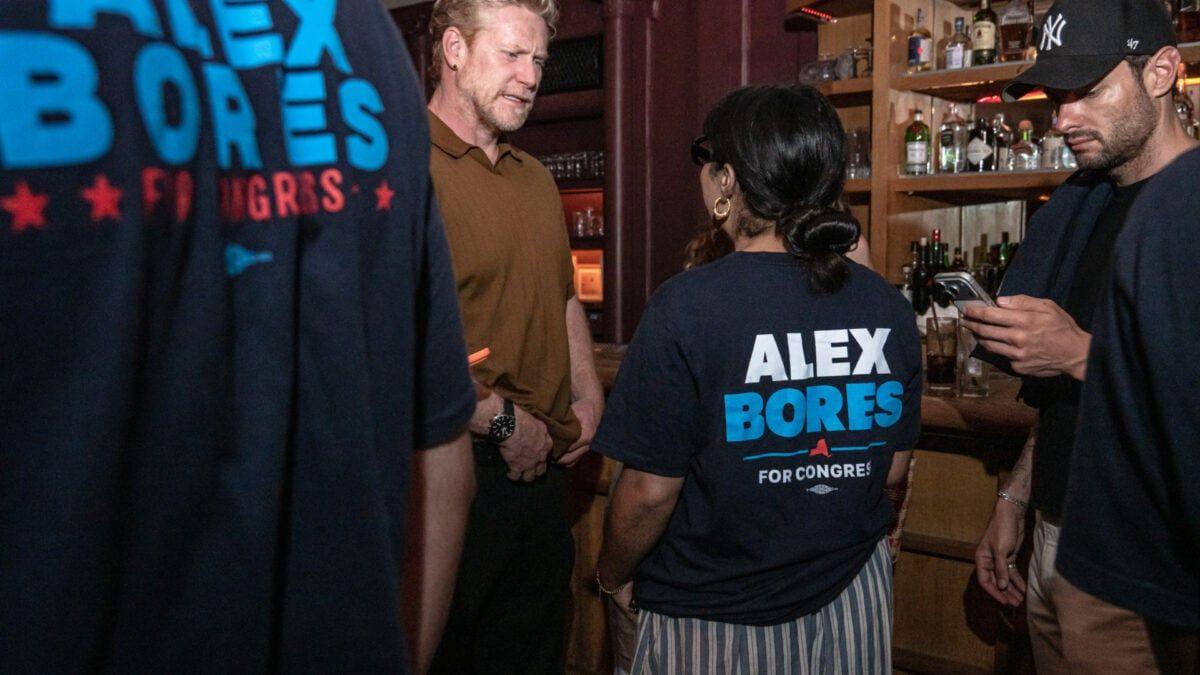
NEW YORK (AP) -- When New York Assemblyman Alex Bores decided to seek a promotion to Congress, the technology industry leapt into his way. Angered by Bores' legislation regulating artificial intelligence, a political group underwritten by investors in OpenAI spent more than $7 million on ads designed to crush the former computer engineer, who's running in the ultracompetitive June 23 Democratic primary for a Manhattan-based U.S. House district. That group, Leading the Future, counts titans of Silicon Valley, major venture capitalists and alumni of President Donald Trump's Republican administration among its donors. Bores complained about the spending, warning that it would deter other state lawmakers and members of Congress from trying to rein in the fast-growing industry. He swiftly became a nationally recognized cautionary tale of an underdog politician battling against an overwhelming tide of tech money. But then another wing of Silicon Valley rode to Bores' rescue. Political groups partly funded by Anthropic, the maker of the chatbot Claude, have spent more than $10 million boosting Bores' campaign. Crypto billionaire Chris Larsen, an Anthropic investor, has pledged another $3.5 million. Bores' race is now a proxy battle for two competing visions of how government should treat the technology industry and artificial intelligence. Adding to the tension is Bores' past working for Palantir, which he quit during Trump's first term over what he said were concerns about the tech company's work on immigration enforcement. "The lines are being drawn, and this primary is very much an expression of that," said Morten Bay, a research fellow at the Center for the Digital Future at the University of Southern California. "The core divide is regulation -- whether you're for or against it." Tech industry is at odds over regulation The schism mirrors a similar one running through Silicon Valley. Some tech titans, like Elon Musk, have embraced Trump and his movement, as well as the idea of limiting or eliminating most government regulations. But a large chunk of the industry remains traditionally Democratic, in favor of some government safeguards. Leading the Future -- funded by major Trump donors like OpenAI President Greg Brockman, venture capitalist Marc Andreesen and Palantir co-founder Joe Lonsdale -- has spent $7.6 million through a subsidiary against Bores. The political action committee, formed last year as the artificial intelligence industry's main political muscle, says that it supports AI regulation but that Congress should take the lead. The group contends that Bores is the only candidate who is bought and paid for. "As we have said from day one, Anthropic, its investors and the dark-money groups it funds would spend millions to send Alex Bores to Congress, and that is exactly what has happened," said Josh Vlasto, a co-lead of Leading the Future. Bores points to his own record crafting AI safety legislation for how he'd tackle the issue at the federal level. The regulation he spearheaded, known as the RAISE Act, is considered among the most sweeping attempts by a state to control the new technology. It requires major AI companies to file reports about safeguards against "catastrophic" risks that could injure more than 50 people, like the previously only-in-science-fiction scenario of AI melting down nuclear power plants or engineering new viruses. Leading the Future opposed Bores' original proposal but acceded to a modified version that was signed into law. But the PAC has made clear it hasn't forgiven Bores and describes his views as extreme. Bores pushed strict rules in New York The RAISE Act is the sort of regulation that would be nullified by Trump's proposed AI framework, which would bar states from enacting their own AI rules so Congress could create a national standard. However, there's been little movement in Washington to do that, which has left the industry essentially unregulated at the federal level. Leading the Future's refrain that Bores is a tool of OpenAI's business competitor has been taken up by Bores' many rivals in the race to succeed retiring Democratic Rep. Jerry Nadler. His 12th Congressional District stretches across upper and midtown Manhattan and is one of the wealthiest and most Democratic districts in the country. At recent debates, Bores' opponents have claimed he's simply a pawn in a corporate battle. "You're in the middle of a civil war between OpenAI and Anthropic. It has nothing to do with standing up to Trump's mega donors," said Jack Schlossberg, the Kennedy family heir and social media personality also running for the seat. Bores and his allies contend his opponents are simply trying to confuse voters. "This race started with AI megadonors pledging $10 million to stop me because they were afraid after I passed the strongest AI safety law in the country," Bores said in a statement. "Since then, everyone who supports AI regulation and safety -- from teachers to tech workers, from AI safety advocates to progressive activists -- has united to take the other side. This isn't one company versus another, this is one ideology versus another: regulate the powerful and protect people, or don't." Some tech groups are backing Bores Brad Carson, a former Democratic congressman from Oklahoma, runs the political action committee Public First, which has spent more than $6 million to back Bores through a subsidiary. The committee was created explicitly to counter Leading the Future and was an outgrowth of a nonprofit Carson helped fund to push for AI regulation. In an interview, Carson bristled at the suggestion that the enterprise was simply an Anthropic tool and said it had raised $30 million from nongovernmental organizations before Anthropic made a $20 million contribution. "It's not like two billionaires fighting it out," Carson said. "It's two philosophical movements fighting it out. All of them have wealthy supporters." Chris Larsen, a cryptocurrency billionaire who's pledged about $3.5 million on Bores' behalf, said in a statement that his decision to get involved "resulted directly from OpenAI's threats to make examples of candidates who seek common-sense regulation." Bay, the research fellow, noted that the district is an odd one for the more Trump-friendly groups to invest in because it's so liberal. Indeed, Bores' main rival for the nomination, Assemblyman Micah Lasher, supported Bores' RAISE Act. Carson said his group wants Bores to win but is comfortable with Lasher. "He's very good on AI issues too," Carson said. "We win either way."
[3]
New Super PAC, the Guardrails Alliance, Aims to Rally Tech Workers to Help Limit A.I.
The Guardrails Alliance, which has raised $5 million, is positioning itself as a populist effort that will take on the pro-A.I. interests trying to influence this year's elections. At an internal OpenAI policy meeting last month, employees pressed executives on donations that one of the company's founders had made to Leading the Future, a super PAC that favors lighter regulation of artificial intelligence and has become a powerful force in the midterm elections. Top policy executives tried to distance OpenAI from the activities of Leading the Future and the co-founder, according to current and former employees who described the meeting as tense but productive. But not all of OpenAI's employees, who disagree with the super PAC's tactics and decisions, left feeling reassured. Now, two Democratic operatives are aiming to leverage the unease within the tech industry over A.I. and harness an agitated work force into a political movement. On Thursday, they unveiled a super PAC, the Guardrails Alliance, with the support of tech workers, labor unions and other groups to push back on deep-pocketed interests like Leading the Future. The group is positioning itself as a populist effort in which small-dollar donations from rank-and-file workers will take on moneyed entities that oppose reining in A.I., while supporting legislation to safeguard the technology. "Our fundamental belief here is that people still do have the power to stop this autocratic takeover of the Trump administration and the tech sector," said Shaunna Thomas, who founded Guardrails with Leah Hunt-Hendrix, referring to how the Trump administration has generally shied from imposing A.I. rules. Guardrails is small compared with Leading the Future, which has a political budget of more than $100 million. Guardrails and its linked nonprofit have raised $5 million, with a goal of amassing $15 million this cycle. It has started deploying the cash. Guardrails said it was buying ads for the Democratic primary in New York City's 12th Congressional District to support Alex Bores, a former tech worker who has written A.I. safety legislation. The race is a focal point in the midterm battle over the technology, with more than $10 million spent on ads by at least three A.I.-related super PACs to support or oppose Mr. Bores before the primary on Tuesday. Guardrails plans to air $250,000 of ads for him over the final days of the race. Guardrails is emerging at a thorny time for the A.I. industry, which faces a backlash over how the technology may affect jobs, warfare and communities. Companies like OpenAI and Anthropic have seen the moment as a referendum on how the public views A.I., and executives at the firms have poured money into different super PACs. Leading the Future was announced last year, with $50 million pledged from the A.I. investor Andreessen Horowitz and $50 million from Greg Brockman, OpenAI's president, and his wife, Anna. Since then, three super PACs, including Guardrails, have formed in reaction to Leading the Future. In November, a group of donors aligned with Anthropic, OpenAI's rival, unveiled a super PAC called Public First. In May, Chris Larsen, a tech billionaire, began a group that has been spending primarily in the Bores race to specifically push back against OpenAI. OpenAI declined to comment. (The New York Times has sued OpenAI and its partner, Microsoft, accusing them of copyright infringement of news content related to A.I. systems. OpenAI and Microsoft have denied those claims.) Ms. Thomas and Ms. Hunt-Hendrix, the Guardrails founders, come from the Democratic Party's left flank. Last year, they began having conversations with groups that said there had not been enough conversations about how to protect people from the rapidly advancing technology. Ms. Thomas previously co-founded UltraViolet, a women's advocacy nonprofit group. Ms. Hunt-Hendrix, who straddles the world of left-wing politics and major donors, is a granddaughter of a Texas oil baron and has sought to use her proximity to the wealthy to move the Democratic Party to the left. Guardrails said its supporters included Chris Hyams, a former chief executive of the employment site Indeed.com; the American Federation of Teachers union; the American Association of University Professors; and the Working Families Party. David Farhi, a former OpenAI researcher, is also a donor. Guardrails said it was in discussions with more tech workers who had concerns about groups like Leading the Future. "This is the oldest story in business: You have billionaire C.E.O.s who want no restrictions or accountability," said Mr. Hyams, who left Indeed last year and now teaches A.I. ethics in Austin, Texas. "And then you have the rest of us, who want to be protected from completely unbridled wealth generation at all costs." At OpenAI, employees have voiced concerns on social media about Leading the Future and its attacks on Mr. Bores. After the tense internal meeting last month, which was earlier reported on by Transformer, the company posted to its policy blog, "We want to be explicit: No outside political group speaks for OpenAI or represents our company's views." Ms. Thomas said she saw Guardrails as a grass-roots counterweight to OpenAI. "This is not about matching them dollar for dollar, fighting them with money or another set of billionaires," she said. "What this vehicle is meant to do is be a political home for people who are concerned about the way the anti-regulation A.I. tech sector is trying to manipulate elections."
[4]
OpenAI's backers spent $7.6 million to destroy a state legislator. Anthropic spent $10 million to rescue him | Fortune
When New York Assemblyman Alex Bores decided to seek a promotion to Congress, the technology industry leapt into his way. Angered by Bores' legislation regulating artificial intelligence, a political group underwritten by investors in OpenAI spent more than $7 million on ads designed to crush the former computer engineer, who's running in the ultracompetitive June 23 Democratic primary for a Manhattan-based U.S. House district. That group, Leading the Future, counts titans of Silicon Valley, major venture capitalists and alumni of President Donald Trump's Republican administration among its donors. Bores complained about the spending, warning that it would deter other state lawmakers and members of Congress from trying to rein in the fast-growing industry. He swiftly became a nationally recognized cautionary tale of an underdog politician battling against an overwhelming tide of tech money. But then another wing of Silicon Valley rode to Bores' rescue. Political groups partly funded by Anthropic, the maker of the chatbot Claude, have spent more than $10 million boosting Bores' campaign. Crypto billionaire Chris Larsen, an Anthropic investor, has pledged another $3.5 million. Bores' race is now a proxy battle for two competing visions of how government should treat the technology industry and artificial intelligence. Adding to the tension is Bores' past working for Palantir, which he quit during Trump's first term over what he said were concerns about the tech company's work on immigration enforcement. "The lines are being drawn, and this primary is very much an expression of that," said Morten Bay, a research fellow at the Center for the Digital Future at the University of Southern California. "The core divide is regulation -- whether you're for or against it." Tech industry is at odds over regulation The schism mirrors a similar one running through Silicon Valley. Some tech titans, like Elon Musk, have embraced Trump and his movement, as well as the idea of limiting or eliminating most government regulations. But a large chunk of the industry remains traditionally Democratic, in favor of some government safeguards. Leading the Future -- funded by major Trump donors like OpenAI President Greg Brockman, venture capitalist Marc Andreesen and Palantir co-founder Joe Lonsdale -- has spent $7.6 million through a subsidiary against Bores. The political action committee, formed last year as the artificial intelligence industry's main political muscle, says that it supports AI regulation but that Congress should take the lead. The group contends that Bores is the only candidate who is bought and paid for. "As we have said from day one, Anthropic, its investors and the dark-money groups it funds would spend millions to send Alex Bores to Congress, and that is exactly what has happened," said Josh Vlasto, a co-lead of Leading the Future. Bores points to his own record crafting AI safety legislation for how he'd tackle the issue at the federal level. The regulation he spearheaded, known as the RAISE Act, is considered among the most sweeping attempts by a state to control the new technology. It requires major AI companies to file reports about safeguards against "catastrophic" risks that could injure more than 50 people, like the previously only-in-science-fiction scenario of AI melting down nuclear power plants or engineering new viruses. Leading the Future opposed Bores' original proposal but acceded to a modified version that was signed into law. But the PAC has made clear it hasn't forgiven Bores and describes his views as extreme. Bores pushed strict rules in New York The RAISE Act is the sort of regulation that would be nullified by Trump's proposed AI framework, which would bar states from enacting their own AI rules so Congress could create a national standard. However, there's been little movement in Washington to do that, which has left the industry essentially unregulated at the federal level. Leading the Future's refrain that Bores is a tool of OpenAI's business competitor has been taken up by Bores' many rivals in the race to succeed retiring Democratic Rep. Jerry Nadler. His 12th Congressional District stretches across upper and midtown Manhattan and is one of the wealthiest and most Democratic districts in the country. At recent debates, Bores' opponents have claimed he's simply a pawn in a corporate battle. "You're in the middle of a civil war between OpenAI and Anthropic. It has nothing to do with standing up to Trump's mega donors," said Jack Schlossberg, the Kennedy family heir and social media personality also running for the seat. Bores and his allies contend his opponents are simply trying to confuse voters. "This race started with AI megadonors pledging $10 million to stop me because they were afraid after I passed the strongest AI safety law in the country," Bores said in a statement. "Since then, everyone who supports AI regulation and safety -- from teachers to tech workers, from AI safety advocates to progressive activists -- has united to take the other side. This isn't one company versus another, this is one ideology versus another: regulate the powerful and protect people, or don't." Some tech groups are backing Bores Brad Carson, a former Democratic congressman from Oklahoma, runs the political action committee Public First, which has spent more than $6 million to back Bores through a subsidiary. The committee was created explicitly to counter Leading the Future and was an outgrowth of a nonprofit Carson helped fund to push for AI regulation. In an interview, Carson bristled at the suggestion that the enterprise was simply an Anthropic tool and said it had raised $30 million from nongovernmental organizations before Anthropic made a $20 million contribution. "It's not like two billionaires fighting it out," Carson said. "It's two philosophical movements fighting it out. All of them have wealthy supporters." Chris Larsen, a cryptocurrency billionaire who's pledged about $3.5 million on Bores' behalf, said in a statement that his decision to get involved "resulted directly from OpenAI's threats to make examples of candidates who seek common-sense regulation." Bay, the research fellow, noted that the district is an odd one for the more Trump-friendly groups to invest in because it's so liberal. Indeed, Bores' main rival for the nomination, Assemblyman Micah Lasher, supported Bores' RAISE Act. Carson said his group wants Bores to win but is comfortable with Lasher. "He's very good on AI issues too," Carson said. "We win either way."
[5]
'People-powered' super PAC launches to counter AI industry spending
A new political organization launched Thursday to "confront the efforts" of the pro-AI super PAC Leading the Future (LTF), which has poured millions of dollars into congressional primaries across the country. The super PAC, titled Guardrails Alliance, said it will represent parents, unions and tech workers to "follow the money" and "expose how a small group of Trump-aligned AI billionaires is trying to buy our elections." The super PAC also kicked off its first ad buy Thursday, spending $250,000 in support of New York Assembly member Alex Bores in New York's 12th Congressional District race. Bores is one of Leading the Future's main targets, spending more than $7 million against his campaign. LTF, launched last year, has received funding from OpenAI co-founder Greg Brockman, venture capitalist Joe Lonsdale, AI firm Perplexity and venture capital firm Andreessen Horowitz. It typically supports candidates who will help advance a "positive, forward-looking agenda for AI innovation" in Washington. The Hill reached out to LTF for comment. It comes just days before the New York Democratic primary to replace incumbent Rep. Jerry Nadler. According to polling from Decision Desk HQ, Bores is neck-and-neck with New York state assembly member Micah Lasher, while Jack Schlossberg, the grandson of former President Kennedy, and George Conway, a former Republican and frequent President Trump critic turned Democrat, trail behind. Guardrails Alliance joins a handful of other super PACs backing Bores in the face of LTF's attacks ads against the former computer engineer. Other AI-safety spending groups supporting Bores this cycle include Public First, launched by former Reps. Chris Stewart (R-Utah) and Brad Carson (D-Okla.), and Dream NYC, which framed Bores as someone who will "stand up to Trump's billionaire allies." You Can Push Back, a more recent super PAC, received $3.5 million from cryptocurrency executive Chris Larsen to support Bores last month.
Share
Copy Link
A new super PAC backed by tech workers, unions, and Democratic operatives has launched to support AI regulation as Silicon Valley splits over government oversight. The Guardrails Alliance faces Leading the Future's $100M budget in a proxy battle playing out in New York's congressional primary, where over $20 million has been spent on a single candidate who championed AI safety legislation.
Democratic operatives Shaunna Thomas and Leah Hunt-Hendrix launched the Guardrails Alliance on Thursday, positioning the new super PAC as a populist counterweight to deep-pocketed interests opposing AI regulation
1
. With $5 million raised and a goal of $15 million this cycle, the group draws support from tech workers, labor unions including the American Federation of Teachers, and organizations like the Working Families Party3
. The PAC aims to leverage growing discontent among rank-and-file employees who demand their companies develop and deploy AI responsibly, creating what Thomas calls "a political home for people who are concerned about the way the anti-regulation AI tech sector is trying to manipulate elections"1
.
Source: NYT
The battle over AI regulation has crystallized in New York's 12th Congressional District, where Alex Bores faces a June 23 Democratic primary that has attracted over $20 million in political spending from competing AI interests . Bores, a former Palantir computer engineer who left the company during Trump's first term over concerns about immigration enforcement work, spearheaded the RAISE Act—considered among the most sweeping attempts by a state to control AI technology
4
. The legislation requires major AI companies to file reports about safeguards against catastrophic risks that could injure more than 50 people, including scenarios like AI melting down nuclear power plants or engineering new viruses .
Source: AP
Leading the Future PAC, backed by OpenAI President Greg Brockman, venture capitalist Marc Andreessen, and Palantir co-founder Joe Lonsdale, has spent $7.6 million through a subsidiary against Bores
4
. The Guardrails Alliance deployed its first $250,000 ad buy supporting Bores, joining other super PACs including Public First Action (backed by Anthropic) which spent more than $10 million boosting his campaign, and You Can Push Back, which received $3.5 million from crypto billionaire and Anthropic investor Chris Larsen5
.The proxy battle reveals a fundamental schism within Silicon Valley over how government should treat the technology industry. Some tech titans like Elon Musk have embraced the Trump administration's approach of limiting or eliminating most government regulations, while a substantial portion of the industry remains traditionally Democratic and favors government safeguards . "The lines are being drawn, and this primary is very much an expression of that," said Morten Bay, a research fellow at the Center for the Digital Future at the University of Southern California. "The core divide is regulation—whether you're for or against it"
4
.
Source: TechCrunch
Leading the Future, which has a political budget exceeding $100 million, maintains it supports AI regulation but argues Congress should take the lead rather than individual states
3
. This stance aligns with Trump's proposed AI framework, which would bar states from enacting their own AI rules to create a national standard—though little movement has occurred in Washington, leaving the industry essentially unregulated at the federal level .Related Stories
At an internal OpenAI policy meeting last month, employees pressed executives on Greg Brockman's donations to Leading the Future in what current and former employees described as a tense but productive discussion
3
. Top policy executives attempted to distance OpenAI from the super PAC's activities, but not all employees left feeling reassured, with several voicing concerns on social media about Leading the Future's attacks on Bores1
. This year, tech worker mobilization has extended beyond AI ethics to demands that companies end contracts with U.S. Immigration and Customs Enforcement and urge the Pentagon to withdraw its designation of Anthropic as a supply chain risk1
.Chris Hyams, former chief executive of Indeed.com and now a Guardrails supporter who teaches AI ethics in Austin, Texas, framed the conflict in stark terms: "This is the oldest story in business: You have billionaire C.E.O.s who want no restrictions or accountability. And then you have the rest of us, who want to be protected from completely unbridled wealth generation at all costs"
3
. Thomas emphasized that Guardrails' grassroots origins distinguish it from corporate-backed efforts: "Our fundamental belief here is that people still do have the power to stop this autocratic takeover of the Trump administration and the tech sector"3
. The outcome of the June 23 primary will signal whether tech worker concerns can translate into electoral influence against well-funded anti-regulation efforts.Summarized by
Navi
[2]
19 Feb 2026•Policy and Regulation

17 Nov 2025•Policy and Regulation

12 Feb 2026•Policy and Regulation

1
Policy and Regulation

2
Startups

3
Policy and Regulation