AI Super PACs Pour $27 Million Into Congressional Primary, But Winner Rejects Their Influence


7 Sources
[1]
AI Super PAC's First Major Target Loses New York Congressional Primary
The increasingly powerful AI lobby poured millions of dollars into a campaign against a congressional candidate running in the Democratic primaries in New York. On Tuesday, they got what they paid for. Outside groups spent more than $40 million on the race to replace retiring Rep. Jerry Nadler's
[2]
Big tech spent millions on a single US congressional race. It won't be the last time
Pro- and anti-AI groups spent $24m on a congressional contest in New York, but it's unclear to what end When the Democratic primary for New York's 12th congressional district was called on Tuesday night, the result capped off one of the most expensive races of its kind in the state's history. More
[3]
AI money gets an early test at the ballot box
Why it matters: AI money is now a significant part of the election landscape. * Industry-backed groups have spent the last year raising hundreds of millions of dollars to influence the political debate around AI -- and in the process, made the technology a more visible issue for voters. * Leading
[4]
Anthropic and OpenAI waged a $27 million proxy war in a Manhattan congressional race. The winner told them both to get lost. | Fortune
Micah Lasher had a message for the two AI companies that had just spent $27 million trying to decide who would represent Manhattan in Congress. "I have some news for the two big AI companies who've taken such an unusual interest in who won this congressional seat," he said from the podium Tuesday
[5]

The AI industry just won a race -- but lost the war
Eric Levitz is a senior correspondent at Vox. He covers a wide range of political and policy issues with a special focus on questions that internally divide the American left and right. Before coming to Vox in 2024, he wrote a column on politics and economics for New York Magazine. New York's
[6]

New York Democrat Micah Lasher wins House primary that drew big spending from AI groups
New York Assemblyman Micah Lasher emerged from a crowded Democratic primary in New York's 12th Congressional District.Lev Radin / ZUMA Press Wire via Reuters New York Assemblyman Micah Lasher has won the Democratic nomination in the 12th Congressional District, NBC News projects, benefitting from
[7]

The AI Industry Successfully Defeats Its No. 1 Target
State Assemblyman Micah Lasher was projected to win the Democratic primary for New York's 12th Congressional District in Manhattan, a major win for AI industry groups that had targeted his leading opponent. Lasher's victory over Alex Bores, another assemblyman, came after an industry-funded super
Share
Copy Link
AI-focused super PACs spent over $27 million on a single congressional primary in Manhattan, making it one of the most expensive races in New York history. Alex Bores, who championed AI safety legislation, lost to Micah Lasher—but the victor promised to ignore both AI companies and pursue the same AI regulation agenda. The race reveals how AI money in politics is reshaping campaigns while raising questions about whether tech spending can counter growing anti-AI sentiment.
AI Money in Politics Reaches Unprecedented Levels in Manhattan Race
The Democratic primary for New York's 12th congressional district became a proving ground for AI political spending, with tech-backed PACs injecting over $27 million into a single race to replace retiring Rep. Jerry Nadler
1
. The staggering sum made it one of the most expensive congressional primaries in state history, transforming a local contest into a national battleground over AI regulation and Silicon Valley's growing political influence2
.Alex Bores, a New York state assemblymember who sponsored the landmark RAISE Act requiring AI companies to develop and publish formal safety protocols, became the primary target of Leading the Future, an AI-focused super PAC backed by OpenAI president Greg Brockman, Andreessen Horowitz, and Perplexity
1
. The tech-backed PACs spent $8 million specifically to defeat Bores, flooding the district with attack ads that framed him as a hypocrite for his previous work at surveillance company Palantir2
.
Source: Vox
Rival AI Companies Turn Race Into Proxy War
The congressional primary quickly evolved into a proxy war between competing factions of Silicon Valley. While Leading the Future worked to defeat Bores, AI safety advocates rallied to his defense with even more substantial political spending. Anthropic-backed Public First Action contributed at least $11 million to support Bores, while crypto billionaire Chris Larsen's You Can Push Back super PAC added another $3.5 million
4
. In total, pro-AI safety groups spent roughly $19 million supporting Bores's candidacy1
.This split reflected deeper divisions within the tech industry over AI governance. Supporters of stricter federal AI policy argued the industry was underestimating dangers of underregulated AI development in pursuit of profit. Critics countered that heavy-handed AI safety legislation would hinder innovation and cause the U.S. to lose a global AI race to China
1
. The race became a litmus test for whether AI oligarchs could effectively punish candidates who challenged their interests.Winner Embraces Same AI Regulation Agenda
Micah Lasher won the Democratic primary with 39% of the vote, defeating Bores by roughly 4,000 votes
4
. But the outcome delivered an unexpected twist: Lasher had co-sponsored the same RAISE Act that made Bores a target and campaigned on an equally aggressive platform for federal AI policy reform1
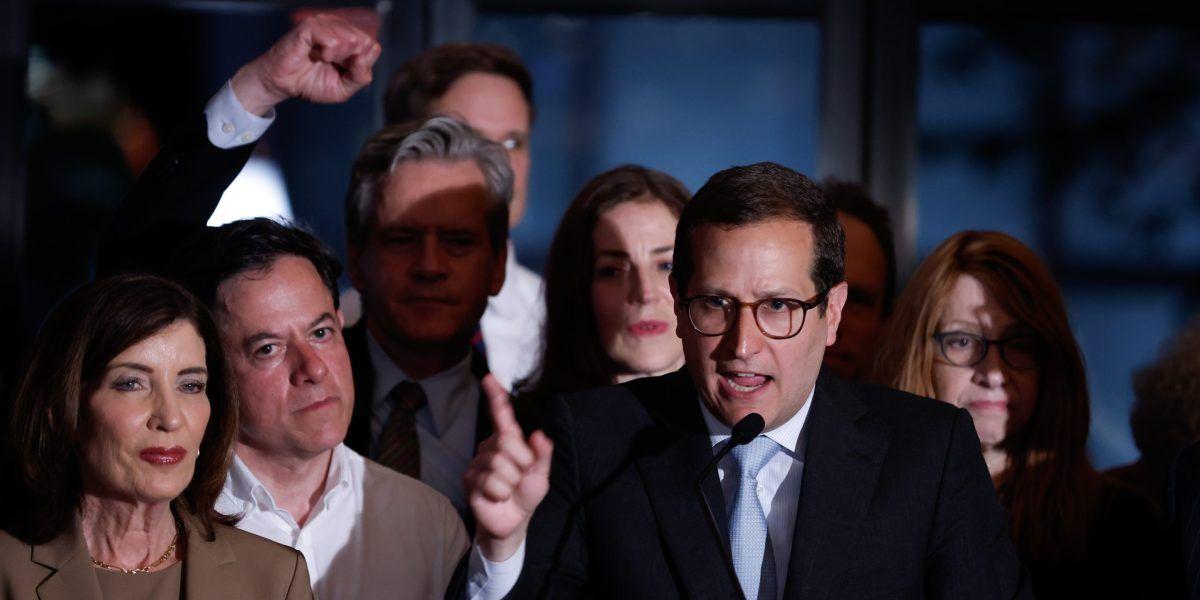
. In his victory speech, Lasher directly addressed the AI companies that spent heavily on the race: "I have some news for the two big AI companies who've taken such an unusual interest in who won this congressional seat. I won't be taking my cues from either of you when it comes to protecting our kids, our jobs, our environment"2
.
Source: Fortune
The result suggests that massive political spending by tech-backed PACs may not achieve their intended goals. Before Leading the Future targeted him, Bores was polling in single digits with only a 10% chance of victory
5
. The opposition campaign may have inadvertently elevated his profile and validated his credentials as a challenger to Silicon Valley power, helping him finish a close second3
.Related Stories

AI Super PACs Prepare for Broader Campaign Influence
The Manhattan race represents just the opening salvo in what promises to be extensive AI industry involvement in elections. Leading the Future has raised over $100 million and thrown its weight behind nearly 30 races as November's midterm elections approach
3
. AI-related super PACs have already spent more than $50 million on 2026 elections, with $22 million from pro-innovation groups and nearly $28 million from pro-safety PACs4
.The flood of attack ads in New York's 12th congressional district offered a preview of tactics likely to appear nationwide. Jobs and Democracy PAC bought an ad supporting Bores that ran as the front page of the New York Daily News, mimicking genuine news coverage and drawing criticism from the newsroom's union
2
. These campaigns aim not just to win individual races but to send signals to other politicians about the consequences of supporting or opposing AI regulation without industry input.
Source: Axios
Despite the uncertain results in New York, the race demonstrates that AI money in politics has become a significant force reshaping the campaign landscape. Whether this political spending can counter growing public backlash against AI remains an open question as both sides prepare for broader battles over the future of AI governance in America.
References
Summarized by

Navi
[2]
Related Stories
AI Super PACs wage $27 million proxy battle over regulation in New York congressional race
17 Jun 2026•Policy and Regulation

Super PACs turn AI regulation into a central campaign topic, spending millions in 2026 midterms
12 Feb 2026•Policy and Regulation

AI industry floods midterm elections with $150 million as battle over regulation intensifies
19 Feb 2026•Policy and Regulation

Recent Highlights



Recent Highlights
Today's Top Stories



Don’t drown in AI news. We cut through the noise - filtering, ranking and summarizing the most important AI news, breakthroughs and research daily. Follow topics that matter to you and stay ahead.


