17 Sources
[1]
OpenAI launches ChatGPT for personal finance, will let you connect bank accounts | TechCrunch
On Friday, OpenAI launched a new set of personal finance tools in preview for ChatGPT Pro subscribers in the U.S., letting them connect their accounts and ask questions ranging from spending analysis to future financial planning. OpenAI has partnered with the financial connection service Plaid to manage the account connections. Users can connect to over 12,000 financial institutions, including Schwab, Fidelity, Chase, Robinhood, American Express, and Capital One. Once users connect these accounts, they will see a dashboard of their portfolio performance, spending, subscriptions, and upcoming payments. The new product comes just one month after OpenAI acquired the team behind personal finance startup Hiro, which was backed by firms like Ribbit, General Catalyst, and Restive, in April. OpenAI said that the Hiro team's expertise in finance was useful in launching this product, but didn't specify if the entire feature was built by them. OpenAI users can access the tool by selecting "Get started" in the "Finances" option in the sidebar, or typing "@Finances, connect my accounts" in a ChatGPT conversation. Once users do that, the chatbot will guide them about linking accounts through Plaid. The company said it plans to support Intuit soon, which would enable analysis such as the impact of a stock sale on taxes or the odds of a credit card approval. According to OpenAI, more than 200 million users already ask financial questions to ChatGPT every month. The company also noted that the new GPT-5.5 model is stronger at reasoning with context, which is crucial for answering finance-related questions. The company said it worked with finance experts to create a benchmark for the model to improve on personal finance questions. With the new financial tool integration, users can get detailed answers to questions such as "I feel like I've been spending more recently. Has anything changed?" or "Help me build a plan to be ready to buy a house in my area in the next 5 years." Users can go to Settings > Apps > Finances to remove connections to certain accounts if they want. Once they disconnect a service, the synced data will be removed from ChatGPT in 30 days. What's more, Users can also view and delete financial memories from the Finances page. Generalized chatbots are designed to answer anything, leading people to ask questions about data-sensitive topics such as health, finance, and personal life. AI companies are realizing this and making specialized products for these sectors. Both OpenAI and Anthropic have launched health-related tools. Earlier this month, Perplxity launched its own financial research product based on its Computer agent. OpenAI said its personal finance tools will be available on ChatGPT on the web and iOS to Pro users. It noted that, based on the feedback from these users, it wants to improve the product before making it available to Plus users.
[2]
OpenAI now wants ChatGPT to access your bank accounts
Your trust in AI is about to be put to the test: OpenAI will soon let you give the chatbot direct access to your bank accounts. The new feature announced in preview today will allow users to "securely connect" ChatGPT with Plaid -- the bank-to-app bridging platform used by 12,000 financial institutions, including Schwab, Fidelity, Chase, Capital One, and more. "More than 200 million people are already going to ChatGPT every month with finance questions - from budgeting to tips on how to cut back on spending," OpenAI said in its announcement. "Now, users can securely connect their financial accounts with Plaid to get the full view of their financial picture in the context of their personal goals, lifestyle, and priorities that they've shared with ChatGPT, powered by OpenAI's advanced reasoning capabilities."
[3]
Trust ChatGPT With Your Finances? OpenAI Rolls Out Banking Integration
OpenAI's ChatGPT has wormed its way into more and more parts of consumers' lives, from work to their children's education, and even mental health and romantic relationships. Now, the AI chatbot is turning its attention toward users' finances. Consumers can now connect bank accounts to the chatbot using technology from fintech Plaid to get more granular details about where their money is going -- for example, how much they are spending on food, entertainment, transport, or utility bills, as well as what upcoming payments they have looming on the horizon. It can also break down easily missed recurring expenses, like monthly subscriptions. According to the announcement, ChatGPT can now provide more forward-looking, financial adviser-style guidance. For example, users can input prompts like: "How can I afford a house in Chicago?" with the LLM then providing a breakdown based on how much cash they have and their monthly income. Financial institutions supported at launch reportedly include Charles Schwab, Fidelity Investments, JPMorgan Chase, Robinhood, American Express, and Capital One. The tool is rolling out now for $200-per-month Pro users in the US on web and iOS, with support for more than 12,000 financial institutions. OpenAI says it eventually plans to roll the tool out to Plus users after it gets a chance to "learn and improve" from early use. Though this is the first time OpenAI has launched a banking-specific integration like this, OpenAI claims that more than 200 million people a month already query ChatGPT about topics like budgeting, investments, and planning for future financial goals. If you're interested in giving the tool a go, open Finances from the sidebar in ChatGPT and select Get Started. Alternatively, users can reportedly start a conversation from anywhere within ChatGPT by typing "@Finances, connect my accounts." Users will then need to connect their bank accounts through Plaid. ChatGPT will then begin syncing and categorizing their data, which may take a few minutes. OpenAI also says it plans to roll out an integration with Intuit, a popular accounting software provider, in the near future. The new feature comes after OpenAI reportedly acquired Hiro Finance in April this year, a startup that billed itself as an "AI personal CFO." OpenAI absorbed its entire team in the process. Relying on ChatGPT as a personal financial adviser may still have some drawbacks. Last month, The Guardian published an investigation in which ChatGPT's financial advice was compared with that of experienced and certified financial advisers. While the experts found much of the chatbot's output to be broadly accurate, they also pointed to notable omissions and a lack of specific recommendations that a real professional might be able to provide. "ChatGPT can help you stay informed and feel more confident managing your finances, but it is not a replacement for professional financial advice," said an OpenAI spokesperson.
[4]
OpenAI wants ChatGPT to read your bank statements -- here's what it can actually see
Simon is a Computer Science BSc graduate who has been writing about technology since 2014, and using Windows machines since 3.1. After working for an indie game studio and acting as the family's go-to technician for all computer issues, he found his passion for writing and decided to use his skill set to write about all things tech. Since beginning his writing career, he has written for many different publications such as WorldStart, Listverse, and MakeTechEasier. However, after finding his home at MakeUseOf in February 2019, he would eventually move on to its sister site, XDA, to bring the latest and greatest in Windows, Linux, and DIY electronics. Summary ChatGPT can connect to your bank to view balances, transactions, investments, and liabilities. It gives personalized saving and budgeting tips when it can see your real transactions. OpenAI says ChatGPT can't see full account numbers or control accounts; privacy controls are included. According to OpenAI, 200 million people visit ChatGPT with money-related issues every month. People want to learn how to save, how to earn more, and how to manage their investments, and when the human world fails to deliver what they're looking for, they turn to AI. However, for an AI to have a good idea of someone's financial situation, it needs details about their accounts so it can better render judgment. So, why not cut out the middleman and just let the AI take a peek at your financial records? That's exactly what OpenAI wants to do with its new feature. The company has announced that a new personal finance experience has arrived on ChatGPT, and fortunately, your AI companion won't have the ability to make purchases on your behalf. Related Watch out, NotebookLM -- ChatGPT's new "study mode" could steal your thunder Looks like I found my newest study buddy. Posts 2 By Mahnoor Faisal OpenAI reveals a new finance experience for ChatGPT Are you brave enough to admit you spend too much on your hobbies? In a blog post on the OpenAI website, the company explains the new feature in preview right now. It lets you connect ChatGPT to your bank account, giving your AI assistant the ability to take a peek at your finances. On the website, OpenAI shows two examples of someone asking ChatGPT, "Help me come up with a plan to save a little bit more in the next few months," one where the finances tool is not connected, and one where it is The chat without the financial data is good, but because ChatGPT doesn't know about the user's financial data, it has to settle for giving general advice. In comparison, the advice it gives when it has access to the user's data means it can sum up the user's expenditures and give personalised tips based on what they spend money on. It's useful, but the very idea of giving a chatbot access to your financial records is enough to make a privacy advocate's toes curl. Fortunately, if you're worried that ChatGPT will start investing in stocks while you're asleep, OpenAI says that its AI won't have that much power: Your financial data is sensitive, and we have built this experience to respect your privacy and ensure that you're in control of your information. When you connect your accounts, ChatGPT can access your balances, transactions, investments, and liabilities to help visualize your finances or answer your questions. It cannot see full account numbers or make any changes to your accounts. While I can imagine some people still not feeling great about using this new financial tool, the truth is that, if people are already uploading records and statements to the AI for help, attaching their account to ChatGPT basically cuts out a few steps to achieve the same result. Related 6 free AI tools that do the same thing as ChatGPT Pro Free alternatives have come a long way. Posts 2 By Dhruv Bhutani
[5]
ChatGPT Can Now Connect to Your Bank Account and See All Your Transactions
On Friday, the company released a preview version of a personal finance feature for U.S.-based ChatGPT Pro users. Select users will now be able to connect their accounts across more than 12,000 financial institutions to the chatbot to view a financial dashboard of their recent account activity and to ask ChatGPT "questions grounded in your financial context," the company announced in a press release. The feature also includes a partnership with financial software company Intuit, in which users will be able to schedule sessions with local tax experts all within ChatGPT. The goal is to eventually make the feature available to all users. "With your financial accounts connected, ChatGPT can combine that reasoning with your real financial context and what you've shared about your goals, lifestyle, and priorities, helping you spot patterns, understand tradeoffs, and plan for big decisions in a way that feels more personal and complete," the company said. That context can include whether you have a mortgage, if you're saving up to buy a car, or any debt you are trying to pay off. ChatGPT can remember all that to "inform future conversations" where users might ask the chatbot to analyze changes in spending patterns, figure out the biggest risks in their portfolios, or build out a plan to buy a house in the next five years. If you are someone reasonably wary of giving out sensitive financial information about yourself, especially to an AI chatbot that had a major data leak scandal not that long ago, you might be thinking, "Why on Earth would I want to do that?" But OpenAI claims there is some existing appetite for it. More than 200 million people every month ask for ChatGPT's help on things like budgeting, investment strategy, and future planning, the company shared in the press release. The company also claims that, with this new tool, the practice will now be safe. The bank accounts will be "securely" connected, and ChatGPT won't be able to see "full account numbers or make any changes to your accounts," OpenAI said. But still, the chatbot will be able to access your balances, transactions, investments, and liabilities in order to perform the tasks that OpenAI is advertising. This information will likely be saved by OpenAI and used at least to train its AI models, that is, if you opt into it through the "improve the model for everyone" option in settings. Chances are, you already do opt into this, as the setting is auto-enabled for users, though you can easily opt out by turning the toggle off. OpenAI has not detailed any way that user data can be used other than for training models. But the company has notoriously walked back some previous ChatGPT claims and promises on its rocky quest for profitability ahead of a rumored IPO. Plus, both the company and its CEO Sam Altman are currently enveloped in a flashy legal battle with Elon Musk, in which some of the unearthed evidence and witness testimony have framed Altman as a liar, though he denies the accusations. Uploading that sensitive information can also carry substantial risks in the event of a hack, leak or breach. “If your documents are part of AI’s training data â€" there is a risk that information will be induced by a special prompt that malicious actors might use," University of Illinois associate computer science professor Gang Wang told CNN earlier this week when asked about the risks of sharing financial information with AI chatbots. The interview took place before OpenAI's announcement of the feature. For example, a hacker who somehow abused ChatGPT to gain access to your recent payments can use that information to craft a believable phishing email, because they would know the exact date you purchased something from a specific merchant and exactly how much you paid.
[6]
OpenAI wants ChatGPT to see your bank account. The pitch is convenience. The risk is everything else.
ChatGPT can now connect to your bank accounts via Plaid, giving OpenAI access to the most intimate data category left. OpenAI has launched a personal finance experience inside ChatGPT, letting subscribers connect their bank accounts, credit cards, investment portfolios, and loan accounts to the chatbot and ask questions grounded in their actual financial data. The feature, released on 15 May, is available in preview to US-based ChatGPT Pro subscribers on web and iOS, with support for more than 12,000 financial institutions through a partnership with Plaid. The integration is straightforward. Users open a new "Finances" tab in the ChatGPT sidebar or type "@Finances, connect my accounts" in any conversation. ChatGPT guides them through linking accounts via Plaid, the same connectivity layer used by Venmo, Robinhood, and most major budgeting apps. Once connected, the chatbot generates a dashboard showing portfolio performance, spending patterns, subscriptions, and upcoming payments. Users can then ask questions like "what did my last holiday actually cost me?" or "help me build a plan to buy a house in five years." OpenAI says ChatGPT can see balances, transactions, investments, and liabilities, but cannot see full account numbers or make changes to accounts. Users can disconnect services at any time through settings, and synced data is removed within 30 days. Financial memories, the contextual information ChatGPT stores about a user's goals and priorities, can be viewed and deleted from the Finances page. The company says more than 200 million users already ask ChatGPT finance-related questions every month. The new tool is designed to move those conversations from generic advice to answers grounded in a user's actual money. The feature runs on GPT-5.5, OpenAI's latest reasoning model, which the company says is stronger at the context-dependent reasoning that personal finance questions require. OpenAI worked with more than 50 finance professionals to build an internal benchmark, on which GPT-5.5 Thinking scored 79 out of 100 and GPT-5.5 Pro scored 82.5. The launch comes exactly one month after OpenAI acquired Hiro Finance, an AI-powered personal finance startup founded by Ethan Bloch, who previously sold neobank Digit to Oportun for more than $200 million. Hiro was backed by Ribbit Capital, General Catalyst, and Restive. OpenAI described it as an acqui-hire: Hiro shut down on 20 April, deleted all user data by 13 May, and Bloch's team of roughly ten people joined OpenAI. The company said the Hiro team's expertise was useful in launching the finance feature but did not specify whether the entire product was built by them. Hiro was itself the second fintech acquisition for OpenAI, following its purchase of investment app Roi approximately six months earlier. OpenAI is also working with Intuit on deeper integrations. Future capabilities could include understanding the tax implications of a stock sale, estimating credit card approval odds, or scheduling a session with a local tax professional, all inside ChatGPT. The Intuit partnership, if it materialises at the scale described, would move ChatGPT from a passive advisory tool to something closer to a financial services platform. The competitive context is immediate. Perplexity launched its Computer for Professional Finance product on 5 May, aimed at analysts and investors, with 40-plus built-in finance tools pulling from SEC filings, FactSet, and other institutional data sources. On 14 May, Perplexity expanded its consumer finance capabilities by adding Plaid integration for personal brokerage, checking, savings, and credit card accounts, the same infrastructure OpenAI announced one day later. Both companies now let paying subscribers connect their bank accounts to an AI chatbot through the same third-party data pipe. The difference is positioning. Perplexity is building outward from institutional finance, with licensed data feeds and audit trails designed for professional research workflows. OpenAI is building inward from consumer convenience, starting with the 200 million people who already ask ChatGPT about their money and giving them a reason to share their actual financial data. The approaches will likely converge, but for now, they reveal different theories about where the value in AI-powered finance actually sits. The timing is also notable because OpenAI recently introduced advertising into ChatGPT, shifting from a cost-per-thousand-impressions model to cost-per-click within ten weeks of the ads launching. OpenAI says it does not build audience segments from user conversations and does not show ads to users it identifies as under 18. But the structural reality is that the same platform now hosts ads, financial data, and 200 million monthly finance conversations. OpenAI's privacy controls may be robust, but the combination of advertising and intimate financial data inside a single product will draw scrutiny from regulators, privacy advocates, and users who are accustomed to treating their ChatGPT conversations as private. The fiduciary question is the one that matters most and receives the least attention. A human financial adviser has a legal obligation to act in a client's best interest. ChatGPT does not. OpenAI includes a disclaimer that the tool "is not a replacement for professional financial advice," but that caveat sits alongside a product experience designed to feel like professional financial advice. The gap between what the product looks like and what it legally is, is where the risk lives. Javelin Research analyst Dylan Lerner described OpenAI's back-to-back fintech acquisitions as an aggressive push into financial services, positioning the company to own what he called "share of mind" in consumer finance. PitchBook fintech analyst Rudy Yang called personal finance one of the most talked-about use cases for generative AI. The consensus is that OpenAI is not entering banking. It is building something that sits above banking: a conversational layer through which consumers interact with their money, potentially disintermediating the banks and fintechs whose accounts it aggregates. The feature is currently limited to Pro subscribers, the $200-per-month tier that gives access to OpenAI's most capable models. OpenAI says it will expand to Plus subscribers after learning from early usage. The company's broader commercial strategy, which now spans consumer subscriptions, enterprise deployment vehicles, developer APIs, and advertising, increasingly resembles a platform play in which financial data is another input to a system designed to know everything about its users. Plaid's chief technology officer, Will Robinson, framed the partnership as a signal of where consumer financial experiences are headed. Plaid's research suggests 64% of consumers who have used AI for finances say it improved their ability to evaluate financial products, and 53% say it helped them manage day-to-day spending. The numbers are encouraging for adoption. Whether they should be encouraging for the people whose data is flowing through the system is a different question. For now, OpenAI is betting that the answer to "should I connect my bank account to a chatbot that also shows me ads?" is yes, provided the chatbot is useful enough. Two hundred million monthly finance conversations suggest the demand is there. The question is whether the trust is.
[7]
ChatGPT wants to be hooked up to your savings account, and that's definitely fine
It can connect to financial accounts and give more personalized budgeting and planning help. Asking ChatGPT how to save money is one thing. Letting it actually get its tentacles into your accounts and tell you where the damage is happening is another level of trust entirely. For those willing to grant that level of access, OpenAI has announced a new personal finance experience in ChatGPT. It sounds potentially very useful in some respects, provided you're not already recoiling at the idea of plugging your financial life into an AI chatbot.
[8]
ChatGPT now wants to connect up to your bank accounts -- so what could possibly go wrong?
* OpenAI launches a personal finance service in ChatGPT * It's being tested now with Pro subscribers in the US * Connect your accounts, and ask queries about your finances OpenAI's latest ChatGPT initiative is "a new personal finance experience": now available in preview to Pro subscribers in the US, the AI chatbot will connect up to user financial accounts, and answer queries on everything from daily budgeting to long-term savings. In its announcement post, OpenAI says it wants to help people to make sense of their money more easily -- without having to check across multiple apps, accounts, spreadsheets, and other records to understand incomings and outgoings. "ChatGPT can combine that reasoning with your real financial context and what you've shared about your goals, lifestyle, and priorities, helping you spot patterns, understand tradeoffs, and plan for big decisions in a way that feels more personal and complete," the post states. That said, the announcement also emphasizes that this "it is not a replacement for professional financial advice", which is probably wise given the potential for hallucinations. The service is powered by GPT‑5.5 Thinking, which OpenAI says "outperforms earlier models on complex personal finance tasks". It's still far from perfect though -- it gets an 82.5 out of 100 on OpenAI's "internal benchmark", whatever that means -- so if ChatGPT tells you you've been spending too much on iced coffees, or that you need to invest your savings in AI companies, you might want to double-check the working. Users aren't convinced According to OpenAI, lots of people are already asking for financial advice from ChatGPT, so this is a logical next step. The idea is you could ask about your spending habits over time, the best way to save up for a house, how much you're spending on subscriptions, and what the risks of certain investments are, for example. The new personal finance experience has been developed in partnership with over 50 finance professionals, and as it gradually expands to more people, OpenAI wants to bring industry partners on board. Eventually, you could be able to ask about different loan options and then apply for a loan right in the ChatGPT app. Accounts from more than 12,000 financial institutions can be connected, and Pro users can get started via the Finances option in the sidebar or with the "@Finances, connect my accounts" prompt. Accounts can be disconnected and chats can be deleted at any time, and ChatGPT cannot make any financial transactions (at least... not yet). Once those accounts are connected, you get a dashboard of information that breaks down where your money is going and coming in from, and your finances over time: It all looks like a sleek set of tables and charts in Excel. Judging by the Reddit reaction, the initial take-up might be slow: one user says this "sounds like malware", while another says it's "clearly insane". There are also very real concerns about data privacy and AI errors. Follow TechRadar on Google News and add us as a preferred source to get our expert news, reviews, and opinion in your feeds.
[9]
OpenAI announces personal finance tools in ChatGPT for power users
Weeks after guru Mel Robbins received backlash for telling women to upload their banking statements to AI (specifically in an ad for Microsoft Copilot), OpenAI today announced a "personal finance experience" within ChatGPT. The company is releasing a preview of the experience for Pro users in the United States, who can connect their financial accounts to the platform via the fintech software Plaid. Once their accounts are linked, ChatGPT can reason with actual monetary numbers and the user's shared priorities to help them spot patterns and plan for the future, OpenAI stated in its blog post introducing the product. Users will be able to see a dashboard of their portfolio, spending, and upcoming payments. OpenAI's suggested use cases include financial goal planning, travel spend analysis, investment risk analysis, and subscription review. Mashable 101 Fan Fave: Vote for your favorite creator today! Pro users in the U.S. can start connecting their accounts today on a web browser or iOS, with support from thousands of financial institutions. OpenAI didn't list the institutions, but screenshots of the experience show American Express, Bank of America, Charles Schwab, and Robinhood as examples. Integration with financial software company Intuit, which runs TurboTax, Credit Karma, and QuickBooks, is coming soon, OpenAI says. In its announcement, OpenAI claims that 200 million people already use ChatGPT each month for budgeting, investment questions, and financial planning. In this new financial mode, ChatGPT can't see full account numbers, but it can assess bank balances, transactions, and liabilities. Users can disconnect their financial accounts at any time, delete financial memories (used specifically for these conversations), or use temporary chats that won't appear in users' history.
[10]
ChatGPT will now dole out finance tips if you connect your bank account. I won't.
ChatGPT can now access your bank account to offer spending analysis and financial planning. ChatGPT already knows a lot about you. OpenAI now wants to add your finances to that list. The company has launched a personal finance feature for ChatGPT, currently in preview for Pro subscribers in the US at $200 a month. OpenAI says it will expand to Plus users after gathering feedback from this early rollout. It lets you connect your financial accounts through Plaid, a platform that bridges bank apps with third-party services and works with over 12,000 institutions, including Chase, Fidelity, Schwab, American Express, and more. What can ChatGPT see when you connect your financial accounts? Once connected, ChatGPT can see your balances, spending history, active subscriptions, upcoming payments, stock portfolio, and liabilities like credit card debt and mortgages. It cannot make changes to your accounts or view full account numbers. Recommended Videos A dashboard gives you a snapshot of your financial picture, and you can ask the chatbot things like whether your spending has changed recently or how to plan for buying a home. OpenAI says its newer GPT-5.5 model handles financial reasoning better than previous versions. Support for Intuit is also coming soon, which would allow ChatGPT to analyze things like the tax impact of a stock sale or your odds of getting approved for a credit card or loan. Should you actually connect your bank account to ChatGPT? OpenAI says users stay in control, with the ability to disconnect accounts at any time. Synced data gets removed within 30 days of disconnecting. You can also delete saved financial memories and choose whether your data is used to train OpenAI's models. OpenAI doesn't clearly spell out what happens to your financial data beyond AI training or what protections are in place in the event of a security breach. Your bank balance, spending habits, and credit card debt are about as personal as it gets. Whether you trust an AI chatbot with all of that is a decision worth taking seriously. This launch follows ChatGPT Health, introduced in January, which raised similar trust questions around sensitive personal data. Earlier today, OpenAI also added Codex to the ChatGPT mobile app, allowing you to monitor and steer AI-powered coding sessions directly from iOS and Android.
[11]
ChatGPT Can Now See Your Bank Account -- Here's What That Actually Means - Decrypt
OpenAI acquired two AI finance startups in the past year -- Roi and Hiro -- to build toward this moment. ChatGPT has been giving generic budgeting advice for years. You know the drill: track your subscriptions, automate your savings, maybe cook at home more. But some people wanted more -- for some reason. If you are one of those people, OpenAI just launched a personal finance feature in ChatGPT that connects to your actual bank accounts and answers money questions based on what you've actually spent -- not what the average American spends. It's rolling out to Pro subscribers ($200/month) in the U.S. on web and iOS first. The feature works through Plaid, the financial data infrastructure that already powers Venmo, Robinhood, and thousands of other fintech apps. Once you connect, ChatGPT gets read-only access to your balances, transactions, investments, and liabilities across more than 12,000 financial institutions -- including Chase, Fidelity, Schwab, American Express, and Capital One. It cannot move money or see your full account numbers: It simply reads all your financial information, thus having the ability to generate a full financial profile of who you are. That's it, nothing to be afraid of... right? The difference in output is stark. Without your accounts connected, ChatGPT responds to "help me save more" with a generic list of suggestions: cut subscriptions, reduce takeout, automate transfers, etc. With your accounts linked, it looks at your last 90 days of actual spending across dining, shopping, and transportation -- and builds a personalized monthly plan with real dollar targets based on what you've already been spending. If you wanted more personalized advice with the normal ChatGPT you would have to download your bank statements one-by-one and feed all that information, consuming a lot of time. This new feature automatically fetches everything for you. This move didn't come out of nowhere. OpenAI acquired Hiro Finance just last month -- a fintech startup that had billed itself as an "AI personal CFO." The deal was effectively an acqui-hire, with the Hiro team folding into OpenAI as Hiro's product shut down. It was OpenAI's second fintech acquisition in less than a year, following its earlier pickup of Roi, a personalized investing app. The new tool also sets a financial benchmark of its own. OpenAI worked with over 50 finance professionals to evaluate model performance on complex personal finance tasks. GPT-5.5 Thinking -- the default model for the Finances feature -- scored 79 out of 100 on that benchmark. GPT-5.5 Pro, available for Pro subscribers, scored 82.5. OpenAI isn't the only one moving here. Perplexity recently launched its own Plaid-connected finance product, and Intuit is coming to ChatGPT soon, which would enable things like estimating the tax impact of selling stock or getting odds on credit card approval -- all inside the chat interface. The obvious question: Is it safe to hand this much financial data to a chatbot? Plaid uses bank-level encryption, doesn't store your bank credentials, and has processed over 150 million connections across 12,000+ institutions without a major breach. The security layer here is Plaid. The real question is what OpenAI does with your data once it arrives. "Your conversations with connected financial accounts follow the same model training settings you choose across ChatGPT," the policy says -- so if you've opted out of contributing to model training, then that applies here too. You can also disconnect at any time, and OpenAI says synced data gets deleted from its systems within 30 days. One important caveat OpenAI makes clearly: This is not a financial advisor. It can spot patterns and suggest targets, but it has no fiduciary duty -- that is, no legal obligation to act in your best interest, so your screw-ups are yours and yours alone. That's a real limitation that banks and regulators will scrutinize closely as the product expands beyond Pro users. OpenAI ran the same playbook with healthcare earlier this year, launching a specialized ChatGPT for clinicians, without actually claiming any responsibility for the clinical advice it provides. Personal finance is the next sector in the same pattern: take a domain where people already use ChatGPT informally, add structured data access, and launch a purpose-built vertical. OpenAI said over 200 million people already ask ChatGPT financial questions every month; the product is just catching up to how people are already using it. The rollout to Plus users comes after OpenAI collects feedback from the Pro preview. Those without a pricey paid account can always go the DIY route: a powerful Hermes agent with a powerful model (even better if it's a local model or a privacy-focused provider like Venice) and some manual data feeding should net you roughly similar results. It's less convenient, but your data stays yours.
[12]
A Marketing Researcher's Take on ChatGPT's New Personal Finance Tools | Newswise
Newswise -- OpenAI's latest expansion of ChatGPT -- new personal finance features now available in preview for U.S. ChatGPT Pro subscribers -- marks a significant step in the company's push toward specialized AI assistants. And Associate Professor of Marketing Daniel McCarthy at the University of Maryland's Robert H. Smith School of Business had a front-row seat. As a member of OpenAI's early testing group for the new tools, McCarthy provided feedback on how consumers might use conversational AI to navigate complex financial decisions. The new features allow users to link accounts from more than 12,000 financial institutions through a partnership with Plaid, giving ChatGPT access to portfolio performance, spending patterns, subscriptions and upcoming payments. The rollout follows OpenAI's April acquisition of the team behind personal finance startup Hiro, whose expertise helped accelerate development. For McCarthy, whose research often focuses on customer behavior, financial forecasting, and the value of firm-customer relationships, the tool's potential lies in its ability to turn scattered financial data into intuitive, context-rich insights. "Having this inside an app I already use every day, and being able to interact with it conversationally, is a huge win," he told OpenAI (scroll to '...ChatGPT Pro community testers' and click "Marketing Professor") during testing. "I can ask a question in plain English and get an answer without navigating dashboards or exporting to a spreadsheet." On LinkedIn, McCarthy emphasized how natural-language queries -- such as How much am I spending on subscriptions? or Show me all my airline travel over the past two years -- produce immediate, sourced answers that previously required manual digging across multiple platforms. He noted that the real significance lies in AI's ability to reason effectively once it has the right contextual information. OpenAI says its new GPT-5.5 model is designed for exactly that, improving the accuracy of finance-related responses and enabling long-term planning tasks like preparing to buy a home. "Bigger picture, I'm increasingly of the view that so much becomes possible when the right context is in place," McCarthy wrote. "Personal finance is a great example of this." OpenAI plans to refine the tools based on Pro-user feedback before expanding access to ChatGPT Plus subscribers.
[13]
ChatGPT's Personal Finance Test Is Rolling Out in the U.S. -- With a Major Warning Label
The feature's release comes just one month after OpenAI acquired Hiro, the personal finance startup, according to Tech Crunch. The team behind Hiro was selected for their "expertise in finance," but did not specify if this feature was built by them. In announcing the feature, OpenAI claims that more than 200 million people come to the chatbot looking for financial advice every month already. "With your financial accounts connected, ChatGPT can combine that reasoning with your real financial context and what you've shared about your goals, lifestyle, and priorities, helping you spot patterns, understand tradeoffs, and plan for big decisions in a way that feels more personal and complete," the company wrote. How reliable will ChatGPT's finance service be? OpenAI cautions users against relying too heavily on the feature, saying that it should not be a replacement for seeking professional financial advice. This is likely due to the possibility of AI hallucinations, according to Tech Radar. However, it is being run with ChatGPT's new 5.5 Thinking, which the company claims to "outperform earlier models on complex personal finance tasks."
[14]
ChatGPT's new banking feature sounds convenient, but the privacy cost is steep
Outside of the office, Josh can be found digging into the latest video games, fantasy books, or tinkering with the newest features in Windows. Summary ChatGPT Pro subscribers can now link to their bank via Plaid to view balances, transactions, and more in chat. Granting ChatGPT access risks exposing detailed finances; anyone with chat access could see sensitive data. OpenAI offers controls and deletions but retains data for up to 30 days. It was only a matter of time, but now OpenAI is asking you to trust ChatGPT with access to your financial records. While the newly revealed feature utilizes a secure platform called Plaid to make the handshake between your bank and the AI, there are a lot of privacy concerns lying in wait beneath the surface. Related This ChatGPT trick feels too good to be hidden Did you know ChatGPT can do this? Posts 1 By Amir Bohlooli All your finances directly in your chats It's really convenient OpenAI has revealed a new feature coming to ChatGPT, and subscribers to the Pro tier of the AI chatbot can try it out right now, according to a blog post from the company. The feature allows you to connect your financial institutes directly to OpenAI's chatbot, so that you can pull information about your finances directly in your chats. So, if you've been using ChatGPT to help you create a budget, then this tool might be really useful. However, there are some very valid concerns around it. While it uses Plaid, the same system utilized by many other companies, it also means anyone with access to your ChatGPT could potentially learn more about your financial information. Of course, the concern doesn't end there. A good idea on paper A privacy nightmare in reality On paper, this idea sounds pretty good, to be honest. Being able to ask ChatGPT how you're spending your money each month could help with figuring out problems in your monthly budget. However, there is a laundry list of privacy concerns you should be taking into account here. We have talked extensively about the importance of online security and practices you should follow to protect your privacy online, like taking time to learn how to delete your online data. And giving AI almost unfettered access to your financial information is certainly high on the list of things you probably shouldn't do. First, there's the whole factor of giving an AI chatbot unbridled access to your financials. Anything fed to ChatGPT is used to feed and train the model's unending appetite for new information. And while OpenAI says that the AI can't see your full account number, or make any changes to your bank accounts, it will still have full access to your balances, transactions, stock portfolio if you have it in the same bank, and any other liabilities you might have such as credit card debt, your mortgage, etc. OpenAI promises that your data is secure, and that you have full control over it and can disconnect your accounts at any point, as well as delete any chats where you interact with the AI in regard to finances. However, the company can still keep that data for up to 30 days, and once it is used to train the model in anyway, there's no real way to get it back. ChatGPT OS Android, iOS, Web Developer OpenAI Price model Free with optional subscription ChatGPT is the flagship AI chatbot from OpenAI, and it's loaded with features. See at Google Play Store See at App Store Expand Collapse Without any solid breakdown of what OpenAI intends to do with this information -- other than train its models -- determining whether you trust the company enough to keep that data secure is something you'll have to decide for yourself.
[15]
ChatGPT Connects Financial Accounts to Deliver Personal Finance Insights | PYMNTS.com
By completing this form, you agree to receive marketing communications from PYMNTS and to the sharing of your information with our sponsor, if applicable, in accordance with our Privacy Policy and Terms and Conditions. OpenAI released this personal finance experience to Pro users in the United States on Friday (May 15) and plans to roll it out to Plus and other users in the future, the company said in a Friday press release. The ability to connect financial accounts is supported by more than 12,000 financial institutions, according to the release. The secure linking of accounts is enabled by Plaid. Intuit will soon support this feature as well. More than 200 million people already ask ChatGPT questions about personal finance every month, the release said. "Recent advances in GPT-5.5 make ChatGPT stronger at reasoning through the complex, context-dependent questions that personal finance often requires," OpenAI said in the release. "With your financial accounts connected, ChatGPT can combine that reasoning with your real financial context and what you've shared about your goals, lifestyles and priorities, helping you spot patterns, understand tradeoffs and plan for big decisions in a way that feels more personal and complete." ChatGPT's personal finance experience can answer questions about goal planning, travel spend analysis, spending insights, scenario planning, investment risks and subscription review, per the release. OpenAI said this experience is not a replacement for professional financial advice. Plaid said in a Friday blog post that the connectivity it provides to the personal finance experience in ChatGPT enables real-time answers that are grounded in the user's actual accounts and cash flow. "There has never been a more exciting time to be building in financial services," Plaid Chief Technology Officer Will Robinson said in the post. "More than half of Americans say managing money without AI will soon feel outdated, and every company in FinTech and banking is already thinking about how to meet that moment." When the support of Intuit is live, the new ChatGPT experience will also allow users to take actions such as submitting a credit card application, getting a trusted tax estimate and scheduling a live session with a local tax expert. Intuit announced in November that it launched a partnership with OpenAI that would lets ChatGPT users take "trusted, secure and accurate financial actions" through Intuit's various apps that can be accessed within the chatbot.
[16]
OpenAI Adds Personal Finance Dashboard to ChatGPT for Smarter Money Planning
OpenAI is expanding ChatGPT with new tools focused on personal finance and budgeting. The update may help users manage spending, savings, and monthly expenses more simply. OpenAI is planning to add new finance tools to ChatGPT. Reports say the company is working on a personal finance dashboard that could help people budget, spend, and save more easily; details are not yet available. This kind of feature is expected to move basic money management right into ChatGPT. So instead of relying on separate finance apps, users might be able to align their budgets and review expenses through plain talk with the AI chatbot, kind of like a digital assistant that remembers what you said. OpenAI is slowly turning ChatGPT into more of a daily-use assistant, rather than a tool used for writing or search-related tasks.
[17]
OpenAI brings personal finance experience to ChatGPT: Here is how it works
Connected accounts can be removed at any time, and synced financial data will be deleted from OpenAI's systems within 30 days after disconnection. OpenAI has introduced a new personal finance experience in ChatGPT, allowing users to connect their financial accounts directly to the AI chatbot. The feature is currently being released as a preview for Pro users in the US and is available on the web and iOS. It aims to help people better understand their spending, savings, and financial goals. The move comes as more than 200 million users already rely on ChatGPT for help with money-related questions such as budgeting, saving, investment planning and more. By linking financial accounts, ChatGPT can provide answers based on a user's real financial situation instead of general suggestions. To begin, users can open the Finances section from the ChatGPT sidebar and tap Get started. Another option is to type a request such as '@Finances, connect my accounts' in a chat. ChatGPT will then guide users through the account connection process. After users verify their accounts, ChatGPT starts syncing and organising financial information, which may take a few minutes. Also read: OpenAI Codex now available in ChatGPT mobile app: Features, availability and more Once connected, users get access to a dashboard that shows an overview of their finances. This includes details such as spending habits, subscriptions, upcoming bills, portfolio performance and more. The aim is to help users quickly understand where their money is going and make smarter financial decisions. Users can also share personal financial details to make ChatGPT's suggestions more relevant. For example, someone saving for a car or paying back a family loan can tell ChatGPT about those goals. The chatbot can remember these details through a feature called Financial memories. Also read: OpenAI may sue Apple over how ChatGPT was integrated into iPhones: Here is what happened 'When you connect your accounts, ChatGPT can access your balances, transactions, investments, and liabilities to help visualise your finances or answer your questions. It cannot see full account numbers or make any changes to your accounts,' the company explained. OpenAI says users remain in control of their information. Connected accounts can be removed at any time, and synced financial data will be deleted from OpenAI's systems within 30 days after disconnection. Users can also delete saved financial memories whenever they want. In temporary chats, ChatGPT will not access connected financial accounts or save chat history. The new personal finance experience runs on GPT-5.5 Thinking, OpenAI's latest reasoning model in ChatGPT.
Share
Copy Link
OpenAI has rolled out a new personal finance feature for ChatGPT Pro subscribers in the U.S., allowing them to connect bank accounts from over 12,000 financial institutions via Plaid. The tool offers spending analysis, portfolio tracking, and personalized financial advice, though privacy concerns remain about sharing sensitive financial data with AI chatbots.
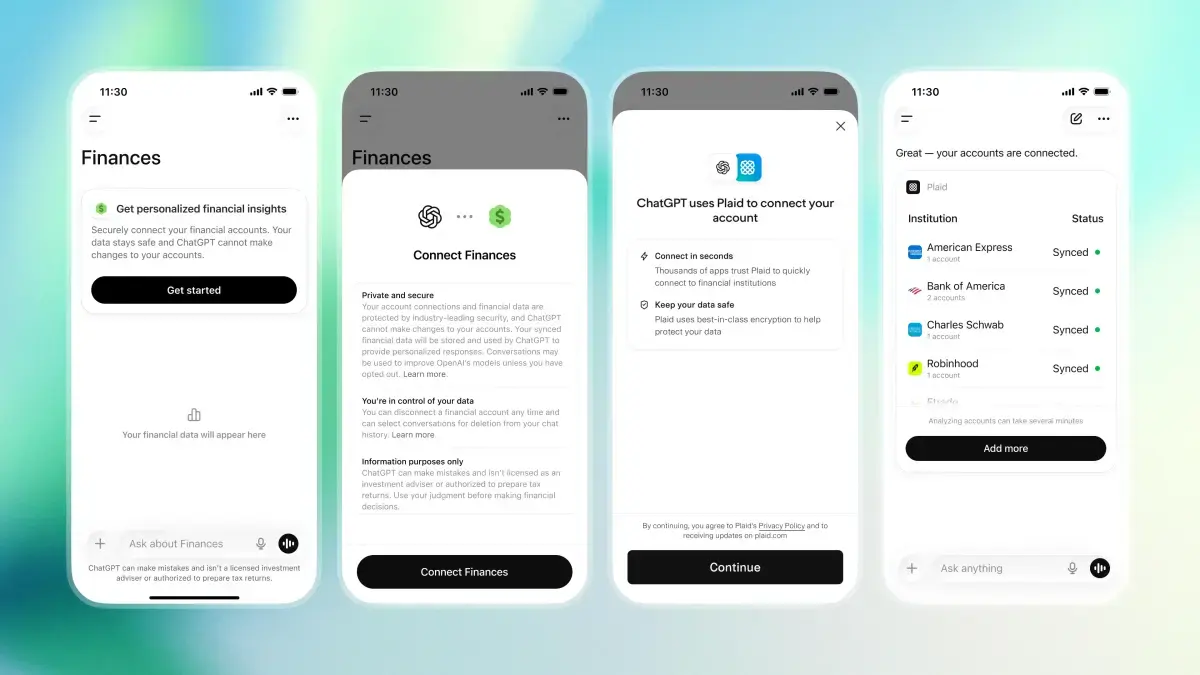
OpenAI launched a new set of personal finance tools in preview on Friday, marking a significant expansion into data-sensitive sectors. The feature allows ChatGPT Pro subscribers in the U.S. to connect bank accounts and receive personalized financial advice based on their actual spending patterns and financial goals
1
. Users can access the tool by selecting "Get started" in the "Finances" option in the sidebar, or by typing "@Finances, connect my accounts" in a ChatGPT conversation1
.The banking integration leverages Plaid, a financial connection service that supports over 12,000 financial institutions, including Schwab, Fidelity, Chase, Robinhood, American Express, and Capital One
1
2
. Once users connect these accounts, they see a dashboard displaying portfolio performance, spending, subscriptions, and upcoming payments1
.
Source: Mashable
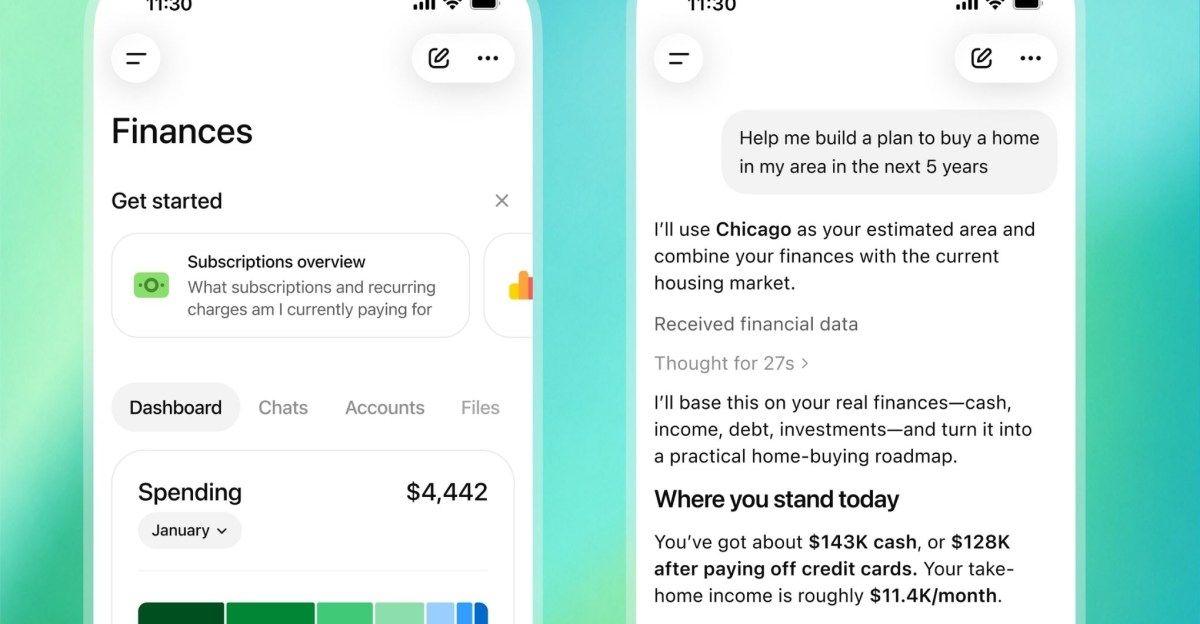
With financial data connected, ChatGPT can provide detailed answers to questions such as "I feel like I've been spending more recently. Has anything changed?" or "Help me build a plan to be ready to buy a house in my area in the next 5 years"
1
. The AI chatbots can break down spending on food, entertainment, transport, or utility bills, and identify easily missed recurring expenses like monthly subscriptions3
.
Source: The Verge
According to OpenAI, more than 200 million users already ask financial questions to ChatGPT every month
1
2
. The company noted that the new GPT-5.5 model is stronger at reasoning with context, which is crucial for answering finance-related questions1
. The tool rolling out now for $200-per-month Pro users on web and iOS will eventually expand to Plus users after OpenAI gets a chance to "learn and improve" from early use3
.The new product comes just one month after OpenAI acquired the team behind personal finance startup Hiro Finance, which was backed by firms like Ribbit, General Catalyst, and Restive, in April
1
. OpenAI said that the Hiro team's expertise in finance was useful in launching this product, but didn't specify if the entire feature was built by them1
.OpenAI also plans to support Intuit soon, which would enable analysis such as the impact of a stock sale on taxes or the odds of a credit card approval
1
. The feature also includes a partnership with Intuit, in which users will be able to schedule sessions with local tax experts all within ChatGPT5
.Related Stories
While the banking integration offers convenience, it raises questions about data privacy in data-sensitive sectors. When users connect their accounts, ChatGPT can access balances, transactions, investments, and liabilities, but cannot see full account numbers or make any changes to accounts
4
5
. Users can go to Settings > Apps > Finances to remove connections to certain accounts, and once they disconnect a service, the synced data will be removed from ChatGPT in 30 days1
.However, this information will likely be saved by OpenAI and used at least to train its AI models if users opt into the "improve the model for everyone" option in settings, which is auto-enabled for users
5
. University of Illinois associate computer science professor Gang Wang warned that "if your documents are part of AI's training data — there is a risk that information will be induced by a special prompt that malicious actors might use"5
. An OpenAI spokesperson clarified that "ChatGPT can help you stay informed and feel more confident managing your finances, but it is not a replacement for professional financial advice"3
.

Source: PC Magazine
Generalized chatbots are designed to answer anything, leading people to ask questions about data-sensitive topics such as health, finance, and personal life. AI companies are realizing this and making specialized products for these sectors
1
. Both OpenAI and Anthropic have launched health-related tools, and earlier this month, Perplexity launched its own financial research product based on its Computer agent1
. This move signals that major AI companies are actively pursuing opportunities in budgeting and financial planning, betting that users will trust them with increasingly sensitive information to receive more contextual and actionable guidance.Summarized by
Navi
[1]
[4]