8 Sources
[1]
Oracle's AI datacenter splurge gives investors the capex jitters
Q4 sales climbed 21%, but Wall Street more interested in $70B buildout bill Oracle has lifted capital spending plans above analyst estimates and expanded borrowing to chase the opportunity it says exists in building datacenters for AI workloads. Despite revenue for Q4 (ended May 31) rising 21 percent year-on-year to $19.2 billion, Oracle's share price fell as markets reacted to its increasing capex, as analysts raised concerns about how Big Red would fund the investments in datacenters. Capex for fiscal 2026 reached $55.7 billion, up from $21.2 billion a year earlier. Speaking to investors, CFO Hilary Maxson said Oracle planned to support its capital investments program by raising around $40 billion in debt and equity in fiscal 2027, including a $20 billion equity issuance already announced. "We don't anticipate raising additional debt funding in calendar year 2026," she said. Last year, Oracle raised $18 billion in debt to help fund its massive datacenter investments. Big Red's market value jumped after it declared $455 billion remaining performance obligations (RPOs) - contracted revenue not yet recognized - more than 300 percent higher than a year earlier. That figure reportedly includes $300 billion for OpenAI alone, as the LLM slinger tries to support its expansion with compute capacity. Maxson said on an earnings call this week: "In order to unlock this unique growth opportunity, we started a program of capital investments. We'll continue those investments in our fiscal year 2027, with an expected net cash outlay for capital expenditures of around $70 billion. This includes customer prepayments and timing impacts expected at around $20 billion-$25 billion, so our reported capex will be higher by this amount." CEO Clay Magouyrk said any increase in capex was not due to component prices but largely due to timing. "Part of my job is to figure out ways to actually accelerate capex. My job is to try to spend the money a little bit faster so I can get ramped revenue sometimes. Component prices in general... I think everyone knows that memory prices have definitely gone up, SSD prices, hard drive prices, etc." However, Magouyrk said Oracle had also been able to lock prices "across the spectrum, whether it be space and power costs, energy costs, people costs, component costs." Oracle added around 400 MW of capacity in Q4 - similar to the last two quarters - and expects to add nearly 1 GW of capacity in fiscal Q1 2027. One analyst told Reuters there is real demand for cloud infrastructure, but the question over how Oracle funds its datacenter expansion "is getting harder, not easier, with capex coming in well above estimates and free cash flow still negative." Oracle announced a number of new customers with its latest financial figures, including a deal for a Fusion HCM system with the US Office of Personnel Management. ®
[2]
Oracle spent $55.7B on data centres, plans to raise $40B more
Oracle spent $55.7 billion on data centres in FY2026, overshooting its own $50 billion guidance. Revenue and cloud bookings beat estimates, but the stock fell 7% after hours on capex concerns and plans to raise another $40 billion. Oracle reported fiscal fourth-quarter revenue of $19.2 billion, up 21% year on year, and adjusted earnings of $2.11 per share, beating analyst estimates of $19.1 billion and $1.97 respectively. The numbers were overshadowed by capital expenditure that came in well above the company's own projections. The company spent approximately $55.7 billion on capital expenditure in the fiscal year ended May 31, exceeding its previous guidance of $50 billion. Oracle now expects to spend roughly $70 billion in net capital expenditure in fiscal 2027, with the reported figure $20 billion to $25 billion higher due to prepayments for components, CFO Hilary Maxson said on the earnings call. The cloud numbers Cloud infrastructure revenue, the business most directly tied to AI workloads, grew 93% to $5.8 billion in the quarter. Total cloud revenue including software applications reached $9.9 billion, up 47%. For the full fiscal year, cloud infrastructure revenue hit $18.1 billion, up 77%. Oracle guided for total cloud revenue to jump approximately 61% in the current quarter ending in August, just shy of the 62% analysts had pencilled in. The $638 billion backlog Remaining performance obligations, Oracle's measure of contracted future revenue, reached $638 billion at the end of the quarter, up from $553 billion three months earlier and well above the $589.5 billion analysts expected. The company said most of the new bookings were for large-scale AI contracts in which customers prepaid for expensive GPU servers. "This substantially reduces the amount of capital Oracle must raise to build out our AI data centres," the company said. Four customers each contracted for more than $8 billion during the quarter. The prepaid and customer-supplied hardware portions of large AI contracts now total $75 billion. The debt question Oracle raised $43 billion in debt financing and $5 billion in equity during the fiscal year just ended. It plans to raise another $40 billion in equity and debt in fiscal 2027, including $20 billion through a previously announced programme to sell shares at market prices. The company has approximately $117 billion of debt in the Bloomberg US high-grade corporate bond index, making it the largest issuer outside the financial sector. The tech industry's broader debt-fuelled AI spending binge has drawn fresh scrutiny from investors questioning whether the returns will justify the cost. OpenAI and the Abilene campus Oracle's large data centres for OpenAI are seeing "significant progress," co-chief executive Clay Magouyrk said. The company has delivered 42% of capacity at its flagship Stargate site in Abilene, Texas, with an additional 35% to be delivered over the next three months. The Abilene campus is part of the broader Stargate project with OpenAI and SoftBank, which now spans multiple sites across Texas, Wisconsin, Michigan, and New Mexico with nearly seven gigawatts of planned capacity and over $400 billion in projected investment. The 30,000 job cuts Beginning in March, Oracle cut up to 30,000 employees, approximately 18% of its global workforce, in the largest restructuring in the company's history. The company reported $1.8 billion in restructuring charges for the fiscal year, nearly five times the prior year's figure. TD Cowen estimates the layoffs will free up $8 billion to $10 billion in annual cash flow, which Oracle is channelling directly into AI data centre construction. The hardest-hit division was Oracle Health, built on the $28.3 billion Cerner acquisition, where an estimated 8,000 to 10,000 employees were let go. The flags Oracle's shares dropped approximately 7% in extended trading after the results, despite the revenue and earnings beat. The stock had climbed 35% over the prior three months, suggesting investor expectations were already elevated. The $638 billion backlog is a contracted figure, not recognised revenue. Only 12% is expected to convert within 12 months and 34% within three years, meaning most of that revenue is years away. Whether AI demand sustains at levels that justify $70 billion in annual capital spending remains an open question, particularly as Oracle takes on more debt in a sector already facing doubts about the profitability of infrastructure investment at this scale.
[3]
Explained: Why Oracle shares crashed 10% in extended trading despite earnings beat
Oracle shares fell sharply in after-hours trading despite beating earnings estimates, as investors reacted to aggressive AI spending plans and rising debt concerns. The company's massive capital raise and infrastructure push raised fears of over-leverage, even as strong revenue growth and bullish guidance highlighted its expanding role in AI cloud infrastructure. The shares of US-based IT major Oracle tumbled 10% in after-market hours on Wall Street after a massive AI spending forecast triggered worries over ballooning debt, despite the company reporting better-than-expected quarterly earnings. Oracle on Wednesday reported total revenue of $19.18 billion for the fourth quarter, higher than analysts' estimate of $19.10 billion, according to data compiled by LSEG, as quoted by Reuters. Its adjusted profit of $2.11 per share for the quarter under review also exceeded expectations of $1.96 per share. US MarketsPowered By As on 11 Jun 2026, 01:30 AM IST S&P 500 Top Gainers Devon Energy46.60(5.74%) JM Smucker117.05(4.15%) APA38.00(3.80%) Cboe Global Markets301.08(3.61%) Gainers" S&P 500 Top Losers Super Micro Computer29.27(-27.98%) Coterra Energy32.56(-8.62%) Generac Hldgs239.11(-8.38%) Zebra Technologies216.79(-7.43%) Losers" Along with the Q4 results, Oracle said it expects to raise nearly $40 billion through a combination of debt and equity financing in 2027. This includes its previously announced $20 billion at-the-market equity issuance. "Oracle's capital investment programme supports the pursuit of unprecedented opportunities in AI Cloud Infrastructure," the company said. It raised $43 billion in debt financing and $5 billion in equity financing in fiscal year 2026. It added that it does not expect to issue additional debt in calendar year 2026. Oracle on Wednesday said that it is building a massive "Stargate" data centre in Texas with OpenAI and others, which will be more than three-quarters complete within 90 days. OpenAI, meanwhile, said its customers can start accessing OpenAI's cutting-edge coding models on Oracle's cloud. "Our pace of delivery continues to accelerate, with our (fiscal first quarter of 2027) delivery approaching one gigawatt, nearly the same capacity as we've delivered in the previous four quarters combined," Oracle CEO Clay Magouyrk told analysts on a conference call. Also read: Global AI debt issuance to top $500 billion in 2026: Morgan Stanley Oracle had said in February it aimed to raise as much as $50 billion this year through a combination of debt and equity sales. The rising debt levels to fund new AI projects by Oracle and other tech giants have led to several analysts sounding the alarm over a possible AI bubble that can pop anytime. Morgan Stanley, in a recent report, forecast AI-related global debt issuance to more than double to nearly $570 billion in 2026, highlighting a rising bond supply and credit market activity as hyperscalers turn to alternative funding sources to meet massive AI-driven capex needs. Hyperscalers Alphabet, Amazon, Microsoft and Meta are expected to spend $700 billion in outlays this year. Also read: Oracle's AI spending blows past estimates, raising worries over growing debt Oracle shares dropped 10% to fall below $181 per share in after-hours trading on Wall Street. Along with the Q4 results, Oracle also announced a dividend of $0.5 per share, with July 10 as the record date to determine the eligibility of shareholders for the payment. "For fiscal year 2027, we confirm our prior revenue guidance of $90 billion total revenue and raise our non-GAAP EPS guidance to $8.05, which is growth of 18% after adjusting for the one-time events of selling our Ampere chip business and Bloom Energy warrants in fiscal year 2026," it said. (With inputs from agencies) (Disclaimer: Recommendations, suggestions, views and opinions given by the experts are their own. These do not represent the views of The Economic Times)
[4]
Oracle Wants To Spend Big For AI, Stock Drops - Oracle (NYSE:ORCL)
The tech giant's shares dipped following the disclosure that fiscal year 2027 net capital expenditures are projected to climb to around $70 billion to fuel massive AI demand. Earnings Highlights Oracle reported revenue of around $19.18 billion, beating estimates of approximately $19.10 billion, according to Benzinga Pro. Revenue rose 21% year over year (Y/Y), driven by robust performance across cloud infrastructure and cloud applications. Adjusted operating income grew 22% Y/Y to $8.6 billion, benefiting from strong top-line growth and operational leverage. Adjusted earnings grew 24% year-over-year to $2.11 per share, beating analyst estimates of $1.96 per share. Operating cash flow reached $32 billion, representing 54% Y/Y growth, while the company invested heavily in expansion with $48 billion in net capital expenditures in the year. Other Key Metrics Remaining Performance Obligations (RPO) surged to a record $638 billion, up 363% Y/Y in the quarter. Management noted that about 12% of RPO is expected to convert into revenue within the next 12 months, with an additional 34% expected over the following 13-36 months. During the quarter, Oracle signed $67 billion in AI infrastructure contracts, bringing total bring-your-own-hardware and prepaid infrastructure agreements to approximately $75 billion. Segment Performance OCI revenue nearly doubled, rising 93% Y/Y, as demand for AI computing capacity and database services continued to accelerate. Cloud Applications revenue reached $4.1 billion, up 10%, while SaaS deferred revenue increased 16% from the prior year. The company's cloud database business expanded 29%, with multi-cloud revenue jumping 404% and multi-cloud bookings climbing 325% year over year. Over the past 12 months, Oracle has deployed more than 1,000 AI agents across its application portfolio and has begun introducing AI token-based and outcome-based pricing models. Outlook For the first quarter, Oracle forecasts adjusted EPS of $1.72-$1.76, above the $1.68 consensus estimate, and revenue of $18.96-$19.26 billion, compared with expectations of approximately $19.06 billion. Total cloud revenue is expected to grow between 57% and 63% in the quarter. Oracle affirmed its fiscal 2027 revenue outlook of $90 billion versus estimates of approximately $88.90 billion and adjusted EPS of $8.05 versus estimates of $8.01. Meanwhile, the company expects gross margins to decline in fiscal 2027 as data center expansion and infrastructure buildouts ramp up. Oracle noted that it expects its new AI patient care management system to push the growth rate of the overall Oracle Health business to double-digits in fiscal 2027. Also, the company announced it expects to raise approximately $40 billion through a combination of debt and equity financing, including its previously announced $20 billion at-the-market equity issuance. Collaboration With OpenAI In a separate release yesterday, Oracle disclosed a new partnership with OpenAI. Enterprises will soon be able to apply eligible Oracle Universal Credits to access OpenAI's frontier models and Codex through OCI, aiming to keep AI deployments inside familiar procurement and governance workflows. The companies said availability begins "in the coming weeks," with customers directed to Oracle sales for timing and eligibility. ORCL Price Action: Oracle shares were down 8.42% at $184.31 during premarket trading on Thursday, according to Benzinga Pro data. Photo via Shutterstock Market News and Data brought to you by Benzinga APIs To add Benzinga News as your preferred source on Google, click here.
[5]
Oracle Q4 Earnings: Cloud, AI Surge As Spending Spikes
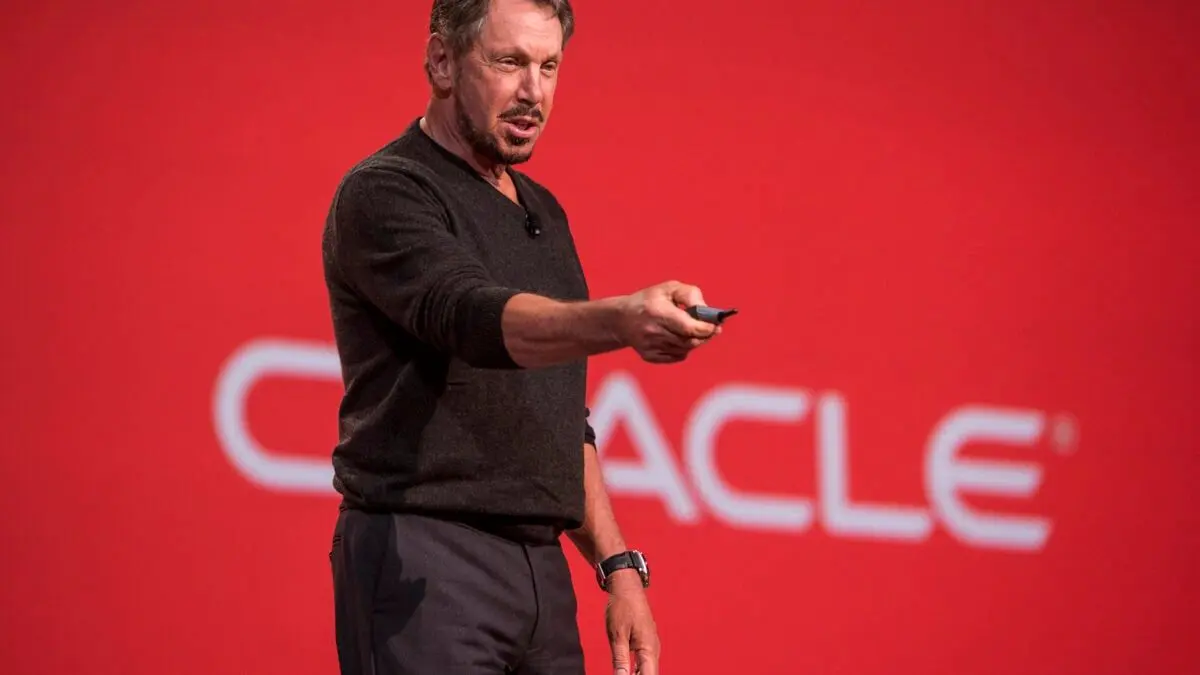
'Our customers have moved past the experiment stage with AI,' says Oracle co-CEO Mike Sicilia. Demand for artificial intelligence and compute pushed Oracle to new revenue milestones in its latest fiscal quarter and year -- although continued eye-popping spending to meet AI demand continues to give investors pause -- as solution providers continue to work on delivering AI products and services to customers. The Austin, Texas-based provider of cloud, AI and database products held its latest quarterly earnings call Wednesday, covering the three months and fiscal year ended May 31. Oracle co-CEO Mike Sicilia (pictured above) said on the call that the vendor's full-stack approach across applications, data, infrastructure, AI tooling and industry expertise gives the company a "unique advantage" in the AI age. "Our customers are now focused on how to leverage AI in their own businesses," Sicilia said. "Our customers have moved past the experiment stage with AI. They are ready to implement enterprise-grade complete agentic solutions to help run their businesses." [RELATED: New Oracle CFO Maxson Brings Energy Expertise To AI Buildout] Oracle Q4 Earnings Snapshot This marked the first Oracle earnings call for Hilary Maxson since the vendor made her its new CFO hired back in April. In a rarity for the company, the call did not feature comments from Larry Ellison, Oracle's co-founder and chief technology officer. Oracle's partnerships with AI upstarts including ChatGPT creator OpenAI have opened business opportunities for solution providers including PwC. The consulting giant's U.S. data, analytics and AI practice leader Rima Safari told CRN in a recent interview that PwC collaborated with OpenAI to build a new offering on top of an Oracle platform to enable users to ask questions in natural language to improve the financial reporting process. She characterized the PwC-OpenAI collaboration as "a major step forward towards redefining the entire future of finance." More connectors across different vendors and different systems like enterprise resource planning (ERP) and customer relationship management (CRM) software will help with governance and trust in AI products and services, Safari said. AI Pricing Models: Token Bundles, Outcome-Based Approach Expand Just as solution providers from various partner ecosystems have experimented with more outcome-based approaches with customers, Oracle's Sicilia told analysts on the call that the vendor has also looked to expand the model across its offers. Solution providers have told CRN that charging by outcomes makes more sense as AI agents bring down the time and effort it takes to complete IT projects and services for customers. Oracle has traditionally leveraged outcome-based pricing in its construction, hospitality and health care businesses and is moving the model into all of its applications, Sicilia said. The vendor's full-stack offers spanning AI models and horizontal and industry apps makes the approach possible. "One of the things we're increasingly hearing from customers is: How much am I going to spend on AI, and how do I get ROI very quickly?" he said. "We have a very unique advantage. ... We are naturally generating these outcomes for customers, and it really gives us the ability to help them understand their own AI budgets, as well as align that to the value." Oracle is also offering token bundles customers can purchase across app suites for more predictable budgeting -- although a lot of Oracle's AI innovations are available at no extra charge within its products and services, Sicilia said. The vendor saw 33 customers participate in the limited roll out of buying token bundles in the quarter. "We're allowing as much flexibility as much aligned with the value in our pricing models across our entire application suite as we possibly can," he said. "I expect that that will continue to resonate well with customers as it did in the quarter and as we roll it out across our entire fleet." Asked about the effect on Oracle due to the "SaaSpocalypse" decreases of software-as-a-service vendors' stock prices, Sicilia said that a couple quarters ago customers did delay decision cycles somewhat, but customers moved on pretty fast in the mission-critical system space. "Enterprise software, particularly when you have AI built into our SaaS solutions, is certainly a very good approach and is necessary to move forward for the modernization and protection of their businesses," he said. "I expect that our applications business will continue to be a healthy contributor to Oracle, as it has been." The AI era and move to inferencing is also proving a boon for Oracle's database business as well, he said. Oracle's AI agent innovation over the past year includes more than 1,000 agents delivered across app suites, he said. "The quickest, most affordable and most productive way customers can begin consuming AI is just to continue using Oracle's applications since every three months they get more and more of the AI features built for them and ready to go," he said. "This is a major shift in enterprise software, and Oracle is uniquely positioned to lead it." Last quarter, Oracle took thousands of customers live with 300 Fusion customers alone, he said. Cloud applications revenue for the quarter grew 9 percent, hitting $4.1 billion. Oracle's cloud apps revenue for the year hit $15.9 billion in the quarter, up 10 percent year on year. Oracle's multicloud AI database business more than quintupled in the quarter, becoming the vendor's fastest growing business in company history, according to Oracle. Its cloud database business revenue grew 29 percent in the quarter. The vendor expects a new AI version of the Cerner hospital and clinic patient care management system to put its health business in a double-digit growth rate in fiscal year 2027. Capital Spending Jumps As Oracle Accelerates AI Buildout Higher-than-expected spending in capital expenditures in the quarter came not just from higher component costs the entire IT industry has experienced, but also speeding up spending to get to revenue faster, Oracle Co-CEO Clay Magouyrk said on the call. When Oracle has enough certainty on the cost of meeting a customer's project, the vendor is comfortable doing fixed-price contracts. Increasing costs are not reducing Oracle margins, he said. On the call, CFO Maxson said that Oracle is still on track to hit long-term targets, including compound annual growth rates (CAGRs). She said that she foresees return on invested capital in the high 20s at a steady state, so expect to continue seeing eye-popping spending by Oracle to meet the AI moment. Sometimes projects can see higher margins if customers supply their own chips, as an example. Asked on the call about increased competition in the data center and cloud computing space from NeoClouds and companies like SpaceX, Magouyrk said he's not worried "Several years in, there's still a massively higher demand than there is supply," he said. "They're going to be more and more people trying to figure out how to meet that demand, but I don't worry about that. I really focus on how do we make sure that we can meet as much of that demand at a reasonable margin profile." Total cloud revenues for the quarter grew 46 percent year on year to a record $9.9 billion. Within those cloud revenues, cloud infrastructure revenue hit $5.8 billion, up 92 percent year on year ignoring foreign exchange. The vendor reported record total cloud revenues of $34 billion for the year. That's an increase of 37 percent year on year. Within that business, cloud infrastructure revenue for the year grew 75 percent year on year ignoring foreign exchange, reaching $18.1 billion. Within those total cloud revenues, cloud infrastructure grew 75 percent year on year to $18.1 billion. Oracle forecasted growth of 27 percent to 29 percent in total revenues in the first quarter of fiscal year 2027 compared to the same period a year ago. Total cloud revenue should grow 57 percent to 63 percent, ignoring foreign exchange. The vendor still expects $90 billion in total revenue for the 2027 fiscal year. Oracle Q4, FY 2026 Results: Cloud Growth Leads Annual Performance Oracle's latest quarter saw a series of record financial milestones, including record remaining performance obligations of $638 billion, up $85 billion -- about 15 percent -- from the prior quarter, according to the vendor. That RPO more than quadrupled the figure reported for the same period a year ago. The vendor expects 12 percent of that RPO to be recognized as revenue in the next 12 months and another 34 percent recognized in the next 13 to 36 months, Maxson said. Those percentages should accelerate over the coming quarters. Oracle credited most of the RPO increase to large-scale AI contracts where customers prepaid for graphics processing units or supplied their own GPUs to Oracle. Those prepaid or supplied GPU customers total $75 billion and brought down the amount of capital Oracle needs to raise for AI data center build out, according to the vendor. As part of that AI data center build out, Oracle raised $43 billion in debt financing and $5 billion in equity financing in fiscal year 2026. Even after all that financing, the vendor wants to raise about $40 billion in debt and equity financing in fiscal year 2027 -- including its previously disclosed $20 billion at-the-market equity issuance. Oracle doesn't expect to issue more debt this calendar year, according to the vendor. Total revenues for the quarter grew 20 percent year on year ignoring foreign exchange to a record $19.2 billion. Oracle's software revenues fell 2 percent to $6.8 billion as customers continued to migrate to the cloud from on-premises software, according to the vendor. Services revenues grew 13 percent to $1.5 billion. Hardware revenues grew 9 percent to about $1 billion. Oracle operating income for the quarter using Generally Accepted Accounting Principles was $6.1 billion, up 20 percent. Without GAAP, it was a record $8.6 billion, up 22 percent. GAAP net income reached $4.2 billion, up 23 percent. Non-GAAP net income was $6.2 billion, up 26 percent. For Oracle's 2026 fiscal year, the vendor reported a record $67.4 billion in total revenues, up 16 percent year on year ignoring foreign exchange. Software revenue for the fiscal year fell 1 percent to $24.5 billion. Services revenue grew 10 percent, reaching $5.7 billion for the year. Hardware revenues grew 5 percent to $3.1 billion. Fiscal year 2026 GAAP operating income was $20.6 billion, up 17 percent, according to Oracle. Non-GAAP operating income hit a record $28.9 billion, up 16 percent. GAAP net income available was $17.0 billion, up 36 percent. Non-GAAP net income was $22.2 billion, up 29 percent. The vendor saw a record fiscal year operating cash flow of $32 billion, up 54 percent year on year, according to Oracle. Oracle's stock fell about 11 percent after market close Wednesday, trading at about $180 a share.
[6]
Oracle slides as hefty AI spending, debt plans spook investors
Shares of Oracle slid on Thursday after the cloud giant's higher-than-expected capital spending plans fuelled concerns over soaring AI data centre costs, overshadowing strong quarterly results. Shares of the Austin, Texas-based company fell 7.2 per cent to US$186.70 in premarket trading and were on track to erode more than $40 billion from the company's market valuation if losses hold. The slide also weighed on the European IT sector, which was already under pressure following a downgrade by UBS Global Wealth Management. Shares of SAP tumbled 4.4 per cent, while Capgemini slid 3.6 per cent. As Oracle scrambles to keep pace with hyperscale rivals, its mounting debt and pressured cash flows are fueling doubts over when these massive outlays will pay off. Oracle said late on Wednesday that it expected capital expenditures of up to $95 billion in fiscal 2027, with plans to raise nearly $40 billion through a combination of debt and equity financing in 2027. It has spent $55.66 billion in fiscal 2026, surpassing its $50 billion target, following a February announcement that it aimed to raise $50 billion through debt and equity sales. "Unlike the so-called hyperscalers..., Oracle was not sitting on a pile of cash or generating huge amounts of cash flow heading into this spending cycle," said Russ Mould, investment director at AJ Bell. "This puts it more at the mercy of markets when it comes to funding any investment, and investors seem to be balking at plans to raise a further $40 billion." However, analysts at J.P. Morgan see this as a necessary trade-off to fuel stronger long-term revenue growth. The brokerage said steady demand should support investor sentiment, provided Oracle's cloud business keeps growing faster than those of major hyperscalers. J.P. Morgan, however, pointed to some execution risks, including scaling data centres, sustaining bookings and managing its rising debt load. Morgan Stanley expects AI-related global debt issuance to more than double to nearly $570 billion in 2026, with hyperscaler spending set to exceed $1 trillion by 2027. Underscoring this borrowing trend, Amazon recently secured a $17.5 billion loan from a lender group including Citibank to fund its infrastructure expansion. Oracle stock trades at 24.56 times its forward earnings estimates, compared with Microsoft's 20.47 multiple and Amazon's 25.19.
[7]
Oracle Goes All Out
If some still doubted AI, which may be fueling an extraordinary speculative bubble lately, particularly amongst equipment manufacturers, the desire of major American names to raise capital, something they haven't done in decades, and to bet big on the technology should finally convert them. Following Google and Meta, on this subject, refer to: Paradigm shift and a new era for Alphabet shareholders and At Meta, rumors of a capital increase weigh on the stock, it is now Oracle's turn to announce it is seeking $40bn in external financing through 2027, half via debt and the other half through a capital increase. This follows a 2026 fiscal year during which Larry Ellison's group added $43bn in additional debt to its balance sheet, ahead of a $5bn capital increase. It will take nothing less to face an extraordinary expansion of Oracle's investments in the infrastructure that will serve as the backbone of AI. Exactly one year ago, we noted in these same columns that these capital expenditures had increased tenfold in ten years, growing at a much faster pace than revenue and operating cash flow. Once again, these expenditures have nearly tripled year-over-year. The natural effect is a compression of free cash flow, the profit returnable to shareholders, which is now deep in the red. The cash position is not improving either, with a dividend that nevertheless increased by $1bn between 2025 and 2026. Oracle is now saddled with substantial debt, equivalent to more than five times its earnings before interest and taxes. This represents a complete paradigm shift for shareholders of the group, which remained entirely debt-free until the pandemic and was able to return the entirety of its juicy profits through share buybacks and dividends. One can assume this bet is not being made blindly: Oracle's cloud segment, which accounts for half of consolidated revenue, saw its sales grow by 39% in the fiscal year just ended, driven by the meteoric growth of infrastructure services. This contrasts with the software segment, which represents just under a third of revenue and saw its sales decline by 1%. Larry Ellison's group has decided to evolve and take a lead in a field where access to capital represents a major competitive advantage. Ultimately, this should make the position of groups that have installed the computing power infrastructure necessary for AI deployment virtually impregnable. It remains to be seen to what extent these investments will pay off, and how long Oracle can degrade its balance sheet without drawing the ire of investors. Judging by the group's current valuation, the latter are currently betting on a win rather than a loss.
[8]
Oracle shares plunge as soaring AI spending rattles investors
STORY: Oracle shares plunged in after-hours trade Wednesday, dropping close to 9%. :: Oracle The dive came after the tech firm said its spending on AI would blow past estimates. It also said it would have to raise more debt next year, reflecting the staggering sums of money being put into AI infrastructure. Oracle has big deals to build data centers for customers like Meta and OpenAI. :: Oracle On Wednesday it said its huge "Stargate" facility in Texas would be more than three-quarters complete within 90 days. OpenAI said customers can now access its cutting-edge coding models on Oracle's cloud. But the rising costs are giving investors the jitters. This year, Oracle says capital expenditures hit close to $56 billion, well above its target. In fiscal 2027, it says that figure will balloon to as much as $95 billion, though some of that will be repaid by customers. The company also said its profit margins would "step down" over the coming year as it ramps up data-center projects. One analyst told Reuters that, while Oracle has real demand for its services, it was getting harder to see how it could fund all the investment required.
Share
Copy Link
Oracle reported strong Q4 earnings with revenue climbing 21% to $19.2 billion, but investors sent shares plunging up to 10% after the company announced plans to spend $70 billion on AI infrastructure in fiscal 2027. The tech giant will raise $40 billion through debt and equity financing to fund its aggressive datacenter buildout, including massive facilities for OpenAI, raising questions about profitability and leverage in an industry already facing AI bubble concerns.
Oracle delivered impressive Oracle Q4 earnings results for the quarter ended May 31, with revenue reaching $19.2 billion, up 21% year-over-year, and adjusted earnings of $2.11 per share beating analyst estimates of $1.96 per share
2
. Despite these strong numbers, the Oracle stock drop was severe, with shares tumbling between 7% and 10% in after-hours trading as investors reacted to the company's aggressive Oracle AI spending plans3
. The disconnect between operational performance and market reaction highlights growing investor concerns about the sustainability of massive AI infrastructure investment across the tech sector.
Source: Benzinga
Oracle Cloud Infrastructure revenue, the segment most directly tied to AI workloads, surged 93% to $5.8 billion in the quarter, while total cloud revenue including software applications reached $9.9 billion, up 47%
2
. The company's remaining performance obligations—contracted future revenue not yet recognized—reached a staggering $638 billion, up 363% year-over-year and well above the $589.5 billion analysts expected4
. However, only 12% of this backlog is expected to convert within 12 months and 34% within three years, meaning most revenue remains years away2
.The Oracle capital expenditure for fiscal 2026 reached $55.7 billion, significantly exceeding the company's own $50 billion guidance and dwarfing the prior year's $21.2 billion
1
. CFO Hilary Maxson announced that Oracle expects net cash outlay for capex to climb to approximately $70 billion in fiscal 2027, with reported figures $20 billion to $25 billion higher due to customer prepayments and timing impacts1
. This aggressive AI infrastructure investment represents one of the largest buildouts in corporate history, raising fundamental questions about returns and free cash flow generation.To fund this massive AI datacenter expansion, Oracle plans to raise approximately $40 billion through debt financing and equity issuance in fiscal 2027, including a previously announced $20 billion at-the-market equity offering
2
. The company raised $43 billion in debt and $5 billion in equity during fiscal 2026, bringing its total debt in the Bloomberg US high-grade corporate bond index to approximately $117 billion, making it the largest issuer outside the financial sector2
. One analyst told Reuters that while real demand exists for cloud infrastructure, the question of how Oracle funds its datacenter expansion "is getting harder, not easier, with capex coming in well above estimates and free cash flow still negative"1
.The OpenAI partnership has become a cornerstone of Oracle's AI strategy, with the company making "significant progress" on large datacenters for the ChatGPT creator, according to co-CEO Clay Magouyrk
2
. Oracle has delivered 42% of capacity at its flagship Stargate data center site in Abilene, Texas, with an additional 35% to be delivered over the next three months2
. The Stargate project now spans multiple sites across Texas, Wisconsin, Michigan, and New Mexico with nearly seven gigawatts of planned capacity and over $400 billion in projected investment2
.
Source: The Register
Oracle added approximately 400 MW of capacity in Q4 and expects to add nearly 1 GW of capacity in fiscal Q1 2027
1
. The company signed $67 billion in AI infrastructure contracts during the quarter, bringing total bring-your-own-hardware and prepaid infrastructure agreements to approximately $75 billion4
. Four customers each contracted for more than $8 billion during the quarter, with most new bookings involving large-scale AI contracts where customers prepaid for expensive GPU servers2
. Oracle announced that enterprises will soon be able to apply eligible Oracle Universal Credits to access OpenAI's frontier models through Oracle Cloud Infrastructure4
.Related Stories
Beginning in March, Oracle cut up to 30,000 employees—approximately 18% of its global workforce—in the largest restructuring in the company's history, with $1.8 billion in restructuring charges for the fiscal year
2
. TD Cowen estimates the layoffs will free up $8 billion to $10 billion in annual cash flow, which Oracle is channeling directly into AI datacenter construction2
. The hardest-hit division was Oracle Health, built on the $28.3 billion Cerner acquisition, where an estimated 8,000 to 10,000 employees were let go2
.
Source: ET
The rising debt levels to fund new AI projects by Oracle and other tech giants have led several analysts to sound alarms over a possible AI bubble
3
. Morgan Stanley forecast AI-related global debt issuance to more revolutionize than double to nearly $570 billion in 2026, highlighting rising bond supply and credit market activity as hyperscalers turn to alternative funding sources to meet massive AI-driven capex needs3
. Hyperscalers Alphabet, Amazon, Microsoft, and Meta are expected to spend $700 billion in outlays this year3
. Whether AI demand sustains at levels that justify $70 billion in annual capital spending remains an open question, particularly as Oracle takes on more debt in a sector already facing doubts about the profitability of infrastructure investment at this scale2
.Oracle's multi-cloud revenue jumped 404% with multi-cloud bookings climbing 325% year-over-year, signaling strong demand for hybrid deployment models
4
. The company's cloud database business expanded 29%, while operating cash flow reached $32 billion, representing 54% year-over-year growth4
. Co-CEO Mike Sicilia told analysts that Oracle has moved past the experiment stage with AI, with customers now focused on implementing enterprise-grade agentic solutions5
. Over the past 12 months, Oracle deployed more than 1,000 AI agents across its application portfolio and began introducing AI token-based and outcome-based pricing models4
.Oracle affirmed its fiscal 2027 revenue outlook of $90 billion versus estimates of approximately $88.90 billion and raised adjusted EPS guidance to $8.05, representing 18% growth
3
. For the first quarter, Oracle forecasts adjusted EPS of $1.72-$1.76, above the $1.68 consensus estimate, with total cloud revenue expected to grow between 57% and 63%4
. However, the company expects gross margins to decline in fiscal 2027 as AI datacenter expansion and infrastructure buildouts ramp up4
. Investors will be watching whether Oracle can convert its massive contracted backlog into actual revenue while managing leverage and maintaining profitability in an increasingly competitive and capital-intensive market.Summarized by
Navi
[1]
[2]
26 Dec 2025•Business and Economy

12 Dec 2025•Business and Economy

17 Nov 2025•Business and Economy

1
Policy and Regulation

2
Technology

3
Health