5 Sources
[1]
Publicis Acquires LiveRamp To Advance New Agentic AI Push
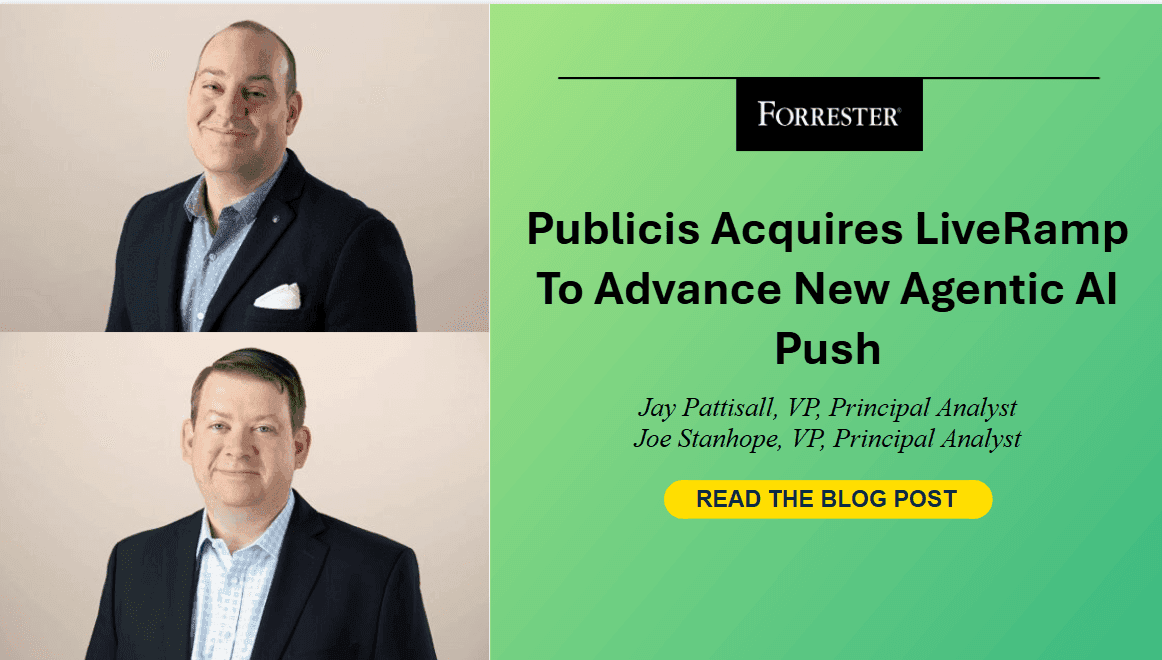
Publicis Groupe has agreed to acquire data collaboration and identity resolution firm LiveRamp for $2.55 billion, in a move aimed to expand the agency holding company's artificial-intelligence offering. The transaction is expected to close by the end of 2026, following the customary regulatory and shareholder approvals. Publicis will operate Liveramp as an independent company and plans to retain all executive management and staff. Publicis Commits To An Agentic Future Based On Data The combination of LiveRamp's clean room technology and data connectivity with the Publicis Epsilon proprietary identity and data assets will enable Publicis, LiveRamp, and their customers to "co-create" data - a process of securely enriching data sets via identifiers, partners, and a vast network of publishers. This would improve audience targeting for advertising execution, as well as campaign measurement and optimization. But the French holding company claims the expanded data foundation also set the stage to elevate AI model performance beyond commoditizing public LLMs and support the training and efficacy of bespoke AI agents built to conduct tasks and complex workflows for their customers. Publicis Is Evolving How Clients Realize Value From Agencies Publicis Groupe and other LiveRamp agency customers are known for using data to increase advertising and marketing precision and personalization across digital channels. But AI transformation is a broader and more strategic undertaking that can live either within or outside of the purview of marketing. The implications of Publicis Groupe expanding its AI remit particularly hit marketing executives as: * Value shifts from advertising execution to AI business transformation. Publicis Groupe is making a strategic bet on AI transformation as a growth opportunity beyond its legacy marketing and advertising business. "We're a strong performer in the marketing landscape," says Carla Serano, Chief Strategy Officer of Publicis Group, "but agentic transformation is the opportunity at hand. And agencies must earn their right to play." With LiveRamp's data collaboration and interoperability, Epsilon's identity resolution and data, Sapient's engineering, and the MRCL AI operating system, Publicis Groupe will make its case for guiding and implementing clients' AI strategies. And in so doing, Publicis will actuate a shift in agency value from scaled advertising execution to facilitating AI's transformation moment. Current clients should define their appetite for expanding their Publicis relationship into enterprise AI initiatives and pressure-test the company's ability to deliver this transformation across products and services. * LiveRamp's data neutral positioning comes into question. Liveramp has been an industry iconoclast with its long-standing commitment to independence; the proverbial "Switzerland of data." Neutrality has enabled Liveramp's industry credibility, scale, and formidable ecosystem of publishers, data providers, and media partners. Publicis has been clear that they recognize the value of Liveramp's market position and have taken initial actions to ensure that all customers regardless of Publicis affiliation can access Liveramp services. There are compelling opportunities for Publicis to accelerate global distribution, expand the partner network, and develop AI technology solutions for marketers and agencies. Nevertheless, clients must be aware that absorption is the inevitable path in M&A, putting Liveramp's neutrality at risk in the long term. LiveRamp clients should monitor how integration affects independence, governance, and product development, and seek to codify current capabilities and access in their agreements with the company. * Data clean room technologies become a new must-have in the agency stack. Publicis Groupe's purchase of LiveRamp is a continuation of a trend. The three largest global agency holding companies have made significant bets on clean room tech and data assets. Publicis acquired Epsilon in 2019, Omnicom cut a deal with AWS in 2023 and acquired Acxiom 2025, and WPP acquired InfoSum in 2025. Activating and enriching client data with proprietary assets and in privacy-compliant manner has become the Big Three's answer to walled gardens dominance. As agency holding companies' tech stacks grow they become important platforms to counter-balance to the ubiquity and opaqueness of technology hyper scalers. Publicis clients should vet these expanded capabilities' data fidelity, privacy safeguards, and overall support for their AI and marketing ecosystems. * The agency buying group expands to the broader c-suite. As Publicis Groupe integrates LiveRamp into its operations and offerings to pursue AI transformation, the buying group expands. The choice of an agency partner becomes as much a business and technology decision as it is a marketing decision. Even if the CMO is responsible for the AI strategy, the CIO, CTO and other in the c-suite must become more involved. Publicis and LiveRamp clients interested in their AI offerings should inroads and alliances with other executives to create a consortium of AI expertise to help manage the systems, data and change management integrations needed for AI transformation, If you are a Forrester client and want to explore the acquisition or how it compares to other agency's efforts in AI, tech, and data, please schedule a Guidance Session with Jay Pattisall or Joe Stanhope.
[2]
France's Publicis bags LiveRamp for $2.2bn in agentic push
Publicis acquired Irish-founded e-commerce analytics business Profitero for €200m in 2022. French communications giant Publicis Groupe has acquired US data company LiveRamp for $2.2bn in a major push towards agentic advertising services. The California-based data platform allows cross-collaboration between thousands of publisher, technology and data partners. It enables data co-creation - a process by which companies can connect multiple data sources across partners in a secure environment. The acquisition allows the 1926-founded Publicis to access new opportunities in AI services and expand its addressable market, it said. While, for LiveRamp, the deal marks additional investment to scale and expand its capabilities. The all-cash deal is based on an acquisition price of $38.5 per share, a near 30pc premium to its closing price on 15 May, Publicis said. The transaction includes acquired net cash of $379m. The deal is expected to close before the end of the year, following which, LiveRamp will continue to be led by its current CEO Scott Howe. Howe will report to Publicis Groupe CEO Arthur Sadoun. "LiveRamp joining Publicis Groupe is the latest demonstration of our commitment to investing in new talent and innovation, ahead of market shifts," said Sadoun, also the company's chairperson. "By building the future of data co-creation, we're empowering our clients to generate new, exclusive and proprietary data, to build the smartest, most differentiated AI agents on top of the leading LLMs (large language models). "It will be valuable for our clients' business growth, and a new addressable market for Publicis," he added. The company expects a 7-8pc growth in net revenue for 2027 and 2028 as a result of the acquisition. Earlier this year, Sadoun told the Financial Times that the company has invested around €14bn in data and technology over the past decade. Early investment in AI tools has helped the company expand business at a time when the media and creative industries are shrinking, he said. The LiveRamp acquisition follows a $4.4bn purchase of data specialist Epsilon in 2019 - the French advertising giant's largest ever. In 2022, the company snapped up Irish-founded e-commerce analytics business Profitero for €200m. Don't miss out on the knowledge you need to succeed. Sign up for the Daily Brief, Silicon Republic's digest of need-to-know sci-tech news.
[3]
Publicis Aims to Create Smarter AI Agents With $2 Billion LiveRamp Deal | PYMNTS.com
The $2.2 billion deal is aimed at making Publicis a "leader in data co-creation, an important capability in the age of artificial intelligence and an enabler of agentic business transformation," the companies said in a Sunday (May 17) news release. As the release noted, LiveRamp is a global data collaboration platform that let companies "unify, manage, and activate" data across the digital space, connecting more than 25,000 publisher domains and 500+ technology and data partners in 14 markets. It also allows brands, retailers, media platforms and data providers to safely and effectively collaborate and connect data. A report by The Wall Street Journal (WSJ) about the deal characterized the acquisition as Publicis trying to tap a rising demand from companies that want to transform their businesses by deploying AI agents that can complete tasks autonomously. "We did not need LiveRamp to win in the marketing space," Publicis CEO and Chairman Arthur Sadoun told WSJ. "Where LiveRamp plus Publicis is going to make a difference is in the agentic space, in this new market where there is huge opportunity because there is a huge barrier created by data." LiveRamp allows companies in different industries to scan data across different sources and transform them into actionable data assets, the report added. "There is no way you can win with agents if you don't have the right and differentiated data," Sadoun said. "For agents to be competitive and to work, they have to run on good data, data that is unique, actionable, connected." In other agentic AI news, PYMNTS wrote Monday about the technology's use in the banking world, following Fiserv's launch of agentOS, an operating system that lets financial institutions deploy and manage AI agents across core banking, payments and servicing workflows. The infrastructure here, that report added, is "moving faster than the rules," with the Financial Data Exchange launching an initiative focused on what happens when AI agents handle consumer financial data autonomously. "The problem it is trying to solve is structural. When a consumer connects a bank account to a third-party app, the consent is visible and deliberate," PYMNTS added. "When an AI agent does the same thing on a consumer's behalf, the questions multiply: who authorized the agent, what data can it access, how is that permission tracked and who is liable when something goes wrong. The standards that govern consumer financial data sharing today were not written for that scenario."
[4]
Publicis strikes $2.2 billion deal for LiveRamp to boost agentic AI capabilities By Investing.com
Investing.com -- Publicis Groupe (EPA: PUB) announced on Sunday that it has entered an agreement to acquire data collaboration company LiveRamp (NYSE: RAMP) for a total enterprise value of $2.167 billion. With this acquisition, the French advertising and public relations company aims to unlock new opportunities for the agentic era and expand its addressable market. LiveRamp will be acquired in an all-cash transaction, based on an acquisition price of $38.5 per share. The transaction represents a total equity value of $2.546 billion and includes net cash of 379 million. The purchase price represents a 29.8% premium to LiveRamp's closing share price on May 15, the last trading day prior to the announcement of the agreement. The acquisition will allow Publicis to become a "leader in data co-creation" and "an enabler of agentic business transformation," the company said in a statement. The deal also enables the company to raise its 2027-2028 targets on net revenue and headline EPS growth at a constant currency. Publicis now expects 7%-8% growth on a constant currency basis in net revenue in 2027 and 2028, up from 6-7%, and 8%-10% growth in headline EPS, up from 7%-9%. Arthur Sadoun, Chairman and CEO of Publicis Groupe commented, "LiveRamp joining Publicis Groupe is the latest demonstration of our commitment to investing in new talent and innovation, ahead of market shifts... we're empowering our clients to generate new, exclusive and proprietary data, to build the smartest, most differentiated AI agents on top of the leading LLMs." The deal is seen as part of the company's continued investment in technology, data and AI services, with, and follows its acquisition of Epsilon in 2019 with the goal of "personalization at scale." "Adding it to our ecosystem of Publicis Sapient, Epsilon, and Marcel, means we will go even further, and faster, in delivering agentic transformation to clients, whatever their stage of enterprise readiness, safely, transparently, and in their own environments," Sadoun added. With 1,300 employees, and a model anchored in a highly recurring revenue base, LiveRamp has delivered a trailing five year CAGR of 13%. "Our customers and partners have always been our North Star, and by joining forces with Publicis, we will have greater resources and flexibility to scale our business, continue innovating our platform, and help them unlock even greater value from their data," Scott Howe, CEO of LiveRamp added.
[5]
Publicis in the spotlight following LiveRamp acquisition
The closing of the transaction is expected by the end of 2026, subject to regulatory approvals and the consent of LiveRamp shareholders. LiveRamp generated revenue of 813 million dollars during the fiscal year ended March 2026. Its operating income stood at 83 million dollars, with a net profit of 146 million dollars. With this acquisition, Publicis continues to bolster its operations in technology, data, and artificial intelligence, following the 2019 acquisition of Epsilon. Already partners since the beginning of 2026, the two groups aim to better leverage advertisers' first-party data within a secure environment. Publicis intends to combine LiveRamp's technologies with assets already owned by Publicis, notably Epsilon, Publicis Sapient, and the Marcel platform, to develop AI solutions powered by secure proprietary data. LiveRamp will be integrated into the group's Technology segment alongside Publicis Sapient, while maintaining its neutral and interoperable positioning, which is considered one of its primary strengths. On the financial front, Publicis anticipates approximately 50 million euros in cost synergies and estimates that the transaction will be accretive to underlying earnings per share from the first year. The group confirmed its 2026 targets and raised its ambitions for 2027-2028, now forecasting net revenue growth of between 7% and 8%, up from 6% to 7% previously, as well as an 8% to 10% increase in underlying earnings per share. Financial targets confirmed Publicis also confirmed its financial targets for 2026. The group is aiming for organic net revenue growth of between 4% and 5%, accompanied by a slight improvement in operating margin compared to 2025. Free cash flow before changes in working capital is expected to be around 2.1 billion euros. 'The price paid appears high, with a multiple of approximately 12.3 times estimated 2026 EBITDA after synergies, but this valuation level reflects LiveRamp's technology profile, stronger growth, and recurring revenues', notes Oddo BHF, which has an outperform rating on the stock. It added: 'The price remains defensible given LiveRamp's tech profile. The main point of focus will be execution: Publicis must preserve LiveRamp's neutrality while integrating it sufficiently with Epsilon, CoreAI, Publicis Sapient, and Marcel to create value'. For Citi, which raised its price target on Publicis to 90 euros from 88 euros, this acquisition will sustainably strengthen the group's growth profile and competitive advantage over its peers. According to analysts at AlphaValue, this announcement should allow Publicis to further strengthen its positions in data and artificial intelligence, two segments considered central to the future of the advertising sector. Since the beginning of the year, Publicis shares have declined by 11%.
Share
Copy Link
French advertising giant Publicis Groupe has agreed to acquire data collaboration platform LiveRamp for $2.2 billion, marking a strategic shift from traditional advertising execution to agentic AI transformation. The deal combines LiveRamp's data clean room technology with Publicis Epsilon's identity resolution assets to enable smarter AI agents that can autonomously handle complex business workflows.
Publicis Groupe has entered an agreement to acquire data collaboration and identity resolution firm LiveRamp for $2.2 billion, signaling a major strategic pivot toward agentic AI capabilities
1
. The all-cash transaction, based on an acquisition price of $38.5 per share, represents a nearly 30% premium to LiveRamp's closing price on May 15 and includes acquired net cash of $379 million2
. Expected to close by the end of 2026 following regulatory approvals, the deal positions Publicis as a leader in data co-creation, a capability the company views as critical for AI business transformation beyond its traditional advertising roots4
.Source: Market Screener
LiveRamp operates as a global data collaboration platform connecting more Pre-computationthan 25,000 publisher domains and 500+ technology and data partners across 14 markets
3
. The platform enables data co-creation, a process by which companies can securely connect multiple data sources across partners to enrich datasets. Publicis CEO Arthur Sadoun emphasized that competitive AI agents require differentiated, actionable data. "There is no way you can win with agents if you don't have the right and differentiated data," Sadoun told The Wall Street Journal3
. The combination of LiveRamp's data clean room technology with Publicis Epsilon's proprietary identity and first-party data assets will enable clients to build bespoke AI agents on top of leading large language models, moving beyond commoditized public LLMs1
.The acquisition represents a fundamental evolution in how Publicis delivers value to clients. Carla Serano, Chief Strategy Officer of Publicis Group, stated: "We're a strong performer in the marketing landscape, but agentic transformation is the opportunity at hand. And agencies must earn their right to play"
1
. With LiveRamp's data collaboration and interoperability joining Publicis Epsilon, Publicis Sapient's engineering capabilities, and the MRCL AI operating system, Publicis aims to guide and implement clients' AI strategies across enterprise operations, not just marketing1
. This shift expands the agency buying group to c-suite executives including CIOs and CTOs, making agency selection as much a business and technology decision as a marketing one.
Source: Forrester
Related Stories
Publicis raised its 2027-2028 financial targets following the announcement, now expecting 7-8% growth in net revenue on a constant currency basis, up from 6-7% previously, and 8-10% growth in headline earnings per share, up from 7-9%
4
. The company anticipates approximately 50 million euros in cost synergies and estimates the transaction will be accretive to underlying earnings per share from the first year5
. LiveRamp generated revenue of $813 million during the fiscal year ended March 2026, with operating income of $83 million and net profit of $146 million5
. With 1,300 employees and a highly recurring revenue model, LiveRamp has delivered a trailing five-year compound annual growth rate of 13%4
.LiveRamp has maintained a reputation as the "Switzerland of data," with neutrality enabling its industry credibility and formidable ecosystem of publishers, data providers, and media partners
1
. While Publicis has committed to operating LiveRamp as an independent company and retaining all executive management including CEO Scott Howe, who will report to Sadoun, analysts note that absorption is the inevitable path in mergers and acquisitions, putting data neutrality at risk long-term1
. The acquisition continues a trend among major agency holding companies investing in data clean room technologies and data assets to counter walled gardens dominance. Publicis acquired Epsilon in 2019 for $4.4 billion, Omnicom partnered with AWS in 2023 and acquired Acxiom in 2025, while WPP acquired InfoSum in 20251
. Sadoun noted that Publicis has invested around €14 billion in data and technology over the past decade, with early investment in AI tools helping expand business while media and creative industries shrink2
. The deal follows Publicis's 2022 acquisition of Irish-founded e-commerce analytics business Profitero for €200 million2
. Clients should monitor how integration affects independence, governance, and product development, particularly regarding audience targeting and campaign measurement capabilities that depend on neutral data access across competitive platforms.Summarized by
Navi
[2]
[4]
[5]
10 Dec 2024•Business and Economy

17 Jul 2025•Business and Economy

09 Oct 2024•Business and Economy

1
Science and Research

2
Technology

3
Policy and Regulation