San Francisco Startup Pays $20 an Hour for Humans to Walk Robot Dogs and Train AI Systems


2 Sources
[1]
This San Francisco Startup Is Hiring Humans to Walk Robot Dogs for $20 an Hour. No Experience Required.
Dimensional is using human walkers to teach robots to navigate city streets. Some overheating may be expected. Peering out your car window in San Francisco can yield some interesting sights, like a human walking a robot dog. AI startup Dimensional recently posted the robot dog walking gig to a
[2]
Get $20 an hour to walk robot dogs, no work experience needed: San Francisco startup has an unusual job offer, but there is a catch
A San Francisco startup is offering $20 an hour to people willing to walk robot dogs through city streets. The job requires no previous experience and includes paid training, but workers must be prepared to carry the 33-pound machines back if they overheat or stop working. The unusual hiring
Share
Copy Link
AI startup Dimensional is offering $20 per hour for people to walk robot dogs through San Francisco streets. The unusual job offer requires no experience but workers must carry 33-pound machines back if they overheat. The initiative helps train AI systems to control robots for future manual labor tasks.
San Francisco Startup Offers Unusual Job Walking Robot Dogs
AI startup Dimensional has posted an unusual job offer in San Francisco, hiring humans to walk robot dogs for $20 an hour with no experience required
1
2
. The San Francisco startup posted the robot dog walking gig to a Bay Area jobs group on Facebook, though the listing has since been deleted. Shifts run four to six hours, and the company provides paid training with payment after each completed shift. Workers use handheld remotes or mobile applications to guide the machines along designated routes while cameras and sensors record information about their surroundings.
Source: Entrepreneur
The Physical Challenge Behind the Job
The unusual job offer comes with a notable catch. Workers must be comfortable carrying the roughly 33-pound machines back to Dimensional's office in San Francisco's Dogpatch neighborhood if they overheat or stop working mid-walk
1
2
. The hardware isn't proprietary—Dimensional owns more than 100 robot dogs, and the ones on the street are $2,000 models from Chinese maker Unitree. These four-legged machines can sometimes overheat or stop functioning during outdoor testing, requiring human intervention to complete the mission.Training AI Agents to Learn Hardware Control
Dimensional is building an open-source operating system designed to let AI agents control robots and eventually perform physical tasks with minimal human involvement. The 26-year-old founder Stash Pomichter told The New York Times that the company wants its technology to help control robots for manual labor in environments such as factories, data centers, and construction sites
1
2
. By hiring humans to walk robot dogs, the startup collects real-world data that helps train AI systems to navigate city streets independently. Pomichter stated, "It's honestly barbaric that humans are still doing these physical tasks," expressing his vision for robots taking on heavy lifting and construction work.Related Stories

Current Limitations of AI Hardware Control
Despite ambitious goals, Pomichter admits that AI agents remain far from ready for independent operation. "What we determined from our dog-walking experiment was that agents are still very bad at controlling hardware," he told The New York Times, adding, "And humans are still needed in the loop."
2
Getting AI systems to operate physical machines independently in real-world environments remains a significant challenge. The human walkers serve a critical purpose: they steer the robot dogs while the machines' cameras and sensors record navigation data, helping Dimensional examine how the robots respond to their surroundings and improve robot control and navigation capabilities.What This Means for the Future of Manual Labor
Dimensional's approach reveals both the promise and current limitations of AI-powered robotics. While the company envisions robots hauling heavy boxes and working construction sites, the reality is that even basic navigation requires extensive human-guided training. The experiment highlights a transitional phase where humans remain essential to teaching machines tasks we hope they'll eventually perform independently. Watch for how quickly Dimensional can reduce human involvement in robot operations—that timeline will signal whether AI agents can truly handle complex physical tasks or if we're still years away from autonomous robots in manual labor settings.
References
Summarized by

Navi
[1]
Related Stories
Robot dogs priced up to $300,000 now patrol AI data centers as security demand surges
17 Mar 2026•Technology

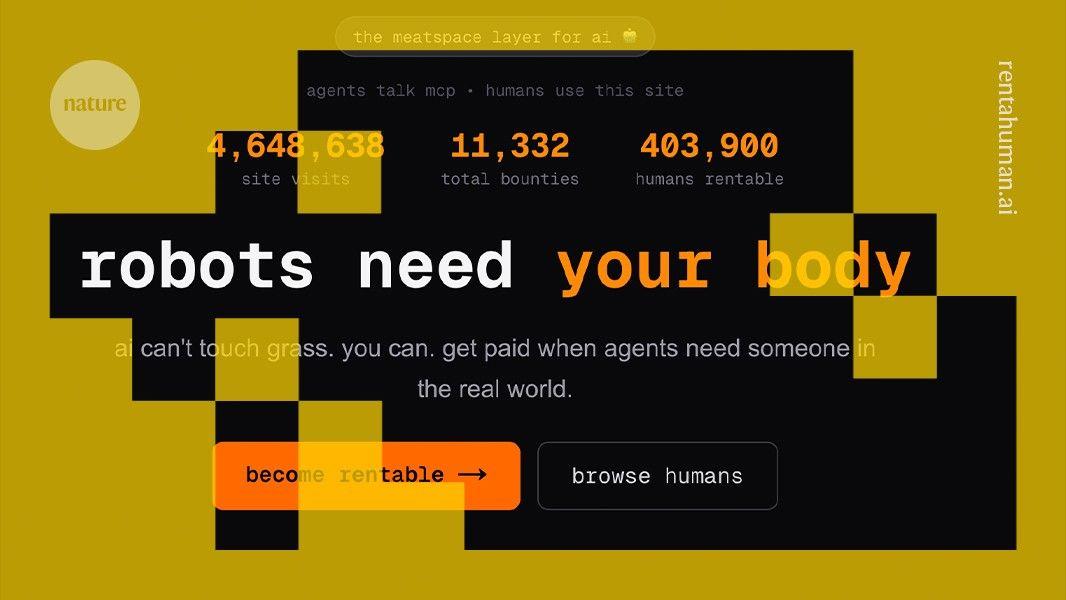
AI agents are hiring humans on RentAHuman, but the reality is far more complicated than it seems
12 Feb 2026•Technology
Startup offers free home cleaning in NYC to gather AI training data for future household robots
29 May 2026•Technology

Recent Highlights
1
OpenAI's AI Models Disprove 27-Year Exponential Time Hypothesis, Rendering Decades of Research Obsolete
Science and Research

2
Google DeepMind unveils Genie 4 world model with audio and 2-minute interactive simulations
Technology

3
OpenAI Cuts Internet Access for AI Model Training After Security Breaches
Technology

Recent Highlights
Today's Top Stories






Don’t drown in AI news. We cut through the noise - filtering, ranking and summarizing the most important AI news, breakthroughs and research daily. Follow topics that matter to you and stay ahead.


