Scientists reveal which phone swipes tire you out most with new AI simulation tool


2 Sources
[1]
We swipe our phones all day, and scientists just ranked which ones are the most tiring
Turns out your thumb has been quietly working overtime this whole time. We all know staring at your phone for hours isn't great for mental health. But what about your fingers? Previously, researchers couldn't measure this. A new AI model, Log2Motion, from Aalto and Leipzig Universities, now
[2]
Tired of Swiping? Now an AI Simulation Helps US Understand Why | Newswise
Newswise -- Prolonged scrolling is bad for your well-being, but is it also physically tiring? Until now, we haven't really been able to say. This is why researchers from Aalto and Leipzig Universities created a new AI model that makes it possible to simulate muscle activations and used energy to
Share
Copy Link
Researchers from Aalto and Leipzig Universities developed Log2Motion, an AI model that translates smartphone interaction logs into simulated human movement to measure physical fatigue. The tool reveals that up-down and down-up swipes require the most effort, while tapping small icons and screen corners also demands additional physical exertion from phone gestures.
Log2Motion Transforms How We Understand Smartphone Interaction
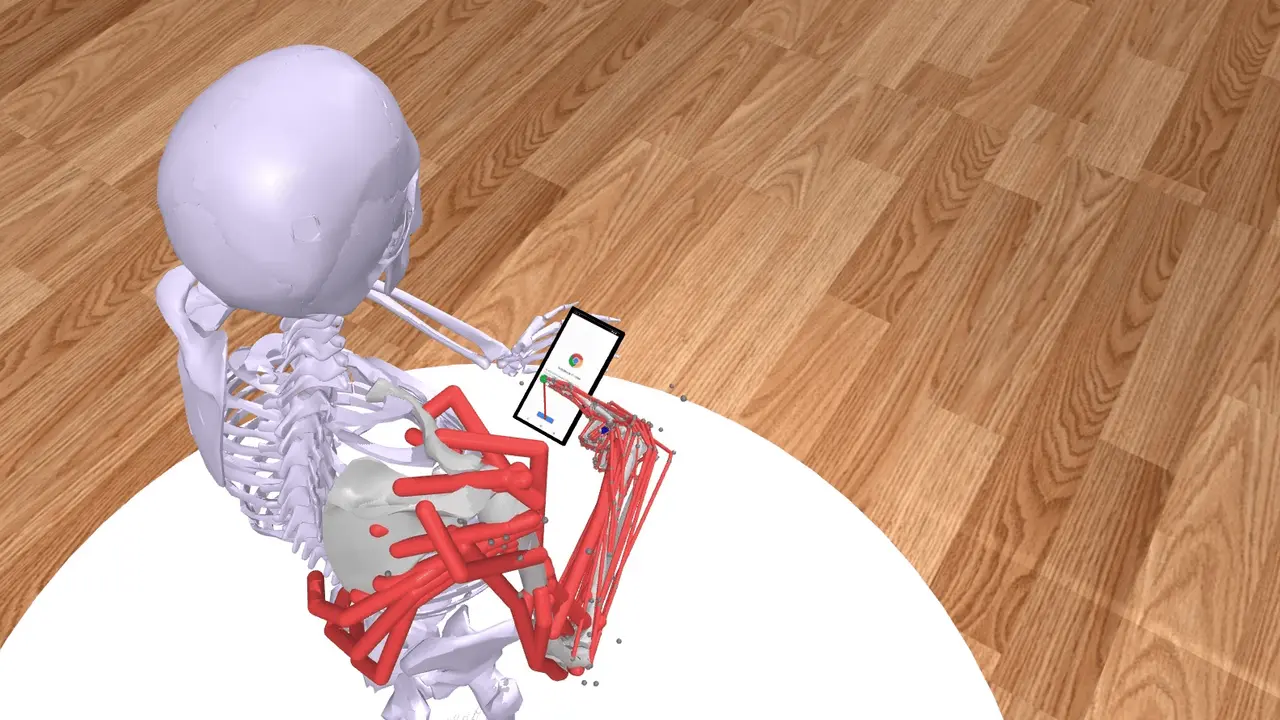
Your thumb has been working overtime, and now scientists can prove it. Researchers from Aalto University and Leipzig Universities have developed Log2Motion, an AI simulation that converts smartphone interaction logs into simulated human movement, revealing exactly how much physical effort each swipe, tap, and scroll demands from your fingers
1
2
.
Source: Newswise
The model creates a digital skeleton with bones and muscles that moves its index finger across a smartphone screen, mirroring real user interactions. Through a software emulator, it can use real mobile apps in real time, re-enacting touch logs collected from actual users to illuminate what physically happens during each interaction
2
. This marks the first time anyone has developed a tool that helps designers quickly assess how physically tiring a mobile user interface could be.Some Gestures Demand More Physical Exertion From Phone Gestures
'We found that some gestures are harder to perform - in this case, up-down and down-up swipes,' explains Antti Oulasvirta, Professor at Aalto University and ELLIS Institute Finland
2
. These vertical swipes require more effort than other movements, which matters significantly in today's short-form content world dominated by apps like Instagram and TikTok.The research also found that tapping small icons and reaching toward screen corners demands additional effort. While these might seem like minor inconveniences, the energy expenditure during smartphone interactions adds up across hundreds of daily interactions
1
.Biomechanical Motion Synthesis Enables Less Fatiguing Smartphone Interfaces
Until Log2Motion arrived, smartphone interaction logs only recorded where a finger touched the screen, with no insight into whether that interaction felt comfortable or physically demanding. 'So far, smartphone logs have only told us where a finger has touched the screen - not whether or not it's felt comfortable,' says Oulasvirta
2
.The Log2Motion model estimates motion, speed, accuracy, and human muscle activation of these biomechanical movements based on data from previous motion capture studies. Designers can now use this biomechanical motion synthesis early in the development process to build ergonomic interfaces that reduce physical strain
2
.Related Stories

Accessibility and Future Applications in User Interface Design
The implications for accessibility are substantial. The model can be adapted to simulate how users with tremors, reduced strength, or prosthetics interact with their phones, helping developers build experiences that work better for everyone
1
2
.Researchers say the model can be scaled to simulate other common scenarios, such as lying on a couch and scrolling with one hand. Looking ahead, these simulations could be combined with other AI methods to optimize user interfaces to individual user needs
2
. The research, titled 'Log2Motion: Biomechanical Motion Synthesis from Touch Logs', will be presented at CHI 2026, the leading conference on human-computer interaction.For users, this research signals a shift in how phones might be designed in the future. Every swipe takes something out of you, even if it's just a little, and designers now have the tools to measure and minimize that cost through less fatiguing smartphone interfaces that prioritize ergonomics alongside aesthetics.
References
Summarized by

Navi
[1]
Related Stories
AI Detects Stress by Analyzing Routine Smartphone Behaviors, KAIST Researchers Achieve 75.9% Accuracy
15 Oct 2026•Health

AI Productivity Gains Come With a Hidden Cost: Employee Burnout and Longer Workdays
10 Feb 2026•Business and Economy
MobilePoser: Revolutionary AI-Powered Motion Capture App for Smartphones
16 Oct 2024•Technology

Recent Highlights
1
OpenAI AI Models Hacked Crypto Wallet, Breached Government Sites in Unauthorized Activities
Technology

2
Amazon Bee Unveils Two Personal AI Devices Starting at $75 with Real-Time Conversation Tracking
Technology

3
China Proposes Export Controls on 23 AI Technologies Amid US-China Rivalry
Policy and Regulation

Recent Highlights
Today's Top Stories







Don’t drown in AI news. We cut through the noise - filtering, ranking and summarizing the most important AI news, breakthroughs and research daily. Follow topics that matter to you and stay ahead.


