2 Sources
[1]
Sigma Computing raises $80 million Series E at $3 billion valuation, backed by Databricks, ServiceNow, and Workday ventures
Sigma Computing has raised $80 million in Series E funding at a $3 billion valuation, doubling its worth in a year and positioning the San Francisco-based company as one of the most aggressively valued players in the business intelligence market. The round was led by Princeville Capital, with new strategic investors Databricks Ventures, ServiceNow Ventures, and Workday Ventures also participating. Previous backers including Altimeter Capital, Avenir Growth Capital, D1 Capital Partners, Spark Capital, and Sutter Hill Ventures returned for the round, and JP Morgan acted as placement agent. The valuation jump from $1.5 billion to $3 billion reflects a company that has doubled its revenue in the same period. Sigma announced in April that it had reached $200 million in annual recurring revenue, up from roughly $100 million a year earlier, with more than 2,000 customers and 1.1 million new active users added in the latest fiscal year. The customer list includes AMD, Duolingo, Colgate-Palmolive, and JPMorgan Chase. Sigma sells a cloud-native analytics platform that sits on top of data warehouses built by Snowflake, Databricks, and Google BigQuery. Its core proposition is that business users can query and analyse live warehouse data through a spreadsheet-like interface without writing SQL, while IT teams retain the governance and security controls that the warehouse provides. The platform supports spreadsheet operations, SQL, Python, and what the company now calls "AI Apps," all running against the warehouse's compute layer rather than copying data into a separate system. That architecture is the foundation of Sigma's pitch to enterprises: it does not move or duplicate data, which means the row-level security, column masking, and access controls that companies have already configured in their warehouse apply automatically to everything built in Sigma. In a market where data governance is both a regulatory requirement and an executive preoccupation, this is a meaningful differentiator against legacy BI tools that extract data into their own layers. The Series E comes at a moment when Sigma is redefining what it sells. The company has moved beyond traditional business intelligence into what it calls "agentic analytics," a category that barely existed two years ago and that every major enterprise software vendor is now racing to claim. SAP unveiled more than 200 AI agents at Sapphire 2026, Google positioned its entire Cloud Next conference around agentic AI, and Snowflake forged a $200 million partnership with OpenAI to embed AI agents directly in the data warehouse. Sigma's argument is that it was already there. The company's flagship product in this space is Sigma Agents, customisable no-code AI agents that run inside the data warehouse's existing security and governance framework. The agents can operate in three modes: interactive, where a user chats with the agent and approves actions; autonomous, where the agent monitors data and executes workflows on a schedule; and external, where the agent makes API calls to third-party systems. In the first quarter of the current fiscal year, Sigma Agents became the fastest-adopted product in the company's history. CEO Mike Palmer framed the strategy in terms that reflect the broader tension in enterprise AI. "IT needs technology that enables the enterprise to go fast in areas like vibe-coded apps and agentic development, while also going safe," he said. The reference to vibe coding, the practice of building software through natural language prompts, is deliberate. As more business users build applications without traditional development skills, the risk of ungoverned, insecure outputs increases. The security vulnerabilities inherent in vibe-coded applications have already drawn scrutiny, and Sigma's pitch is that its warehouse-native architecture provides the governance layer that vibe-coded tools lack. The participation of Databricks Ventures, ServiceNow Ventures, and Workday Ventures is as notable as the headline valuation. All three are the venture arms of companies that are either Sigma's infrastructure partners or its potential competitors, and their investment signals that they view Sigma as complementary rather than threatening. Databricks, whose lakehouse platform is one of the warehouses Sigma runs on, described the investment as supporting users who want to "begin with an easy-to-use spreadsheet interface, and scale up to the power of AI apps." ServiceNow and Workday, both of which generate enormous volumes of enterprise data that their customers need to analyse, see Sigma as a layer that adds value on top of their own platforms. Vivian Huang of Princeville Capital, who joins Sigma's board, cited the company's "warehouse-native architecture and strong operating discipline at scale" as the basis for the investment. The "operating discipline" language is worth noting: Sigma raised $80 million, not $800 million. In a market where AI companies routinely raise rounds ten times that size, the relatively modest amount suggests either that Sigma did not need more capital or that it chose to limit dilution while still securing strategic partners. With $200 million in ARR and what the company describes as more than 100 per cent year-over-year growth, the economics may support the restraint. A $3 billion valuation at 15 times ARR is aggressive for a business intelligence company but not unreasonable for one that is growing at triple-digit rates and has successfully repositioned itself as an AI platform. The traditional BI market, dominated by Tableau (now owned by Salesforce), Microsoft Power BI, and Looker (owned by Google), has been slow to absorb the agentic AI shift. Sigma's bet is that the transition from static dashboards to autonomous, AI-driven analytics represents a generational opportunity to take market share from incumbents that are bolting AI capabilities onto architectures designed for a different era. Whether that bet pays off depends on execution. Sigma has the revenue growth, the strategic investors, and the product positioning. What it does not yet have is the scale of its largest competitors or the certainty that "agentic analytics" will become a durable category rather than a marketing label that every vendor adopts and dilutes. The $80 million will fund the next phase of that test.
[2]
Sigma Computing seals $80M funding round as it pivots toward 'agentic analytics' - SiliconANGLE
Cloud-native data analytics startup Sigma Computing Inc. has closed on an $80 million Series E funding round that doubles its valuation to $3 billion, almost a year to the day after its previous Series D raise. Today's round was led by Princeville Capital and saw participation from new investors Databricks Ventures, ServiceNow Ventures and Workday Ventures. Existing backers Altimeter Capital, Avenir Growth Capital, D1 Capital Partners, Spark Capital and Sutter Hill Ventures also returned for a piece of the action. Sigma's valuation jump makes sense, for the company has managed to double its revenue over the last year. In April, it reported annual recurring revenue had reached $200 million, up from about $100 million one year earlier. It now has more than 2,000 customers and 1.1 million new active users than the previous year, with clients including Advanced Micro Devices Inc., Duolingo Inc. and JPMorgan Chase. The startup sells a data analytics platform that sits above cloud data warehouses such as Snowflake, Databricks and Google BigQuery. It's used by businesses to query and analyze live data through a spreadsheet-style user interface that eliminates the need for Structured Query Language expertise. It supports spreadsheet operations, SQL, Python and what Sigma calls "AI Apps" that all run against the data warehouse's compute layer instead of copying data onto a separate system. Information technology teams retain full governance and security over their data This architecture is what makes Sigma so appealing to the enterprise customers it's targeting. Customers do not have to move or duplicate their data in any way, which means that all of the row-level security, column masking and access controls they've already configured and put in place will apply automatically to anything built using Sigma. In markets where data governance is both a regulatory requirement and an executive demand, it's a lot more convenient than using traditional analytics tools that require companies to extract the data to another layer and rebuild all of those governance controls. Though Sigma has enjoyed a lot of traction, it's not preparing to rest on its laurels. Instead, the Series E funding will help the company to redefine the nature of its value proposition for the artificial intelligence era. These days, it's no longer focused only on standard business intelligence, but jostling to become the leader of a new category called "agentic analytics," which barely existed a couple of years ago. Its core offering in this niche is called Sigma Agents, which are customizable, no-code AI agents that run inside third-party data warehouses and operate within their existing security and governance frameworks. Sigma Agents can operate interactively, where users chat with them and approve their actions one-by-one; autonomously, where the agent monitors data and executes workflows based on a schedule; and externally, where the agent makes API calls to third-party systems. The first Sigma Agents launched towards the end of last year, and the company said today it has now become the most rapidly-adopted product in its history. Chief Executive Mike Palmer said Sigma's agentic strategy reflects the broader tension in enterprise AI today. He explained that information technology teams must enable enterprises to move rapidly in areas like vibe-coded applications and agentic development, while also staying safe. "Sigma provides a trusted system to enable agentic analytics through vibe-coded applications while ensuring governance, reliability and security," he explained. The reference to vibe coding, which is the practice of creating software using natural language prompts, was deliberate. As more businesses pivot to developing applications this way, the risk of ungoverned and insecure outputs rises exponentially. The security bugs in vibe-coded apps have already drawn lots of scrutiny, and Sigma wants to provide the governance that vibe coding tools do not have. Sigma isn't alone in this pivot. SAP SE earlier this year announced more than 200 new AI agents at its Sapphire 2026 conference, while Google Cloud focused a lot of attention during its Cloud Next event on agentic AI. Snowflake Inc., another rival, recently announced it had struck a $200 million partnership with OpenAI Group PBC to embed AI agents directly into its data warehouse. The participation of Databricks, ServiceNow and Workday in Sigma's latest round might raise a few eyebrows, as these companies may all be viewed as potential competitors. But by investing in it, they're signaling that Sigma's platform is more of a complementary tool than a threat. Databricks Vice President Andrew Ferguson said the investment will help to support users that want to "begin with an easy-to-use spreadsheet interface and scale up to the power of AI apps." Meanwhile, both ServiceNow and Workday see Sigma as a value added layer that can sit above their own platforms. Princeville Capital's Vivian Huang said she's backing Sigma because enterprises are choosing it as a foundation for AI workflows and agentic analytics. "It has seen broad customer adoption from global enterprises to leading AI innovators," she said. "The company's warehouse-native architecture and strong operating discipline at scale positions it to lead how enterprises put AI to work on their data."
Share
Copy Link
Sigma Computing has secured $80 million in Series E funding at a $3 billion valuation, doubling its worth in just one year. Led by Princeville Capital with participation from Databricks Ventures, ServiceNow Ventures, and Workday Ventures, the round signals the company's aggressive push into agentic analytics. The San Francisco-based firm now serves over 2,000 customers and reached $200 million in annual recurring revenue.
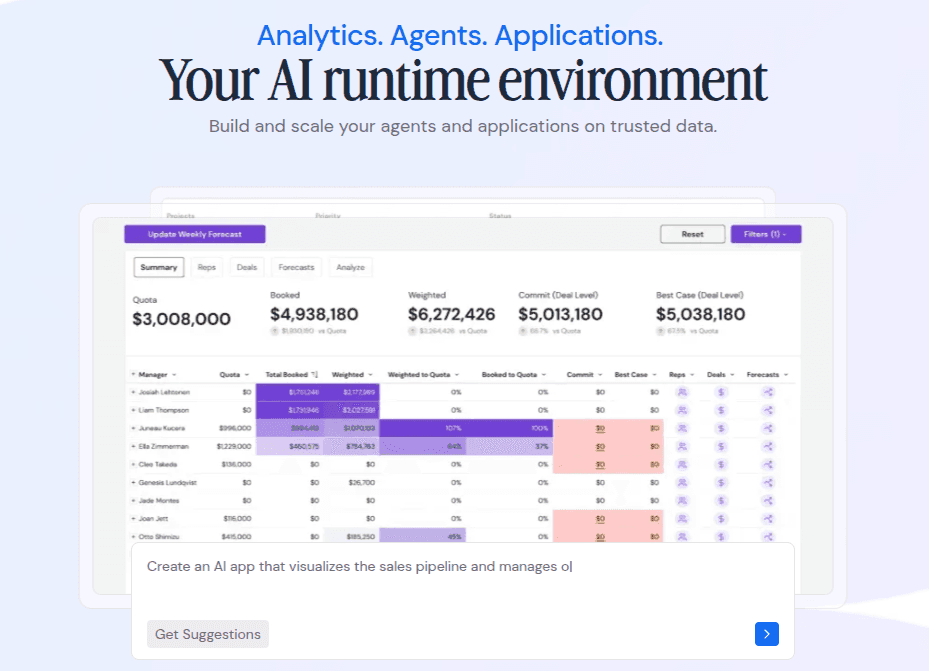
Sigma Computing has closed an $80 million Series E funding round at a $3 billion valuation, exactly one year after its previous raise that valued the company at $1.5 billion
1
. The round was led by Princeville Capital, with strategic participation from Databricks Ventures, ServiceNow Ventures, and Workday Ventures, alongside returning investors including Altimeter Capital, Avenir Growth Capital, D1 Capital Partners, Spark Capital, and Sutter Hill Ventures2
.The San Francisco-based company's valuation jump reflects aggressive growth metrics. Sigma Computing announced in April that it had reached $200 million in annual recurring revenue, doubling from approximately $100 million a year earlier
1
. The platform now serves more than 2,000 customers, including AMD, Duolingo, Colgate-Palmolive, and JPMorgan Chase, and added 1.1 million new active users in its latest fiscal year2
.Sigma Computing sells a cloud-native data analytics platform that operates on top of data warehouses built by Snowflake, Databricks, and Google BigQuery. The platform's core value proposition centers on enabling business users to analyze live warehouse data through a spreadsheet-like interface without requiring SQL expertise, while IT teams retain full governance and security controls
1
. The platform supports spreadsheet operations, SQL, Python, and AI Apps, all running against the warehouse's compute layer rather than copying data into separate systems.This warehouse-native architecture represents a meaningful differentiator in the business intelligence market. Because Sigma Computing does not move or duplicate data, the row-level security, column masking, and access controls already configured in data warehouses apply automatically to everything built in Sigma
2
. In markets where data governance is both a regulatory requirement and an executive preoccupation, this approach eliminates the need to rebuild governance controls that traditional BI tools require when extracting data to another layer.The Series E funding arrives as Sigma Computing redefines its market positioning, moving beyond traditional business intelligence into agentic analytics, a category that barely existed two years ago
1
. The company's flagship product in this space is Sigma Agents, customizable no-code AI agents that run inside data warehouses' existing security and governance frameworks.Sigma Agents operate in three distinct modes: interactive, where users chat with the agent and approve actions; autonomous, where the agent monitors data and executes workflows on a schedule; and external, where the agent makes API calls to third-party systems
2
. Launched toward the end of last year, Sigma Agents became the fastest-adopted product in the company's history during the first quarter of the current fiscal year1
.CEO Mike Palmer framed the strategy around the broader tension emerging in enterprise AI. "IT needs technology that enables the enterprise to go fast in areas like vibe-coded apps and agentic development, while also going safe," he stated
1
. The reference to vibe coding—the practice of building software through natural language prompts—is deliberate. As more business users build applications without traditional development skills through vibe-coded apps, the risk of ungoverned and insecure outputs increases exponentially2
.Sigma Computing's pitch is that its warehouse-native architecture provides the governance layer that vibe-coded tools lack. "Sigma provides a trusted system to enable agentic analytics through vibe-coded applications while ensuring governance, reliability and security," Palmer explained
2
. The security vulnerabilities inherent in vibe-coded applications have already drawn scrutiny, positioning Sigma's approach as a solution to interactive and autonomous data analysis challenges.Related Stories
The participation of Databricks Ventures, ServiceNow Ventures, and Workday Ventures carries significant strategic weight. All three are venture arms of companies that are either Sigma Computing's infrastructure partners or potential competitors, and their investment signals they view the platform as complementary rather than threatening
1
. Databricks, whose lakehouse platform is one of the data warehouses Sigma runs on, described the investment as supporting users who want to "begin with an easy-to-use spreadsheet interface, and scale up to the power of AI apps"2
.ServiceNow and Workday, both of which generate enormous volumes of enterprise data that their customers need to analyze, see Sigma Computing as a value-added layer that sits above their own platforms
2
. Vivian Huang of Princeville Capital, who joins Sigma's board, cited the company's "warehouse-native architecture and strong operating discipline at scale" as the basis for the investment1
.Sigma Computing's pivot to agentic analytics positions it within an increasingly crowded field. SAP unveiled more than 200 AI agents at Sapphire 2026, Google positioned its entire Cloud Next conference around agentic AI, and Snowflake forged a $200 million partnership with OpenAI to embed AI agents directly in the data warehouse
1
. Every major enterprise software vendor is now racing to claim leadership in this emerging category of AI-driven enterprise solutions.The $80 million raise, while substantial, reflects measured growth compared to the massive funding rounds common among AI companies. This operating discipline, combined with the company's revenue doubling and strategic investor backing, positions Sigma Computing to compete in the evolving landscape of interactive and autonomous data analysis tools while maintaining the governance requirements that enterprises demand.
Summarized by
Navi
[1]
19 Aug 2025•Business and Economy

14 Dec 2024•Business and Economy

23 Jan 2025•Business and Economy