7 Sources
[1]
SK Hynix overtakes Samsung to become Korea's most valuable company
SEOUL, June 22 (Reuters) - SK Hynix (000660.KS), opens new tab on Monday overtook Samsung Electronics (005930.KS), opens new tab to become South Korea's most valuable listed company, marking a dramatic reversal of fortunes for a chipmaker that two decades ago nearly collapsed under debt. The company, now the dominant supplier of high-bandwidth memory (HBM) chips used in AI systems for customers such as Nvidia (NVDA.O), opens new tab and Google (GOOGL.O), opens new tab has emerged as one of the biggest beneficiaries of the global AI boom, helping propel its shares up more than 340% this year and lifting its market value above both Samsung Electronics and Micron (MU.O), opens new tab. Shares of SK Hynix, now the world's most valuable memory chipmaker, traded up 5.7% to bring the company's market capitalisation to 2,082.5 trillion won ($1.35 trillion) as of 0347 GMT, compared with gains of 0.4% in Samsung Electronics to 2081.3 trillion won, excluding preferred shares. The stock hit the milestone as AI reshapes the global semiconductor industry, elevating specialised memory chips from commonly traded commodities into critical components of the infrastructure powering applications such as ChatGPT and advanced AI models. SK Hynix focuses primarily on memory chips, versus Samsung Electronics whose business also involves manufacturing logic chips as well as electronics. Samsung Electronics had held the top spot since 2000. "The emergence of customised AI memory fundamentally changed the industry's economics and allowed SK Hynix to establish itself as the market leader," said Kim Sunwoo, a senior analyst at Meritz Securities. For SK Hynix, the achievement marks the culmination of one of the biggest turnarounds in South Korea's corporate history. In 2002, then-Hynix Semiconductor was on the verge of being sold to Micron, having been crippled by debt accumulated during an aggressive expansion drive. The deal eventually fell through, leaving the company under creditor control for nearly a decade. Its shares plunged as low as 135 won in 2003, leaving it viewed as a penny stock, or "Dongjeon-ju" in Korean, among investors. Its fortunes in the years since tracked the global memory industry's traditional boom-and-bust cycle. In 2023, a severe downturn battered memory prices, pushing SK Hynix to report an annual operating loss of 7.73 trillion won. It started recovering a year later as the AI boom gained momentum and the likes of Microsoft, Google and Meta invested heavily, pushing it to report an annual operating profit of 23.5 trillion won in 2024, a record at the time . ($1 = 1,538.7300 won) Reporting by Heekyong Yang; Editing by Sam Holmes and Kevin Buckland Our Standards: The Thomson Reuters Trust Principles., opens new tab
[2]
Samsung just lost a crown it held for 25 years
It has a market cap of approximately $1.35 trillion, largely due to the boom in demand for high-bandwidth memory (HBM) chips. The AI boom isn't just causing smartphone prices to increase, it's also impacting the value of companies that make chips for AI systems. For over 25 years, Samsung was the biggest publicly listed company by market capitalization in South Korea, its home market. However, with the increased demand for AI chips, SK Hynix has now surpassed its market valuation for the first time ever. According to a Reuters report, South Korean chip manufacturer SK Hynix has overtaken Samsung, with a market capitalization of 2,080.4 trillion won (~$1.35 trillion), compared with Samsung's 2,066.7 trillion won (~$1.34 trillion), excluding preferred shares. SK Hynix has had a turbulent history: before being acquired by SK Group, the company nearly went bankrupt and was on the verge of being sold to Micron in 2002. It was also considered a penny stock in 2003, with its shares trading at just 135 won (~$0.088). The primary factor in SK Hynix's sudden growth is the increased demand for high-bandwidth memory (HBM) chips. The company is the leading supplier of HBM chips, with its memory being used in AI systems for NVIDIA, Microsoft, and Google. It currently holds a 61% share in the HBM market, compared to Micron's 21% and Samsung's 17%. SK Hynix continued investing in HBM development during a period of low growth in the memory market, and analysts suggest that this investment is why it's now one of the strongest players in the market. In a statement to Reuters, Samsung said that its market cap should be calculated including preferred shares. With those shares included, the company's market value would stand at 2,246.4 trillion won (~$1.46 trillion).
[3]
SK Hynix overtakes Samsung to become South Korea's most valuable company
SK Hynix has surged past Samsung Electronics to become South Korea's most valuable company, driven by its dominance in high-bandwidth memory (HBM) chips crucial for AI systems. This remarkable turnaround, from near collapse two decades ago to a market leader, highlights the transformative impact of the AI boom on the semiconductor industry. The chipmaker's strategic focus on specialized HBM has propelled its shares to unprecedented heights. SK Hynix on Monday overtook Samsung Electronics to become South Korea's most valuable listed company, marking a dramatic reversal of fortunes for a chipmaker that two decades ago nearly collapsed under debt. The company, now the dominant supplier of high-bandwidth memory (HBM) chips used in AI systems for customers such as Nvidia and Alphabet's Google, has emerged as one of the biggest beneficiaries of the global AI boom, propelling a more than 340% rally in its shares this year and lifting its market value above both Samsung Electronics and Micron. Shares of SK Hynix, now the world's most valuable memory chipmaker, traded up 5.7% to bring the company's market capitalisation to 2,082.5 trillion won ($1.35 trillion) as of 0347 GMT, compared with gains of 0.4% in Samsung Electronics to 2,081.3 trillion won, excluding preferred shares. The stock hit the milestone as AI reshapes the global semiconductor industry, elevating specialised memory chips from commonly traded commodities into critical components of the infrastructure powering applications such as ChatGPT and advanced AI models. SK Hynix focuses primarily on memory chips, whereas Samsung Electronics also manufactures logic chips and consumer electronics such as smartphones and TVs. Samsung Electronics had held the top spot since 2000. "The emergence of customised AI memory fundamentally changed the industry's economics and allowed SK Hynix to establish itself as the market leader," said Kim Sunwoo, a senior analyst at Meritz Securities. Samsung said in a statement that any calculation of its market capitalisation should include preferred shares, which would bring the value to around 2,252 trillion won. SK Hynix's soaring share price marks the culmination of one of the biggest turnarounds in South Korea's corporate history. In 2002, then-Hynix Semiconductor was on the verge of being sold to Micron, having been crippled by debt accumulated during an aggressive expansion drive. The deal eventually fell through, leaving the company under creditor control for nearly a decade. Its shares plunged as low as 135 won in 2003, leaving it viewed as a penny stock, or "Dongjeon-ju" in Korean. Its fortunes in the years since tracked the global memory industry's traditional boom-and-bust cycle. In 2023, a severe downturn battered memory prices, pushing SK Hynix to report an annual operating loss of 7.73 trillion won. It started recovering a year later as the AI boom gained momentum and the likes of Microsoft, Google and Meta invested heavily, pushing it to report an annual operating profit of 23.5 trillion won in 2024, a record at the time. TURNAROUNDAnalysts attribute SK Hynix's central role in the global AI ecosystem to its decision to continue investing in HBM, a specialised memory chip stacked vertically to deliver faster performance and lower power consumption, during a downturn in the memory industry. Unlike conventional memory products, HBM chips are tightly integrated with AI processors, creating significantly higher barriers to entry and giving suppliers greater pricing power. By 2025, SK Hynix captured 61% of the global HBM market, far ahead of Samsung Electronics' 17% and Micron's 21%. SK Hynix was founded in 1983 as a unit of Hyundai, but was later spun off and purchased by SK Group, the family-run "chaebol" conglomerate whose businesses span telecoms to energy. SK Group Chairman Chey Tae-won, who faced strong opposition to the deal at the time, explained his thinking in a book published in January. "What I really wanted to accomplish when we acquired Hynix was to transform it from a commodity memory producer into a mainstream semiconductor company whose products are indispensable," Chey said. "In the past, it did not matter whether memory came from Hynix, Samsung or Micron. They were interchangeable commodity products. HBM is different. If SK Hynix's HBM is replaced with another product, the AI system may not function properly. What used to be a peripheral component has become a core component," Chey said. Analysts say that Samsung's position as the world's largest DRAM producer could also be under threat by SK Hynix. Bank of America estimates that SK Hynix's monthly DRAM output will reach about 589,000 wafers this year, compared with roughly 691,000 wafers for Samsung Electronics. However, SK Hynix is likely to expand DRAM output by about 38% between 2025 and 2028, compared with about 17.5% growth at its rival. That would narrow SK Hynix's production gap to less than 10% by 2028 from about 23% in 2025, which would be a particularly significant achievement because of Samsung's larger manufacturing scale. "Previously, the difference in manufacturing scale meant there was simply no way for rivals to close the profitability gap with Samsung," said Kim. Reuters has reported that SK Hynix is opting to choose the Nasdaq for its planned U.S. listing, which would broaden the company's investor base and raise its profile further among global investors.
[4]
Nvidia Supplier SK Hynix Overtakes Samsung Electronics To Become South Korea's Most Valuable Company - SA
AI Memory Chip Demand Propels SK Hynix Past Samsung Shares of SK Hynix surged 5.7% during trading, lifting the company's market capitalization to about 2,082.5 trillion won ($1.35 trillion), narrowly edging past Samsung Electronics at 2,081.3 trillion won, Reuters reported. The milestone marked a historic shift in South Korea's corporate hierarchy, with Samsung having held the top spot since 2000. At the time of writing, SK Hynix stock was trading 4.7% higher at KRW 2,894,000 (about $1,884) in Seoul while Samsung shares were up 0.14% at KRW 354,500 (about $230). The rally comes as demand for advanced memory chips continues to soar amid massive investments in AI infrastructure by major U.S. technology companies. SK Hynix has emerged as one of the biggest beneficiaries of the trend thanks to its leadership in high-bandwidth memory, or HBM, chips used in AI accelerators. SK Hynix Emerges As A Major Winner Of The AI Boom South Korean memory chipmakers have reported record profits as the rapid buildout of AI data centers has tightened supply and pushed memory prices higher. Investor enthusiasm has been particularly strong for SK Hynix. The company's shares have climbed more than 327% year-to-date, significantly outperforming Samsung Electronics, whose stock has gained roughly 175% over the same period. The latest jump also reinforces SK Hynix's growing importance in the AI supply chain. The company is a key supplier of advanced memory products used alongside graphics processing units powering generative AI applications. Trillion-Dollar Valuations Highlight Semiconductor Industry Shift At the time of writing, SK Hynix had an intraday market capitalization of approximately KRW 2,061.4 trillion, compared with Samsung Electronics' KRW 2,324.6 trillion. ETFS With South Korean Exposure In the iShares fund, SK Hynix and Samsung account for 25.97% and 23.69% of assets, respectively, while in the Franklin fund, they represent 34.05% and 20.33% of assets. According to Benzinga Edge Stock Rankings, the iShares MSCI South Korea ETF ranks in the 97th percentile for Momentum, driven by strong performance across short, medium and long-term time frames. Disclaimer: This content was partially produced with the help of AI tools and was reviewed and published by Benzinga editors. Photo Courtesy: JHVEPhoto on Shutterstock.com Market News and Data brought to you by Benzinga APIs To add Benzinga News as your preferred source on Google, click here.
[5]
SK Hynix dethrones Samsung Electronics as South Korea's most valuable company
South Korean chipmaker SK Hynix has briefly surpassed Samsung Electronics to become the nation's most valuable company. This surge, driven by booming demand for memory chips fuelled by AI data centre construction, has seen SK Hynix shares skyrocket over 340% this year. Both companies have benefited immensely from the AI revolution, with SK Hynix now recognised as the world's leading memory chip producer. The market value of South Korean chipmaker SK Hynix briefly topped that of peer Samsung Electronics on Monday to make it the country's most valuable firm. Shares of SK Hynix, now the world's most valuable memory chipmaker, traded up 5.7% to bring the company's market capitalisation to 2,082.5 trillion won ($1.35 trillion) as of 0347 GMT, compared with gains of 0.4% in Samsung Electronics to 2081.3 trillion won, excluding preferred shares. Samsung Electronics had held the top spot since 2000. South Korean chipmakers have posted record profits, benefiting from the rush to build AI data centres by U.S. tech giants that have boosted demand for memory chips, constrained supply and driven up prices. SK Hynix shares have risen more than 340% this year alone, outperforming Samsung's 200% jump. In May, SK Hynix joined rivals Samsung Electronics and Micron Technology in topping $1 trillion in market value for the first time, driven by the AI rally.
[6]
SK hynix overtakes Samsung in market value amid AI-driven chip boom - The Korea Times
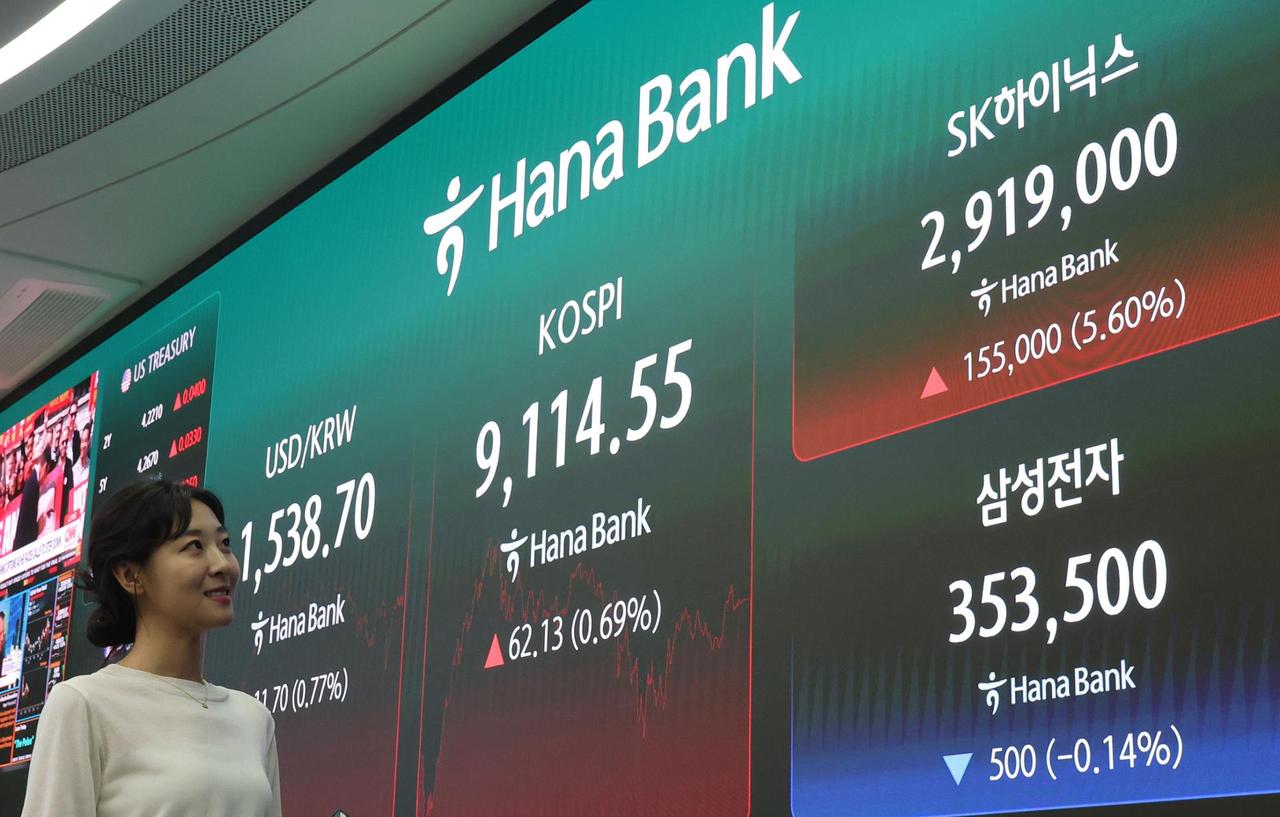
A dealing room display at Hana Bank in Seoul shows the won-dollar exchange rate, KOSPI and the closing prices of SK hynix and Samsung Electronics, Monday. KOSPI closed at 9,114.55, up 62.13 points, or 0.69 percent, from the previous session, setting a record high on a closing basis. SK hynix also overtook Samsung Electronics to become the No. 1 company by market capitalization on the benchmark index. Yonhap SK hynix overtook Samsung Electronics to claim the top position on KOSPI by market capitalization on Monday, ending Samsung's reign of 25 years and seven months as the benchmark index's most valuable listed company. KOSPI, meanwhile, edged higher to close above the 9,100 mark, setting a new record high on a closing basis. According to the Korea Exchange, SK hynix recorded a market capitalization of about 2,080.38 trillion won ($1.35 trillion), surpassing Samsung Electronics' 2,066.66 trillion won by about 13.72 trillion won on a closing price basis. Samsung Electronics first claimed KOSPI's top spot by market capitalization on July 29, 1999, and had maintained its dominance uninterrupted since Nov. 21, 2000. The change at the top comes amid a rally in the semiconductor sector fueled by surging demand tied to the artificial intelligence (AI) boom. While both Samsung Electronics and SK hynix have benefited from the trend, SK hynix has delivered markedly stronger stock performance, ending Samsung's long-standing reign as the market's most valuable company. Samsung's shares have risen nearly 200 percent so far this year, but SK hynix has far outpaced that gain with a rally of more than 340 percent over the same period. During Monday's trading session, SK hynix extended its gains, rising 5.61 percent to close at 2,919,000 won. Samsung Electronics, by contrast, slipped 0.14 percent to end at 353,500 won. SK hynix derives most of its revenue from memory semiconductors, including high-bandwidth memory (HBM), making it one of the biggest beneficiaries of the AI boom. Strong demand for AI servers and HBM has directly boosted the company's earnings prospects and valuation. Samsung Electronics, on the other hand, has a much broader business portfolio encompassing smartphones, home appliances, displays and semiconductors. Market participants say this diversification has limited the extent to which the company can capitalize on the ongoing semiconductor upcycle. Still, Samsung holds the edge over SK hynix in total market capitalization once its preferred shares, valued at about 184 trillion won, are included. SK hynix's market capitalization is composed entirely of common shares, as the company has not issued any preferred shares. Hanwha Investment & Securities raised its target price for SK hynix by 164 percent to 4.3 million won, the highest target ever set for the company by a domestic brokerage house. "SK hynix is evolving into a company capable of generating robust profits on a sustained basis," said Park Jun-young, an analyst at Hanwha Investment & Securities. Park noted that Micron, which operates in the same segment of the semiconductor industry, trades at a price-to-earnings ratio of more than 10 times, while SK hynix is valued at just 6.6 times forward earnings over the next 12 months. "The company is still not receiving even the baseline valuation multiples typically afforded to global technology firms," he said. Another factor underpinning SK hynix's share price is growing anticipation over its planned American Depositary Receipt (ADR) listing in the United States later this year. The company moved a step closer to that goal in March by filing a registration statement with the U.S. Securities and Exchange Commission (SEC). ADRs allow shares of foreign companies to be traded on U.S. stock exchanges, improving access for international investors and potentially broadening the shareholder base. KOSPI opened 97.99 points, or 1.08 percent, lower at 8,954.43 and fluctuated between gains and losses throughout Monday's session before closing up 62.13 points, or 0.69 percent, at 9,114.55, setting a new record high on a closing basis. The secondary Kosdaq likewise reversed early losses, rising after opening at 957.49, down 9.10 points, or 0.94 percent, from the previous session, to close at 968.40, up 1.81 points, or 0.19 percent. In Seoul's foreign exchange market, the Korean won opened 3.9 won weaker at 1,530.9 per U.S. dollar compared with the previous session and extended its losses to finish onshore trading at 1,537.0, down 10 won from the previous close.
[7]
SK Hynix overtakes Samsung as South Korea's most valuable company
SK Hynix on Monday overtook Samsung Electronics to become South Korea's most valuable listed company. Shares in what is now the world's most valuable memory chipmaker closed 5.6% higher to bring the company's market capitalization to $1.35 trillion. That was fractionally ahead of Samsung Electronics, which had held the top spot since 2000. :: SK Hynix Now Hynix gets the bragging rights as AI continues to reshape the global semiconductor industry. It also marks the one of the biggest turnarounds in South Korea's corporate history. In 2002, the then-Hynix Semiconductor was on the verge of collapse, having been crippled by debt. Today, SK Hynix has emerged as one of the biggest beneficiaries of the global AI boom, propelling a more than 340% rally in its shares this year. It is a dominant supplier of high-bandwidth memory chips used in AI systems for customers such as Nvidia and Alphabet's Google. Samsung said that any calculation of its market capitalization should include preferred shares, by which metric it would still be top dog. By 2003 it was viewed as a penny stock.
Share
Copy Link
SK Hynix has surpassed Samsung Electronics to claim the title of South Korea's most valuable company, driven by explosive demand for high-bandwidth memory chips used in AI systems. The chipmaker's shares surged more than 340% this year, lifting its market capitalization to $1.35 trillion and ending Samsung's 25-year reign at the top since 2000.
SK Hynix has achieved a milestone that seemed unthinkable just two decades ago, surpassing Samsung Electronics to become South Korea's most valuable company
1
. The memory chip producer saw its shares climb 5.7% on Monday, pushing its market capitalization to 2,082.5 trillion won, or approximately $1.35 trillion, narrowly edging past Samsung Electronics at 2,081.3 trillion won, excluding preferred shares2
. This marks the first time Samsung has lost its position as the nation's largest publicly listed company since claiming the top spot in 20003
.
Source: Korea Times
The shift in corporate hierarchy reflects how the AI boom has fundamentally reshaped the semiconductor industry, transforming specialized memory chips from commodities into critical components powering applications like ChatGPT and advanced AI models
1
. SK Hynix shares have surged more than 340% this year alone, significantly outperforming Samsung's roughly 200% gain over the same period5
.The primary catalyst behind SK Hynix's meteoric rise is its dominance in high-bandwidth memory chips, or HBM, which have become essential for AI systems. The company now commands a 61% share of the global HBM market, far ahead of Micron's 21% and Samsung's 17%
3
. These specialized chips are stacked vertically to deliver faster performance and lower power consumption, making them indispensable for AI accelerators used by tech giants including Nvidia, Google, and Microsoft1
.
Source: ET
"The emergence of customised AI memory fundamentally changed the industry's economics and allowed SK Hynix to establish itself as the market leader," said Kim Sunwoo, a senior analyst at Meritz Securities
3
. Unlike conventional memory products, HBM chips are tightly integrated with AI processors, creating significantly higher barriers to entry and giving suppliers greater pricing power3
.SK Hynix's achievement represents one of the most dramatic turnarounds in South Korean corporate history. In 2002, the company—then known as Hynix Semiconductor—was on the verge of being sold to Micron after being crippled by debt accumulated during an aggressive expansion drive
1
. The deal fell through, leaving the company under creditor control for nearly a decade. By 2003, its shares had plunged to just 135 won, making it a penny stock among investors2
.The company's fortunes tracked the global memory industry's boom-and-bust cycle for years. As recently as 2023, a severe downturn pushed SK Hynix to report an annual operating loss of 7.73 trillion won
1
. However, the AI boom changed everything. By 2024, the company posted a record annual operating profit of 23.5 trillion won as Microsoft, Google, and Meta invested heavily in AI data centers3
.Related Stories
Analysts credit SK Hynix's success to its strategic decision to continue investing in HBM development during periods of low growth in the memory market
2
. SK Group Chairman Chey Tae-won, who faced strong opposition when acquiring the company, explained his vision in a book published in January: "What I really wanted to accomplish when we acquired Hynix was to transform it from a commodity memory producer into a mainstream semiconductor company whose products are indispensable"3
.
Source: ET
That vision has materialized as SK Hynix emerged as a key supplier in the AI chip supply chain, with its memory products now critical for Nvidia's AI accelerators and systems deployed by major tech giants
4
. The rush to build AI data centers has constrained supply and driven memory chip prices higher, benefiting South Korean chipmakers with record profits5
.Looking ahead, Bank of America estimates that SK Hynix's monthly DRAM output will reach about 589,000 wafers this year compared to roughly 691,000 wafers for Samsung Electronics
3
. However, SK Hynix is likely to expand DRAM output by about 38% between 2025 and 2028, compared with about 17.5% growth at Samsung, which could narrow the production gap to less than 10% by 2028 from about 23% currently3
.This trajectory suggests Samsung's position as the world's largest DRAM producer could face pressure from SK Hynix in coming years. The stock price performance also highlights how specialized AI memory chips have elevated certain players in the semiconductor industry to unprecedented valuations. In May, SK Hynix joined Samsung Electronics and Micron Technology in topping $1 trillion in market value for the first time
5
. Samsung responded to the market shift by noting that calculations including preferred shares would place its market value at around 2,252 trillion won, or approximately $1.46 trillion3
.Summarized by
Navi
[2]
[4]
23 Jan 2025•Business and Economy

01 Feb 2025•Business and Economy

29 Jan 2026•Business and Economy

1
Startups

2
Policy and Regulation

3
Policy and Regulation