9 Sources
[1]
Snowflake lifts annual product revenue forecast, shares soar
Sept 2 (Reuters) - Snowflake (SNOW.N), opens new tab raised its full-year product revenue forecast on Wednesday, betting on strong demand for its cloud data platform and AI offerings, sending its shares up more than 20% in extended trading. The company now expects fiscal 2027 product revenue of $6.07 billion, compared with its previous forecast of $5.84 billion. Snowflake has benefited from demand for its core cloud data-warehousing products, aided by legacy-system migrations and AI adoption. Businesses use Snowflake's cloud platform to store and analyze information, and to build applications and AI products. Its AI offerings include coding assistant Cortex Code and enterprise chatbot CoWork. Snowflake's second-quarter product revenue rose 37% to $1.49 billion. It posted overall revenue of $1.55 billion for the quarter, compared with analysts' average estimate of $1.48 billion, according to data compiled by LSEG. Last quarter, Snowflake signed a five-year, $6 billion deal with Amazon Web Services to use AWS' Graviton processors and AI infrastructure. The company reported adjusted profit of 62 cents per share for the quarter, above analysts estimate of 45 cents. Reporting by Anzar Mehraj in Bengaluru; Editing by Sahal Muhammed Our Standards: The Thomson Reuters Trust Principles., opens new tab
[2]
Snowflake spikes 22% on healthy results and AI coding momentum
* Snowflake beat on the top and bottom lines and issued upbeat revenue guidance. * The company pointed to growth in its artificial intelligence coding agent named CoCo. In this article * SNOW Follow your favorite stocksCREATE FREE ACCOUNT Sridhar Ramaswamy, CEO of Snowflake, poses in front of the company signage outside of the New York Stock Exchange on Sept. 30, 2025. NYSE Snowflake shares rose 22% in extended trading on Wednesday after the data analytics software maker reported results and guidance that surpassed expectations. Here's how the company performed relative to LSEG consensus: * Earnings per share: 62 cents adjusted vs. 45 cents expected * Revenue: $1.55 billion vs. $1.48 billion expected Snowflake's revenue jumped 35% year over year in the fiscal second quarter, which ended on July 31, according to a statement. The company recorded a net loss of $191.7 million, or 55 cents per share, smaller than the net loss of $297.9 million, or 89 cents per share, one year ago. The company pointed to gains from the CoCo artificial intelligence coding agent, which now has 9,100 accounts, an increase of over 2,000 during the quarter. For the fiscal third quarter, Snowflake said it sees $1.59 billion in product revenue, above the $1.50 billion consensus among analysts polled by StreetAccount. Management pushed up its product revenue forecast for the fiscal year, calling for $6.07 billion, compared with $5.84 billion in May. It's now forecasting a 14.5% adjusted operating margin, wider than the 13.5% figure it had projected in May. As of Wednesday's close, Snowflake shares were up 39%, while the S&P 500 index had gained about 12% in the same period. If the stock moves as high on Thursday as it did after hours on Wednesday, it would represent the fourth highest jump since Snowflake went public in 2020. Executives will discuss the results with analysts on a conference call starting at 5 p.m. ET. watch now VIDEO1:1501:15 Cramer's Stop Trading: Snowflake Squawk on the Street Choose CNBC as your preferred source on Google and never miss a moment from the most trusted name in business news.
[3]
Snowflake Stock Soars as Surging AI Demand Boosts Earnings
Get personalized, AI-powered answers built on 27+ years of trusted expertise. Snowflake stock is surging on signs that enterprise AI demand is driving big gains for its business. Shares of Snowflake (SNOW) were up more than 20% in extended trading Wednesday, putting them on track to hit a new record high, after the AI data cloud company posted quarterly results that topped analysts' estimates and raised its outlook. The company reported adjusted earnings per share of $0.62 for its fiscal 2027 second quarter, on a 35% year-over-year rise in revenue to $1.55 billion. Those numbers were well above the adjusted EPS of $0.45 on revenue of $1.48 billion that analysts surveyed by Visible Alpha expected. CFO Brian Robins said in a release that Snowflake saw a "meaningful step-up in AI revenue." The company said it netted 692 new clients in the quarter, including 14 Forbes Global 2000 businesses. "AI continues to compound our advantages, creating a flywheel effect across the business," CEO Sridhar Ramaswamy said. Snowflake projected current-quarter product revenue of between $1.588 billion and $1.593 billion, which would represent up to 38% growth. It lifted its full-year product revenue forecast to $6.07 billion from $5.84 billion previously. Snowflake shares were up nearly 40% for the year through Wednesday's close.
[4]
Snowflake Stock Shoots Up 23% After Hours -- Jim Cramer Calls It a 'Thing of Beauty' - Snowflake (NYSE:SNO
On Wednesday, Snowflake Inc. (NYSE:SNOW) shares surged 23.14% in after-hours trading after the AI data cloud company delivered a stronger-than-expected fiscal second-quarter report and raised its full-year outlook. Jim Cramer, Brad Gerstner React Following the earnings, Jim Cramer posted on X, "Snowflake a thing of beauty." Altimeter Capital founder Brad Gerstner highlighted Snowflake's transformation, noting that when SNOW last traded around $375 in 2021, it had about $1 billion in revenue. "Today it's $ 6 B with accelerating 37% revenue growth & expanding operating margins driven by AI use cases like CoCo & Cowork. Congrats," he wrote. Futurum Group CEO Daniel Newman added to the excitement with a blunt message: "RIP SaaSpocalypse." The remark reflects a growing debate over whether AI agents could disrupt traditional software businesses. Snowflake's latest results instead suggest AI may be creating a new growth opportunity for data and software platforms. Analyst Color Snowflake Vs. Databricks: Can SNOW Stock Hold Its Ground Against A Rising Tech Giant? Snowflake Inc. (NYSE: SNOW) faces heavy pressure from rival Databricks' explosive growth, but analysts say Snowflake's superior cash flow and cheaper stock price keep it a buy. 3 min read Read this article Snowflake Earnings Beat Wall Street Estimates Snowflake reported $1.55 billion in second-quarter revenue, ahead of analysts' $1.48 billion estimate. Adjusted earnings came in at 62 cents per share, topping expectations of 45 cents. Trending Product revenue, Snowflake's key sales metric, climbed 37% to $1.49 billion. AI Growth Fuels Snowflake's Bullish Outlook Snowflake raised its fiscal 2027 product revenue forecast to $6.07 billion. The company now expects product revenue growth of 36% for the full year. For the fiscal third quarter, Snowflake expects product revenue between $1.588 billion and $1.593 billion, representing 37.5% year-over-year growth. It also raised its full-year adjusted operating margin forecast to 14.5% from 13.5%. CEO Sridhar Ramaswamy said AI is creating a "flywheel effect" across the business, with Snowflake's CoWork and CoCo products driving adoption and new workloads. Price Action: Snowflake shares closed at $305.84 on Wednesday, but surged 23.14% to $376.60 in after-hours trading, according to Benzinga Pro. According to Benzinga Edge Stock Rankings, Snowflake ranks in the 94th percentile for Momentum, with the stock posting gains across the short-, medium- and long-term periods. Disclaimer: This content was partially produced with the help of AI tools and was reviewed and published by Benzinga editors. Tech Jim Cramer Says 'WOW' as Dell Crushes Earnings; Patrick Moorhead Says the Company Is Doing 'Exactly What It Told Investors' Dell's blowout quarter drew strong analyst praise, with Jim Cramer saying "WOW" and one analyst comparing its growth favorably with Nvidia's. 3 min read Read this article Photo Courtesy: katz / Shutterstock.com Market News and Data brought to you by Benzinga APIs To add Benzinga News as your preferred source on Google, click here.
[5]
Snowflake Stock Surges on Q2 Double Beat as AI Momentum Continues - Snowflake (NYSE:SNOW)
Snowflake Inc (NYSE:SNOW) posted financial results for the second quarter of fiscal 2027 on Wednesday after the close. Here's a rundown of the report. * Snowflake shares are in the spotlight. What's going on with SNOW stock? Snowflake Q2 Key Metrics Snowflake reported second-quarter revenue of $1.55 billion, beating analyst estimates of $1.48 billion, according to Benzinga Pro. The AI data cloud company reported adjusted earnings of 62 cents per share for the quarter, beating estimates of 45 cents per share. Total revenue was up 35% year-over-year with a net revenue retention rate of 126%. Product revenue came in at $1.49 billion, up 37% on a year-over-year basis. Remaining performance obligations totaled $9 billion, up 30% year-over-year. Snowflake said it ended the quarter with 828 customers with trailing 12-month product revenue greater than $1 million, up 27% year-over-year. Trending The company had approximately $1.71 billion in cash and cash equivalents and $637.51 million in short-term investments at quarter's end. "AI continues to compound our advantages, creating a flywheel effect across the business. CoWork and CoCo are driving transformational outcomes for our customers, while fueling rapid adoption, user growth, new workloads, and overall platform consumption," said Sridhar Ramaswamy, CEO of Snowflake. Snowflake sees third-quarter product revenue in the range of $1.588 billion to $1.593 billion, up approximately 37.5% year-over-year. The company noted that it expects an adjusted operating margin of 15.5% in the third quarter and 14.5% for the full year, up from prior guidance of 13.5%. Snowflake management will discuss the quarter on an earnings call scheduled for 5 p.m. ET. A link to the call has been provided below. SNOW Stock Surges After Hours SNOW Price Action: Snowflake shares were up 22.78% in after-hours Wednesday, trading at $375.50 at publication time, according to Benzinga Pro. Tech Nvidia Jumps On AI Bid, Software Stocks Dip: Stock Market Today Nvidia surges 4.7%, while Credo, MongoDB and Palo Alto all cratered Wednesday despite quarterly beats, as costs surged. 6 min read Read this article Image: Shutterstock.com Market News and Data brought to you by Benzinga APIs To add Benzinga News as your preferred source on Google, click here.
[6]
Snowflake Q2 fiscal 2027 presentation: accelerating growth, shares jump 22% By Investing.com
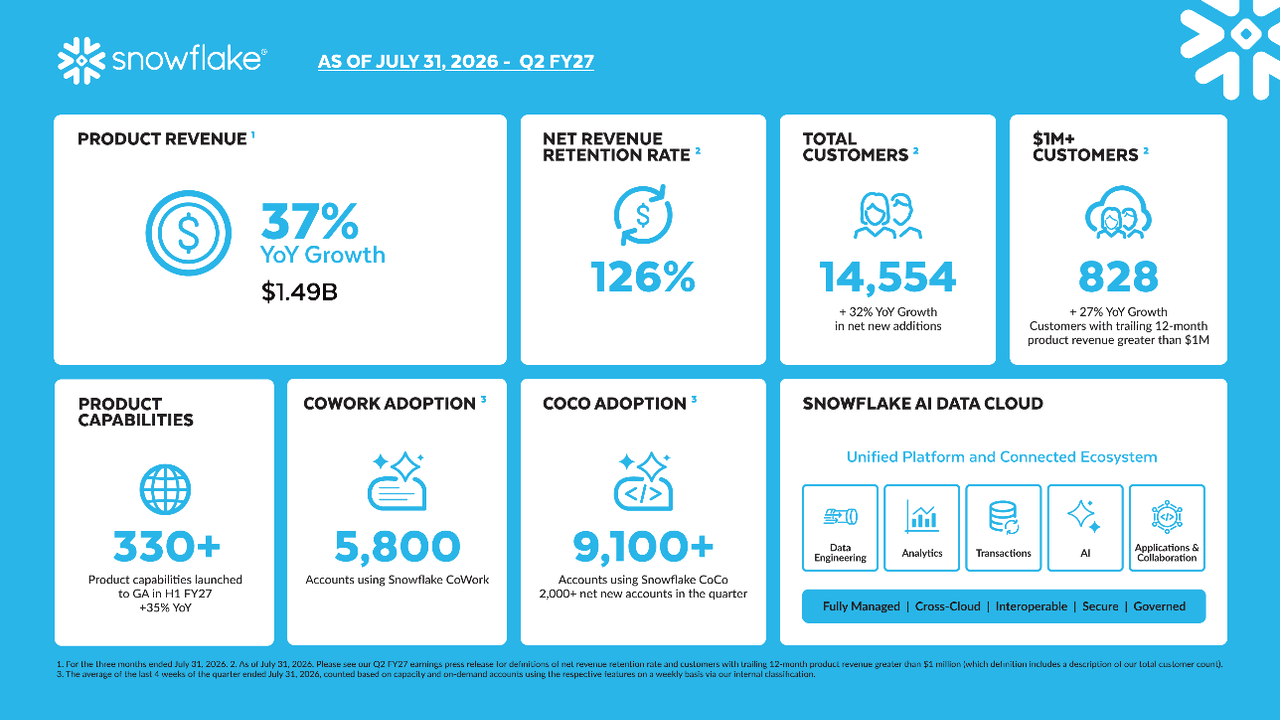
Snowflake Inc. (NYSE:SNOW) unveiled its second quarter fiscal 2027 investor presentation on September 2, 2026, showcasing accelerating revenue growth and expanding profitability that sent shares surging more than 22% in after-hours trading. The cloud data platform provider reported product revenue of $1.49 billion, representing 37% year-over-year growth and marking the third consecutive quarter of acceleration. The strong performance, which exceeded Wall Street expectations, came as the company positions itself at the forefront of what it calls "The Era of the Agentic Enterprise," emphasizing artificial intelligence as a core driver of customer adoption and platform expansion. After closing the regular session down 4.26% at $306.19, the stock jumped to approximately $375 in extended trading, pushing well above its previous 52-week high of $341.95. Executive Summary The presentation highlighted four key performance pillars for Q2 FY27. As shown in the following financial highlights dashboard, the company demonstrated strong execution across multiple metrics: Product revenue grew 37% year-over-year to $1.49 billion, while the company maintained a net revenue retention rate of 126%, indicating robust expansion within the existing customer base. Snowflake now serves 828 customers generating more than $1 million in annual product revenue, up 27% from the prior year. Non-GAAP product gross margin reached 75%, reflecting the company's ability to maintain profitability while scaling rapidly. The company also raised its full-year fiscal 2027 product revenue guidance to $6.07 billion, implying 36% growth, and increased its non-GAAP operating margin outlook to 14.5% from a previous target of 13.5%. Strategic Vision: The Agentic Enterprise A central theme of the presentation was Snowflake's vision for transforming enterprise architecture to support AI-driven operations. The company illustrated how fragmented data systems currently limit AI implementation across organizations: This complex, disconnected architecture creates security vulnerabilities, data quality issues, and operational inefficiencies that prevent enterprises from effectively deploying AI at scale. In response, Snowflake outlined its solution framework built on four foundational pillars: The company's approach centers on providing unified, governed enterprise data ready for AI applications, offering flexibility in AI model and cloud infrastructure choices, integrating with major systems of record, and delivering an "Agentic Control Plane" accessible across the organization. The architectural vision is further detailed in the company's three-pillar framework for the agentic enterprise: At the core sits the AI Data Cloud, which connects enterprise data and context, AI model choice, and software applications through a unified platform. This platform supports five key workloads, as illustrated in the following diagram: The AI Data Cloud encompasses data engineering, analytics, transactions, AI capabilities, and applications with collaboration tools, all delivered as a fully managed, cross-cloud, interoperable, secure, and governed solution. Quarterly Performance Highlights Snowflake's financial performance demonstrated consistent momentum across both annual and quarterly metrics. The following charts illustrate the company's revenue trajectory: Annual product revenue has grown from $2.67 billion in fiscal 2024 to $4.47 billion in fiscal 2026, representing 29% year-over-year growth in the most recent fiscal year. More notably, quarterly product revenue accelerated to 37% year-over-year growth in Q2 FY27, reaching $1.49 billion compared to $1.09 billion in the prior-year period. Customer commitments continued to expand, as shown in the following remaining performance obligations trend: Total RPO reached $9.0 billion as of July 31, 2026, with 54% expected to be recognized as revenue within the next twelve months. This represents a substantial pipeline of contracted future revenue, though the company noted that RPO can be influenced by renewal timing, capacity purchases, contract terms, and foreign exchange rates. The company's customer acquisition strategy showed strong results across both total customer count and strategic enterprise accounts: Snowflake's total customer base grew to 14,554 as of Q2 FY27, while Forbes Global 2000 customers reached 829, representing penetration of over 41% of the world's largest enterprises. The company added 692 net new customers in the quarter, representing 32% year-over-year growth in customer additions. High-value customer expansion accelerated significantly, as demonstrated in the following chart: The number of customers generating more than $1 million in annual product revenue grew 27% year-over-year to 828, with 48 net additions in the quarter alone. This cohort represents the company's most strategic accounts and typically demonstrates higher retention and expansion rates. Customer Retention and Expansion Snowflake maintained a world-class net revenue retention rate, as illustrated in the following quarterly trend: The 126% net revenue retention rate in Q2 FY27 indicates that existing customers increased their spending by 26% over the prior year period, reflecting both increased consumption of the platform and expansion into new use cases. This metric has remained consistently above 125% for five consecutive quarters, demonstrating the durability of customer relationships and the value customers derive from the platform. The company's AI Data Cloud metrics showed strong adoption of collaboration and marketplace features: As of July 31, 2026, 43% of customers had engaged in data sharing with at least one "stable edge," defined as sustained compute consumption resulting in recognized revenue. The Snowflake Marketplace grew to 4,105 listings, representing 21% year-over-year growth and providing customers with access to third-party data products and services. The dramatic expansion of the AI Data Cloud ecosystem is visualized in the following network diagrams comparing April 2020 to July 2026: This visualization, based on actual AI Data Cloud sharing activity, illustrates the exponential growth in data collaboration and interconnectivity among Snowflake customers over a six-year period, transforming from a sparse network to a dense, highly connected ecosystem. Financial Analysis and Operational Efficiency The company demonstrated improving operational leverage across key efficiency metrics: Non-GAAP operating margin expanded to 15% in Q2 FY27 from 11% in the prior-year period, representing 400 basis points of improvement. This expansion occurred while the company maintained a 75% non-GAAP product gross margin and 6% non-GAAP adjusted free cash flow margin, demonstrating the ability to invest in growth while improving profitability. The company's headcount growth has been disciplined, with total employees reaching 9,394 in Q2 FY27, up modestly from 8,769 in Q2 FY26. Sales and marketing represents the largest function at 4,427 employees, followed by research and development at 2,571 employees. Revenue remains heavily concentrated in the Americas, which accounted for 77% of total revenue in Q2 FY27, while EMEA contributed 17% and Asia-Pacific Japan 6%. This geographic distribution has remained relatively stable over the past year, though EMEA showed a slight increase from 16% to 17% of the mix. Market Opportunity and Strategic Positioning Snowflake outlined a substantial expansion of its total addressable market over the next five fiscal years: The company estimates its TAM will grow from $225 billion in fiscal 2026 to $460 billion by fiscal 2031, representing a doubling of the addressable opportunity. This expansion reflects both the growth of existing market categories and the emergence of new use cases driven by AI and advanced analytics. The company emphasized three core value propositions that differentiate its platform: Snowflake positions its solution as easy to deploy at scale by eliminating architectural complexity, connected through integration of data, applications, and models without data movement, and trusted through built-in governance and cost controls that reduce enterprise AI risk. Forward-Looking Statements and Guidance The company provided updated fiscal 2027 guidance alongside historical performance context: For fiscal 2027, Snowflake expects product revenue of $6.07 billion, representing 36% year-over-year growth and an increase from previous guidance. The company raised its non-GAAP operating margin target to 14.5% from 13.5%, while slightly lowering non-GAAP product gross margin guidance to 74.0% due to a higher mix of AI workloads, which currently carry lower margins than traditional data warehousing operations. The company maintained its non-GAAP adjusted free cash flow margin guidance at 23.0% for the full fiscal year, indicating continued strong cash generation despite increased investment in AI capabilities and go-to-market expansion. Management noted that AI products contributed approximately half of the recent acceleration in product revenue growth, with the remainder coming from faster customer migrations, broader adoption of notebooks and applications, and expanded use of core platform capabilities. Product Innovation and Adoption The presentation highlighted significant product development velocity, with the company launching over 330 product capabilities to general availability in the first half of fiscal 2027, representing 35% year-over-year growth in feature releases. This rapid innovation cycle reflects the company's investment in research and development and its focus on expanding platform capabilities to address emerging customer needs. Two specific products showed strong adoption metrics: Snowflake CoWork, focused on collaborative development, reached 5,800 accounts, while Snowflake CoCo, the company's AI-focused offering, surpassed 9,100 accounts with 2,000 net new accounts added in Q2 alone. These products represent key elements of the company's strategy to capture AI-driven workloads and enable customers to build intelligent applications on the Snowflake platform. The comprehensive business highlights dashboard summarizes the company's performance across operational and financial dimensions: This dashboard view reinforces the breadth of Snowflake's platform capabilities across data engineering, analytics, transactions, AI, and applications, all delivered through a unified, cross-cloud architecture that emphasizes security, governance, and interoperability. Market Reaction and Investor Sentiment The market's response to Snowflake's Q2 fiscal 2027 results was decisively positive, with shares jumping 22.61% to $375 in after-hours trading from the regular session close of $306.19. This surge represented a reversal of the 4.26% decline during regular trading hours and pushed the stock well above its previous 52-week high of $341.95. The strong market reaction reflected investor approval of both the current quarter's performance and the raised full-year guidance, particularly the combination of accelerating revenue growth and expanding operating margins. The results demonstrated that Snowflake's AI strategy is translating into measurable business momentum, with management indicating that AI-related products contributed approximately half of the recent growth acceleration. Analysts had been closely watching whether Snowflake could prove that AI adoption would drive durable revenue growth rather than short-term pilot projects. The 37% product revenue growth, sustained 126% net revenue retention, and increased guidance provided evidence that customers are moving AI workloads into production at scale. The company's consumption-based business model, which recognizes revenue as customers use the platform rather than upfront, provides transparency into actual customer value realization. This model aligns Snowflake's revenue with customer success, though it also creates variability based on usage patterns and can result in lower revenue if customers optimize their consumption or if performance improvements reduce costs. With a market capitalization exceeding $106 billion based on the after-hours price, Snowflake trades at a premium valuation relative to traditional enterprise software peers, reflecting investor expectations for sustained high growth in the expanding cloud data and AI markets. The company's ability to maintain growth rates above 35% while improving profitability will be critical to supporting this valuation over time. Full presentation: This article was generated with the support of AI and reviewed by an editor. For more information see our T&C.
[7]
Earnings call transcript: Snowflake beats Q2 2026 estimates, shares jump 22% By Investing.com
Snowflake reported fiscal second-quarter results that topped Wall Street expectations, with adjusted earnings of $0.62 a share on revenue of $1.55 billion, ahead of forecasts for $0.45 a share and $1.48 billion. The company also raised its full-year product revenue outlook and said growth accelerated for a third straight quarter. Shares surged 22.37% in after-hours trading to $374.25, reversing a 4.26% decline during the regular session and pushing the stock above its 52-week high. Key Takeaways * Snowflake beat estimates on both earnings and revenue, with EPS ahead by 37.8% and sales ahead by 4.7%. * Product revenue grew 37% from a year earlier to $1.49 billion, marking the third consecutive quarter of acceleration. * Management said AI products contributed about half of the acceleration, led by CoCo and CoWork. * Full-year product revenue guidance was raised to $6.07 billion, implying 36% growth. * The stock jumped sharply after hours, signaling investor approval of both the results and outlook. Company Performance Snowflake said its business continued to gain momentum in the second quarter, helped by stronger demand for its core data platform and a faster ramp in AI-related products. Product revenue rose 37% year over year, and the company said growth has accelerated by 7 percentage points in just two quarters, after ending the prior fiscal year at 30% growth. The company also pointed to broader customer adoption. Net revenue retention was 126%, remaining performance obligations rose 30% to $9 billion, and Snowflake added 692 net new customers. It now counts 14,554 customers overall, including 829 from the Forbes Global 2000. With a market capitalization of $106.6 billion and revenue growth of 31% over the last twelve months, the company commands a premium valuation. According to InvestingPro analysis, the stock currently appears overvalued relative to its Fair Value estimate, placing it among companies on the Most Overvalued list. Snowflake's results come as enterprise software companies race to show that AI can drive real spending, not just pilot projects. Management said AI is helping customers move more workloads into production and use data in more parts of the business, including supply chain, finance, sales and risk management. Financial Highlights * Product revenue: $1.49 billion, up 37% year over year. * Total revenue: $1.55 billion, above the $1.48 billion forecast. * Adjusted EPS: $0.62, above the $0.45 forecast. * Non-GAAP operating margin: 15%, up more than 400 basis points from a year earlier. * Net revenue retention rate: 126%. * Remaining performance obligations: $9 billion, up 30% year over year. * Net new customers: 692, up 32% from a year earlier. * Forbes Global 2000 customers: 829, or 41% of the list. * Customers spending more than $1 million annually: 828, with 48 net new additions in the quarter. * Cash, cash equivalents and investments: $4.3 billion. Earnings vs. Forecast Snowflake posted adjusted earnings of $0.62 a share, compared with analysts' estimate of $0.45. That was a beat of $0.17 a share, or 37.8%. Revenue came in at $1.55 billion, above the $1.48 billion consensus by $70 million, or 4.7%. The earnings beat was larger than the revenue beat, which suggests the company also delivered better-than-expected profitability. That mattered to investors because Snowflake has been under pressure to prove it can grow quickly while also improving margins. The company said its non-GAAP operating margin expanded to 15%, and management raised full-year operating margin guidance to 14.5% from 13.5%. That combination of faster growth and better profitability likely helped fuel the strong after-hours rally. Market Reaction Snowflake shares closed the regular session at $306.19, down 4.26% from the prior close of $319.80. After the report, the stock climbed to $374.25, a gain of $68.41, or 22.37%, from the regular-session close. From the previous close, the after-hours move was about 17.0%. The jump pushed the shares above the top of their 52-week range of $341.95, a sign that investors viewed the quarter as stronger than expected. The move also reversed the day's earlier weakness, suggesting that the results and outlook changed sentiment quickly. Outlook & Guidance Snowflake raised its full-year product revenue forecast to $6.07 billion, which would represent 36% growth. The company also guided for third-quarter product revenue of $1.588 billion to $1.593 billion, implying 37% to 38% growth. Management said the higher outlook reflects strength in both the core business and AI products. The company also lifted its full-year non-GAAP operating margin guidance to 14.5% from 13.5%, while lowering non-GAAP product gross margin guidance to 74% because of a larger mix of AI workloads, which currently carry lower margins. Executives said the company remains on track for GAAP profitability in the fourth quarter of fiscal 2028. They also said the business is entering the second half of fiscal 2027 with strong momentum. An InvestingPro tip notes that analysts predict the company will be profitable this year on an adjusted basis, supporting management's optimistic timeline. The platform's Financial Health score of 2.19 rates as "FAIR," and investors can explore comprehensive analysis through Snowflake's Pro Research Report, one of 1,400+ available deep-dive reports that transform complex data into actionable intelligence. Executive Commentary Chief Executive Sridhar Ramaswamy said, "AI is compounding Snowflake's advantage across 3 reinforcing dynamics." He said AI is bringing new workloads onto the platform, driving adoption of first-party products and lifting overall consumption. Ramaswamy also said, "I think we see the acceleration come from a very broad swath of customers." He said the growth is not concentrated in AI-native companies, which remain a small part of revenue. Chief Financial Officer Brian Robins said, "We are increasing our FY 2027 non-GAAP operating margin guidance from 13.5% to 14.5%." He added that the company's first priority is to build great products, then drive adoption and customer benefit, and only then focus on margin effects. Risks and Challenges * Lower product gross margin guidance suggests AI growth may pressure near-term profitability. * Snowflake must prove that AI usage will create durable demand, not just short-term spending. * Competition remains intense from cloud providers, data warehouse rivals and AI model companies. * The company is still balancing rapid product expansion with disciplined spending. * Some customers may continue to push for lower costs, which could limit consumption growth in weaker macro conditions. Q&A Analysts pressed management on several issues, including the durability of AI-driven growth, the split between AI and core platform contributions, and the company's model-neutral strategy. On growth quality, Ramaswamy said the acceleration is broad-based and not concentrated in a small group of AI-native customers. He also said Snowflake's tools make it easier for customers to optimize spending rather than waste it. When asked how much AI contributed to the acceleration, he said the split was roughly even, with AI products contributing about half. He also pointed to faster migrations and broader use of notebooks, applications and AI functions. Another major topic was model neutrality. Executives said customers want flexibility to switch between models and optimize costs, and they argued that Snowflake's ability to support frontier, open-source and proprietary models is a competitive advantage. Analysts also asked about the company's regional performance, the role of the Frontier Engineering program, and whether traditional software companies are becoming more database-like. Management said all regions are performing well and reiterated that customers prefer to keep data in one central platform rather than copy it across multiple systems. Full transcript - Snowflake Inc (SNOW) Q2 2027: Operator: Good day, and welcome to the second quarter FY 2027 Snowflake earnings presentation. Today's conference is being recorded. At this time, I would like to turn the conference over to Katherine McCracken. Please go ahead. Katherine McCracken, Head of Investor Relations, Snowflake: Good afternoon, and thank you for joining us on Snowflake's second quarter fiscal 2027 earnings call. Joining me on the call today are Sridhar Ramaswamy, our Chief Executive Officer, Brian Robins, our Chief Financial Officer, and Christian Kleinerman, our Executive Vice President of Product, who will participate in the Q&A session. During today's call, we will review our financial results for the second quarter fiscal 2027 and discuss our guidance for the third quarter and full year fiscal 2027. During today's call, we will make forward-looking statements, including statements related to our business operations and financial performance. These statements are subject to risks and uncertainties, which could cause them to differ materially from our actual results. Information concerning these risks and uncertainties is available in our earnings press release, our most recent Forms 10-K and 10-Q, and our other SEC reports. All our statements are made as of today, based on information currently available to us. Except as required by law, we assume no obligation to update any such statements. During today's call, we will also discuss certain non-GAAP financial measures. See our investor presentation for the definition of the non-GAAP financial measures and a reconciliation of GAAP to non-GAAP measures and business metric definitions, including customer count and adoption. The earnings press release and investor presentation are available on our website at investors.snowflake.com. A replay of today's call will also be posted on the website. With that, I would now like to turn the call over to Sridhar. Sridhar Ramaswamy, Chief Executive Officer, Snowflake: Thank you, Catherine. Thank you all for joining us today. We're in the midst of a once-in-a-lifetime technology shift, and Snowflake remains at the center of the enterprise AI revolution. AI is fundamentally changing how enterprises build, operate, and make decisions. To stay competitive, every organization faces a new imperative: become an agentic enterprise, and do it quickly, safely, and cost efficiently. Snowflake is making this transformation a reality. We bring together the core elements of an agentic enterprise, a governed data foundation, access to leading AI models, deep application workflows, and a unifying agentic control plane that orchestrates across these elements to turn intent into governed action. By putting intelligence to work at scale, our customers are building faster, executing more efficiently, and reimagining their businesses in ways that weren't possible before. Put simply, the agentic enterprise runs on Snowflake. The traction is translating into strong business performance, as evidenced by our Q2 results. Product revenue came in at $1.49 billion, with growth accelerating to 37% year-over-year, marking our second consecutive quarter of record sequential dollar growth. After exiting Q4 of last fiscal year at 30% year-over-year growth, we have now added 7 points of acceleration in just 2 quarters. With our continued focus on executing with discipline and operational rigor, our Q2 non-GAAP operating margin expanded by more than 400 basis points year-over-year to 15%. Thank you to all of our Snowflakes for the hard work and dedication that made this performance possible. As these results convincingly demonstrate, AI is compounding Snowflake's advantage across 3 reinforcing dynamics. First, AI is bringing new workloads onto the platform. To power their AI initiatives, enterprises need a governed, unified foundation for data and context, and companies across industries are turning to Snowflake to power that foundation. Second, our first-party AI products, CoCo and CoWork, continue to see rapid adoption. As customers build and deploy agents on Snowflake, we are expanding our role into the agentic control plane and creating new opportunities for growth. Third, AI activation continues to lift overall platform consumption. Customers using AI on Snowflake consume more across the data platform, creating a structural multiplier for our business. Together, these dynamics show how the agentic enterprise has created a powerful flywheel across our business, and that flywheel is accelerating. At the heart of this momentum is the continued strength of our core business. Snowflake now provides the data and AI foundation for 14,554 customers around the world. Customers continue to turn to Snowflake because our AI Data Cloud is easy to use, seamlessly connected for collaboration, and trusted, with enterprise-grade governance and security. This quarter, we added 692 net new customers, including 14 from the Forbes Global 2000, representing a 32% increase in net new customer additions year-over-year. At the same time, some of the world's most recognizable enterprises are deepening their relationships with Snowflake. Companies like BlackRock and Block are running more of their mission-critical work on Snowflake, and in several cases, adopting CoCo to move faster. The pattern is consistent. The more our customers build on Snowflake, the more they lean in. In fact, 65 customers have now crossed $10 million in trailing 12-month product revenue, demonstrating how our largest customers continue to go all in on Snowflake. Part of our strength is in extending our customers' reach to the critical data that sits outside of their organization. Currently, 43% of our customers share data on Snowflake with at least one Stable Edge, demonstrating Snowflake's role as the circulatory system of the modern enterprise. We enable data, applications, and AI agents to move securely and seamlessly, not just within, but across organizations. In fact, Credit chose Snowflake for our data-sharing capabilities, which now facilitate privacy-safe ads measurement. As customers move quickly to modernize their data estates and establish a strong contact layer for AI, more and more customers are migrating workloads to our platform, a process now massively accelerated with AI. For example, one of the largest Australian banks migrated its financial crime platform to Snowflake, processing 17 billion transactions and delivering 10x faster query performance. Now, they're building AI agents on Snowflake to accelerate the migration of the rest of their data estate and automate legacy data discovery and mapping. As AI strengthens demand for our core platform, it is also expanding Snowflake's opportunity to deliver a new generation of AI-powered products and experience. Because Snowflake sits at the center of our customers' data, business context, AI models, and workflows, we are uniquely positioned to become the governed control plane for the agentic enterprise. Our breakout AI products, CoWork and CoCo, bring that vision to life. They provide a governed layer where users across the business, from knowledge workers to builders, can put the full power of their enterprise context to work, all with simple conversational language. With CoWork and CoCo, customers are reimagining some of their most critical business processes, from supply chain operations to enterprise-wide sales motion. Sayari, whose risk intelligence supports Fortune 100 enterprises and national security agencies, chose Snowflake to rebuild its global data infrastructure and cut costs by more than half. Its engineers are now using CoCo to accelerate the migration of 12 billion records into an AI-ready foundation. As more customers see what's possible with this technology, adoption continues to build. CoWork expanded to 5,800 accounts, up nearly 11% quarter-over-quarter. Meanwhile, CoCo continues to see rapid adoption, surpassing 9,100 accounts and adding more than 2,000 net new accounts in this quarter alone. We have customers like 1Password, the security company trusted by more than 200,000 businesses, which choose Snowflake for our CoCo capabilities. CoCo enables their team to move key data pipelines into Snowflake quickly, laying the foundation for their data and AI work. The world's number one job site, Indeed, has rolled out CoWork and CoCo across its data teams and integrated Snowflake into its core data architecture, citing lower cost and greater efficiency, which compounds at the scale that they operate in, over 60 countries and 28 languages. The opportunity goes beyond adoption. By making it possible to build, collaborate, and interact with enterprise data through conversational language, CoWork and CoCo are bringing entirely new users to Snowflake. Within accounts adopting these products, we see a step change in user growth as Snowflake reaches new lines of business and expands its footprint within existing teams. As we continue to develop CoWork and CoCo as agency control planes, we are also building out the broader platform enterprises need to put AI to work at scale. Model choice gives customers the flexibility to select from leading frontier and open models and evolve their approach as the market changes. Post-training lets them adapt models to their specific data and business context. Agent observability and analytics give customers full visibility into what their AI is doing, how it's performing, and what it costs. To help our customers optimize cost, performance, and speed, we've introduced Cortex AI Gateway, which dynamically routes each task to the right model based on customer-defined policies and real-world performance data with cost and governance controls built in. As those economics improve, customers can deploy AI more broadly and with greater confidence, creating another catalyst for adoption and consumption on Snowflake. Cortex AI Gateway also extends AI from insight to action through its integration of Natoma. Users can now send emails, summarize Slack conversations, open Jira tickets, and act across their business, all without leaving CoWork or CoCo. We have also continued to advance how our agents understand the unique context of a business. At Snowflake Summit, we introduced Cortex Sense, which captures the business definitions and institutional knowledge an AI agent needs and provides that context at the moment it answers a question. This means Snowflake is giving AI both the context to understand a business and the ability to act on its behalf with enterprise security, governance, and observability built in. As we drive this AI transformation for our customers, we are leading from the front, using CoCo and CoWork throughout our own business to accelerate productivity and efficiency. For example, in our marketing organization, CoCo has helped bring search optimization in-house, eliminating $400,000 in annual agency spend, reducing keyword research from approximately 10 hours to 20 minutes, and content production from an estimated 24 hours down to just two. In finance, our long-range planning used to require a three-person team and more than 50 spreadsheets. It now runs with one analyst and a series of models that reflect our pricing structure and consumption dynamics. Within our sales teams, we have automated prospecting for over 125,000 contacts and leads, with 70% of initial outreach emails for inbound leads now being generated automatically before SDR involvement. We are bringing these proven use cases directly to market while applying our operational learnings to continuously upgrade our platform, moving with speed to capture the AI opportunity in front of us. In the first half of this year alone, we have launched over 330 product capabilities to general availability, 35% more than we did in the first half of last year, underscoring both the pace of our innovation and the breadth of platform expansion underway across Snowflake. Our go-to-market organization also continues to execute, as reflected in strong new customer growth. We have deployed CoCo and CoWork across the sales team to analyze pipelines, prepare for customer conversations, and accelerate the onboarding of new reps. Our teams are using these products every day, learning firsthand what they can do, and taking those insights directly to our customers. We are seeing the results in how quickly customers are putting Snowflake to work. The number of use cases, individual customer projects deployed on Snowflake increased 89% year over year as customers moved more workloads into production. At the same time, use cases won per account executive increased 43% year over year, demonstrating both growing customer demand and strong sales productivity. We are pairing this investment in growth with continued operational discipline. We remain on track for GAAP profitability in Q4 fiscal 2028, and the operating leverage we build along the way strengthens the durability of that outcome. Taken together, our rapid pace of innovation, tighter go-to-market execution, and operational discipline positions us well to capture the huge opportunity ahead. This quarter demonstrated that the transition to the agentic enterprise is accelerating, and Snowflake is at the center of it. AI agents are only as powerful as the data and business context they reason from and the governance surrounding them. Snowflake provides that trusted foundation while bringing together model choice and flexibility, access to critical applications, and the agentic control plane that connects intelligence to action across the enterprise. CoWork and CoCo demonstrate what governed architecture makes possible, enabling business users and builders to work with greater speed and intelligence while Snowflake manages the complexity underneath. Importantly, our customers' success with AI translates directly into growth for Snowflake. AI brings new workloads to the platform, extending our reach to new users, and drives greater consumption across the business. We are entering the second half of fiscal 2027 with strong product momentum, and we see a long runway for durable high growth and continued margin expansion. The agentic enterprise runs on Snowflake, and we are just getting started. With that, I will pass it to Brian to go through the financial details. Brian Robins, Chief Financial Officer, Snowflake: Thank you, Sridhar. In Q2, product revenue once again accelerated to reach 37% year-over-year growth. This marks our third straight quarter of acceleration. Q2 benefited from continued strength in our core data platform business and a meaningful step-up in AI revenue. Our AI revenue reflects a broadening portfolio of AI capabilities. CoCo delivered another standout quarter. Consumption of CoWork is scaling and driving revenue contribution alongside a diverse set of AI tools from AI functions and document processing to machine learning and notebooks. Our go-to-market teams continue to execute well against a strong demand environment. As Sridhar mentioned, net new customer additions increased 32% year over year. We added 14 net new Forbes Global 2000 customers, bringing our total to 829. Our AI Data Cloud now supports over 41% of the Forbes Global 2000. Within our existing base, customer expansion is healthy, as evidenced by our net revenue retention rate of 126%. This expansion is underpinned by growth in both migrations and AI use cases. In Q2, 48 net new customers surpassed $1 million in trailing 12-month spend. We now have 828 customers spending above the $1 million threshold. Remaining performance obligations grew 30% year over year, totaling $9 billion. As a reminder, we continue to see customers favor Q4 renewals. As a result, we expect bookings to be increasingly weighted towards the fourth quarter. Of the $9 billion RPO, we expect approximately 54% to be recognized as revenue in the next 12 months. This represents an approximately 42% year-over-year growth compared to our estimate in the same quarter last year. Our Q2 results reinforce our commitment to delivering both growth and margin expansion. In Q2, non-GAAP operating margin expanded over 400 basis points year over year to reach 15%. Our outperformance was driven by strong revenue growth and disciplined headcount management. Year to date, we have added 334 employees, which includes 173 from our Observe acquisition. This compares to 935 added in the year-ago period. We ended the quarter of $4.3 billion in cash equivalents, short-term, and long-term investments. Moving to our outlook. As always, our forecast is based on observed consumption patterns. There are no changes to our forecast methodology or our guidance philosophy. Given the strength we have observed both in our core data platform business and AI business, we are raising our product revenue guidance for the year. For FY 2027, we now expect product revenue of $6.07 billion, representing 36% year-over-year growth. This includes approximately one percentage point of growth from Observe, consistent with our previous outlook. In Q3, we expect product revenue between $1.588 billion and $1.593 billion, representing 37%-38% year-over-year growth. Turning to margins, for FY 2027, we now expect 74% non-GAAP product gross margin. This revised outlook includes a higher revenue mix from fast-growing AI workloads, which carry a lower contribution margin today. We are delivering continued operating margin expansion as we offset growing cloud costs with slowing headcount expense. We are increasing our FY 2027 non-GAAP operating margin guidance from 13.5% to 14.5%. For Q3, we expect non-GAAP operating margin of 15.5%. We are reiterating our full-year non-GAAP adjusted free cash flow margin guide of 23%. I would like to close with my two key goals for the year. First, help the business to deliver growth and margin expansion. Second, support ongoing excellence in our go-to-market motion. AI is fundamental to our progress against both goals. As we help our customers modernize their data and business operations, AI is becoming a powerful growth driver. Internally, AI is unlocking greater productivity. Across the organization, from sales to engineering to finance, our use of AI is transforming our daily work. AI is driving greater efficiency and reducing our reliance on headcount growth. Our progress against both priorities is evident in the strength of our Q2 results. With that, I will pass the call to the operator for Q&A. Operator: Thank you. If you are dialed in via the telephone and would like to ask a question, please signal by pressing star 1 on your telephone keypad. If you are using a speakerphone, please make sure your mute function is turned off to allow your signal to reach our equipment. A voice prompt on the phone line will indicate when your line is open. Please limit yourself to one question to allow everyone an opportunity. We will take our first question from Sanjit Singh with Morgan Stanley. Sanjit Singh, Analyst, Morgan Stanley: Yeah, thank you for taking the question, and congrats on the second quarter of a pretty material acceleration. The spirit of my question is around the quality of the acceleration that you are seeing, and just sort of as a backdrop, around the time the company went public, growth was being driven by a lot of investment in cloud-native companies that may have been unprofitable. I wanted to ask the question on the quality of the acceleration on sort of two levels. First, on the right to win. In the script, you guys mentioned supply chain use cases and finance use cases. The question here is: Why is CoCo, along with the platform, the right mousetrap for these use cases that kind of extend beyond classic business analytics use cases? On the durability of the growth, are you seeing any sort of irrational behavior or poor operational hygiene when it comes to consuming both CoCo and CoWork? This is a question on the quality of the acceleration you are seeing. Sridhar Ramaswamy, Chief Executive Officer, Snowflake: This is Sridhar. Let me take a first cut at this. Other folks can add on, since it is a pretty broad question. First, I think we see the acceleration come from a very broad swath of customers. It is not concentrated, for example, with, let us say, AI-native companies. They continue to be a small part of our overall revenue stream. I think the thing that is also materially different this time around with folks that are investing is that products like CoCo make optimization far, far easier than before. You can point CoCo at a query that is taking too long to run, or you can basically have it debug the top 10 longest-running queries or the most idle warehouses. Things like that are a lot easier to do. In fact, our cost management skill in CoCo is a top 10 skill. Brian Robins, Chief Financial Officer, Snowflake: It is also the case that as a company, we have learnt the lessons of the pandemic, and one thing that we stress with each and every one of our customers is the need to drive spend in an efficient way. This is also a mantra that our sales team itself adopts pretty aggressively because they know that every such case where they go to a customer and point out things that they could be doing better is a trust-building exercise that is going to more than pay for itself in new projects that customers will implement on Snowflake. Sridhar Ramaswamy, Chief Executive Officer, Snowflake: Overall, I am pretty happy with both the fact that our growth is coming from a very broad swath of our customers, without a whole lot of concentration in any one particular sector, and also about the fact that the very tools that make it possible to do things quickly also come with a set of functions that make it pretty easy to optimize. The final point, as I said, others will add onto it, the final point about our right to win for the kind of business use cases that perhaps we previously were not there in the conversation for. AI, as you know Has massively shrunk the distance between data and value. I am sure all of you live it in your day-to-day life. But certainly, I, as a CEO, can get a whole lot of value out of data a lot faster because of tools like CoCo and CoWork. The agentic harness is indeed a very powerful weapon for solving many different kinds of problems. It is our ability to take these powerful tools and drive our own transformation, whether it is in making SDRs more efficient, or in making account planning work much more effectively at scale, or in letting our sales leaders inspect and run their businesses a lot more effectively, or our finance team, under Brian, to be a lot more effective with what they do. We are able to go to our customers and not just preach, but also demonstrate what we have shown for ourselves internally. That just gives us a lot of credibility going into these conversations about transformation. Brian Robins, Chief Financial Officer, Snowflake: I will add just a little onto what Sridhar said. From a durability perspective, we give our guidance based observed behavior. So we have seen a couple quarters of this behavior. Our sales team is doing a great job with proving the business value of the use cases, and we are continuing to see great new logo additions. When we look at CoCo, the accounts that are using CoCo are consuming more of the core as well. So there is this flywheel effect that we talk about. We had 9,100 CoCo accounts this quarter. That is up significantly from last quarter, and the gross retention rate has been relatively flat across the last several quarters. Then just want to emphasize what Sridhar said as well, is we are actually selling into way more personas today. In a given week, I have 3 to 5 conversations with CFOs of existing customers of ours, or customers that want to be. So the CFOs are now making the purchase decision, the CRO, CMO, CEOs. So there is a lot more personas that we are selling into this broader portfolio of products. Sanjit Singh, Analyst, Morgan Stanley: Appreciate the thoughts. Thank you. Operator: Thank you. We will take our next question from Kirk Materne with Evercore ISI. Kirk Materne, Analyst, Evercore ISI: Yeah, thanks very much for taking the question. Congrats on a great start to the year. I was wondering if you guys could try to separate out a little bit or give us a little bit of color on how we should think about what portion of the acceleration is coming from these newer products that are obviously getting really rapid adoption, versus sort of the flywheel of those newer products on the core. I assume just given the size of the core, it's the core growing faster is probably the bigger factor. But I was wondering if there's any way for us to sort of distill down what these newer products are having, maybe on their own account. Thanks. Sridhar Ramaswamy, Chief Executive Officer, Snowflake: I would roughly call it even. Our AI products, which is a pretty broad swath at this point. Absolutely, it's CoCo and CoWork, but it's also things like AI Functions that make data operations proceed at an impressive scale, or even newer products like the AI Gateway. They contributed approximately half of the acceleration that we are seeing. There are a lot of other products that are also demonstrating robust growth, and Brian touched on some of them. Whether it's notebooks or applications written in Streamlit or React that are deployed into Snowflake, and of course, migrations themselves going faster. I have talked pretty much in every single earnings call over the past six quarters about migrations. That is an area where we continue to get faster and faster. Some of the recent advances, both in models and harnesses, are letting us run long duration tasks of a scale and complexity that we haven't been able to do before. The rate at which workloads are coming onto Snowflake is also an important factor. One anecdotal example, a big network equipment manufacturer is doing a Teradata migration in less than 3 quarters this year, this is something that would have taken probably 2 to 3 years in any previous time. These are some of the things that are contributing to our acceleration and beat. Kirk Materne, Analyst, Evercore ISI: Thanks so much, Sridhar. Operator: Thank you. We will take our next question from Karl Keirsted with UBS. Karl Keirsted, Analyst, UBS: Okay, great. Maybe I'll direct this to Sridhar and Christian. I'd love to ask about model neutrality and model choice. I'm guessing the bulk of tasks completed by CoCo are being directed to Frontier Labs. I'm just curious, during the quarter, did you detect any interesting behavioral shift, let's say, a mix shift from open class models to Sonnet class models? If that happens, Brian, is there any effect, potentially positive on gross margins to Snowflake's financials? Sridhar, is being model neutral, is that becoming a competitive advantage in cases where Snowflake competes directly with the prospect of a customer using one of the Frontier Labs standalone? Thanks so much. Sridhar Ramaswamy, Chief Executive Officer, Snowflake: I'll start. Christian will add on. As models have gotten more powerful, cost has absolutely become a concern. All of you know this, at least as far as the Frontier Labs go, there used to be somewhat of a dichotomy where Anthropic was available extensively on AWS, while the OpenAI models tended to be more on Azure. The material change that's happened is that both the companies are deploying substantial capacity of their own, but it's also the case that they are available in other clouds than the ones that they started with. We are absolutely seeing a lot of interest in being able to switch between different models and also to optimize cost. This is also where open source models come in. There's obviously been several generations of these open source models, and we support many of them within Snowflake. Yes, we have pretty different economics when it comes to open source models since we run the inference ourselves. So that offers a lot of potential for future optimization. Within our harnesses, many of the requests that we get from customers come in this mode that we call auto, where we can pair up the task with the model that is most appropriate for that particular task. That gives us a lot of leeway in being able to optimize tasks for our customers. Christian Kleinerman, Executive Vice President of Product, Snowflake: Yeah, Karl, in addition to what Sridhar said, another interesting trend that I would call it early, but we're hearing from a number of customers, is the desire to post-train open models, which the training itself is an opportunity for us, and we're starting to see a lot of interest. To your question on whether neutrality is a competitive advantage, absolutely it is. We have heard from many, many customers that they made large commitments to one specific model company, and later on are saying, "Oh, I should have wanted to do a different model." Whereas the commitment to Snowflake gives them that flexibility, and as Sridhar said, automatic routing into what is the right model for the right task. So definitely a very strong advantage for us. Sridhar Ramaswamy, Chief Executive Officer, Snowflake: This is a theme that clearly Christian and early Snowflake pioneered in terms of being able to offer really great capability across the cloud service providers. To quote Yogi Berra, "It feels like deja vu all over again" when it comes to model neutrality. Karl Keirsted, Analyst, UBS: Okay. Very helpful. Thank you. Brian Robins, Chief Financial Officer, Snowflake: Thank you. Karl, just, oops. Real quickly, I just wanted to hit on the margin aspect to your question. Karl Keirsted, Analyst, UBS: Yeah. Thank you, Brian. Brian Robins, Chief Financial Officer, Snowflake: Going back to when we develop products, the number one thing is we want to develop a great product. That is the key thing that we want to do. Secondly, we want to make sure that we have massive adoption through use cases and driving benefit to then in turn drive revenue. Then we will work on sort of the margin implication of that. Sridhar and I are very committed to driving overall operating margin leverage in the business. You saw our non-GAAP product gross margin go down to 74% because we have increased our guidance so much. The mix between our AI products and the course changed a little, but we are still committed as we guided to increasing our overall operating margin. As we go through and do model choice and use different models, the best thing for us right now is to give our customers the best answer with the best business outcome. Then we will continue to work on margins as we go forward, but we are committed to driving operating leverage in the model. Christian Kleinerman, Executive Vice President of Product, Snowflake: I have one more thing on this one, Karl, which is even the frontier models have been revising prices down on a regular basis and have been introducing additional models to their families, which have kept costs somewhat in check relative to the usage of organizations. Karl Keirsted, Analyst, UBS: Thank you. Operator: Thank you. We will take our next question from Raimo Lenschow with Barclays. Raimo Lenschow, Analyst, Barclays: Thank you. Congrats from me as well. If I look at the organization and if I look at where revenue's coming from at the moment, you're still relatively indexed towards U.S., North America. Can you talk a little bit about what you're seeing in other regions like Europe, Asia? Because it does seem there's a big opportunity to expand the footprint there. Thank you. Brian Robins, Chief Financial Officer, Snowflake: Yeah, absolutely. I think this isn't region-specific. I sat in a sales QBR just a month ago and looked at sort of the performance, and all regions are performing, and the outlook for our regions are factored into our guidance, but all regions are operating very well. Raimo Lenschow, Analyst, Barclays: Thank you. Operator: Thank you. We will take our next question from Ryan MacWilliams with Wells Fargo. Ryan MacWilliams, Analyst, Wells Fargo: Hey, thanks for taking the question. This really seems like the AI moment for the data space. What would you say is the biggest change on why AI is accelerating Snowflake revenues now? Is it Cortex Code helping users get activated on AI faster? Has it been some of your other product improvements in conjunction with better AI models now making AI use cases more attractive, or are customers just more ready for AI? What do you think has led to this AI moment for Snowflake? Thanks. Sridhar Ramaswamy, Chief Executive Officer, Snowflake: I spoke earlier about the flywheel. It's a lot of things coming together. What products like CoWork firmly demonstrated was the ability to get really flexible and quick value from data. The demo that I have unfailingly showed every CEO that I've met is the one in which I look up their company as a customer on Snowflake. It really brings alive the power of data in ways that abstract expressions never can. There's this growing realization that AI is a massive unlock for getting the data to the right person. Most data teams are embracing this moment because they see this as a way to get past the unending backlogs that they've had pretty much since time immemorial. That's a little bit of effect number one. What CoCo has done for us in a super native way is it's made the entirety of Snowflake absolutely our sales team AI native. They feel a lot more confident about being able to support any use case on Snowflake because the answer to most problems that a customer or you run into is to simply ask CoCo how you solve the problem, and in most cases, it can solve it by itself. So we see a lot of customers, a lot of partners take on migrations, get projects done that honestly we would not even have conceived of when we originally wrote Cortex Code. That's the magic of these coding agents. In a funny kind of way, CoCo also makes it far easier to create agents and get value from the data itself. This is the combination that makes Snowflake so attractive. It is not just acquiring customers. We track this metric called time to 80% of purchased consumption for new logos that we acquire. We measure it cohort by cohort. Basically, of the customers that you acquired, let us say, in January, what fraction of them are consuming more than 80% of their purchase capacity, call it three months after their purchase month? This metric has very, very visibly improved for the newest cohorts of customers that we are acquiring. That is the power of AI. It is faster to get projects done, it is faster to get value from data, and that is the flywheel that we think is really driving the acceleration in our overall business. As models continue to get smarter, as our ability to run more long-duration things, agents in the cloud continue to mature, we expect this flywheel to accelerate even more. Ryan MacWilliams, Analyst, Wells Fargo: Appreciate the color. Thank you. Operator: Thank you. We will take our next question from Matt Hedberg with RBC Capital Markets. Matt Hedberg, Analyst, RBC Capital Markets: Great. Thanks for taking my question. Congrats from me as well. I wanted to piggyback on the CoCo CoWork line of questioning. It just seems increasingly that both products are really well-positioned to agentify the modern enterprise. Sridhar, you mentioned you use it every day, your sales team is using it every day. I am just curious, how deep within your knowledge worker base is CoCo being used? Things like procurement, as an example. Is the right way to think about CoCo being more of a sandbox as some of these use cases become more repeatable, that these can be brought over to CoWork as more turnkey use cases of agents? Sridhar Ramaswamy, Chief Executive Officer, Snowflake: This is Cristian's favorite question, so I will let him answer it. Christian Kleinerman, Executive Vice President of Product, Snowflake: Absolutely. The pattern that we are seeing is we are leveraging CoCo and CoWork throughout pretty much every function and every key business process throughout Snowflake. We are leveraging that not only to inform the quality and completeness of our products, but also go in and engage with our customer, tell them, "This is how you become AI native. This is how you go and drive efficiencies." That continues to accelerate and inform one another. Brian Robins, Chief Financial Officer, Snowflake: You are talking about sort of how deep it is used by knowledge workers. Just in my organization, we are using it in deal desk, in tax, in accounting, in internal audit, FP&A, treasury. So we have over 150 Snowflake on Snowflake within the organization, where people are using CoCo to fundamentally change the way that they do work. So, the adoption within the finance organization is almost at 100%. Christian Kleinerman, Executive Vice President of Product, Snowflake: It is true across functions. Brian Robins, Chief Financial Officer, Snowflake: Mm-hmm. Absolutely. Operator: Thank you. We will take our next question from Koji Ikeda with Bank of America. Koji Ikeda, Analyst, Bank of America: Hey, guys. Thanks so much for taking the question. You described AI as a structural multiplier, because customers using AI consume more across the broader Snowflake platform. What is the consumption uplift for AI adopters relative to comparable non-adopters? How has that developed across the earliest cohorts, and what evidence are you seeing, or maybe what is giving you the confidence that all of this reflects higher lifetime consumption rather than projects just being pulled forward? Thank you. Sridhar Ramaswamy, Chief Executive Officer, Snowflake: Yeah, I will take a first cut, and Brian will add on. At this time, we are not ready to share the exact uplift numbers, but we do measure cohort behavior. As CoCo adoption gets deeper, more users within an account adopting, and more accounts and more customers themselves adopting, the effect is pretty noticeable for all the different cohorts that we have worked with. What gives us confidence that this is not merely projects being pulled forward is both the breadth and depth of use cases that are coming our way in terms of what people are doing with CoCo and CoWork. It is allowing people to do fairly sophisticated actions that previously would have required things like applications. Our own sales leadership teams, for example, have been experimenting a lot with their inspection process, how they can drive their business forward. Something like that would have required a specialized piece of software, a multi-quarter implementation cycle, and then a staged rollout. Things like that are literally now a matter of a pretty smart sales leader saying things in English and having CoWork translate that into what looks like a product. This, combined with the fact that we are now having conversations with our customers about a set of use cases that honestly would not have been considered before. This is everything from supply chain optimization or much better support systems in the case of Sanofi, or much better fraud and risk detection systems. This is what gives us confidence that there is both breadth and depth in what AI is able to do for Snowflake. Koji Ikeda, Analyst, Bank of America: Thank you. Operator: Thank you. Thank you. We will take our next question from Brent Thill with Jefferies. Brent Thill, Analyst, Jefferies: Thanks, Sridhar. On CoCo, good to see 2,000 accounts added. I guess when you start to see now quarter-over-quarter, is there a difference you are seeing in adoption? Are you getting bigger lands, more users, bigger consumption right out of the gate? Anything that you are seeing that is a trend line since the product has shipped? Sridhar Ramaswamy, Chief Executive Officer, Snowflake: Yeah. I work with the team that basically does go to market. This is the sales team, especially on the solution engineering side, our specialist team, but also the product team. We have a pretty sophisticated methodology for measuring CoCo penetration from, we need to get through legal terms, all the way to there are a set of daily users of the product that are living inside CoCo. We have our own pipeline for the different stages of this penetration. More importantly, we also now have a suite of tools, ranging from in-product guidance within Snowsight to hands-on labs that we run for 3 hours with our customers. Obviously, we have a lot of customers. We can't do hands-on labs with each and every one of them. We are getting much better at matching our actions to the things that are going to drive outcomes. We are also doing a good job of sharing best practices across the different theaters in the globe. All of this is driving just really positive momentum. More importantly, this feels like a problem that is ours to solve and drive at scale for the simple reason that CoCo makes every single thing that a customer does with Snowflake go faster and better. It's among the easiest sales that we have done to our customers. I'm also pretty happy with how methodical and thorough we are being in driving CoCo adoption. Brent Thill, Analyst, Jefferies: Thank you. Operator: Thank you. We will take our next question from Brad Zelnick with Deutsche Bank. Dan, Analyst, Deutsche Bank: Hey, thanks. This is Dan on for Brad. Congrats on a great quarter. I wanted to maybe go back to an earlier question on model neutrality or optionality. With open and frontier models now being offered, maybe there's a third leg around models of your own, like Arctic, that might be specifically tuned for the Snowflake platform. I'd just be curious what the latest is in terms of your ambitions here, and how that all might fold into the overarching model strategy for CoCo and CoWork. Christian Kleinerman, Executive Vice President of Product, Snowflake: Yeah. So Christian here, Brad. We have not changed the direction we've been on, which is we're not training models to go get into a frontier type of model. But we have continued developing models in the Arctic family for tasks that are Sridhar Ramaswamy, Chief Executive Officer, Snowflake: more specific, more constrained, that we can provide higher accuracy and more efficiency. We do that in some of the AI functions. We do that for some of the document processing. We do that for embedding, et cetera. So we will continue doing that type of activity. As you know, the mixing and matching of frontier closed models, open weight models, and our own models with fine-tuned models will continue to be part of how we help customers, at the end of the day, deliver or achieve what they want, which is: what is the right model for the right task that gives the correct results at the best efficiency? Operator: Thank you. We will take our next question from Alex Zukin with Wolfe Research. Alex Zukin, Analyst, Wolfe Research: Hey, guys. Thanks for taking the question, and congrats on an exceptional quarter. I guess maybe, Sridhar, it feels like we're still very early in the agentic enterprise experience, and yet you guys are already seeing pretty meaningful inflection. I appreciate that it's too maybe early to share the ARPU expansion at some of these early adopters, but you talked about accessing larger strategic priorities, maybe larger budgets. Maybe can you just talk about what is the ambit of opportunity that you are now able to access and see in terms of budget dollars? Maybe weave in, we've heard some really exciting tales of your FDE program and some of the exceptional traction that's getting out there in the marketplace, particularly on the outcome-based selling. Maybe just give us a sneak preview of that as well. Sridhar Ramaswamy, Chief Executive Officer, Snowflake: Yeah. As I was remarking earlier, AI has dramatically lowered the distance between business value that somebody sees, I mean, that a company sees, and the data estate that's next to it. Often, it's not as complicated as it sounds. Recently, I was talking to an asset manager that manages tens of billions of dollars of assets, and they have this problem where they get a very large number of data sets delivered to them every single day. They have a large portfolio of assets that they have, and a set of decisions that they are in the process of making about new moves that they could be taking. Obviously, this is distributed across hundreds, if not thousands of people. That act of distributing information effectively is basically manual at this place. It's spreadsheets being passed around. Someone has to download a spreadsheet and update a model that's probably sitting on their local PC. We are talking to them about how do we construct effectively like a multiplexer demultiplexer for the most important information that is coming, and that can meaningfully lower both their return and reduce their exposure, because models just do a much better job of doing this kind of work. That's just one among many, many, many conversations that I end up having, which is pretty remarkable for a person effectively heading a data infrastructure company. We've also hired a set of exceptional folks that have industry expertise that can answer simple questions around what are the top six things that are going to make the biggest difference to a company's top line and bottom line, and is there a new perspective that we can offer to these? This is what the frontier engineering team is doing. It is combining a knowledge of what is possible with the data platform, with the harnesses like CoCo and CoWork, with the industry-specific knowledge needed to drive meaningful outcomes to our customers. We have talked publicly about working with folks like Sanofi in our frontier engineering program. But this is an area where there is breadth and depth of adoption. We are, for example, helping a big financial institution effectively overhaul their digital and data strategy, and bring it to the modern world in a way that is very, very sustainable for them. The confidence that we have going into these kinds of engagements is not just that we commit to delivering the outcome. Obviously, we get paid only when we deliver outcomes in situations like this, but it's also in the fact that Snowflake is an open, well-understood platform. Compared to some pretty proprietary folks out there, where you have to go back to them after you get the first outcome, we can confidently tell them that their data team is very, very capable of driving further engagement with the projects that they have done and building on top of it. It's the combination of these things, our ability to truly talk about business outcomes, commit to delivering them, but deliver it on a clean, open, well-understood architecture that makes the customer looks good and stay good, that I'm most excited by. Alex Zukin, Analyst, Wolfe Research: Excellent. Thank you. Operator: Thank you. We will take our next question from Tyler Radke with Citi. Tyler Radke, Analyst, Citi: Hey, thank you. Sridhar, I wanted to ask your take on some of the moves we've seen from traditional SaaS companies partnering with LLMs and sort of becoming more of a database themselves as the LLMs sort of take the UI layer. How do you see this playing out? Does it make sense for Snowflake to take on more of this system of record data? How do you sort of anticipate that competitive overlap looks over time? Sridhar Ramaswamy, Chief Executive Officer, Snowflake: I mean, the way I think about this is that as software gets easier and easier to create, it is the data and semantics that acquire more and more importance. It is not lost on any of us that our ability to talk about new value with our customers is driven both by the breadth of the data estates that many, many of our customers have on Snowflake, combined with the power of the harness, obviously using the best models. So I have been very, very consistent for now two-plus years in my conviction, in our conviction, that owning the user experience is critical. And we see CoCo and CoWork as fundamental to our future because they demonstrate to us and to our customers what is possible. But on the other hand, we understand that we live in a world where we have to play nice. Snowflake is only a part of the overall software estate that our customers have. We offer interoperability at multiple levels, but we think our flagship products are very important to our future. Christian Kleinerman, Executive Vice President of Product, Snowflake: Yeah, I will add maybe that the notion of some of these application providers becoming database players is not a new trend. And what we hear consistently from CIOs and CDOs is, "If I use three applications, I am not going to copy my data into three different platforms. It is easier to consolidate in a single central platform like Snowflake." Which is why we have bidirectional, zero-copy partnerships with many of them, and we see a lot of customers aligning their data estates with Snowflake. Sridhar Ramaswamy, Chief Executive Officer, Snowflake: Yeah. Our investments in, which Christian has pioneered and spearheaded with the team for a very long time, around being able to host applications in Snowflake, small and big, also positions us exceptionally well for many applications, not just analytic ones, but also systems of record, operational ones, that can be built right on top of Snowflake. So internally, we have many projects, some of which Christian and I do not even know of people that are building interesting applications on top of the analytic data and operational stores that they are setting up within Snowflake. You can definitely expect to hear a lot more about things like Hybrid Tables and Postgres because they are the foundation, we think, for a new generation of agentic applications, some of which will have UI and some of which will not, on top of Snowflake. Christian Kleinerman, Executive Vice President of Product, Snowflake: Thank you. Operator: Thank you. We will take our next question from Dharmik Jhaveri with J.P. Morgan. Dharmik Jhaveri, Analyst, J.P. Morgan: Hi. Thanks for taking my question, and congrats from my end on the strong results here. Maybe if I can ask on the full year guide and trying to parse out the increase in the full year guide between core increases on the core versus AI. I think the last quarter you had mentioned most of the full year guide increase was on account of CoCo. This quarter, it sounds a lot more balanced between core and AI, and your confidence in forecasting acceleration and product revenue growth also seems to be much higher. Just wondering if there's something fundamentally that changed during the quarter in terms of consumption of the core from your customers that's driving that higher visibility and a raise to the full year, or is it more just on account of visibility after having got through half of the year at this point? Brian Robins, Chief Financial Officer, Snowflake: Yeah. This is Brian. Thanks for the question. We base our guidance based on observed behavior up until the call that we have. What we saw is that we talked about CoCo, CoWork, and all the AI functions driving additional business, but as well as the people who adopt them, they're also increasing business within the core. So it's a reflection of the strength that we're seeing in our AI products, as well as the underlying strength that we're seeing in the core. Dharmik Jhaveri, Analyst, J.P. Morgan: Thank you. Operator: Thank you. This concludes today's question and answer session. I will now pass the call back to Snowflake for closing remarks. Sridhar Ramaswamy, Chief Executive Officer, Snowflake: Thank you, everyone. The Agentic Enterprise runs on Snowflake. We have just achieved 37% year-over-year product revenue growth, marking our third straight quarter of acceleration, while expanding our non-GAAP operating margin 400 basis points year-over-year to 15%. AI has created a powerful flywheel effect across our business, strengthening platform demand, driving adoption of our native AI products, and in turn, fueling greater consumption across the business. This flywheel is accelerating. Based on this strength, we have increased our fiscal year 2027 product revenue guidance by over 500 basis points to 36% year-over-year growth. We are executing with discipline and focus and see enormous opportunity ahead. Thank you. Operator: Thank you. This does conclude today's call. Thank you for your participation. You may now disconnect. This article was generated with the support of AI and reviewed by an editor. For more information see our T&C.
[8]
Earnings Flash (SNOW) Snowflake Inc. Reports Q2 Revenue $1.55B, vs. FactSet Est of $1.48B
Snowflake Inc. is an artificial intelligence (AI) data cloud company. The Company provides a platform which powers the AI data cloud, enabling customers to consolidate data into a single source of truth to drive insights, apply AI to solve business problems, build data applications, and share data and data products. Its cloud-native architecture includes three independently scalable but logically integrated layers across storage, compute, and cloud services. The storage layer ingests massive amounts and varieties of structured, semi-structured, and unstructured data. The compute layer provides dedicated resources to enable users to simultaneously access common data sets for many use cases with minimal latency. The cloud services layer enables users to securely use AI within applications, tools, and processes. Its platform supports a wide range of product categories for customers’ business objectives, including analytics, data engineering, AI, applications and collaboration.
[9]
Why is Snowflake stock surging today? By Investing.com
Investing.com -- Snowflake stock surged 20.9% in after-hours trading to reach $369.89 after the AI data cloud company reported fiscal second-quarter 2027 results that topped expectations on every key metric and accompanied the beat with a significant raise to full-year guidance. Adjusted EPS of $0.62 crushed the $0.45 analyst consensus, while total revenue of $1.55 billion exceeded the $1.48 billion estimate, representing 35% year-over-year growth. Product revenue -- the most closely watched metric for Snowflake's consumption-based model -- came in at $1.49 billion, up 37% year-over-year and marking the third consecutive quarter of accelerating growth. Management raised its full-year fiscal 2027 product revenue forecast to $6.07 billion from $5.84 billion and widened its adjusted operating margin target to 14.5%, up from 13.5% guided in May. The company also credited momentum in its CoCo AI coding agent, which grew to 9,100 accounts during the quarter. For Q3, Snowflake guided product revenue to approximately $1.59 billion, ahead of the roughly $1.50 billion analysts had anticipated. The move was further supported by a wave of pre-earnings analyst price target increases, with firms including Wells Fargo, Cantor Fitzgerald, UBS, Rosenblatt, and BTIG all raising targets in the days leading up to the report, reflecting growing conviction around AI workload adoption. The broader market provided no meaningful tailwind, with the S&P 500 and Nasdaq each slipping slightly on the day, underscoring that the after-hours rally was entirely a function of company-specific execution. Taken together, the combination of a significant earnings beat, accelerating product revenue growth for a third straight quarter, a raised full-year outlook, and expanding margins delivered precisely the evidence investors had demanded to justify Snowflake's premium valuation -- sending the stock well above its prior 52-week high of $341.95. This article was generated with the support of AI and reviewed by an editor. For more information see our T&C.
Share
Copy Link
Snowflake raised its annual product revenue forecast to $6.07 billion from $5.84 billion, driven by surging AI demand and strong adoption of its CoCo AI coding agent. The company's stock soared 22% in after-hours trading following a fiscal Q2 earnings report that beat analyst expectations on both revenue and profit.

Snowflake posted robust financial results for its fiscal 2027 second quarter, with revenue reaching $1.55 billion compared to analyst estimates of $1.48 billion.
1
2
The AI data cloud company reported adjusted earnings of 62 cents per share, significantly exceeding the 45 cents analysts had projected.3
This strong financial performance represents a 35% year-over-year revenue increase, demonstrating the company's ability to capitalize on enterprise AI adoption.2
Product revenue climbed 37% to $1.49 billion, with the company achieving a net revenue retention rate of 126%.
5
Snowflake ended the quarter with 828 customers generating trailing 12-month product revenue exceeding $1 million, up 27% year-over-year.5
The company added 692 new clients during the quarter, including 14 Forbes Global 2000 businesses.3
Following the earnings announcement, Snowflake stock surged more than 22% in after-hours trading on Wednesday, with shares climbing to $376.60 from a closing price of $305.84.
4
The company raised its fiscal 2027 annual product revenue forecast to $6.07 billion, up from the previous guidance of $5.84 billion issued in May.1
2
If NYSE:SNOW maintains this momentum through Thursday's trading session, it would mark the fourth highest single-day jump since the company went public in 2020.
2
Market commentators reacted enthusiastically, with Jim Cramer calling the results "a thing of beauty" and Futurum Group CEO Daniel Newman declaring "RIP SaaSpocalypse," suggesting AI is creating growth opportunities rather than disrupting traditional software businesses.4
Snowflake's AI offerings demonstrated significant traction, with the CoCo AI coding agent now serving 9,100 accounts, an increase of over 2,000 during the quarter.
2
CEO Sridhar Ramaswamy emphasized that "AI continues to compound our advantages, creating a flywheel effect across the business."3
The company's AI workloads, including CoWork enterprise chatbot and Cortex Code, are driving transformational outcomes for customers while fueling rapid adoption and platform consumption.5
CFO Brian Robins noted the company experienced "a meaningful step-up in AI revenue" during the quarter.
3
Businesses continue adopting Snowflake's cloud data platform to store and analyze information while building AI products and applications.1
The company has also benefited from legacy-system migrations and ongoing cloud data-warehousing demand.1
Related Stories
Snowflake projected third-quarter product revenue between $1.588 billion and $1.593 billion, representing approximately 37.5% year-over-year growth and exceeding the $1.50 billion consensus.
2
5
The company raised its adjusted operating margin forecast to 14.5% for the full year, up from the previous 13.5% projection.2
Remaining performance obligations totaled $9 billion, up 30% year-over-year, indicating strong future revenue visibility.
5
Snowflake reported approximately $1.71 billion in cash and cash equivalents and $637.51 million in short-term investments at quarter's end.5
The company's net loss narrowed to $191.7 million, or 55 cents per share, compared to $297.9 million, or 89 cents per share, one year ago.2
Altimeter Capital founder Brad Gerstner highlighted Snowflake's transformation, noting that when the stock last traded around $375 in 2021, it had approximately $1 billion in revenue compared to today's $6 billion with accelerating 37% revenue growth and expanding operating margins driven by AI use cases.
4
Last quarter, Snowflake signed a five-year, $6 billion deal with AWS to use Graviton processors and AI infrastructure, further solidifying its position in the AI-driven cloud data-warehousing market.1
Summarized by
Navi
[3]
[4]
27 Feb 2025•Business and Economy

22 May 2025•Business and Economy

26 Feb 2026•Business and Economy

1
Policy and Regulation

2
Technology

3
Technology