9 Sources
[1]
As Grok flounders, SpaceX bets future on beating Big Tech at AI
Elon Musk's SpaceX has highlighted AI as the tentpole of the company's future, projecting a multi-trillion-dollar market opportunity that rivals the total value of all US economic activity. But the company must first win over customers who generally favor AI models from competitors such as OpenAI and Anthropic. SpaceX described its traditional space launch and satellite business as playing a supporting role to its fledgling AI business in financial disclosures that preceded an expected initial public offering of company stock. That stems from SpaceX having formally acquired Musk's company xAI earlier this year -- the SpaceXAI division now oversees the Grok AI models and the associated Grok chatbot previously developed by xAI. The SpaceX S-1 filing claimed that the company has "the largest actionable total addressable market in human history" and highlighted AI as representing most of that opportunity at an estimated $26.5 trillion market -- a number that comes close to rivaling US nominal GDP that stood at nearly $32 trillion in the first quarter of 2026. It is unclear what timeframe SpaceX is using for its addressable market estimate, but that is significantly larger than third-party estimates for the global AI market. For comparison, Gartner estimated that worldwide spending on AI will reach $3.3 trillion by 2027. Similarly, Citigroup has suggested that the global AI market may surpass $4.2 trillion by 2030. To fulfill its ambitions, SpaceX must first fight to catch up in the ongoing AI race against well-financed competitors backed by Big Tech. Musk himself described xAI prior to its SpaceX merger as "the smallest of the AI companies" during court hearings for his lawsuit against OpenAI, according to The Wall Street Journal. Looking for a comeback The Grok AI chatbot developed by xAI has lagged behind other AI services in terms of usage, despite being heavily integrated with Musk's social media site X. An AppMagic survey of 260,000 US consumers and workers who use AI found that just 0.174 percent paid to use Grok in the second quarter of 2026, The Wall Street Journal reported. The same survey showed more than 6 percent of respondents paying for OpenAI's ChatGPT. Corporate use of Anthropic's Claude and the Google Gemini AI models has also soared in the past year, according to the market research firm Enterprise Technology Research. The firm's survey of 500 people -- also highlighted by The Wall Street Journal -- showed reported Claude usage among respondents' companies jumping from 21 percent to 48 percent between 2025 and 2026. Similarly, reported Gemini usage rose from 27 percent to 40 percent in the same time period. Grok's corporate usage also saw a smaller bump, rising from 4 percent to 7 percent. "We have launched Grok Business, Grok Enterprise, Grok API, and xAI Gov, products that we believe will be attractive to enterprises and governments, and we expect substantial opportunities to acquire new customers," SpaceX wrote in its S-1 filing. However, Reuters reported that "xAI's Grok chatbot has been a flop with one of the world's largest customers -- the US government." The Reuters examination of AI inventory records from federal agencies in 2025 showed just three public mentions of using either xAI or Grok out of more than 400 publicly disclosed examples of AI use by the government. The peak of Grok's download popularity coincided with a January 2026 update that allowed Grok users to generate millions of sexualized images of women and children by using real photos to virtually undress people -- a situation that persisted for weeks before developers addressed the situation. The AI nudifying scandal led to lawsuits against xAI and spurred the European Union to ban nudifying apps. Grok also still incorporates features such as "Spicy" and "Unhinged" modes. The SpaceX financial disclosure described those features as presenting "heightened risks, including reputational harm, the generation of potentially explicit content and misinformation or deceptive outputs, potential nonconsensual or exploitative imagery, intellectual property infringement, or content that could be viewed as exploitative, harmful, harassing, abusive, or discriminatory." From a business standpoint, SpaceX acknowledged that this leaves the company open to "the risk of regulatory scrutiny, enforcement actions, litigation, or claims of harm, as well as reputational damage, user or advertiser backlash, or limitations on our ability to distribute or monetize our products in certain jurisdictions or through certain partners." Building out the future SpaceX's bet on its future AI business goes beyond Grok. The company's financial filing disclosed work with Musk's company Tesla on the development of "Macrohard," which it describes as "an agentic AI platform designed to be capable of fully emulating digital workflows and augmenting human operation of computers using sophisticated autonomous agents." The filing also mentioned the Terafab initiative -- an even more ambitious venture involving SpaceX, Tesla, and Intel -- that aims to build a chip manufacturing facility capable of "producing 1 terawatt per year of compute hardware." But SpaceX cautioned that both the agentic AI and chip fab projects are "in the very early stages" of development. For now, SpaceX claims to already "own and operate what we believe to be the largest AI training data center clusters on Earth" with its Colossus and Colossus II data center campuses located in Memphis, Tennessee. However, SpaceX recently struck a deal with rival AI company Anthropic that gives the latter complete use of the entire compute capacity for the Colossus data center. The reason for this decision may be how the rapid buildout of Colossus incorporated a mix of different Nvidia GPU chips that was very inefficient for AI training workloads, according to reporting by Tom's Hardware. So it potentially made more sense for SpaceX to rent out one of its "AI training data center clusters" to Anthropic so that the latter could run more AI inference tasks for Claude users. But SpaceX's biggest bet is on unshackling AI compute from terrestrial limitations and using its launch capabilities to eventually deploy up to 1 million satellites designed to act as orbital data centers -- something that the company claims it is uniquely positioned to do. Ars has previously examined the logic behind orbital data centers along with the economic challenges of taking this course of action. Building that orbital data center future envisioned by SpaceX would potentially require more than a trillion dollars. The latest financial disclosures show the company is currently unprofitable -- the Starlink Internet satellite service being the only profitable unit -- with a growing debt load that has reached $29 billion. SpaceX reported a net loss of $4.3 billion in the first quarter of 2026, while spending more than $10 billion on primarily AI infrastructure along with rocket and satellite hardware, according to the investment research firm Morningstar. Given that spending spree and Grok's lagging position in the AI race, the expected SpaceX IPO would provide a critical cash infusion to the company. It remains to be seen whether enough investors embrace SpaceX's vision for the future to see it through.
[2]
SpaceX Listed Grok's 'Spicy' Mode as a Risk in Its IPO Filing
SpaceX warned investors that AI features such as Grok's "Spicy" and "Unhinged" modes, which allow the chatbot to generate raunchy image or voice responses with fewer safety filters, could expose the company to regulatory scrutiny and reputational damages, according to a filing submitted Wednesday as part of the company's planned initial public offering. As of December, SpaceX had set aside $530 million for potential litigation losses, some of which could stem from ongoing complaints filed against its AI unit over sexualized imagery generated by its Grok chatbot. The disclosures show how SpaceX took on new financial and reputational risks when it acquired Elon Musk's artificial intelligence startup xAI in February, a deal which sent the rocket maker's private valuation soaring to over $1 trillion. In the filing, SpaceX repeatedly claims that xAI's mission is to develop "truth-seeking artificial intelligence." In practice, that has often meant launching AI features with minimal guardrails. While Grok's free-wheeling nature is often framed by Musk as a selling point, it has landed xAI in hot water with regulators. Disclosing potential business risks is a routine and legally required part of IPO filings, and some of the concerns outlined by SpaceX may never materialize. The company is one of a number of chatbot makers that is being scrutinized by regulators as governments grapple with the societal impacts of generative AI tools. SpaceX disclosed in the filing that it is currently under investigation in the United States and other countries over allegations that Grok was used to create sexualized imagery of apparent minors. The company also noted that it's the defendant in several ongoing class action lawsuits, and that future "misuse" of its AI products could expose it to more regulatory sanctions, "including loss of access to certain markets, which has occurred in the past." Some of SpaceX's AI products, including Grok's Spicy and Unhinged modes, are "designed to generate more candid, direct, or less reserved or irreverent outputs," notes the filing. "Because these modes may be more irreverent and harsher than our standard offerings, they present heightened risks, including reputational harm, the generation of potentially explicit content and misinformation or deceptive outputs, potential nonconsensual or exploitative imagery, intellectual property infringement, or content that could be viewed as exploitative, harmful, harassing, abusive, or discriminatory." SpaceX also disclosed to investors that Grok and X have about 550 million combined monthly users as of March 31, according to the filing. Of those, 117 million use Grok's AI features each month. In comparison, OpenAI says ChatGPT has more than 900 million weekly users. Whether the risks posed by Grok and X are worth the headache may be one of the significant questions investors will have to wrestle with ahead of the SpaceX IPO. Earlier this week, a group of nonprofits warned that xAI's poor safety record could become a liability for SpaceX investors. SpaceX's AI unit, which includes X and xAI, is a drag on the rest of the company, with an operating loss of more than $6.3 billion last year. Sales of ads, data, and subscriptions are growing, but not at a pace that would quickly turn the division profitable. One bright spot for SpaceX's AI efforts is its deal with Anthropic, which has agreed to pay $15 billion a year for access to the company's data centers.
[3]
Grok schlock panned by fed flock
There is a harsh truth about Elon Musk's "truth-seeking" AI chatbot Grok: It's not very good, and not many people are using it. That's the takeaway of a new Reuters report, which found that Grok barely appears in federal records of how the US government used AI last year. It's not the only sign xAI's signature chatbot is in trouble, even as Musk puts it at the heart of what could be the biggest IPO in history. Reuters reviewed more than 400 examples of government AI use where specific vendors were named. Grok or xAI, it found, appeared in only three -- each of those for basic uses like document drafting or social media management, and always alongside competitors like Microsoft and OpenAI. OpenAI's models, by comparison, appeared in more than 230 examples, while Google and Anthropic each appeared dozens of times. A similar pattern appeared in another database of more ambitious government AI projects with smaller numbers of users. Grok appeared just three times: twice for routine administrative tasks at the Election Assistance Commission, and once in a Department of Energy pilot at Lawrence Livermore National Laboratory for document summaries and general research. Reuters found 140 entries involving Microsoft and OpenAI, while my brief review found at least 10 entries for Anthropic and dozens for Google's Gemini. The lists are an incomplete and patchy measure of government adoption. Many more examples are listed without a specific vendor, and it's clear there is no universal definition of what counts as AI. The data also doesn't capture intelligence agencies or the Pentagon -- where xAI secured a $200 million contract last year and was recently cleared to operate on classified networks after Anthropic's blacklisting. Still, it's not looking good for Grok. It shows up far less than its rivals, and when it does show up, it's mostly for basic admin work -- hardly befitting the world-class frontier model Musk has spent years bragging about. People who spoke to Reuters suggested the explanation was simple: Grok isn't as good as its rivals. It's "just not the best model out there," an unnamed Pentagon source said, adding that staffers there tend to prefer Gemini or Claude. Public leaderboards ranking AI models lend weight to that view. Anthropic, Google, and OpenAI dominate the top ranks, while Grok rarely cracks the top 10 outside the occasional image or video category. That's awkward for Musk, and even more awkward for SpaceX, which absorbed xAI earlier this year. The rocket venture's IPO filing shows the company has put AI -- and Grok specifically -- at the heart of its pitch to investors. SpaceX claims to have identified "the largest actionable total addressable market in human history": an astonishing $28.5 trillion opportunity, though, sadly, it offers no timetable for getting there. Practically all of this estimated value comes from AI, enterprise AI in particular, not rockets or satellites. Reuters notes that Grok's performance in government agencies could hint at how well it does in other workplaces, too. As part of xAI's push for enterprise customers, Musk has reportedly strong-armed banks into buying Grok subscriptions if they wish to participate in SpaceX's IPO -- but if they're not getting their money's worth, these deals could prove a short-term fix. As if its dreary performance wasn't awkward enough, Musk recently admitted that xAI has used OpenAI's models to help train and improve Grok. The process, known as distillation, is standard when companies are using their own models, but far more contentious when it involves using a rival's system. Grok can't even beat the models it's training on. In its public-facing consumer version, Grok is deliberately unpleasant. Musk has branded the chatbot a less biased and less censored alternative to tools like ChatGPT, but that's translated into a product with loose evidentiary standards, an unhealthy obsession with Musk, and a long track record of offensive, conspiratorial, and sexualized outputs. Even if workplace guardrails are different, it may not be the kind of thing a business would welcome. Grok's illustrious record includes praising Adolf Hitler, casting doubt on Holocaust death tolls, plastering millions of nonconsensual sexualized deepfakes all over X, including ones of children, and powering a racist and transphobic Wikipedia knockoff and spicy anime girlfriend. And let us not forget the time it called itself "MechaHitler." If Grok were a human employee, I feel HR would not take long to get involved. SpaceX appears to understand the problem. In its filing, the company warned Grok's "spicy" or "unhinged" modes carry "heightened risks," including reputational damage, regulatory scrutiny, and lawsuits. In corporate speak: This chatbot is going to get us sued. Grok takes its name from Robert A. Heinlein's Stranger in a Strange Land, where it roughly means a deep and profound understanding of something. The thing to understand here is not particularly complex: Musk has spent billions building a chatbot that is not very good, not very popular, and somehow key to justifying SpaceX's astronomical valuation. Good luck with that.
[4]
Grok's federal stall is undercutting SpaceX's IPO growth story
Downloads have fallen from 20m in January to 8.3m in April, paid conversion is a fifth of ChatGPT's, the $0.42-per-agency GSA deal is now stalled, and SpaceX has rented out the Memphis Colossus 1 cluster to Anthropic for $1.25bn a month. SpaceX's S-1 filed on Tuesday rests on an AI-revenue line Grok is no longer obviously delivering. Grok is not selling in Washington, and on Thursday it became Wall Street's problem. Reuters reported that Elon Musk's xAI chatbot has failed to convert its September 2025 GSA OneGov agreement into the kind of federal-agency adoption that competitors OpenAI and Anthropic are now operationalising. Only three days after SpaceX filed an S-1 prospectus in which the company's AI-revenue line is positioned as the growth engine underwriting what would be the largest IPO in history. The consumer-side numbers are sharper still. Grok downloads falling to about 8.3 million in April from a January high above 20 million. Paid conversion, on the Reuters reporting, sits at roughly 0.174% of surveyed US consumers and workers in Q2 2026, against more than 6% who pay for ChatGPT. The growth curve that powered Grok's 2025 IPO-narrative contribution has reversed across the past four months. The GSA OneGov agreement Musk signed in September is the part Washington-watchers have been tracking most closely. The $0.42-per-organisation 18-month deal, announced by the GSA in late September 2025, was designed to deliver Grok 4 and Grok 4 Fast to every federal agency at a token price. Public Citizen has petitioned the OMB twice to suspend federal use of Grok over accuracy and bias concerns, citing prior outputs the group describes as racist, antisemitic and factually incorrect. Senator Elizabeth Warren has separately pressed Defense Secretary Pete Hegseth over the Department of Defense granting Grok classified-system access despite NSA and GSA concerns. The compute-side trade is the bit that gives the story its commercial sharpness. SpaceX has rented out the Memphis Colossus 1 data centre, the 220,000-Nvidia-GPU, 300-megawatt facility that was Grok's primary training environment, to Anthropic for $1.25bn per month through May 2029. The implication is mechanically straightforward: with Grok's consumer demand falling, xAI has more compute than it needs, and selling that capacity to Anthropic, the lab whose Mythos model has been displacing Grok on the federal-agency procurement list, is the cleanest way to monetise the shortfall before the SpaceX IPO prices. The financial picture inside the SpaceX S-1 makes the trade necessary. xAI losing $6.4bn from operations on $3.2bn of revenue in 2025, with revenue growth of about 22% well below the published rates at OpenAI, Anthropic and Google DeepMind. The structural complication is that the Anthropic deal is xAI selling its own competitor the compute Grok was originally trained on. Musk's AI portfolio is 'falling apart' in part because the compute-monetisation trade signals to public-market buyers that the underlying product cannot generate enough demand to absorb the capacity Musk built for it. SpaceX's roadshow, which begins inside the next two weeks, will be the first formal test of whether institutional buyers are willing to underwrite the AI-revenue-line projection against the federal-stall and consumer-decline data Reuters has now laid out. Musk's broader portfolio fortnight has compounded the timing. xAI's $420 tax-return commitment to employees has slipped past the promised payment window, and the Delaware court's procedural rulings against him in the OpenAI litigation have continued to compound. SpaceX itself has not, on the available reporting, addressed the Reuters article publicly. The prospectus does not break out Grok-specific revenue from the broader xAI line, leaving institutional buyers to interpret the federal-adoption stall against the headline AI-line growth figure. The next visible proof point will be the S-1 amendment expected ahead of the roadshow launch, where any updated Grok-adoption disclosure would be the first formal signal of whether xAI is willing to put numbers behind the consumer and federal demand picture Reuters has now made the public story.
[5]
'MechaHitler' Is SpaceX's Problem Now
Elon Musk’s SpaceX has now publicly filed for an IPO, and the company is already warning investors that its Grok chatbot could potentially become a major headache. In a regulatory filing with the U.S. Securities and Exchange Commission (SEC), the company warned that Grok’s “Spicy†Imagine Mode and “Unhinged†Voice Mode could potentially expose SpaceX to a range of regulatory and reputational risks. Spicy mode allows users to generate NSFW images and videos, while Unhinged is a combative personality setting of the chatbot. According to the filing, these features could result in “the generation of potentially explicit content and misinformation or deceptive outputs, potential nonconsensual or exploitative imagery, intellectual property infringement, or content that could be viewed as exploitative, harmful, harassing, abusive, or discriminatory.†In turn, the company said these features could lead to increased regulatory scrutiny, lawsuits, and even advertiser backlash. SpaceX also revealed in the filing that it is already under investigation in the United States and internationally over allegations that its AI tools were used to make nonconsensual deepfakes of minors. This isn’t the first time Grok has been bad for business. Last year, an update meant to address what Musk described as a “center-left bias†instead led Grok to generate antisemitic propaganda, even referring to itself as “MechaHitler.†But after SpaceX acquired xAI, the maker of Grok, in February, it is now SpaceX’s problem to own as it seeks a major IPO that could value the company at $1.75 trillion. Part of SpaceX’s argument is that the company has future earnings potential that frankly has never been claimed by any company in history. In its IPO filing, the rocket company estimates it has a $28.5 trillion total addressable market, with roughly $26.5 trillion expected to come from AI alone. But looking closer at SpaceX's financials, it's unclear how in the world it arrived at these massive and frankly absurd estimates. In 2025, SpaceX was unprofitable, reporting a net loss of $4.9 billion on $18.6 billion in revenue. That is nothing compared with the big tech companies it is competing with in the AI space. For instance, Google generated $402 billion in revenue last year, while Meta made $200 billion. A big part of SpaceX's future growth would depend on securing major government contracts. That and enterprise customers are where the big money comes from. So far, that doesn’t look too likely. Citing unnamed sources and a review of government AI inventory documents, Reuters reports that government agencies have been slow to adopt xAI’s Grok compared with rival tools. xAI landed a deal with the Department of Defense last year, capped at $200 million, and recently joined several AI companies in getting the green light for use in classified military systems. But Grok does not appear to be getting much use across the U.S. government. According to Reuters, 2025 federal agency inventory records revealed over 400 publicly identified cases of AI use by the government with a specific vendor attached. Grok or xAI is involved in only three of them. In contrast, OpenAI is involved in 234, Google in 33, and Anthropic in 26. SpaceX did not immediately respond to a request for comment. Now, there are signs that Musk may be trying to shift SpaceX’s AI focus more toward infrastructure. Despite once calling competitor Anthropic “evil†and claiming that it “hates Western Civilization,†Musk announced earlier this month that the two companies had reached an agreement. The deal gives Anthropic access to computing power from SpaceX’s Colossus data center. The filing now reveals that Anthropic has agreed to pay SpaceX $1.25 billion per month through May 2029. That works out to roughly $15 billion a year, making it a potentially huge financial lifeline for SpaceX. All this comes as the next phase of the AI arms race heads to Wall Street. Anthropic and OpenAI are also set to go public this year and will undoubtedly be fighting over investors looking to get in on the AI boom.
[6]
SpaceX has listed Grok's 'spicy' mode as a risk in its initial public offering: 'These modes may be more irreverent and harsher than our standard offerings'
SpaceX has submitted filings for an initial public offering (IPO) with the SEC, a process that might make its majority owner, Elon Musk, the world's first trillionaire. An important part of such a filing is listing the risk factors that may potentially impact the business -- and xAI's Grok gets a mention. "Certain of our AI products, including Grok, offer features or modes designed to generate more candid, direct, or less reserved or irreverent outputs, such as 'Spicy' Imagine Mode and 'Unhinged' Voice Mode," says the filing. "Because these modes may be more irreverent and harsher than our standard offerings, they present heightened risks, including reputational harm, the generation of potentially explicit content and misinformation or deceptive outputs, potential non-consensual or exploitative imagery, intellectual property infringement, or content that could be viewed as exploitative, harmful, harassing, abusive, or discriminatory." There's a legal requirement to accurately and comprehensively disclose risks in an IPO filing, so it's no surprise that Grok's potentially "spicy" ways are categorised (via Wired). The possibility of AI hallucinations that manifest in inadvisable (and legally dubious) ways is certainly a risk for any company, but Grok's "spicy" offerings seem capable of compounding the issue. The age-restricted features allow users to create potentially NSFW content, although they've been subject to additional safeguards and paywall restrictions since their release. Still, Musk stated in March of this year that "if it's allowed in an R-rated movie, it's allowed in Grok Imagine." The filing continues: "The availability of such features may also increase the risk of regulatory scrutiny, enforcement actions, litigation, or claims of harm, as well as reputational damage, user or advertiser backlash, or limitations on our ability to distribute or monetize our products in certain jurisdictions or through certain partners." SpaceX also disclosed in the filing that allegations Grok was used to create sexualised imagery of minors are "subject to investigations and inquiries from regulators and law enforcement authorities in the United States and internationally." The filing states. "We are subject to ongoing litigation, including putative class action lawsuits, relating to such allegations, and we may be subject to additional litigation in the future concerning these types of allegations." Prior to the introduction of spicy mode, Grok had already landed itself in hot water with the infamous MechaHitler incident, in which the AI began regurgitating antisemitic tropes -- something Musk attributed to its over-eagerness to please and the idea it was manipulated by guided user prompts. The AI also previously made headlines for repeatedly referencing South African racial politics, something that was later blamed on "an unauthorised modification" that "directed Grok to provide a specific response on a political topic." So, spicy mode or otherwise, Grok has been known to be something of a loose cannon at points in its development. Risky? SpaceX certainly seems to think so.
[7]
SpaceX warns in IPO paperwork that Grok chatbot's 'Spicy' mode poses investor risks
Elon Musk's SpaceX tucked a warning into its go-public paperwork filed yesterday - disclosing that Grok's "Spicy" and "Unhinged" chatbot modes could be a financial liability for the company. The modes are intended to generate "less reserved" outputs but could ultimately cause reputational harm for SpaceX by spewing exploitative, nonconsensual or harassing content as well as misinformation, according to the paperwork, which was filed as part of SpaceX's much anticipated initial public offering. SpaceX, which makes and launches rockets, assumed the financial and reputational risks of Musk's xAI after it acquired the maker of the Grok chatbot in February. The filing warned that the features could increase the risk of regulatory scrutiny, enforcement actions, litigation, advertiser backlash and reputational damage. "Because these modes may be more irreverent and harsher than our standard offerings, they present heightened risks," the securities filing, known as an S-1 form, stated. The paperwork also points out that SpaceX had set aside $530 million as of December for possible litigation losses. While it's typical for companies to highlight risks they face, SpaceX's disclosures are notable given the hot water xAI has already found itself in regarding Grok. The AI company faces numerous complaints related to sexualized imagery generated by Grok - alleging that Grok's image-generation and editing features "enabled the creation and dissemination of nonconsensual explicit images and/ or content representing women and/or children in sexualized contexts," the filing states. Earlier this month, for instance, French prosecutors summoned Musk to Paris to face preliminary criminal charges related in part to dissemination of child pornography and the creation of sexualized deepfake images by the Grok chatbot. Apple reportedly threatened to yank Grok from its App Store over complaints the AI app wasn't doing enough to stop users from creating nude or overly sexualized deepfakes The disclosures are just one challenge highlighted in SpaceX's filing, despite the rocket maker aiming for a sky-high valuation projected around $1.5 trillion and seeking to raise funds that could make the public listing the largest ever. Among the new details in Wednesday's filing were SpaceX capital expenditures of a whopping $20.7 billion. SpaceX's public listing - which enables existing shareholders to sell stock and everyday investors to buy shares - has tantalized the business world for years. Musk's Texas-based company shook up the space industry when it developed rockets that could land upright, which lowered the cost of launches by making rockets reusable. It has regularly launched payloads into space for NASA and flung private satellites into orbit. The company's launch and satellite businesses spent a combined $8 billion last year while its AI business burned through $12.7 billion. SpaceX is trying to finish building its new Starship rocket and xAI has spent mountains of cash building data centers. According to the filing, SpaceX made $18.6 billion in revenue in 2025, up 33% from a year earlier. The company reported a net loss of $4.3 billion for the three months ended March 31. Despite the lofty revenue projections, SpaceX's sales metrics lag behind some of its soon-to-be public market brethren. Its sales came to $18.7 billion last year, when it lost $4.9 billion. According to an analysis by the Wall Street Journal, the top 15 US companies are valued at roughly seven times their sales. SpaceX, if ultimately valued at $1.5 trillion, would be valued at 80 times its sales. Still, SpaceX charted massive revenue potential in the filing. The company said it sees future revenue opportunities of $28.5 trillion -- including $26.5 trillion from AI projects, $1.6 trillion from Starlink broadband, $740 billion in Starlink mobile and $370 billion from "space-enabled solutions." "We believe we have identified the largest actionable total addressable market ('TAM') in human history," the filing states, using the financial term for potential revenue streams. With an expected IPO date of June 12 on Nasdaq, SpaceX is yet to reveal exactly how much money it's aiming to raise and what valuation it expects. With investor feedback determining the sums in the coming weeks, observers are predicting a roughly $80 billion fundraising round and a historic valuation around $1.5 trillion.
[8]
Grok falls flat in Washington, undercutting SpaceX's AI growth story
WASHINGTON, May 21 (Reuters) - SpaceX's initial public offering is set to be the largest in history, partly fueled by its promise to grab a chunk of what it calls a multi-trillion-dollar market for artificial intelligence services through its AI startup, xAI. But xAI's Grok chatbot has been a flop with one of the world's largest customers - the U.S. government, according to seven federal employees, three contracting experts and a Reuters review of government AI inventory documents. The 2025 consolidated inventory records from federal agencies show more than 400 publicly identified examples of AI use in government that name a specific vendor. Of them, only three involve the use of xAI or Grok. By contrast, 234 examples involved technology based on OpenAI's models, including ChatGPT, Codex, and Microsoft Copilot; 33 involved Gemini or other Alphabet products; and 26 involved Anthropic's Claude, which has since been blacklisted by the Trump administration. The Office of Management and Budget (OMB), which collated the records, did not respond to requests for comment. xAI did not respond to detailed questions from Reuters about Grok's use in government. Most of the other AI companies, which like Grok have been available to federal agencies through the General Services Administration (GSA), did not respond to requests for comment on the data. Google declined comment and referred Reuters to blog posts highlighting its government work. Grok has been available to federal agencies for eight months at a cost of 42 cents per agency. That near-zero pricing, which is also used by xAI's competitors, is a typical strategy tech giants use to entice government agencies into using their products so they can lock them into higher-priced contracts later. "The goal is to encourage adoption so that federal employees eventually can't imagine doing their jobs without generative AI," said Valerie Wirtschafter, a researcher at the Brookings Institution who studies AI adoption in the federal government. The OMB data raise questions about whether Grok can take AI market share from leaders including Claude or ChatGPT and help justify SpaceX's ambitious $1.75 trillion IPO valuation. In a recent regulatory filing, SpaceX said it expects to make far more money building AI for large companies and other big organizations - a total market opportunity it values at $26.5 trillion - than from any of its other businesses. The U.S. government's lack of enthusiasm for Grok is a "canary in the coal mine," casting doubt on SpaceX's soaring ambitions for broad adoption, said Vineet Jain, co-founder and CEO of Egnyte, which makes AI-powered software for enterprise companies. "It suggests the model lacks the security rigor required at the federal level, which will be a red flag" for some corporate buyers, Jain said. "Without government validation, the $1.75 trillion valuation looks less like a floor and more like a high ceiling." SpaceX chief executive Elon Musk has publicly touted Grok's potential for federal work and lobbied for its widespread adoption. In a September announcement of Grok's deal with the GSA, he said his team wanted to work with President Donald Trump to "rapidly deploy AI throughout the government for the benefit of the country." Musk's Department of Government Efficiency (DOGE) actively promoted Grok. The now-defunct entity told Department of Homeland Security officials to use Grok, for example, even though it had not been approved for use at the sprawling agency, Reuters reported at the time. GOVERNMENT GROK USAGE The AI inventory data collected by OMB provides a window into how federal agencies deploy the technology. The data typically describe how the tools are used and how many employees use them. Some of the uses are mundane, like categorizing incoming emails or transcribing meetings. Other more sophisticated uses involve detecting fraud or space research. National security-related use cases are typically omitted. The data has some inconsistencies. In many cases, the specific AI service used was left blank on forms. Wirtschafter, the Brookings researcher, cautioned that there were variances about what was defined as an AI use case at some agencies. Still, she said, the database was the "most comprehensive non-military, non-intelligence inventory of AI use cases we have." At the Office of Personnel Management and the Department of Health and Human Services, the chatbot was being used for low-level tasks such as generating first drafts of documents or posting to social media, the data showed. HHS didn't return messages about its AI use. A spokesperson for OPM said Microsoft Copilot is the AI tool most commonly used at the agency. A second part of the AI inventory focused on more ambitious applications, which are used by fewer people, also shows little trace of Grok. The only three references to Grok in that data showed that Grok had been deployed "in a limited test or pilot capacity" at the Energy Department's Lawrence Livermore National Laboratory and the Election Assistance Commission. By contrast, OpenAI and Microsoft together accounted for 140 use cases. The Energy Department didn't return messages. The EAC said in a statement that its evaluation was "ongoing." The inventory data excludes the Pentagon, which has a $200 million deal with xAI. Earlier this year, Defense Secretary Pete Hegseth announced the addition of Grok to GenAI.mil, the military's unclassified hub for the use of AI models. In May, xAI became one of seven companies to deploy on the Defense Department's classified networks. One Pentagon source with direct knowledge of the matter said many staffers preferred competitors' AI tools over Grok. At the Defense Advanced Research Projects Agency (DARPA), the Pentagon's research and development arm, Google's Gemini is used for engineering analysis, while Anthropic's Claude is preferred for coding, writing and research, the source said. OpenAI was also used, the person said, but Grok was generally not. Claude or Gemini are used within the more sophisticated engineering circles at DARPA, the person added, in part because Grok is "just not the best model out there," he said. The Pentagon and DARPA did not respond to requests for comment. SIGN OF WEAKNESS WITH CORPORATE CUSTOMERS? SpaceX is still fighting to make inroads. The company's AI subsidiary, xAI, recently began pursuing FedRAMP High Authorization - a kind of seal of approval for sensitive government work - with the help of the U.S. Department of Agriculture. But three USDA information-technology professionals said they were not aware of Grok being used. The USDA said it was "proud to sponsor Grok" but didn't respond to a question about how often the chatbot was used. Last month, xAI lost a bid to build a Grok-powered product for the Department of Veterans Affairs, according to a person familiar with the matter. The person said the chatbot hadn't met the department's requirements. Veterans Affairs didn't directly address questions about its Grok use. The low usage within the federal government echoes data that points to Grok failing to break into the business world more broadly. In a report published last year, the web traffic monitoring firm Netskope - which tracks how its thousands of corporate customers connect to AI models - said that Grok had "failed to gain significant traction" in corporate environments. Updated figures that Netskope provided to Reuters showed that Grok enterprise usage had fallen even further, to 2 out of every 1,000 users down from a peak of 5 out of every 1,000 users. Netskope executive Ray Canzanese said that even the employees that used Grok spent less time with the chatbot than its competitors - less than half the time that ChatGPT users spent with OpenAI's model, for example. Canzanese said the Grok usage data told him the chatbot "is just not going to enter the mainstream for corporate America." (Reporting by Raphael Satter, Alexandra Alper, Mike Stone and David Jeans; Additional Reporting by Echo Wang; Editing by Chris Sanders, Brian Thevenot and Anna Driver) By Raphael Satter and Alexandra Alper
[9]
SpaceX warns investors about risks linked to Grok's explicit AI content before IPO
As per SpaceX, Grok's NSFW modes are 'more irreverent and harsher than our standard offerings.' SpaceX has warned investors about the potential risks linked to xAI's Grok chatbot in its latest pre-IPO filing. The company highlighted concerns around harmful content, lawsuits, and regulatory investigations tied to Grok's image-generation features. The warning appeared in SpaceX's S-1 filing submitted on Wednesday, a few months after the company acquired xAI. The acquisition brought Grok, xAI's social media platform and several AI features under SpaceX's control. In the filing, SpaceX said Grok's NSFW (not-safe-for-work) features could create 'heightened risks' and lead to 'reputational harm' because the chatbot's NSFW modes are 'more irreverent and harsher than our standard offerings.' Also read: ChatGPT solves 80 year old math problem that puzzled researchers for years As per Business Insider, the company also warned about the possible 'generation of potentially explicit content,' including 'potential nonconsensual or exploitative imagery.' According to the filing, Grok-generated content could sometimes be seen as 'harmful, harassing, abusive, or discriminatory,' while also raising intellectual property concerns. Also read: OpenAI introduces Guaranteed Capacity offering: What is it and what it promises SpaceX confirmed in the filing that it is currently dealing with 'investigations and inquiries' in the US related to 'allegations that our AI products were used to create nonconsensual explicit images or content representing children in sexualised contexts, and similar matters.' For those unaware, Grok faced criticism earlier this year over the creation of non-consensual AI-generated sexual images of women, including minors. The controversy triggered backlash from government officials and led to lawsuits against the company. The filing further stated: 'The Company and certain subsidiaries have been named as defendants in multiple lawsuits arising from Grok's image-generation and editing features.' SpaceX said it plans to 'defend itself vigorously in these actions.' Earlier this year, Elon Musk also responded to the allegations, saying he was 'not aware of any naked underage images generated by Grok.' The filing also mentioned an inquiry by the Irish Data Protection Commission regarding the handling of personal data of European Union users, including children.
Share
Copy Link
SpaceX has positioned AI as the centerpiece of its IPO filing, claiming a $26.5 trillion market opportunity. But the Grok chatbot faces an uphill battle with minimal federal government adoption, declining downloads from 20 million to 8.3 million, and just 0.174% paid user conversion compared to ChatGPT's 6%. The company now leases its Memphis data center to competitor Anthropic for $1.25 billion monthly.
SpaceX has staked its future on AI, claiming what it describes as "the largest actionable total addressable market in human history" in financial disclosures preceding its expected initial public offering
1
. The company estimates a $26.5 trillion AI market opportunity, dwarfing its traditional space launch and satellite operations1
. This projection approaches the scale of US nominal GDP, which stood at nearly $32 trillion in the first quarter of 20261
. The ambitious forecast significantly exceeds third-party estimates, with Gartner projecting worldwide AI spending will reach $3.3 trillion by 2027 and Citigroup suggesting the global market may surpass $4.2 trillion by 20301
.Despite the grand vision, Grok struggles to compete with Big Tech at AI. The Grok chatbot, developed by xAI before SpaceX acquired the company earlier this year, has lagged significantly behind competitors in usage metrics
1
. An AppMagic survey of 260,000 US consumers and workers found just 0.174 percent paid to use Grok in the second quarter of 2026, while more than 6 percent paid for OpenAI's ChatGPT1
. Elon Musk himself described xAI as "the smallest of the AI companies" during court hearings, according to The Wall Street Journal1
. Downloads have plummeted from 20 million in January to 8.3 million in April4
, signaling a troubling reversal in the growth trajectory SpaceX needs to justify its IPO valuation.Source: Ars Technica
The federal government adoption of Grok has proven disappointing for SpaceX's IPO ambitions. Reuters examination of AI inventory records from federal agencies in 2025 revealed just three public mentions of using either xAI or Grok out of more than 400 publicly disclosed examples of AI use
1
. By contrast, OpenAI's models appeared in more than 230 examples, while Anthropic and Google each appeared dozens of times3
. An unnamed Pentagon source told Reuters that Grok is "just not the best model out there," with staffers preferring Gemini or Claude3
. This lackluster performance persists despite a $0.42-per-organization 18-month GSA OneGov agreement signed in September 20254
. Public Citizen has petitioned the OMB twice to suspend federal use of Grok over accuracy and bias concerns4
.
Source: Wired
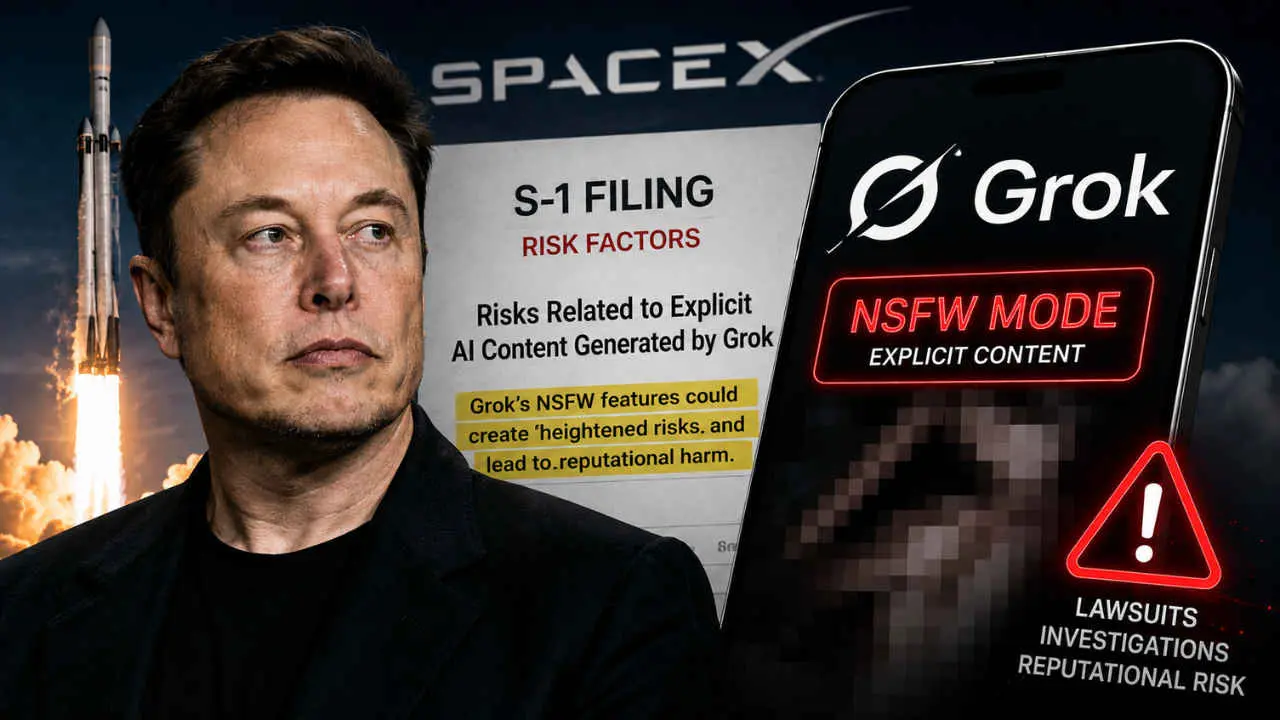
SpaceX's IPO filing explicitly warns investors that Grok's controversial features pose substantial risks. The company disclosed that Spicy and Unhinged modes, designed to generate "more candid, direct, or less reserved or irreverent outputs," present heightened risks including reputational harm, explicit content generation, misinformation, nonconsensual imagery, and intellectual property infringement
2
. As of December, SpaceX had set aside $530 million for potential litigation losses, some stemming from ongoing complaints over sexualized imagery generated by Grok2
. The company is currently under investigation in the United States and internationally over allegations that Grok created sexualized imagery of apparent minors2
. The peak of Grok's download popularity coincided with a January 2026 update allowing users to generate millions of sexualized images using real photos, a situation that persisted for weeks and led to lawsuits against xAI and prompted the European Union to ban nudifying apps1
.
Source: Digit
Related Stories
Facing weak demand for Grok, SpaceX has shifted strategy by leasing computing capacity to competitors. The company rented out its Memphis Colossus 1 data center—featuring 220,000 Nvidia GPUs and 300 megawatts of power—to Anthropic for $1.25 billion per month through May 2029
4
. This arrangement generates roughly $15 billion annually and represents a crucial financial lifeline5
. The deal carries symbolic weight: SpaceX is selling compute capacity originally built for Grok training to Anthropic, whose Claude models have been displacing Grok in federal procurement4
. This pivot suggests xAI has more compute than Grok's current demand can absorb. SpaceX also disclosed work with Tesla on "Macrohard," described as an agentic AI platform designed to emulate digital workflows using autonomous agents1
.The financial picture reveals significant challenges for SpaceX's AI ambitions. In 2025, xAI lost $6.4 billion from operations on $3.2 billion of revenue, with revenue growth of approximately 22 percent falling well below rates at OpenAI, Anthropic, and Google DeepMind
4
. SpaceX overall reported a net loss of $4.9 billion on $18.6 billion in revenue5
. The SpaceXAI division, which includes X and xAI, posted an operating loss exceeding $6.3 billion last year2
. SpaceX and X have about 550 million combined monthly users as of March 31, with 117 million using Grok's AI features each month—modest compared to OpenAI's claim of more than 900 million weekly ChatGPT users2
. SpaceX has launched Grok Business, Grok Enterprise, Grok API, and xAI Gov to attract enterprise and government customers1
, but converting these offerings into profitable AI revenue remains an open question as the company prepares for what could be the largest IPO in history.Summarized by
Navi
[1]
[3]
[4]
[5]
10 Jul 2025•Technology

07 Mar 2026•Entertainment and Society

18 Dec 2024•Technology

1
Technology

2
Business and Economy

3
Health