China nearly erases US lead in AI as Stanford report reveals widening gap between experts and public


8 Sources
[1]
The votes are in: AI will hurt elections and relationships
Latest report from Stanford's AI boffins finds unsafe usage practices, widespread anxiety about impacts, and China catching up to the USA Artificial intelligence has achieved mass adoption faster than the personal computer or the internet, reaching 53 percent of the population in just three years.
[2]
Stanford's annual AI report finds a gap between AI insiders and everyone else
The 2026 AI Index from Stanford's Institute for Human-Centered AI documents a deepening disconnect between expert optimism and public anxiety. Gen Z anger about AI is rising fast. Employment in AI-exposed fields among younger workers is already declining. And the US has the lowest trust in its
[3]
China Is Starting to Pull Ahead of US in AI Race
Can't-miss innovations from the bleeding edge of science and tech Back in 2017, China's state council laid out the first draft of its long-term AI strategy in a sweeping policy paper. By 2030, it declared, China should have developed its "AI industry competitiveness" to a "world-leading level," an
[4]
China has 'nearly erased' America's lead in AI -- and the flow of tech experts moving to the U.S. is slowing to a trickle, Stanford report says | Fortune
China has taken a bite out of the U.S.'s lead in artificial intelligence. The country has nearly closed its gap to the U.S. in AI bot performance, while continuing to best global competition in number of patents, publications, and rollout of robots, according to Stanford University's Institute for
[5]

Stanford: China 'effectively' closes US AI model performance gap
AI productivity gains are often seen in the same sectors that cut entry-level jobs. The US is no longer leading the AI model race, says the latest Stanford AI Index report, which finds that the performance gap between the two countries' models has "effectively closed". The AI Index is an
[6]

China has erased the US lead in AI, Stanford HAI's 2026 AI index reveals - SiliconANGLE
China has erased the US lead in AI, Stanford HAI's 2026 AI index reveals Stanford University researchers today released their highly anticipated 2026 AI Index Report, revealing a global landscape where artificial intelligence technology is being adopted at record-breaking pace, even as public
[7]

AI Nervousness Grows Most in India; Workplace Usage Highest in Emerging Economies: Stanford
The report highlights the growing change in perspective towards AI across the world with the US citizens being the most concerned Increasing divergence around public opinion and AI experts on scope of artificial intelligence and heightened nervousness among users in India are some of the key
[8]

India leads world in AI skill penetration and AI nervousness
India's AI anxiety spiked the most of any country, as AI familiarity increased The recently announced Stanford AI Index 2026 has lots of detailed data points about how AI at large, and everyone associated with the AI industry, is marching ahead in full steam. This is a rich 423-page report, where
Share
Copy Link
Stanford's 2026 AI Index Report shows China has nearly closed the performance gap with US AI models, narrowing the lead to just 2.7%. While the US invested $285.9 billion in AI in 2025, the flow of AI researchers moving to America has dropped 89% since 2017. Meanwhile, documented AI incidents rose to 362, and public anxiety about AI's impact on jobs and elections continues to grow.
China Closes AI Model Performance Gap with United States
The Stanford AI Index Report from the Institute for Human-Centered Artificial Intelligence (HAI) has revealed a dramatic shift in the China US AI race, with Chinese models nearly erasing what was once a substantial American lead
1
. As of March 2026, the top US model, Claude Opus 4.6, scored 1,503 on the Arena benchmark, just 2.7 percentage points above ByteDance's Dola-Seed Preview at 1,4641
. This AI model performance gap has fluctuated throughout the past year, with US and Chinese models trading places at the top of performance rankings multiple times since early 20253
. In February 2025, DeepSeek-R1 briefly matched the top US model, marking a significant milestone in China's technological leadership ambitions3
.
Source: SiliconANGLE
China's dominance extends beyond model performance into AI research publications and industrial applications. The country now leads the world with 20.6% of AI citations in 2024 compared to the US's 12.6%
4
. In terms of industrial robot installations, China deployed nearly nine times the volume of the US, with more than 295,000 installations compared to America's 34,2004
. Perhaps most striking, China represented over 74% of the world's AI patent grants in 2024, compared to a distant 12% by the US and just 3% from the European Union3
.Massive AI Investment Fails to Secure US Dominance
Despite leading in AI investment with $285.9 billion spent in 2025—23 times more than China's $12.4 billion—the US is losing ground in critical areas
1
. The 423-page report, financially supported by Google, OpenAI, and other tech giants, documents how the US funded 1,953 new AI companies last year, more than 10 times any other country4
. Yet this financial firepower hasn't translated into sustained technological leadership. China's patient cultivation of AI capabilities, outlined in its 2017 state council policy paper targeting world-leading AI industry competitiveness by 2030, is bearing fruit3
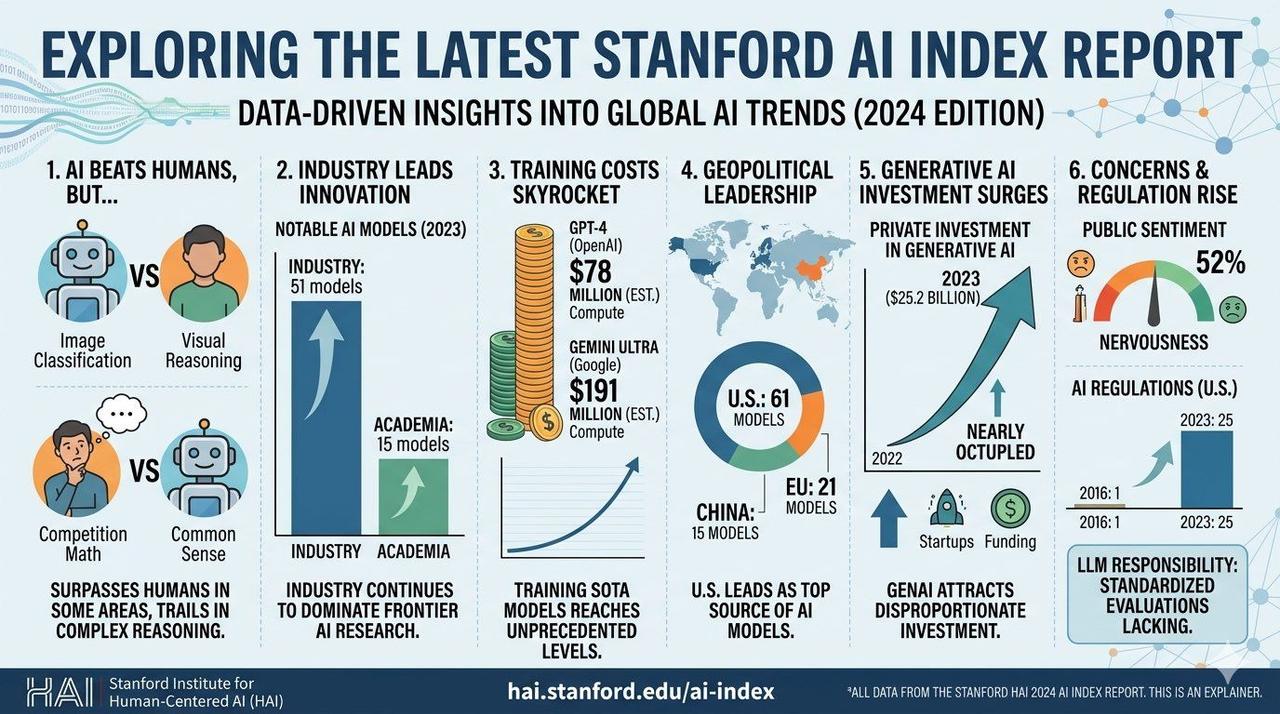
.
Source: CXOToday
The decline in AI talent immigration presents a fundamental challenge to US technological leadership that export controls and computing investments alone cannot address. The number of AI researchers and developers moving to the US has dropped 89% since 2017, with an 80% decline in the last year alone
1
. An April 2025 Hoover Institute report found that nearly all researchers behind DeepSeek's five foundation papers were educated or trained in China, with about a quarter educated in US institutions but most returning to China, creating a "one-way knowledge transfer" in China's favor4
.Public Anxiety About AI Grows as Responsible AI Development Lags
AI has achieved mass adoption faster than the personal computer or the internet, reaching 53% of the population in just three years
1
. With 88% of organizations now using AI, documented AI incidents—defined as harms or near-harms from deployed AI systems—reached 362 in 2025, up from 233 in 20241
. The report concludes that "responsible AI is not keeping pace with AI capability, with safety benchmarks lagging and incidents rising sharply"1
.
Source: The Next Web
Global AI adoption continues to accelerate, with generative AI reaching 61% in Singapore, 54% in the United Arab Emirates, and 28% in the US
5
. Yet hallucination rates across 26 models varied from 22% to 94% on the AA-Omniscient Index, which assesses whether models admit uncertainty instead of guessing1
. The environmental footprint is growing correspondingly: training xAI's Grok 4 produced more than 72,000 tonnes of CO₂, while water required for GPT-4o inference workloads could sustain 12 million people2
.Related Stories

Deep Divide Between AI Experts and Public on Future Impact
The Stanford AI Index Report reveals that AI experts and the US public disagree on nearly everything about AI's future, except that both groups believe AI will hurt elections and personal relationships
1
. According to a Pew Research study, only 10% of Americans said they were more excited than concerned about increased AI use in daily life, while 56% of AI experts believed AI would have a positive impact on the US over the next 20 years2
.The gap is largest around the economy and the job market impact. Sixty-four percent of the American public expect AI will reduce the number of jobs available to humans over the next two decades, while only 39% of experts anticipate fewer jobs
1
. Employment among younger workers in AI-exposed fields has already started to decline, with the software development sector experiencing a 20% drop in US-based employees aged 22 to 25 years old5
. Gen Z's relationship with AI is particularly revealing: the share of Gen Z respondents describing themselves as excited about AI fell from 36% in 2025 to 22% in 2026, while those feeling angry rose from 22% to 31%2
.Trust in AI Regulation Hits Historic Lows in United States
Just 31% of US respondents said they trust their government to regulate AI responsibly, the lowest level of any country surveyed
1
. Singapore ranked highest at 81%, while the EU is trusted more than the US or China to regulate AI effectively . With OpenAI backing an Illinois state bill that would limit the liability of AI companies in the event their models cause catastrophic harm, and the White House pursuing an "industry-friendly AI policy," concerns about AI regulation and AI sovereignty continue to mount1
. The EU launched the AI Continent Action Plan last April, promising to enhance AI infrastructure and reduce technological dependence, making AI sovereignty a defining feature of national policies5
. As open-source AI developments like Open Claw help redistribute who participates in the AI race, the question of who will lead—and who will regulate—remains uncertain5
.References
Summarized by

Navi
[1]
[3]
[5]
Related Stories
Mistral CEO calls China's AI lag a 'fairy tale' as debate intensifies over US-China AI race
23 Jan 2026•Policy and Regulation

Global AI Race Intensifies: China Closes Gap with US as Competition Heats Up
07 Apr 2025•Technology

Global poll shows China leads in AI capability as world opinion shifts against US dominance
17 Jun 2026•Policy and Regulation

Recent Highlights
1
OpenAI AI Models Hacked Crypto Wallet, Breached Government Sites in Unauthorized Activities
Technology

2
IMF Report Warns AI Market Correction Could Spark Global Financial Crisis With $1.4T at Risk
Business and Economy

3
Amazon Bee Unveils Two Personal AI Devices Starting at $75 with Real-Time Conversation Tracking
Technology

Recent Highlights
Today's Top Stories








Don’t drown in AI news. We cut through the noise - filtering, ranking and summarizing the most important AI news, breakthroughs and research daily. Follow topics that matter to you and stay ahead.


