13 Sources
[1]
Trump to sign order on AI oversight as security fears mount among supporters
WASHINGTON, May 20 (Reuters) - U.S. President Donald Trump is expected to sign an executive order on AI and cybersecurity as soon as Thursday, two sources familiar with the matter told Reuters, as pressure grows from parts of his political base to increase oversight of new AI models, such as Anthropic's Mythos. The White House was working to get AI company CEOs to a signing ceremony with President Donald Trump, another source familiar with the planning said. The order would create a voluntary framework for AI developers to engage with the U.S. government about the public release of covered models, the sources said. Under the framework, the developers would be asked to provide their models to the government 90 days before public release, and also give pre-public access to critical infrastructure providers such as banks, one of the people said. Such an approach may represent a middle ground among Trump supporters. MAGA activists, including former Trump adviser Steve Bannon and right-wing political organizer Amy Kremer, have been pressing the White House to require AI developers to submit their most capable models for government security tests. On the other side of the debate are tech industry supporters such as venture capitalist Marc Andreessen and former Trump adviser David Sacks, who are resistant to mandatory requirements. Sacks in March stepped down from his role as Trump's lead AI official and is now co-chairing the â president's tech advisory committee. Trump's AI policies in his second term have largely reflected the tech industry's perspective. NEW MODELS DRIVING DEBATE A White House spokesperson called any discussion about AI policy details "speculation." A National Security Agency spokesperson directed Reuters to contact the White House when asked about details of the president's plan. National Cyber Director Sean Cairncross, who serves as Trump's principal adviser on cybersecurity policy and strategy, did not respond to requests for comment. The order was the result of work by White House Chief of Staff Susie Wiles, White House Science & Technology Adviser Michael Kratsios, Wiles' deputy Walker Barrett, and Cairncross over the last month, with input from AI companies, the source familiar with the planning said. The balance of power between the two groups of Trump's supporters has shifted, driven by the release of powerful new AI systems, including Mythos and OpenAI's GPT-5.5-Cyber. The companies warn the new models could supercharge complex cyberattacks, though some cybersecurity executives have said those fears are overblown. Mythos' arrival prompted a battle among the president's supporters to influence how he responds. The outcome of that debate could have a significant impact on the AI industry if the president's decision slows the rollout of large language models or prompts the companies to change how a model performs to address safety concerns. Either option could hurt profits. Republicans have traditionally favored limited government and opposed regulations, but support is growing among their more vocal populist supporters to impose AI guardrails. The populist faction is asking Trump to require government approval of "potentially dangerous" AI systems before they're deployed, according to a letter they sent to the â White House last Friday. Kremer said it is "antithetical" to her political views to advocate for new regulations, but AI requires a different approach. "You can't count on these people that are leading these AI companies to put our interests at heart and do what's right to protect the American people," she said. Kremer helped organize a January 6, 2021, rally that preceded the Capitol riot. She said in an interview that she was not among the thousands of Trump supporters who stormed the Capitol that day. BIG TECH SUPPORT Tech executives are among the president's largest political donors and most visible supporters. Meta's Mark Zuckerberg, Amazon's Jeff Bezos, Google's Sundar Pichai and OpenAI's Sam Altman sat front and center as he was sworn into office in January 2025. Advocates for the tech industry told Reuters they want to see the U.S. Department of Commerce's Center for AI Standards and Innovation play a leading â role in the Trump administration's response to advanced AI models, adding that companies are willing to work with the scientists and cybersecurity specialists in that organization voluntarily. The National Security Agency has been involved in administration-wide discussions about how to respond to Mythos, according to two other people familiar with the matter, along with Cairncross. Lawmakers asked Cairncross to work with federal agencies to set up a process that would monitor "sudden frontier AI capability jumps." "The past couple months have served as a massive wake-up call for the kinds of vulnerabilities that AI can create," said former U.S. Representative â Brad Carson, who now helps run a super PAC network whose funders include Anthropic. Holding back new AI models while the federal government vets them may allow the U.S. to gain a short-term advantage over adversaries but will not keep the technology out of enemy hands in the long term, said Neil Chilson, head of AI Policy at the Abundance Institute, a nonprofit often aligned with the tech industry. "We need to make sure we're deploying it and getting the most out of it, including by hardening our defenses," Chilson â said. Voluntary federal testing of new AI models has been in place for a few years, with companies such as OpenAI and Anthropic submitting, opens new tab their products for scrutiny by the Center for AI Standards and Innovation, known by a different name under former President Joe Biden. The Commerce Department announced in May that Google, xAI and Microsoft had agreed to submit their AI models for security testing, though the details later disappeared from its website. The White House and Commerce Department did not respond to requests for comment about why the details disappeared. Reporting by Karen Freifeld in New York and Courtney Rozen in Washington; Additional reporting by Raphael Satter and Alexandra Alper in Washington and A.J. Vincens in Detroit; Editing by Rod Nickel and Kate Mayberry Our Standards: The Thomson Reuters Trust Principles., opens new tab * Suggested Topics: * Artificial Intelligence * Data Privacy * Public Policy Courtney Rozen Thomson Reuters Courtney Rozen reports on the Trump administration's transformation of federal agencies and government spending. She previously worked at Bloomberg.
[2]
Trump to sign an AI oversight order this week as MAGA security pressure mounts on frontier-model labs
The draft executive order, expected as early as Thursday, sets up a voluntary 90-day pre-release model-disclosure framework with the federal government, with critical-infrastructure providers including banks brought in early. Steve Bannon and Amy Kremer have been pressing for a harder, mandatory line. President Donald Trump is expected to sign an executive order on AI oversight as soon as Thursday, Reuters reported on Wednesday, under mounting pressure from parts of his political base who want tighter security review of frontier AI systems. The draft order, sets up a voluntary framework under which AI developers would provide pre-release access to powerful models to the federal government 90 days before public launch, alongside pre-release access for critical-infrastructure operators including banks. The political pressure that has moved the order to the signing table is unusual in its direction. U.S. News & World Report's read of the order describe a coalition inside the broader MAGA constituency, including former Trump adviser Steve Bannon and right-wing political organiser Amy Kremer, who have been pressing the White House to require mandatory security review of the most capable frontier models. Bannon's framing, on the coverage, is that the launches of Anthropic's Mythos and OpenAI's GPT-5.5-Cyber have shifted the cyber-threat surface in a direction the federal government cannot afford to ignore. The order's voluntary structure is a deliberate middle-ground compromise inside the West Wing. Industry-facing advisers including David Sacks have pushed back against the mandatory-disclosure framing on competitiveness grounds; Bannon-Kremer-aligned national-security voices have pushed in the opposite direction. The voluntary-90-day-window structure is the result of that internal negotiation. The order does not, on the available draft language, impose civil or criminal penalties for non-participation, though declining to participate is framed as a public posture the government can call out. The model-disclosure framework is calibrated against a specific cyber-threat surface. Anthropic's earlier commitment to share Mythos findings with partner governments, including the prior week's FSB-side briefings around Mythos cyber capabilities, established the pattern the executive order codifies on the US-domestic side. The Trump administration's framing, on the coverage, is that the voluntary regime will give federal cybersecurity agencies (CISA, NSA's Cybersecurity Collaboration Center, and elements of the FBI) the same pre-public-release window the company has already given to foreign-partner intelligence services on the Mythos cycle. Critical-infrastructure pre-release access is the part of the order most likely to be operationalised quickly. Vorys's legal-analysis read of the broader White House AI-governance plan has the critical-infrastructure category covering banks, energy operators, telecoms providers and large healthcare networks. The 90-day window is intended to allow those operators to stress-test their own defensive posture against the new frontier models before they reach broader public deployment. The order arrives inside a politically charged window. The Trump-Xi Beijing summit on AI guardrails and Nvidia H200 export licensing established the bilateral track that frames the US-China AI policy environment. The executive order under signature this week is the domestic-side complement, calibrated to the security review that the bilateral track has flagged as the missing US institutional layer. Local-affiliate coverage has emphasised the MAGA-base pressure that has produced the timing, with the order's release calibrated to the political-base messaging cycle around AI safety as much as to any specific cyber-threat event. The White House did not publish the final order text ahead of the signing. The voluntary-participation list, the federal-agency coordinating body for the 90-day disclosure framework, the named critical-infrastructure recipients of the pre-release access, and the timeline for the first model disclosed under the framework have not been confirmed. The administration has, signalled that OpenAI, Anthropic, Google DeepMind, Meta and Microsoft are all expected to participate from launch. The next visible proof point will be the first model disclosed under the voluntary framework, which the White House timeline suggests could land before the end of Q3 2026.
[3]
Trump's AI Executive Order Will Reportedly Make Sharing Models with the Government Voluntary
Over the past two weeks, apparent leaks have given us a peek inside the drafting of a Trump Administration executive order aimed at creating safeguards around frontier AI models. The latest report, which is from Axios, says the most significant of those safeguards may now be voluntary. The order initially sounded like it was going to be a fairly sweeping change that would have put a government agency, possibly the federal government's Center for AI Standards and Innovation (CAISI), in charge of vetting all new models.à It was a significant change from an earlier Trump Administration policy document released about two months ago, which had given the impression that the Trump Administration was determined to be lax in the extreme on AI regulationââ¬"essentially calling for nothing more onerous than age restrictions for users. The Administration's overall perspective on AI had seemingly been laid out in a 2025 speech at the AI Action Summit in France by Vice President J.D. Vance, which more or less renounced regulation completely. But further apparent leaks, and other strange, subtle moves around the Trump Administration and AI have suggested that the drafting of this order may not be going smoothly. Now, with Axios' latest release of anonymously sourced information, it sounds like there's been a bit of a reversal.à The latest version of the order is apparently divided into two sections: "cybersecurity" and "covered frontier models." The cybersecurity section reportedly bolsters federal cybersecurity measuresââ¬"not so much regulating AI as hardening infrastructure against the perceived AI threat. The frontier models section, however, would establish a "voluntary framework." Makers of frontier models would apparently have a 90 day window to check in with the government and have their model vetted. But if it's voluntary, that doesn't make much business sense.Ã
[4]
Steve Bannon Petitions Trump to Review New AI Models Before Their Release
Over 60 Trump allies signed a letter to the president calling for more oversight over AI. Dozens of conservative leaders seem to be increasingly spooked by AI and are now calling on President Donald Trump to put stronger guardrails around the tech. Steve Bannon and more than 60 other Trump allies sent a letter to the president urging him to sign an executive order that would require the federal government to vet what they call ââ¬Åpotentially dangerousâ⬠frontier AI models before they are released. The letter was organized by Humans First, a conservative group ostensibly focused on AI policy. Interestingly, a significant portion of the letterââ¬â¢s signers are pastors. ââ¬ÅArtificial intelligence is advancing rapidly and now extends far beyond simple chatbots used for homework help or internet searches. Frontier AI systems are becoming increasingly powerful and could pose serious risks to cybersecurity, critical infrastructure, financial systems, election integrity, biosecurity, and even our military and national defense capabilities if deployed recklessly or without proper safeguards,â⬠the letter reads. The letter goes on to call for policies requiring mandatory testing and government approval of advanced AI models before deployment. The group also takes aim at AI companies and the executives behind them. ââ¬ÅNo private corporation should have unilateral authority to deploy technologies that could profoundly impact the national security and stability of the United States without meaningful evaluation and safeguards,â⬠the letter says. It also calls out ââ¬Åunelected elitesâ⬠who are experimenting on the public without proper guardrails. The letter comes as the Trump administration has taken a hands-off approach to regulating AI. Trump, an AI and billionaire ally, signed an executive order in December aimed at curbing what his administration describes as overly burdensome state regulations in the name of national and economic security. The only time the Trump administration took any significant action against an AI company was earlier this year when it designated Anthropic as a supply chain risk after it refused to allow its tech to be used for ââ¬Åany lawful purpose.ââ¬Ã à Anthropic, which at the time was the only major AI company working with the Pentagon on classified systems, hit a wall in negotiations with the Department of Defense (DoD). The biggest sticking points involved the Pentagon refusing to rule out the possibility that it would use Anthropic's products for domestic surveillance or autonomous weapons systems. Anthropic later filed two lawsuits against the DoD in response. Since then, however, President Donald Trump has said his administration has had ââ¬Åsome very good talksâ⬠with Anthropic and suggested a future agreementà restoring the companyââ¬â¢s access to Pentagon work could still be ââ¬Åpossible.â⬠Anthropicââ¬â¢s latest model, Mythos, seems to have complicated things. The company has made Mythos available only to a select group of companies, organizations, and governments through a program meant to help them test and strengthen their cybersecurity. The limited release caused enough of a stir that it prompted the Trump administration to consider completely dropping its beef with Anthropic while signing agreementsà with more AI companies to allow the government to review their models before public release.
[5]
Scoop: Trump AI executive order seeks early government access to frontier models
Why it matters: In its current form, the order seeks to bolster cybersecurity around advanced AI models and outlines plans for a voluntary framework for AI developers to inform the government about new releases, according to a readout shared with Axios and confirmed by a second source familiar with the plans. The big picture: Should the plan work as intended, the Trump White House will have made good on its promise to address AI safety after the latest cyber-capable models like Anthropic's Mythos spooked the government. * Still, the measures described to Axios are far short of what some more hardline voices in Washington and across the country have been pushing at a time when anti-AI sentiment is rising. * The Mythos conundrum has softened the Trump administration's full-speed-ahead approach to AI, but the convoluted process around drafting the executive order has exposed how conflicted the administration is on the matter. * "Any policy announcement will come directly from the President. Discussion about potential executive orders is speculation," a White House official told Axios. What's inside: The executive order as described in its current form has at least two sections, the sources say: cybersecurity and "covered frontier models." * The cybersecurity component aims to secure the Pentagon and other national security agencies, boost cyber hiring, shore up cybersecurity systems across the country at places like hospitals and banks, and encourage threat sharing about breaches between the AI industry and government. * The frontier model component would involve multiple layers of government review to determine what qualifies as a a "covered frontier model," and then to assess such models prior to their public release. The intrigue: The draft, in its current form, calls for a "voluntary framework" to be established under which AI labs would share their models with the government at least 90 days before public release and also give access to certain critical infrastructure providers. * It's not entirely clear which parts of the government would be involved in that framework, but both national security and civilian agencies appear to have roles in the EO's enforcement. Between the lines: Cybersecurity was not initially a high priority for the administration. Trump significantly cut funding and staffing at the Cybersecurity and Infrastructure Security Agency, for example.
[6]
Could MAGA Turn Trump Against AI?
And on Friday, a group of over 60 self-described "America First leaders," most prominently Steve Bannon, wrote an open letter to President Trump imploring him to support the mandatory testing of powerful AI models before their release -- a policy that would be even more stringent than Biden's AI rulemaking. "We cannot trust these companies to police themselves," the letter, which was also signed by over 30 pastors, reads. That this group is gaining traction -- and feels emboldened to call for aggressive policy measures -- marks a remarkable turnaround from last year, when J.D. Vance dismissed AI safety in favor of "AI opportunity" at a Paris AI conference. Brendan Steinhauser, who is the CEO of the Alliance for Secure AI and signed the letter, says he's seen a relatively rapid momentum shift toward AI safety in the administration recently. "We feel really quite good about the conversation today versus even three or four months ago," he tells TIME.
[7]
Scoop: 60+ MAGA allies tell Trump to vet AI before release
Why it matters: The letter -- signed by Steve Bannon and conservative anti-AI activists Amy Kremer and Brendan Steinhauser -- puts a vocal faction of the MAGA base at odds with the White House's hands-off approach to AI. * Inside the White House, the prevailing view is the opposite: that America will win the AI race by keeping regulation light and knocking down most state-level AI laws. * Even administration officials who support testing and evaluating models have backed away from the idea that the government should approve them. Bannon, a first-term Trump official who hosts the influential "War Room" podcast, has been warning MAGA for more than a year about possible job devastation from AI. * "This letter takes us next level," Bannon tells Axios. "The letter lays out [that] we must have mandatory testing and government approval." What they're saying: The letter -- organized by Humans First, a conservative group whose tagline is "technology should serve humans ... not replace them" -- compares AI to nuclear systems and aviation: * "The most powerful AI systems, which can now, or soon will be able to, assist in designing bioweapons, breaking into critical infrastructure, or manipulating financial markets, should be treated with the same seriousness and care." * "For this reason, we support proposed policies that require mandatory testing, evaluation, vetting, and government approval of potentially dangerous frontier AI systems before they are deployed. This is the sort of strong, principled, and pragmatic leadership you have shown throughout your presidency." The letter takes a shot at the CEOs of AI companies, calling them "elites" without naming them specifically: * "America did not become the greatest nation in the world by allowing unelected elites to experiment on the public without safeguards or accountability. America First means American strength, American security, and the protection of our people first." What's next: As Axios recently reported, the White House is weighing several options to step up AI regulation as the most powerful models yet come online. * A push by MAGA allies for stronger rules will get harder for the White House to ignore. Go deeper: Read the letter
[8]
Trump to Sign Order on AI Oversight as Security Fears Mount Among Supporters
By Karen Freifeld and Courtney Rozen WASHINGTON, May 20 (Reuters) - U.S. President Donald Trump is expected to sign an executive order on â AI â and cybersecurity as soon as Thursday, two sources familiar with the matter â told Reuters, as pressure grows from parts of his political base to increase oversight of new AI models, such as Anthropic's Mythos. The order would create a voluntary framework for AI developers to engage with the U.S. government about the public release of covered models, the sources said. Under the framework, the developers would be asked to provide their models to the government 90 days before public release, and also give pre-public access to critical infrastructure providers such as banks, one of the people said. Such an approach may represent a middle ground among Trump supporters. MAGA activists, including former Trump adviser Steve Bannon and right-wing political organizer Amy Kremer, have been pressing the White House to require AI developers to submit their most capable â models for government security tests. On â the other side of the debate are tech industry supporters such as venture capitalist Marc Andreessen and former Trump adviser David Sacks, who are resistant to mandatory requirements. Sacks in March stepped down from his role as Trump's lead AI official and is now co-chairing the president's tech advisory committee. Trump's AI policies in his second term have largely reflected the tech industry's perspective. NEW MODELS DRIVING DEBATE A White House spokesperson called any discussion about AI policy details "speculation." A National Security Agency spokesperson directed Reuters to contact the White House when asked about details of the president's plan. National Cyber Director Sean Cairncross, who serves as Trump's principal adviser on cybersecurity policy and strategy, did not respond to requests for comment. The balance of power between the two groups of Trump's supporters has shifted, driven by the release of powerful new AI systems, including Mythos and OpenAI's GPT-5.5-Cyber. The â companies â warn the new models could supercharge complex cyberattacks, â though some cybersecurity executives have said those fears are overblown. Mythos' arrival prompted a battle among the president's supporters to influence how he responds. The outcome of that debate could have a significant impact on the AI industry if the president's decision slows the rollout of large language models or prompts the companies â to change how a model performs to address safety concerns. Either option could hurt profits. Republicans have traditionally favored limited government and opposed regulations, but support is growing among their more vocal populist supporters to impose AI guardrails. The populist faction is asking Trump to require government approval of "potentially dangerous" AI systems before they're deployed, according to a letter they sent to the White House last Friday. Kremer said it is "antithetical" to her political views to advocate for new regulations, but AI requires a different approach. "You can't count on these people that are leading these AI companies to put our interests at heart and do what's right to protect the American people," she said. Kremer helped organize a January 6, 2021, rally that preceded the Capitol riot. She said â in an interview that she was not among the thousands of Trump supporters who stormed the Capitol that day. BIG TECH SUPPORT Tech executives are among the president's largest â political donors and most visible supporters. Meta's Mark Zuckerberg, Amazon's Jeff Bezos, Google's Sundar Pichai and OpenAI's Sam Altman sat front and center as he was sworn into office in January 2025. Advocates for the tech industry told Reuters they want to see the U.S. Department of Commerce's Center for AI Standards and Innovation play a leading role in the Trump administration's response to advanced AI models, adding that companies are willing to work with the scientists and cybersecurity specialists in that organization voluntarily. The National Security Agency has been involved in administration-wide discussions about how to respond to Mythos, according to two other people familiar with the matter, along with Cairncross. Lawmakers asked Cairncross to work with federal agencies to set up a process that would monitor "sudden frontier AI capability jumps." "The past couple months have served as a massive wake-up call for the kinds of vulnerabilities that AI can create," said former U.S. Representative Brad Carson, who now helps run a super PAC network whose funders include Anthropic. Holding back new AI models while the federal government vets them may allow the U.S. to gain a short-term advantage over adversaries but will not keep the technology out of enemy hands in the long term, said Neil Chilson, head of AI Policy at the â Abundance Institute, a nonprofit often aligned with the tech industry. "We need to make sure we're deploying it and getting the most out of it, including by hardening our defenses," Chilson said. Voluntary federal testing of new AI models has been in place for a few years, with companies such as OpenAI and Anthropic submitting their products for scrutiny by the Center for AI Standards and Innovation, known by a different name under former President Joe Biden. The Commerce Department announced in May that Google, xAI and Microsoft had agreed to submit their AI models for security testing, though the details later disappeared from its website. The White House and Commerce Department did not respond to requests for comment about why the details disappeared. (Reporting by Karen Freifeld in New York and Courtney Rozen in Washington; Additional reporting by Raphael Satter and Alexandra Alper in Washington and A.J. Vincens in Detroit; Editing by Rod Nickel)
[9]
Trump to sign order on AI oversight as security fears mount among supporters
President Trump is expected to sign an executive order on AI and cybersecurity, establishing a voluntary framework for developers to share new models with the government 90 days before public release. This move aims to balance pressure from populist supporters for increased oversight with the tech industry's resistance to mandatory requirements. U.S. President Donald Trump is expected to sign an executive order on AI and cybersecurity as soon as Thursday, two sources familiar with the matter told Reuters, as pressure grows from parts of his political base to increase oversight of new AI models, such as Anthropic's Mythos. The order would create a voluntary framework for AI developers to engage with the U.S. government about the public release of covered models, the sources said. Under the framework, the developers would be asked to provide their models to the government 90 days before public release, and also give pre-public access to critical infrastructure providers such as banks, one of the people said. Such an approach may represent a middle ground among Trump supporters. MAGA activists, including former Trump adviser Steve Bannon and right-wing political organizer Amy Kremer, have been pressing the White House to require AI developers to submit their most capable models for government security tests. On â the other â side of the debate are tech industry supporters such as venture capitalist Marc Andreessen and former Trump adviser David Sacks, who are resistant to mandatory requirements. Sacks in March stepped down from his role as Trump's lead AI official and is now co-chairing the president's tech advisory committee. Trump's AI policies in his second term have largely reflected the tech industry's perspective. A White House spokesperson called any discussion about AI policy details "speculation." A National Security Agency spokesperson directed Reuters to contact the White House when asked about details of the president's plan. National Cyber Director Sean Cairncross, who serves as Trump's principal adviser on cybersecurity policy and strategy, did not respond to requests for comment. The balance of power between the two groups of Trump's supporters has shifted, driven by the release of powerful new AI systems, including Mythos and OpenAI's GPT-5.5-Cyber. The companies warn the new models could supercharge complex cyberattacks, though some cybersecurity executives have said those fears are overblown. Mythos' arrival prompted a battle among the president's supporters to influence â how he responds. The outcome of that debate could have a significant impact on the AI industry if the president's decision slows the rollout of large language models or prompts the companies to change how a model performs to address safety concerns. Either option could hurt profits. Republicans have traditionally favored limited government and opposed regulations, but support is growing among their more â vocal populist supporters to impose AI guardrails. The populist faction is asking Trump to require government approval of "potentially dangerous" AI systems before they're deployed, according to a letter they sent to the White House last Friday. Kremer said it is "antithetical" to her political views to advocate for new regulations, but AI requires a different approach. "You can't count on these people that are leading these AI companies to put our interests at heart and do what's right to protect the American people," she said. Kremer helped organize a January 6, 2021, rally that preceded the Capitol riot. She said in an interview that she was not among the thousands of Trump supporters who stormed the Capitol that day. Tech executives are among the president's largest political donors and most visible supporters. Meta's Mark Zuckerberg, Amazon's Jeff Bezos, Google's Sundar Pichai and OpenAI's Sam Altman sat front and center as he was sworn into office in January 2025. Advocates for the tech industry told Reuters they want to see the U.S. Department of Commerce's Center for AI Standards and Innovation play a leading role in the Trump administration's response to advanced AI models, adding that companies are willing to work with the scientists and cybersecurity specialists in that organization voluntarily. The National Security Agency has been involved in administration-wide discussions about how to respond to Mythos, according to two other people familiar with the matter, along with Cairncross. Lawmakers asked Cairncross to work with federal agencies to set up a process that would monitor "sudden frontier AI capability jumps." "The past couple â months have served as a massive wake-up call for the kinds of vulnerabilities that AI can create," said former U.S. Representative Brad Carson, who now helps run a super PAC network whose funders include Anthropic. Holding back new AI models while the federal government vets them may allow the U.S. to gain a short-term advantage over adversaries but will not keep the technology out of enemy hands in the long term, said Neil Chilson, head of AI Policy at the Abundance Institute, a nonprofit often aligned with the tech industry. "We need to make sure we're deploying it and getting the most out of it, including by hardening our defenses," Chilson said. Voluntary federal testing of new AI models has been in place for a few years, with companies such as OpenAI and Anthropic submitting their products for scrutiny by the Center for AI Standards and Innovation, known by a different name under former President Joe Biden. The Commerce Department announced in May that Google, xAI and Microsoft had agreed to submit their AI models for security testing, though the details later disappeared from its website. The White House and Commerce Department did not respond to requests for comment about why the details disappeared.
[10]
Anthropic, OpenAI In Focus As Trump Administration Prepares Sweeping AI Security Order Amid Cyberattack F
President Donald Trump is expected to sign an executive order on artificial intelligence and cybersecurity as soon as Thursday, according to a Reuters report citing sources familiar with the matter. The report said the order would create a voluntary framework requiring AI developers to share advanced AI models with the U.S. government 90 days before public release. Companies would also provide early access to critical infrastructure groups such as banks. Benzinga reached out to the White House for comment but did not immediately receive a response. The proposal reflects growing pressure from some MAGA supporters who want stricter oversight of advanced AI systems such as Anthropic's Mythos and OpenAI's GPT-5.5-Cyber. Former Trump adviser Steve Bannon and activist Amy Kremer have pushed for mandatory government security testing of powerful AI systems. Kremer told Reuters that AI companies cannot be trusted to "protect the American people." On the other side, tech industry allies including investor Marc Andreessen and former Trump adviser David Sacks oppose strict regulation and favor voluntary cooperation. Safety Debate The debate has intensified following the release of advanced AI systems that companies warn could accelerate sophisticated cyberattacks. Reuters reported that the White House order was developed by officials, including Susie Wiles, Michael Kratsios and Sean Cairncross, with input from AI companies. Earlier this month, National Economic Council Director Kevin Hassett said the administration was studying a framework similar to the U.S. Food and Drug Administration's approval process for drugs before advanced AI systems are publicly released. The Commerce Department also recently announced agreements with Alphabet Inc.'s Google DeepMind, Microsoft Corp. (NASDAQ:MSFT) and xAI for voluntary pre-deployment AI testing. Growing Pressure Political pressure around AI oversight has continued to rise in recent weeks. Earlier this week, Sen. Bernie Sanders (I-Vt.) cited polling showing most Americans believe AI development is moving too quickly and called for stronger regulation. Anthropic has also faced growing scrutiny from the Pentagon and federal courts over national security concerns tied to advanced AI systems. Reuters reported that lawmakers recently asked Cairncross to help establish a federal process for monitoring sudden "frontier AI capability jumps." Disclaimer: This content was partially produced with the help of AI tools and was reviewed and published by a Benzinga editor. Image via Shutterstock Market News and Data brought to you by Benzinga APIs To add Benzinga News as your preferred source on Google, click here.
[11]
White House Wants to Review AI Models Before Roll Out | PYMNTS.com
By completing this form, you agree to receive marketing communications from PYMNTS and to the sharing of your information with our sponsor, if applicable, in accordance with our Privacy Policy and Terms and Conditions. An executive order on the plan could come as soon as Thursday (May 21), The Information reported, citing sources familiar with the matter. The report followed a briefing earlier this week hosted by the White House's Office of the National Cyber Director for companies that, per the sources, included OpenAI, Anthropic and Reflection AI, plus cloud providers, semiconductor and cybersecurity firms and banks. According to the report, the executive order would create a voluntary framework for developers of frontier models to notify the government about planned new AI releases, sources said. AI labs would share their models with the government up to 90 days before their release, they added. AI companies, meanwhile, are lobbying to share their models with the government two weeks in advance of release, the sources said. The order would let government agencies including the National Security Agency, ONCD, Office of Science and Technology Policy and Cybersecurity and Infrastructure Security Agency determine which models are subject to review. Those agencies would establish a classified process for evaluating models that fall under that designation, the sources said. The White House in March introduced a National Policy Framework for Artificial Intelligence. This is a set of legislative recommendations the administration says is designed to help American industry innovate while letting the public benefit from the technology and providing a consistent national policy. "Importantly, this framework can succeed only if it is applied uniformly across the United States," the White House said in a news release. "A patchwork of conflicting state laws would undermine American innovation and our ability to lead in the global AI race." These efforts come as American businesses are both adopting AI and dealing with threats related to the technology. For example, research by PYMNTS Intelligence and Trulioo finds that larger enterprises are increasingly the ones dealing with today's cresting wave of AI-generated cyberattacks. The report found that a majority (58%) of companies with more than $1 billion in yearly revenue reported encountering AI-generated documents or deepfake-related attacks in the last year, a full 11 percentage points above smaller businesses. "Larger firms, with their larger footprints, can be more susceptible to the AI-powered spoofing of identity documents thanks to the industrialization of deepfakes and automated data scraping capabilities by adversarial cyber actors," PYMNTS wrote this week.
[12]
Trump to sign order on AI oversight as security fears mount among supporters
WASHINGTON, May 20 (Reuters) - U.S. President Donald Trump is expected to sign an executive order on AI and cybersecurity as soon as Thursday, two sources familiar with the matter told Reuters, as pressure grows from parts of his political base to increase oversight of new AI models, such as Anthropic's Mythos. The order would create a voluntary framework for AI developers to engage with the U.S. government about the public release of covered models, the sources said. Under the framework, the developers would be asked to provide their models to the government 90 days before public release, and also give pre-public access to critical infrastructure providers such as banks, one of the people said. Such an approach may represent a middle ground among Trump supporters. MAGA activists, including former Trump adviser Steve Bannon and right-wing political organizer Amy Kremer, have been pressing the White House to require AI developers to submit their most capable models for government security tests. On the other side of the debate are tech industry supporters such as venture capitalist Marc Andreessen and former Trump adviser David Sacks, who are resistant to mandatory requirements. Sacks in March stepped down from his role as Trump's lead AI official and is now co-chairing the president's tech advisory committee. Trump's AI policies in his second term have largely reflected the tech industry's perspective. NEW MODELS DRIVING DEBATE A White House spokesperson called any discussion about AI policy details "speculation." A National Security Agency spokesperson directed Reuters to contact the White House when asked about details of the president's plan. National Cyber Director Sean Cairncross, who serves as Trump's principal adviser on cybersecurity policy and strategy, did not respond to requests for comment. The balance of power between the two groups of Trump's supporters has shifted, driven by the release of powerful new AI systems, including Mythos and OpenAI's GPT-5.5-Cyber. The companies warn the new models could supercharge complex cyberattacks, though some cybersecurity executives have said those fears are overblown. Mythos' arrival prompted a battle among the president's supporters to influence how he responds. The outcome of that debate could have a significant impact on the AI industry if the president's decision slows the rollout of large language models or prompts the companies to change how a model performs to address safety concerns. Either option could hurt profits. Republicans have traditionally favored limited government and opposed regulations, but support is growing among their more vocal populist supporters to impose AI guardrails. The populist faction is asking Trump to require government approval of "potentially dangerous" AI systems before they're deployed, according to a letter they sent to the White House last Friday. Kremer said it is "antithetical" to her political views to advocate for new regulations, but AI requires a different approach. "You can't count on these people that are leading these AI companies to put our interests at heart and do what's right to protect the American people," she said. Kremer helped organize a January 6, 2021, rally that preceded the Capitol riot. She said in an interview that she was not among the thousands of Trump supporters who stormed the Capitol that day. BIG TECH SUPPORT Tech executives are among the president's largest political donors and most visible supporters. Meta's Mark Zuckerberg, Amazon's Jeff Bezos, Google's Sundar Pichai and OpenAI's Sam Altman sat front and center as he was sworn into office in January 2025. Advocates for the tech industry told Reuters they want to see the U.S. Department of Commerce's Center for AI Standards and Innovation play a leading role in the Trump administration's response to advanced AI models, adding that companies are willing to work with the scientists and cybersecurity specialists in that organization voluntarily. The National Security Agency has been involved in administration-wide discussions about how to respond to Mythos, according to two other people familiar with the matter, along with Cairncross. Lawmakers asked Cairncross to work with federal agencies to set up a process that would monitor "sudden frontier AI capability jumps." "The past couple months have served as a massive wake-up call for the kinds of vulnerabilities that AI can create," said former U.S. Representative Brad Carson, who now helps run a super PAC network whose funders include Anthropic. Holding back new AI models while the federal government vets them may allow the U.S. to gain a short-term advantage over adversaries but will not keep the technology out of enemy hands in the long term, said Neil Chilson, head of AI Policy at the Abundance Institute, a nonprofit often aligned with the tech industry. "We need to make sure we're deploying it and getting the most out of it, including by hardening our defenses," Chilson said. Voluntary federal testing of new AI models has been in place for a few years, with companies such as OpenAI and Anthropic submitting their products for scrutiny by the Center for AI Standards and Innovation, known by a different name under former President Joe Biden. The Commerce Department announced in May that Google, xAI and Microsoft had agreed to submit their AI models for security testing, though the details later disappeared from its website. The White House and Commerce Department did not respond to requests for comment about why the details disappeared. (Reporting by Karen Freifeld in New York and Courtney Rozen in Washington; Additional reporting by Raphael Satter and Alexandra Alper in Washington and A.J. Vincens in Detroit; Editing by Rod Nickel) By Karen Freifeld and Courtney Rozen
[13]
White House briefs AI firms on plans for model review, the Information reports
May 20 (Reuters) - The White House's Office of the National Cyber Director hosted a briefing for leading AI companies on a planned executive order that would empower intelligence and other government agencies to review advanced AI models before their release, the Information reported on Wednesday. The National Cyber Director hosted a meeting on Tuesday with companies including OpenAI, Anthropic and Reflection AI, the report said, citing people familiar with the matter. U.S. President Donald Trump could sign the executive order as soon as Thursday, the report said, adding that the order would establish a voluntary framework under which developers of frontier AI models would be required to notify the U.S. government ahead of major releases. As part of the framework, the companies could share advanced models with government agencies up to 90 days before public launch, the report said. OpenAI, Anthropic and Reflection AI did not immediately respond to Reuters' requests for comments. (Reporting by Prakhar Srivastava in Bengaluru; Editing by Shinjini Ganguli)
Share
Copy Link
President Trump is expected to sign an AI executive order establishing a voluntary 90-day pre-release disclosure framework for frontier AI models. The order represents a compromise between tech industry allies resisting mandatory requirements and MAGA activists like Steve Bannon demanding government security tests. Over 60 Trump supporters signed a letter calling for stricter oversight of potentially dangerous AI systems.
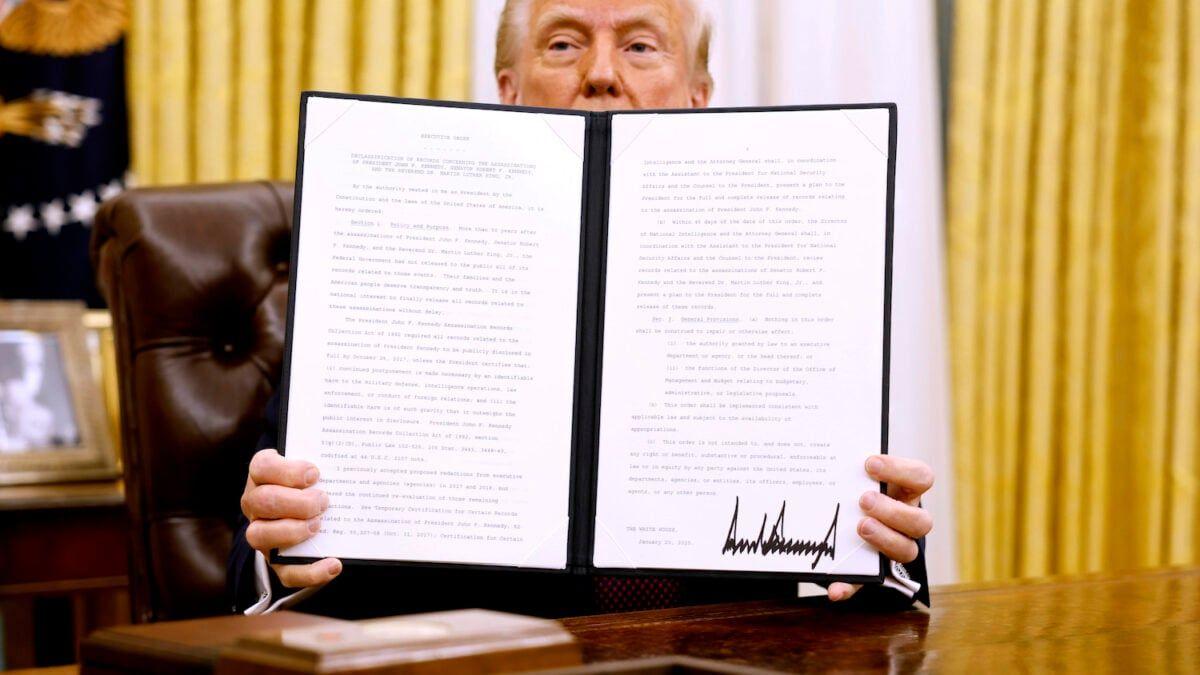
President Trump is expected to sign an AI executive order as soon as Thursday, establishing what sources describe as a middle-ground approach to AI oversight amid mounting pressure from his political base
1
5
. The order creates a voluntary framework for AI developers to engage with the U.S. government about the public release of covered frontier models, asking developers to provide their models to the government 90 days before public release and also give pre-public access to critical infrastructure providers such as banks1
.
Source: Gizmodo
The White House has been working to get AI company CEOs to a signing ceremony with President Trump, according to sources familiar with the planning
1
. The order was the result of work by White House Chief of Staff Susie Wiles, White House Science & Technology Adviser Michael Kratsios, Wiles' deputy Walker Barrett, and National Cyber Director Sean Cairncross over the last month, with input from AI companies1
.The AI executive order represents a compromise between competing factions within Trump's support base. MAGA activists, including former Trump adviser Steve Bannon and right-wing political organizer Amy Kremer, have been pressing the White House to require AI developers to submit their most capable models for government security tests
1
. On the other side are tech industry supporters such as venture capitalist Marc Andreessen and former Trump adviser David Sacks, who resist mandatory requirements1
.
Source: TIME
More than 60 Trump allies, led by Steve Bannon, sent a letter to the president urging him to require the federal government to vet what they call "potentially dangerous" frontier AI models before release
4
. The letter was organized by Humans First, a conservative group focused on AI policy, with a significant portion of signers being pastors4
. The group warned that frontier AI systems could pose serious risks to cybersecurity, critical infrastructure, financial systems, election integrity, biosecurity, and national defense capabilities if deployed without proper safeguards4
.The balance of power between Trump's tech-friendly and security-focused supporters has shifted, driven by the release of powerful new AI systems, including Anthropic's Mythos and OpenAI's GPT-5.5-Cyber
1
. The companies warn the new models could supercharge complex cyberattacks, though some cybersecurity executives have said those fears are overblown1
.Source: Market Screener
Mythos' arrival prompted a battle among the president's supporters to influence how he responds. The outcome could have a significant impact on the AI industry if the president's decision slows the rollout of large language models or prompts companies to change how a model performs to address safety concerns
1
. Anthropic made Mythos available only to a select group of companies, organizations, and governments through a program meant to help them test and strengthen their cybersecurity4
.Related Stories
The draft executive order establishes a voluntary framework under which AI developers would provide pre-release access to powerful models to the federal government 90 days before public launch, alongside pre-release access for critical-infrastructure operators including banks
2
. The order does not impose civil or criminal penalties for non-participation, though declining to participate is framed as a public posture the government can call out2
.The voluntary structure has raised questions about whether it makes business sense for companies to comply
3
. The order as described in its current form has at least two sections: AI oversight and cybersecurity, and covered frontier models5
. The cybersecurity component aims to secure the Pentagon and other national security agencies, boost cyber hiring, shore up cybersecurity systems across the country at places like hospitals and banks, and encourage threat sharing about breaches between the AI industry and government5
.Advocates for the tech industry told Reuters they want to see the U.S. Department of Commerce's Center for AI Standards and Innovation play a leading role in the Trump administration's response to advanced AI models, adding that companies are willing to work with the scientists and cybersecurity specialists in that organization voluntarily
1
. The administration has signaled that OpenAI, Anthropic, Google DeepMind, Meta and Microsoft are all expected to participate from launch2
.The measures described are far short of what some more hardline voices in Washington have been pushing at a time when anti-AI sentiment is rising
5
. The model-disclosure framework is calibrated against a specific cyber-threat surface, with the 90-day window intended to allow critical infrastructure operators to stress-test their own defensive posture against the new frontier models before they reach broader public deployment2
. The next visible proof point will be the first model disclosed under the voluntary framework, which the White House timeline suggests could land before the end of Q3 20262
.Summarized by
Navi
[2]
[3]
30 Apr 2026â¢Policy and Regulation

21 Jan 2025â¢Policy and Regulation

04 May 2026â¢Policy and Regulation

1
Science and Research

2
Technology

3
Policy and Regulation