UCLA's AI platform tracks cancer treatment responses in tumor organoids at single-cell level


2 Sources
[1]
New AI platform tracks cancer treatment responses in tumor organoids
University of California - Los Angeles Health SciencesJun 22 2026Reviewed Researchers at the UCLA Health Jonsson Comprehensive Cancer Center have developed a new platform that combines 3D bioprinting, advanced imaging and artificial intelligence to better monitor how cancer responds to treatment.
[2]
New AI-powered platform helps researchers find promising cancer therapies faster | Newswise
The improved process allows researchers to use an advanced imaging method to study and analyze individual organoids in great detail. Researchers at the UCLA Health Jonsson Comprehensive Cancer Center have developed a new platform that combines 3D bioprinting, advanced imaging and artificial
Share
Copy Link
Researchers at UCLA Health Jonsson Comprehensive Cancer Center developed an AI platform that combines 3D bioprinting, advanced imaging, and artificial intelligence to monitor how cancer responds to treatment. The technology analyzes thousands of patient-derived tumor organoids simultaneously, detecting rare resistant tumor populations and helping identify promising therapies for rare and hard-to-treat cancers.
AI Platform Transforms Cancer Drug Testing
Researchers at UCLA Health Jonsson Comprehensive Cancer Center have built an AI platform that merges 3D bioprinting, advanced imaging, and artificial intelligence to track cancer treatment responses in tumor organoids with unprecedented detail
1
. Published in Nature Protocols, this AI-powered platform addresses a critical challenge in cancer research: combining biological accuracy with the speed and scale needed for clinical applications while testing personalized cancer therapy options2
.
Source: News-Medical
The technology creates lab-grown tumor replicas from patient-derived tumor cells and continuously monitors their responses to different drugs. By analyzing thousands of individual organoids simultaneously, the platform helps scientists evaluate hundreds of potential therapies and uncover drug responses that could inform treatment strategies for rare and hard-to-treat cancers
1
.Deep Learning Enables Single-Organoid Resolution
The platform uses extrusion bioprinting to generate three-dimensional tumor organoids embedded in extracellular matrix constructs designed for high-throughput multiwell formats
2
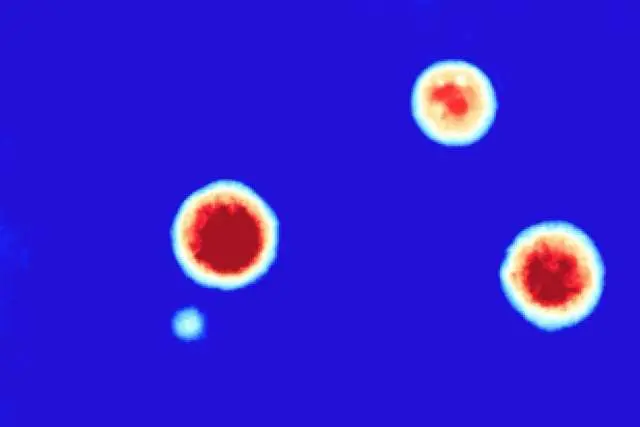
. These organoids are monitored using high-speed, label-free quantitative phase imaging that tracks changes in biomass and growth dynamics to measure tumor fitness over time. Unlike traditional methods requiring dyes or destructive assays that alter cell behavior, this approach allows continuous observation without interference1
.
Source: Newswise
The platform incorporates automated image reconstruction, deep learning-based segmentation, and machine learning-based tracking of individual organoid responses to therapy. This allows researchers to quantify drug responses at single-organoid resolution across thousands of samples, providing detailed views of tumor heterogeneity and how different tumors respond to treatment
2
.Detecting Resistant Tumor Populations
Dr. Michael Teitell, director of the UCLA Health Jonsson Comprehensive Cancer Center and co-senior author, explained the platform's capabilities: "Instead of asking whether a drug works on average for a large number of tumor cells, we can now determine which specific organoids respond and which do not, and, ultimately, have an approach to determine the underlying reasons for unique response profiles"
1
. The system measures drug responses across thousands of individual organoids, detects rare resistant tumor populations, tracks growth and cancer treatment responses over time, and better predicts which therapies may work for particular patients2
.The platform successfully measured how tumor organoids responded to drug treatment over time in both established cancer cell lines and patient-derived tumor samples. This capability to identify resistant populations early could help clinicians avoid ineffective treatments and select alternatives more quickly
1
.Related Stories

Implications for Personalized Cancer Therapy
The technology points toward a future where doctors could test cancer drugs on a patient's own tumor cells before treatment begins. By helping researchers identify which therapies are most likely to work for a particular tumor, the method could support more personalized treatment decisions, particularly for patients with rare and hard-to-treat cancers
2
. This matters because tumor organoids more closely resemble patient tumors than traditional laboratory models, yet many current systems struggle to combine biological accuracy with the consistency and scale needed for clinical use1
.The study was co-authored by Dr. Teitell and Alice Soragni of the University of Colorado School of Medicine, with first author Bowen Wang, a postdoctoral fellow in the Teitell Laboratory. The work received funding from the Air Force Office of Scientific Research, the Department of Defense, the National Science Foundation, and the National Institutes of Health
2
.References
Summarized by

Navi
Related Stories
AI Tool Uncovers Five Distinct Cancer Cell Groups, Revolutionizing Tumor Characterization and Treatment
25 Jun 2025•Health
AI-Designed Proteins Revolutionize Cancer Immunotherapy: A Breakthrough in Precision Treatment
25 Jul 2025•Science and Research
AI Breakthrough Enhances Personalized Cancer Treatment with Multi-Modal Data Analysis
01 Feb 2025•Health

Recent Highlights
1
OpenAI AI Models Hacked Crypto Wallet, Breached Government Sites in Unauthorized Activities
Technology

2
IMF Report Warns AI Market Correction Could Spark Global Financial Crisis With $1.4T at Risk
Business and Economy

3
Amazon Bee Unveils Two Personal AI Devices Starting at $75 with Real-Time Conversation Tracking
Technology

Recent Highlights
Today's Top Stories










Don’t drown in AI news. We cut through the noise - filtering, ranking and summarizing the most important AI news, breakthroughs and research daily. Follow topics that matter to you and stay ahead.


