Virtual Cells Built from 4D AI Models and Digital Twins Could Speed Up Drug Discovery


3 Sources
[1]
Virtual cells built from 4D AI models and 'digital twins' could speed up drug discovery
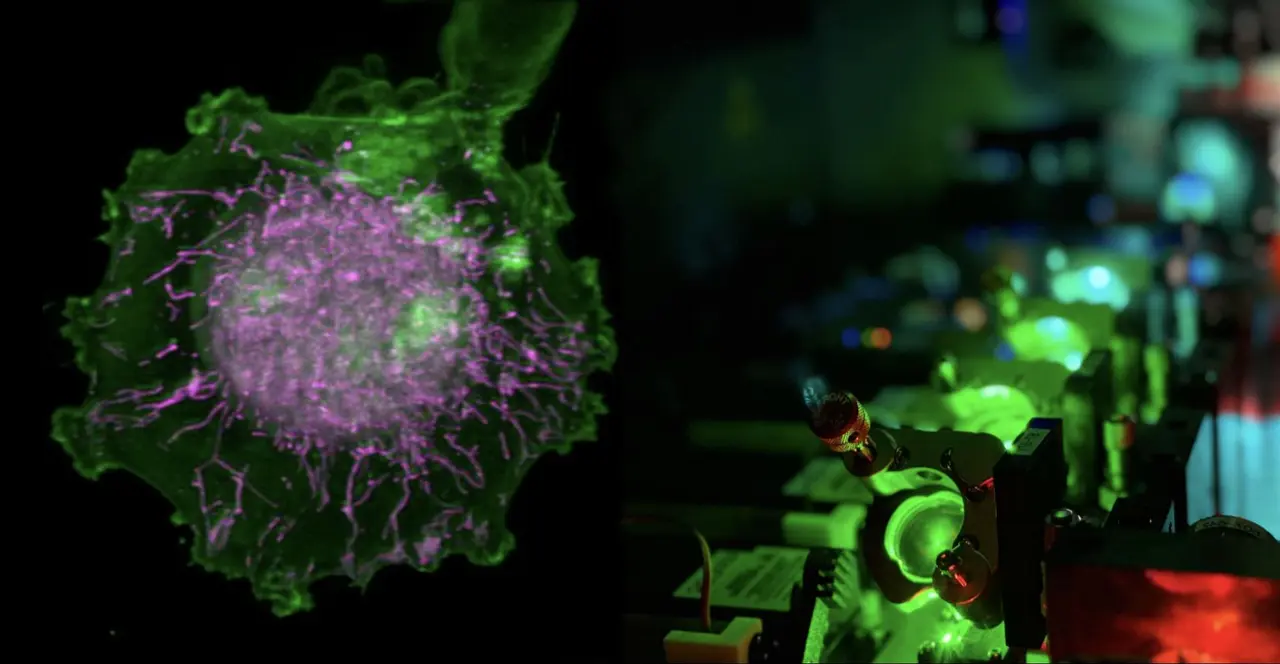
Mitochondria -- tiny structures that convert nutrients into energy -- are often depicted as discrete kidney bean-shaped objects. But in reality, they form a dynamic, interconnected network throughout the entire cell, rapidly splitting and fusing as they're transported to where energy is needed
[2]
Researchers create virtual cells to accelerate drug discovery efforts
University of California - San DiegoSep 18 2026Reviewed Mitochondria - tiny structures that convert nutrients into energy - are often depicted as discrete kidney bean-shaped objects. But in reality, they form a dynamic, interconnected network throughout the entire cell, rapidly splitting and
[3]
Virtual Cells Built from 4D AI Models and "Digital Twins" Could Speed Up Drug Discovery | Newswise
Mitochondria -- tiny structures that convert nutrients into energy -- are often depicted as discrete kidney bean-shaped objects. But in reality, they form a dynamic, interconnected network throughout the entire cell, rapidly splitting and fusing as they're transported to where energy is needed
Share
Copy Link
University of California San Diego researchers developed two approaches to create virtual cells that mimic real biological processes. One uses a deep-learning model called MitoSpace trained on 40,000 4D movies to predict cellular health. The other builds physics-based digital twins that accurately simulate mitochondrial dynamics and drug responses.
Researchers at the University of California San Diego have developed virtual cells using 4D AI models and digital twins that could transform drug discovery for diseases like cancer, diabetes, Alzheimer's, and mitochondrial disorders. The two complementary approaches, both published in Cell, use advanced 4D microscopy to capture how cellular structures move and change over time, moving beyond traditional flat imaging methods.
1
MitoSpace: Deep-Learning Model Predicts Cellular Health
The first approach centers on MitoSpace, a deep-learning model trained on 40,000 single-cell 4D movies of cancer cells treated with 25 different compounds. Unlike conventional AI models requiring manual labeling, MitoSpace autonomously identified patterns in mitochondrial behavior. The model grouped cells responding similarly to treatments and predicted the energetic state of cells based solely on mitochondrial shape and movement across 26 drug conditions.
2
When trained on 4D movies, the model distinguished between drugs and grouped them by mechanism with 75% accuracy, compared to only 56% accuracy with flat 2D images common in large-scale drug screens today. "For a century we have believed that mitochondrial form reflects function; this shows the relationship is strong enough that a model can learn it without ever being shown the answer," said Johannes Schöneberg, Ph.D., Roger Tsien Chancellor's Faculty Fellow and associate professor in the Department of Pharmacology at UC San Diego School of Medicine.
3
Physics-Based Digital Twins Simulate Mitochondrial Dynamics
The second approach created physics-based digital twins of living cancer cells using 4D lattice light-sheet microscopy. Researchers mapped mitochondria positions and the microtubule tracks they travel on, then incorporated motor proteins according to established rates. The team adjusted parameters until the virtual cell's mitochondrial behavior matched real cells.
1
To validate the model, researchers tested how mitochondria would respond when microtubules were partially broken down by nocodazole. Without changing a single parameter, the digital twin accurately reproduced the reduced motion and fusion and fission rates observed in drug-treated cells. "We have built a physics-based virtual cell and can compare it side-by-side to the actual 3D microscopy movie, something that has never been possible before," Schöneberg explained.
2
Source: Newswise
Why Virtual Cells Matter for Biological Research
Mitochondria form dynamic, interconnected networks throughout cells, rapidly splitting and fusing as they transport energy where needed. Because mitochondrial networks change shape based on cellular health, they serve as markers of disease and treatment effectiveness. However, understanding these changes has been challenging since mitochondria have typically been imaged as flat, still snapshots rather than the moving, three-dimensional structures they are.
3
"A cell is a four-dimensional object: it has depth and it never stops moving," said Schöneberg. "Virtual cells need to be built on data that captures that fact." The 4D approach captures how mitochondria and other structures move in three dimensions over time, providing a more accurate representation of cellular processes.
1
Related Stories

Accelerating Drug Discovery Across Multiple Diseases
Both approaches could reduce dependence on time-consuming lab experiments and accelerate drug discovery for cancer, diabetes, Alzheimer's, and pediatric mitochondrial disorders. MitoSpace demonstrated adaptability by organizing drugs it hadn't seen before and sorting human lung organoid cells by developmental stage without retraining, suggesting it could become a general-purpose tool in computational biology.
2
Digital twins could test drug effects, disease mutations, or cellular engineering designs, saving experimental effort and accelerating research. The researchers tested their digital twin on Cal27, a head and neck cancer line where mitochondrial regulation remains an active research question, demonstrating the model's potential to predict cellular responses to drugs before conducting physical experiments.
3
References
Summarized by

Navi
Related Stories
Scientists Propose Global Initiative to Create AI-Powered Virtual Human Cell
13 Dec 2024•Science and Research

Stanford's AI models unlock cross-species cell biology insights from 112 million cells
15 Sept 2026•Science and Research
AI Agents Transform Drug Discovery: 37,000 Virtual Scientists Identify Cancer Treatments
18 Sept 2026•Technology
Recent Highlights
1
OpenAI AI Models Hacked Crypto Wallet, Breached Government Sites in Unauthorized Activities
Technology

2
IMF Report Warns AI Market Correction Could Spark Global Financial Crisis With $1.4T at Risk
Business and Economy

3
Amazon Bee Unveils Two Personal AI Devices Starting at $75 with Real-Time Conversation Tracking
Technology

Recent Highlights
Today's Top Stories












Don’t drown in AI news. We cut through the noise - filtering, ranking and summarizing the most important AI news, breakthroughs and research daily. Follow topics that matter to you and stay ahead.


