Workday stock soars 10% as AI push drives earnings beat, but analysts warn of pricing pressures


3 Sources
[1]
Strong demand for agentic AI offerings helps Workday beat expectations and boost its stock price - SiliconANGLE
Strong demand for agentic AI offerings helps Workday beat expectations and boost its stock price Shares of the financial services and human resources software company Workday Inc. rose more than 10% in late trading after it reported first-quarter earnings and revenue that came in higher than
[2]
Workday Serves 65% Of The Fortune 500, But Analyst Warns AI Could Compress Its Per-Seat Pricing Model - W
BofA Securities reinstated coverage on Workday Inc. (NASDAQ:WDAY) on Wednesday, issuing a neutral rating and a $140 price forecast. Entrenchment Limits Displacement Risk Analyst Tal Liani highlighted that Workday remains deeply embedded as a mission-critical system of record for Human Capital
[3]
Why Is Workday Stock Soaring Friday? - Workday (NASDAQ:WDAY)
AI Push Helps Workday Beat Estimates Workday reported first-quarter earnings of $2.66 per share, beating analyst estimates of $2.51, according to Benzinga Pro data. Revenue rose to $2.54 billion, ahead of the consensus estimate of $2.52 billion. Adjusted operating income increased to $809
Share
Copy Link
Workday shares surged over 10% after reporting first-quarter earnings of $2.66 per share, beating Wall Street expectations. The software company credited strong demand for its agentic AI offerings, with over 4,000 customers now using AI agents. However, analysts warn that AI could compress Workday's traditional per-seat pricing model as companies reduce headcount through automation.
Workday Earnings and Revenue Beat Expectations on AI Momentum
Workday reported first-quarter earnings of $2.66 per share, easily surpassing Wall Street's target of $2.51 per share, while revenue climbed 13% to $2.54 billion, ahead of the consensus estimate of $2.52 billion
1
. Subscription revenue, a critical metric for the software company, increased 14% to $2.35 billion, with 40% of that growth stemming from net new business1
. The strong performance drove net income to $222 million, a substantial jump from $68 million in the year-ago period1
. Workday stock surged more than 10% in after-hours trading following the announcement1
.
Source: Benzinga
Agentic AI Offerings Drive Growth Across Enterprise Workflows
AI adoption accelerated significantly during the quarter, with the number of clients using Workday AI agents more than doubling from the previous quarter to over 4,000 customers using at least one agent
1
. Workday's President of Product and Technology Gerrit Kazmaier revealed that annualized revenue from its agentic AI offerings is approaching $500 million1
. The company introduced several AI-powered products, including a travel agent combining booking and expense management, an IT service management agent called Sana for onboarding workflows, and a deployment agent designed to reduce implementation effort by approximately 30%3
. AI contributed more than 25% of new annual contract value from customer expansions, with AI-related deals averaging 50% larger in size3
. Workday processed 14 million recruiting workflows during the quarter, up 44% year over year, while contract analysis volume exceeded 1.1 million, increasing 53% sequentially3
.Analysts Warn AI Could Compress Per-Seat Pricing Model
Despite the positive earnings report, BofA Securities reinstated coverage on Workday with a neutral rating and a $140 price forecast, highlighting structural concerns about the company's business model
2
. While Workday serves approximately 65% of the Fortune 500 and maintains an exceptional 97% gross retention rate for Human Capital Management and payroll systems, analyst Tal Liani warned that generative AI introduces credible risk of value compression2
. Because Workday primarily prices its software on a per-seat pricing model, efficiency initiatives that reduce corporate headcounts present a direct headwind. "AI decouples the value of the solution from the number of seats," Liani noted, adding that shifting toward agentic or hybrid pricing models will take time to offset traditional seat compression2
.Related Stories
Workday Faces Intensifying Competition in Agentic Market
Workday confronts growing competition from rivals such as Salesforce and ServiceNow for enterprise's agentic spending, requiring the company to "both innovate and differentiate why its AI delivers comparatively more value," according to Valoir analyst Rebecca Wettemann
1
. She explained that Workday's customers have numerous alternatives when it comes to agentic systems, and even if they use Workday's platforms as the application layer, that doesn't guarantee they will adopt its agentic AI offerings1
. One of Workday's main challenges is that it's one of the more expensive enterprise software platforms in terms of deployment and support costs, making it "less insulated from a SaaSpocalypse than some of its peers," Wettemann added1
. The company has expanded integrations across Microsoft Copilot, Microsoft Teams, and Google Gemini to broaden its AI ecosystem3
.Growth Deceleration and Margin Improvements Shape Outlook
Workday raised its fiscal 2027 adjusted operating margin outlook to 30.5%, up from 30% in February, citing operational efficiency gains and growing AI leverage
3
. The company reaffirmed subscription revenue guidance of $9.925 billion to $9.950 billion, representing expected growth of 12% to 13%3
. However, BofA Securities emphasized that Workday's top-line expansion has been slowing from roughly 30% down to the mid-to-low teens, modeling total revenue growth of 11.5% for fiscal year 2027 and 11.3% for fiscal year 20282
. Despite the after-hours gains, WDAY stock remains down 43% year to date, reflecting ongoing investor concerns about AI disruption in the software sector1
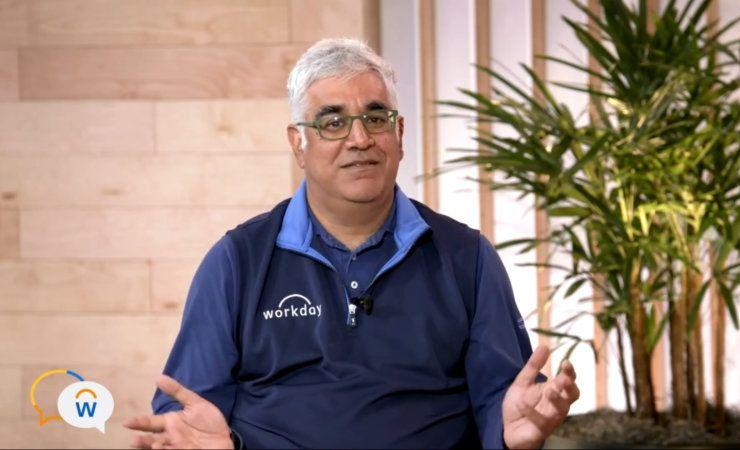
. Founder and CEO Aneel Bhusri, who returned to lead the company through this challenging period, stated: "Our core business is strong, our AI strategy is working, and we're moving with the speed and focus required to lead"1
.
Source: SiliconANGLE
References
Summarized by

Navi
[1]
[2]
Related Stories
Workday's Q4 Earnings Surge: AI Integration Drives Growth and Expansion
26 Feb 2025•Business and Economy

Workday's Q1 Earnings Beat Expectations, but Stock Drops on Conservative Guidance
24 May 2025•Business and Economy

Workday's Q2 Earnings Beat Estimates, but AI Disruption Fears Linger
22 Aug 2025•Technology

Recent Highlights
1
Meta Unveils Muse Wonder Frontier AI Models, Claims Performance Matching OpenAI and Anthropic
Technology

2
IMF Report Warns AI Market Correction Could Spark Global Financial Crisis With $1.4T at Risk
Business and Economy

3
OpenAI Releases 722 AI-Generated Math Solutions, Triggering Existential Crisis in Mathematics
Technology

Recent Highlights
Today's Top Stories









Don’t drown in AI news. We cut through the noise - filtering, ranking and summarizing the most important AI news, breakthroughs and research daily. Follow topics that matter to you and stay ahead.


