Young Chinese turn to AI one-person firms to escape workplace age discrimination and job anxiety


3 Sources
[1]
Young Chinese use AI to launch one-person firms over job anxiety
Shanghai (AFP) - Young Chinese, many who fear age discrimination in their workplace after turning 35, are increasingly starting "one-person companies" that have artificial intelligence do most of the work. Smaller startups are already in vogue in Silicon Valley and elsewhere, with rapidly
[2]
Young Chinese use AI to launch one-person firms over job anxiety
Young Chinese, many who fear age discrimination in their workplace after turning 35, are increasingly starting "one-person companies" that have artificial intelligence do most of the work. Smaller startups are already in vogue in Silicon Valley and elsewhere, with rapidly advancing AI tools seen
[3]
Job anxiety after 35 drives young Chinese to launch one-person firms using AI - VnExpress International
Young Chinese, many of whom fear age discrimination in the workplace after turning 35, are increasingly starting "one-person companies" where artificial intelligence does most of the work. Smaller startups are already in vogue in Silicon Valley and elsewhere, with rapidly advancing AI tools seen
Share
Copy Link
Young Chinese professionals are launching AI-powered one-person firms to combat the "curse of 35"—widespread age discrimination in competitive sectors. Cities like Suzhou are pledging up to $100 million in subsidies to support these ventures, aligning with Beijing's technological self-reliance goals while addressing youth unemployment that affects one in six young people.
AI One-Person Firms Emerge as Response to Age Discrimination
Young Chinese professionals are increasingly turning to one-person firms powered by AI as they confront mounting job anxiety and age discrimination in the workplace. The trend addresses what's known on Chinese social media as the "curse of 35"—an invisible line where workers in tech, government, and other competitive sectors face re-evaluation and potential displacement
1
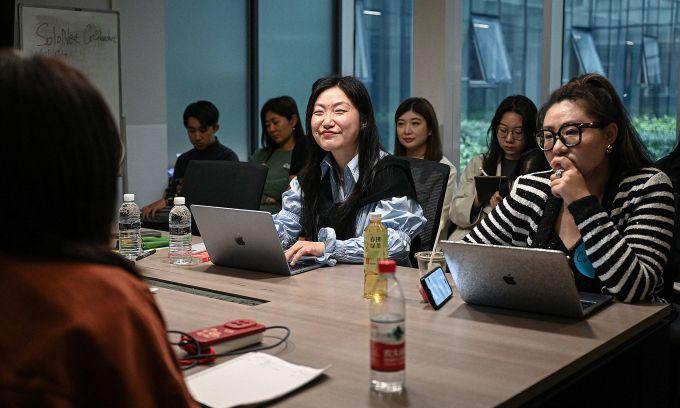
. Karen Dai, founder of Shanghai-based SoloNest, describes the one-person company as "a product of the AI era," noting that AI tools have "lowered the entry barrier" for solo entrepreneurship3
. This model mirrors trends already in vogue in Silicon Valley and elsewhere, where rapidly advancing AI tools serve as welcome teammates even as they trigger layoffs at existing firms2
.
Source: VnExpress
Lowering Entrepreneurial Barriers Through AI-Powered Ventures
The technological empowerment brought by AI has fundamentally changed what's possible for solo entrepreneurs. Wang Tianyi, a 26-year-old former product manager, now earns up to 40,000 yuan ($5,800) per month creating AI-generated commercials for businesses after quitting his internet company job
1
. He predicts people flying solo will become a "major trend" because one-person companies "have an efficiency advantage" thanks to AI. At SoloNest's weekend events for solo entrepreneurs, around 20 people in their 20s and 30s gather for three-hour idea exchanges—the 134th such iteration demonstrating sustained interest in this entrepreneurship model3
. Shanghai resident Wei Xin, 34, exemplifies this shift. Anticipating her document reviewer role at a foreign consulting firm would be replaced by AI, she proactively enrolled in a course on Google's Gemini and experimented with creating an AI-generated digital version of herself before pivoting to social media content creation1
.
Source: France 24
Government Funding and Subsidies Fuel OPC Growth
Chinese municipalities are rolling out substantial government funding and subsidies to support these AI-powered ventures, using the English initials "OPC" in official policy—a rare linguistic choice. In November, Suzhou vowed to cultivate "more than 10,000 OPC talents" by 2028 and funnel approximately 700 million yuan ($100 million) toward sectors including AI robotics, healthcare, and smart transportation
3
. Chengdu promised subsidies of up to 20,000 yuan for graduates establishing AI-driven one-person firms1
. These initiatives align with Beijing's political goal of technological self-reliance while offering cities a cost-effective strategy to address youth unemployment, which affects one in six people between ages 16 and 243
. Brookings fellow Kyle Chan, an expert on China's technology development, describes these measures as "carrots to help these startups get off the ground and be successful," noting that "the cost of doing this, from the local governments, for an OPC, is very low"1
.Related Stories

Balancing AI Anxiety with Creative Control
The rise of one-person firms reflects both opportunity and anxiety among young Chinese professionals. Wei Xin articulated this tension, saying "there's a bit of AI anxiety" and expressing concern that "if I don't use it, don't approach it, I might soon be eliminated"
3
. Dai, who at 38 has crossed the invisible line herself, observes that young people who witnessed a decade of rapid economic expansion in China maintain a hunger to grow. They're asking themselves as early as age 30: "when I reach that invisible line of 35, what preparations should I make?"1
. Many of Wang's friends are opting to work on independent projects instead of vying for corporate jobs, though he acknowledges that "the important thing in the future will be how to sell it," with new companies often struggling to turn a profit3
. Despite profitability challenges, young Chinese are investing in backup plans, exploring what they can accomplish "with my own two hands, helped by the convenience of AI," finding "a sense of control, of creativity" in the process1
.References
Summarized by

Navi
Related Stories
AI in China Triggers Mass Layoffs as 160 Beijing Coders Lose Jobs in Automation Push
24 Aug 2026•Business and Economy

China bets on artificial intelligence to create jobs and rejuvenate economy amid global concerns
11 Mar 2026•Policy and Regulation

China tech giants recruit teenagers as young as 13 to combat AI talent shortage
22 Jul 2026•Business and Economy
Recent Highlights



Recent Highlights
Today's Top Stories



Don’t drown in AI news. We cut through the noise - filtering, ranking and summarizing the most important AI news, breakthroughs and research daily. Follow topics that matter to you and stay ahead.


