AI in BFSI Shifts From Pilots to Production as Agentic AI Takes Center Stage at Global Fintech Fest


17 Sources
[1]
BFSI sector in no hurry to adopt complete automation: Perfios Group CEO
The BFSI sector adopts automation cautiously due to strict regulations and its conservative nature. Artificial general intelligence adoption will likely be slow, with humans remaining essential. Automation will enhance underwriter efficiency for loan decisions, not replace human oversight entirely.
[2]
Indian Fintech Moves Beyond AI Demos
AI is all set to take centre stage at the Global Fintech Fest (GFF) in Mumbai this week, with product launches, live demos and industry conversations on how this emerging tech is reshaping financial services. But beyond the buzz, the bigger story is how deeply AI-powered systems are entering the
[3]
GFF 2026: SBI sees FCNR liquidity deployment taking 3-4 months, eyes agentic AI for banking
State Bank of India anticipates deploying foreign currency deposits over three months. The bank is enhancing artificial intelligence adoption across key operational areas. Agentic AI will perform tasks autonomously, improving efficiency and risk management. This technology aims to extend
[4]
BFSI Shifts AI to Production, but Realizing P&L Returns Emerges as Next Challenge: Beams-A&M
Beams Fintech Fund, in partnership with Alvarez & Marsal (A&M), today launched Beyond the AI Pilot: Scaling Value in BFSI, a report examining the evolution of AI adoption across India's banking, financial services and insurance sector, and the challenge of translating operational impact into
[5]
GFF 2026: After KYC, SBI chief flags 'Know Your Agent' as AI enters banking
Agentic AI's growing use in finance necessitates new checks beyond customer identification. Banks may develop a 'Know Your Agent' framework for autonomous systems. This framework will address AI identity, authentication, and transaction limits. Such systems require accuracy, accountability, and
[6]
How AI is Transforming Banking, Financial Services in 2026
That model turns AI from support into part of the bank's core system. The strongest banks will combine strong data capabilities, modern infrastructure, useful AI agents and firm controls. The central race now concerns safe AI use at scale. AI agents now handle complex banking tasks across credit,
[7]
Zeta Survey: 70% of Indian Banks Run AI in Production, but Security Concerns Delay Scale
Zeta today announced the findings of its 2026 CXO survey on the state of AI in Indian banking, based on responses from 40 CXOs across 18 leading banks and NBFCs. AI is now in production at most institutions: 70% of CDO respondents place their banks at selective or scaled deployment, including 30%
[8]
'99% accuracy is not enough': SBI chairman lays out three rules for trusted AI
Financial institutions must build trust into agentic AI systems from the outset. These systems require 100% accuracy and consistent performance at population scale. Accountability becomes crucial as AI moves from recommendation to execution of actions. Access without asymmetry ensures AI adapts to
[9]
BFSI moves beyond AI pilots as firms chase measurable business value: Report
Indian financial institutions are deploying artificial intelligence across many operational areas. These deployments show productivity gains but struggle with financial impact. Companies like Tata Capital and Niyo report significant operational improvements from AI. Fragmented data and integration
[10]
GFF 2026: India's AI advantage could be cost, not just capability, says Sarvam CEO
India's AI advantage centers on deploying technology affordably for its vast population. The nation aims to lead in AI adoption and development over the next decade. Sarvam AI is building infrastructure to serve AI models at scale and lower costs. Specialised models offer better value than large
[11]
GFF 2026: Axis Bank, J.P. Morgan see banking move from AI that knows customers to AI that acts
Banks are using AI to deeply understand customers and anticipate their needs. Axis Bank is experimenting with AI for personalised banking services and customer engagement. J.P. Morgan is deploying AI for trade analysis, customer service, and fraud detection. This AI transformation spans the entire
[12]
AI at population scale: Rahul Chari's charter for the next 300 million
At Global Fintech Fest 2026, PhonePe co-founder and CPTO Rahul Chari laid out an AI philosophy built on intent-led experiences, engineering scale and operational efficiency. Listen to this article in summarized format Listen × Subscribe to Unlock AI Briefing and Premium Content New Year Offer
[13]
AI can speed business loans, but underwriters stay in charge: HyperVerge's Kedar Kulkarni
HyperVerge launched AI underwriting agents to speed business loan processing. These agents extract data from financial documents and assist in video discussions. Background checks are significantly reduced from hours to minutes. Human oversight remains crucial for final complex credit decisions.
[14]
PhonePe's AI strategy: What large enterprises can learn from new-age fintech
New-age fintechs are using AI to shorten development cycles, simplify customer journeys and automate complex internal processes. Their advantage lies as much in speed of execution as in the technology itself. For larger organisations, the question is how to bring that agility into established
[15]
Your bank account could one day become an AI agent: Perfios Group CEO Nitin Chugh
Bank accounts may soon act as AI agents, understanding finances and offering recommendations. These agents could coordinate, make decisions, and execute financial workflows efficiently. Agentic AI promises to transform processes like home loans, reducing completion times significantly. However,
[16]
Indian banks move AI into production, but scaling remains a challenge: Zeta
Indian banks are now deploying artificial intelligence in production across various functions. Scaling these AI deployments faces significant hurdles related to security and data usability. Retail lending and customer service show the biggest operational impact from current AI initiatives. Banks
[17]

Sarvam to ElevenLabs: How AI is entering Indian banking and fintech
I dialed up the bank today. Not a real bank but it was a call to an AI system which knew my contact from the bank's database, verified my identity by asking for my date of birth and told me my bank balance in less than five seconds. This was a demo by ElevenLabs at GFF 2026 and this is just a small
Share
Copy Link
At Global Fintech Fest 2026, India's banking sector reveals a cautious yet decisive shift toward agentic AI deployment. State Bank of India introduces a Know Your Agent framework while Perfios launches autonomous credit evaluation systems. The sector moves beyond proof-of-concept, deploying AI-powered systems across underwriting, fraud detection, and customer engagement while maintaining human oversight for critical decisions.
Indian BFSI Sector Moves AI From Experimentation to Execution
At the Global Fintech Fest 2026 in Mumbai, India's banking, financial services and insurance sector demonstrated a decisive shift from AI experimentation to operational deployment. State Bank of India chairman C S Setty announced the bank is focusing on three major areas: adoption of agentic AI, customer engagement with hyper-personalization, and AI in risk management
3
. Meanwhile, Perfios Group launched its agentic AI operating system designed to help banks evaluate credit based on everyday real-world data, particularly for rural India and MSMEs1
. This marks a fundamental evolution in AI adoption in Indian fintech, moving from isolated pilots to integrated AI-powered systems that handle real financial workflows.
Source: Digit
Agentic AI Emerges as Next Frontier Despite Regulatory Constraints
Agentic AI represents systems that move beyond assisting employees to carrying out tasks and responding to changing circumstances autonomously
3
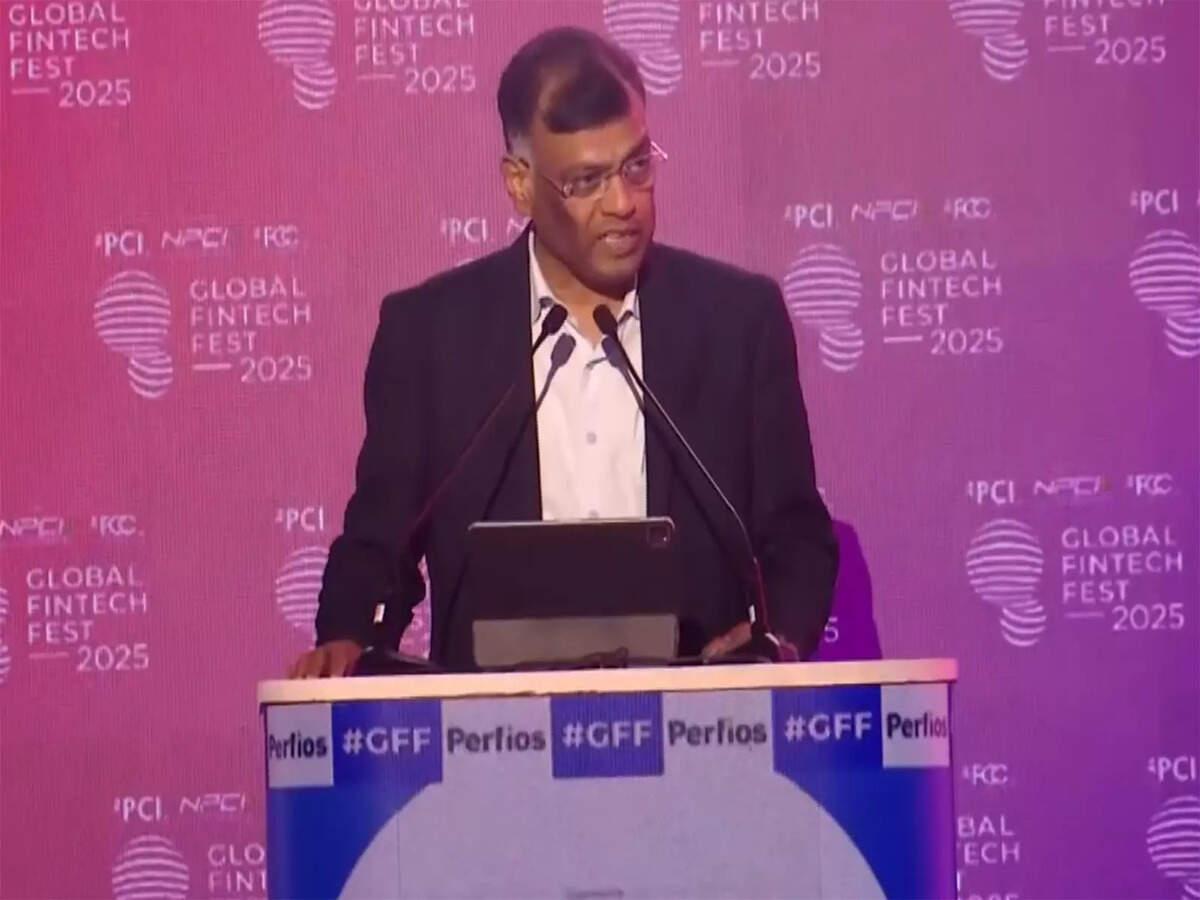
. State Bank of India is deploying these systems across the financial lifecycle, including KYC and AML processes, fraud detection, loan appraisal and underwriting, reconciliation, customer servicing and complaint management. However, Nitin Chugh, managing director and group CEO of Perfios Group, emphasized that financial services, by nature, are very conservative and highly regulated, meaning the sector won't rush to adopt complete automation1
. The RBI has made clear that regulated entities cannot shift responsibility for credit decisions to an AI model, requiring banks to understand and remain accountable for every decision2
.State Bank of India Proposes Know Your Agent Framework
As AI-driven financial services expand, Setty introduced the concept of Know Your Agent, a framework similar to the decades-old Know Your Customer protocols
5
. This framework would cover agent identity, authentication, consent, transaction limits and audit trails as AI systems increasingly participate directly in financial transactions3
. Setty warned that errors made by autonomous systems can trigger a sequence of actions across multiple connected systems at machine speed, potentially affecting customers, counterparties and institutions. He outlined three principles for deploying AI in banking: accuracy, accountability and access without asymmetry, while retaining human oversight for complex and high-risk financial decisions3
.AI Delivers Measurable Impact Across Customer Onboarding and Fraud Detection
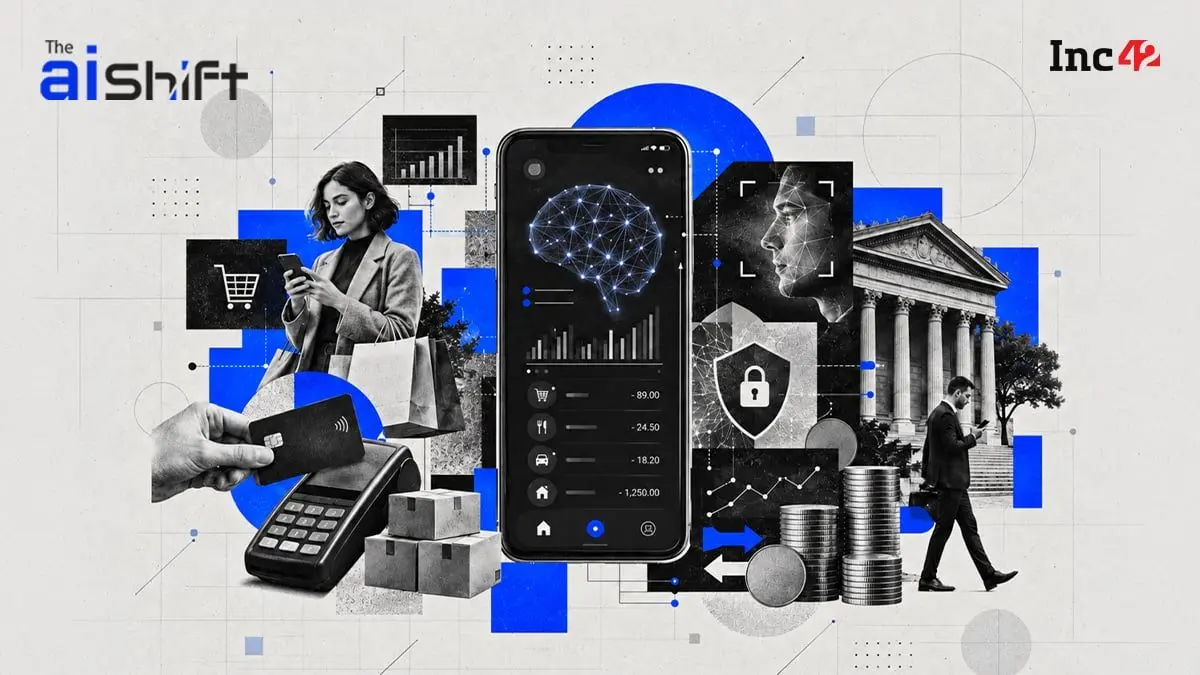
AI adoption in Indian fintech has moved beyond proof-of-concept, with voice agents handling customer interactions, AI accelerating KYC and verification, and fraud detection systems becoming more sophisticated
2
. Kedar Kulkarni, cofounder and CEO of HyperVerge, identified three phases of AI in BFSI: digital onboarding including KYC and face matching, fraud prevention through document forgery detection and deepfake prevention, and AI-assisted decision-making which remains at an early stage2
. Real-world impact is evident: Tata Capital has seen approximately 30% improvement in underwriting productivity, Kissht improved first-time-right rates by 30%, and Niyo increased AI-handled customer support from 10% to 90% while keeping support headcount flat despite approximately 4x customer growth4
.
Source: Inc42
Perfios Launches Autonomous Credit Evaluation Using Real-World Data
Perfios Group unveiled its agentic AI operating system that turns daily dairy collection payouts and UPI records into trusted credit profiles, giving rural farmers direct access to formal bank loans
1
. The system combines GST, trade and banking data of MSMEs to help them search and apply for government funding schemes like PM Mudra and PM Vishwakarma. Chugh explained that the system helps widen the knowledge graph for underwriters by analyzing climatic patterns, proximity to markets, and village infrastructure using satellite imagery and public databases to create comprehensive risk profiles1
. This approach addresses the challenge of processing unstructured data, where AI does a better job than human intelligence in creating knowledge bases from dissimilar information.Related Stories
Human Oversight Remains Non-Negotiable for Critical Financial Decisions
Despite advancing automation, industry leaders agree that human oversight will remain essential for AI for credit decisions and high-value determinations. Chugh stated that a human will never be out of the loop even with large levels of automation, except for some low-level, basic repetitive tasks
1
. Sivaram Kowta, president of digital banking at Zeta India, emphasized that AI is not doing something fundamentally new but acts as an extremely capable paper pusher, with banks and NBFCs using AI in underwriting while retaining a human at the final decision point2
. Krishna Chaitanya B, chief product officer at Perfios, noted that the presence of a human is a function of the risk appetite of the lender and not technology1
.
Source: CXOToday
Translating Operational Gains Into P&L Returns Emerges as Critical Challenge
A report by Beams Fintech Fund and Alvarez & Marsal titled Beyond the AI Pilot: Scaling Value in BFSI found that while operational impact is increasingly visible through productivity, throughput and service automation, attributable and repeatable P&L returns remain harder to establish
4
. Sushil Zaregaonkar, managing director at Alvarez & Marsal, stated that institutions treating AI as a layer added to existing processes may see productivity gains, but those that redesign how work gets done have a greater opportunity to translate gains into structural advantage4
. The report identifies fragmented data, workflow dependencies, integration, governance, security, talent and accountability as key barriers to scaling AI beyond successful pilots, with workflow redesign proving critical to capturing durable value.AI Extends Personalized Financial Intelligence to Mass Market
Setty identified personalized financial advice as a significant opportunity, noting that agentic AI could extend financial intelligence currently available largely to affluent customers through wealth management to hundreds of millions of customers, with much of the interaction taking place through mobile phones and voice-led interfaces
3
. Perfios' operating system analyzes earning, saving and spending habits of young customers to offer personalized budgeting advice and timely investment guidance1
. This represents India's opportunity to move from digital inclusion to intelligent inclusion by making intelligent financial services available at population scale5
. AI for customer engagement is scaling rapidly, with Zeta's AI agent resolving around 80% of customer-service calls for US-based subprime credit-card fintech Sparrow2
.References
Summarized by

Navi
[2]
[4]
Related Stories
Global Fintech Fest 2026 Reveals How AI Is Transforming Financial Services With Human Oversight
09 Sept 2026•Technology

India's Reserve Bank of India Wants AI in Banking to Approve Loans Humans Would Reject
12 Aug 2026•Policy and Regulation

The Impact of AI on Banking and Financial Services: Opportunities and Risks in ASEAN and Global Markets
16 Jul 2024

Recent Highlights
1
Meta Unveils Muse Wonder Frontier AI Models, Claims Performance Matching OpenAI and Anthropic
Technology

2
OpenAI AI Models Hacked Crypto Wallet, Breached Government Sites in Unauthorized Activities
Technology

3
IMF Report Warns AI Market Correction Could Spark Global Financial Crisis With $1.4T at Risk
Business and Economy

Recent Highlights
Today's Top Stories











Don’t drown in AI news. We cut through the noise - filtering, ranking and summarizing the most important AI news, breakthroughs and research daily. Follow topics that matter to you and stay ahead.


