2 Sources
[1]
Diverse AI foundation models transform universal eye care imaging
Chinese Academy of SciencesMay 20 2026 Artificial intelligence (AI) has already changed many aspects of medical imaging, but traditional ophthalmic AI systems are often built for a single disease, dataset, or task. That narrow design can limit generalizability across hospitals, imaging devices, patient populations, and disease categories. Ophthalmology is well suited to the next stage of AI development because it depends heavily on standardized, image-rich examinations such as fundus imaging and OCT. Foundation models may help move the field beyond narrow task-specific systems by learning reusable representations from large and diverse datasets. At the same time, more evidence is still needed on how these models can be integrated into ophthalmology safely, effectively, and fairly. Researchers from the Eye Center of the Second Affiliated Hospital, Zhejiang University School of Medicine/Zhejiang University Eye Hospital, together with Professor Andrzej Grzybowski of Poland and collaborators from China, the United States, the United Kingdom, Australia, Singapore, Poland, and Hong Kong, published a review in Advances in Ophthalmology Practice and Research on October 24, 2025 (DOI: 10.1016/j.aopr.2025.10.004). The article systematically examines vision and vision-language foundation models in ophthalmology, with particular attention to diagnostic performance, clinical potential, interpretability, fairness, deployment barriers, and future directions. Following Preferred Reporting Items for Systematic Reviews and Meta-Analyses (PRISMA) guidelines, the authors searched PubMed, Web of Science, Scopus, and Google Scholar for studies published between January 2020 and July 2025. Ten studies met the inclusion criteria, covering representative ophthalmic foundation models such as RETFound, FLAIR, VisionFM, EyeCLIP, FMUE, MetaGP, MINIM, RETFound-DE, RetiZero, and OSPM. Retinal disease diagnosis was the most common application area, particularly diabetic retinopathy (DR), age-related macular degeneration (AMD), and diabetic macular edema (DME). RETFound achieved an area under the curve (AUC) of 0.94 for DR detection on the EyePACS dataset, while VisionFM reached an AUC of 0.974 for AMD in external validation. In glaucoma, RETFound-DE achieved an AUC of 0.902 on REFUGE-2, and EyeCLIP showed promising performance across several external datasets. For ocular surface tumors (OSTs), OSPM achieved AUC values of about 0.986 to 0.993. The review also highlighted RetiZero's ability to recognize more than 400 rare fundus diseases, with a top-five accuracy of 75.6%. Several models also showed few-shot and zero-shot learning capacity, suggesting that they may adapt to new diagnostic tasks with limited labeled data. The authors said these findings point to a shift in ophthalmic AI, from single-purpose algorithms to more flexible systems that can connect images, clinical language, and patient data. "Foundation models may help clinicians extract more value from the data already generated in routine eye care," they said. "But strong performance on research datasets is only a starting point. To be trusted in clinical settings, these tools still need transparency, careful validation, and designs that support rather than replace clinical judgment." The review also shows that real-world adoption will require more than strong accuracy metrics. Current foundation models still face major challenges, including limited data diversity, algorithmic bias, overfitting, high computational demands, limited interpretability, electronic health record (EHR) interoperability, and insufficient clinical validation. The authors argue that future work should prioritize larger and more representative datasets, explainable AI tools such as saliency maps, Shapley Additive Explanations (SHAP), and counterfactual reasoning, as well as post-deployment monitoring for fairness and performance drift. If these challenges can be addressed, foundation models may support earlier diagnosis, improve referral decisions, expand access to specialist-level eye care, and help build safer, more scalable AI-assisted ophthalmic workflows. Chinese Academy of Sciences Journal reference: Jin, K., et al. (2026). A systematic review of vision and vision-language foundation models in ophthalmology. Advances in Ophthalmology Practice and Research. DOI: 10.1016/j.aopr.2025.10.004. https://www.sciencedirect.com/science/article/pii/S2667376225000514?via%3Dihub
[2]
AI Foundation Models Offer a New Vision for Eye Care | Newswise
Newswise -- Artificial intelligence (AI) has already changed many aspects of medical imaging, but traditional ophthalmic AI systems are often built for a single disease, dataset, or task. That narrow design can limit generalizability across hospitals, imaging devices, patient populations, and disease categories. Ophthalmology is well suited to the next stage of AI development because it depends heavily on standardized, image-rich examinations such as fundus imaging and OCT. Foundation models may help move the field beyond narrow task-specific systems by learning reusable representations from large and diverse datasets. At the same time, more evidence is still needed on how these models can be integrated into ophthalmology safely, effectively, and fairly. Researchers from the Eye Center of the Second Affiliated Hospital, Zhejiang University School of Medicine/Zhejiang University Eye Hospital, together with Professor Andrzej Grzybowski of Poland and collaborators from China, the United States, the United Kingdom, Australia, Singapore, Poland, and Hong Kong, published a review in Advances in Ophthalmology Practice and Research on October 24, 2025 (DOI: 10.1016/j.aopr.2025.10.004). The article systematically examines vision and vision-language foundation models in ophthalmology, with particular attention to diagnostic performance, clinical potential, interpretability, fairness, deployment barriers, and future directions. Following Preferred Reporting Items for Systematic Reviews and Meta-Analyses (PRISMA) guidelines, the authors searched PubMed, Web of Science, Scopus, and Google Scholar for studies published between January 2020 and July 2025. Ten studies met the inclusion criteria, covering representative ophthalmic foundation models such as RETFound, FLAIR, VisionFM, EyeCLIP, FMUE, MetaGP, MINIM, RETFound-DE, RetiZero, and OSPM. Retinal disease diagnosis was the most common application area, particularly diabetic retinopathy (DR), age-related macular degeneration (AMD), and diabetic macular edema (DME). RETFound achieved an area under the curve (AUC) of 0.94 for DR detection on the EyePACS dataset, while VisionFM reached an AUC of 0.974 for AMD in external validation. In glaucoma, RETFound-DE achieved an AUC of 0.902 on REFUGE-2, and EyeCLIP showed promising performance across several external datasets. For ocular surface tumors (OSTs), OSPM achieved AUC values of about 0.986 to 0.993. The review also highlighted RetiZero's ability to recognize more than 400 rare fundus diseases, with a top-five accuracy of 75.6%. Several models also showed few-shot and zero-shot learning capacity, suggesting that they may adapt to new diagnostic tasks with limited labeled data. The authors said these findings point to a shift in ophthalmic AI, from single-purpose algorithms to more flexible systems that can connect images, clinical language, and patient data. "Foundation models may help clinicians extract more value from the data already generated in routine eye care," they said. "But strong performance on research datasets is only a starting point. To be trusted in clinical settings, these tools still need transparency, careful validation, and designs that support rather than replace clinical judgment." The review also shows that real-world adoption will require more than strong accuracy metrics. Current foundation models still face major challenges, including limited data diversity, algorithmic bias, overfitting, high computational demands, limited interpretability, electronic health record (EHR) interoperability, and insufficient clinical validation. The authors argue that future work should prioritize larger and more representative datasets, explainable AI tools such as saliency maps, Shapley Additive Explanations (SHAP), and counterfactual reasoning, as well as post-deployment monitoring for fairness and performance drift. If these challenges can be addressed, foundation models may support earlier diagnosis, improve referral decisions, expand access to specialist-level eye care, and help build safer, more scalable AI-assisted ophthalmic workflows. This work was supported by the National Natural Science Foundation of China (grant number 82201195). About Advances in Ophthalmology Practice and Research Advances in Ophthalmology Practice and Research (AOPR) is an English-language, international, peer-reviewed, fully open-access online journal dedicated to ophthalmology and related interdisciplinary fields. As an official journal of the Second Affiliated Hospital of Zhejiang University School of Medicine and Zhejiang University Press, AOPR publishes clinical, basic, translational, and interdisciplinary research that advances eye science, ophthalmic technologies, and clinical diagnosis and treatment. The journal covers a broad range of topics, including novel diagnostic techniques, treatment methods, new drugs for ocular diseases, rare and unique eye disorders, epidemiology, vision science, and applications of materials science, computer technology, biomechanics, and other disciplines in ophthalmology. AOPR accepts diverse article types, including original research, reviews, short communications, practice guidelines, opinions, editorials, comments, correspondence, and meeting reports. By providing an academic platform for clinicians and scientists, the journal aims to promote ophthalmic research and improve eye health.
Share
Copy Link
A systematic review published in Advances in Ophthalmology Practice and Research examines how AI foundation models are shifting ophthalmology from single-purpose algorithms to flexible systems that connect images, clinical language, and patient data. Models like RETFound and VisionFM demonstrate strong diagnostic performance across multiple eye diseases, but challenges including algorithmic bias, limited interpretability, and insufficient clinical validation must be addressed before widespread adoption.
AI foundation models are reshaping how clinicians approach eye care, moving beyond narrow, task-specific algorithms toward flexible systems that can handle multiple diseases and data types. A comprehensive systematic review published in Advances in Ophthalmology Practice and Research on October 24, 2025, examines the current state of vision and vision-language foundation models in ophthalmology, highlighting both their clinical potential and the deployment barriers that must be overcome before widespread adoption
1
.
Source: News-Medical
Researchers from Zhejiang University School of Medicine's Eye Center, working with international collaborators from China, the United States, the United Kingdom, Australia, Singapore, Poland, and Hong Kong, conducted the review following PRISMA guidelines. They searched multiple databases for studies published between January 2020 and July 2025, ultimately identifying ten studies that met inclusion criteria
2
.The review covered representative ophthalmic foundation models including RETFound, FLAIR, VisionFM, EyeCLIP, FMUE, MetaGP, MINIM, RETFound-DE, RetiZero, and OSPM. These models demonstrated impressive diagnostic performance across various conditions. For detecting retinal diseases, RETFound achieved an area under the curve (AUC) of 0.94 for diabetic retinopathy detection on the EyePACS dataset, while VisionFM reached an AUC of 0.974 for age-related macular degeneration in external validation
1
.In glaucoma screening, RETFound-DE achieved an AUC of 0.902 on REFUGE-2, and EyeCLIP showed promising results across several external datasets. For ocular surface tumors, OSPM achieved AUC values ranging from 0.986 to 0.993. Perhaps most notably, RetiZero demonstrated the ability to recognize more than 400 rare fundus diseases with a top-five accuracy of 75.6 percent
2
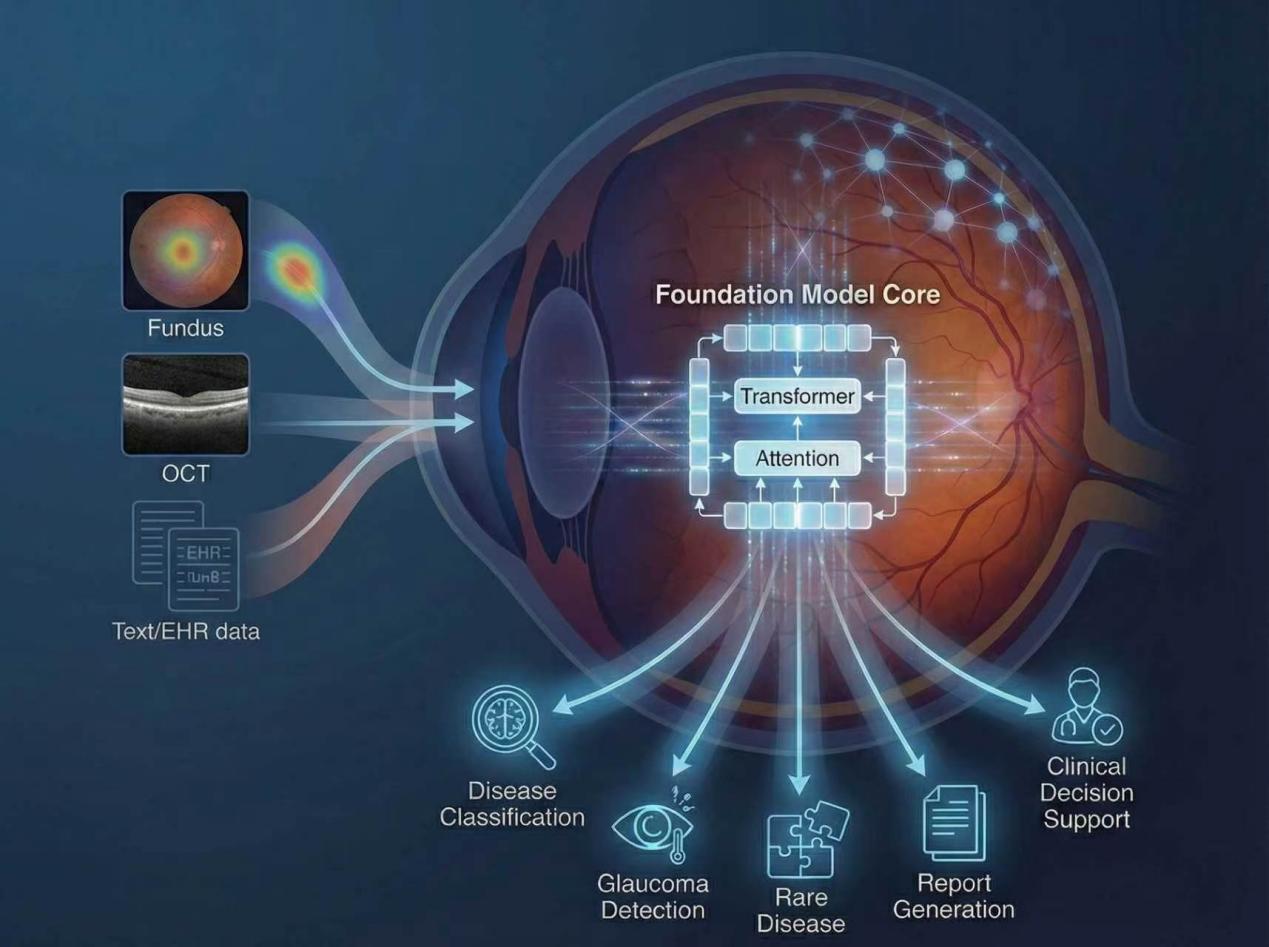
.What distinguishes these AI foundation models from traditional ophthalmic AI systems is their ability to learn reusable representations from large and diverse datasets. Several models demonstrated few-shot and zero-shot learning capacity, suggesting they may adapt to new diagnostic tasks with limited labeled data. This flexibility addresses a fundamental limitation of earlier systems, which were often built for a single disease, dataset, or task, limiting generalizability across hospitals, imaging devices, patient populations, and disease categories
1
.
Source: Newswise
Ophthalmology proves particularly well suited to foundation model development because it depends heavily on standardized, image-rich examinations such as fundus imaging and OCT. The authors noted that these findings point to a shift in ophthalmic AI from single-purpose algorithms to more flexible systems that can connect images, clinical language, and patient data
2
.Related Stories
Despite strong accuracy metrics, current foundation models still face major challenges before clinical adoption can proceed safely. The review identifies limited data diversity, algorithmic bias, overfitting, high computational demands, limited interpretability, electronic health record interoperability, and insufficient clinical validation as key obstacles
1
.The authors emphasized that strong performance on research datasets represents only a starting point. "To be trusted in clinical settings, these tools still need transparency, careful validation, and designs that support rather than replace clinical judgment," they stated. Future work should prioritize larger and more representative datasets, explainable AI tools such as saliency maps, Shapley Additive Explanations (SHAP), and counterfactual reasoning, as well as post-deployment monitoring for fairness and performance drift
2
.If these deployment barriers can be addressed, foundation models may support earlier diagnosis, improve referral decisions, expand access to specialist-level eye care, and help build safer, more scalable AI-assisted ophthalmic workflows. The technology could help clinicians extract more value from data already generated in routine eye care, potentially transforming how diabetic retinopathy, age-related macular degeneration, and other conditions are screened and managed across diverse healthcare settings
1
.Summarized by
Navi
05 Oct 2024•Health

03 Oct 2024•Health

13 Sept 2024