AMD Ross AI Assistant Transforms Embedded Development With Natural-Language Workflows


3 Sources
[1]
AMD Introduces Ross AI Assistant for Embedded Design Workflows
AMD has introduced AMD Ross, an agentic AI assistant for embedded development. The tool is designed to help engineers work across hardware design and debugging, software and algorithm development, edge AI implementation, and deployment. AMD says developers can use natural-language instructions to
[2]
AMD Introduces Ross Agentic AI Assistant to Accelerate Embedded System Development
What Makes AMD Ross Unique? Unlike generic AI assistants, AMD Ross is built around AMD Embedded development environments, institutional AMD engineering knowledge and expert-authored methodologies. It's not merely an AI coding assistant layered on top of development tools; it combines direct access
[3]
AMD Brings the Power of Agentic AI to Embedded Design and Development Cycle
AMD Ross agentic AI assistant spans software, silicon and board design to dramatically accelerate embedded system design, optimization, debug and deployment compared to typical development life cycles. What's the News? AMD today introduced AMD Ross™, an agentic AI assistant designed to accelerate
Share
Copy Link
AMD introduced AMD Ross, an agentic AI assistant designed to accelerate embedded development from hardware design to deployment. The tool uses natural-language instructions to search documentation, run commands, and execute workflows across AMD's development tools. Built on AMD Knowledge Base and expert methodologies, Ross supports the entire embedded system development lifecycle.
AMD Ross Redefines Embedded Development With Agentic AI Assistant
AMD has launched AMD Ross, an agentic AI assistant built specifically for embedded development workflows.
1
The AI assistant addresses the growing complexity engineers face across hardware design, software development, edge AI implementation, and system-level deployment. Unlike generic coding assistants, AMD Ross integrates directly with AMD's embedded development environments, combining institutional engineering knowledge with expert-authored methodologies to accelerate embedded system development.2
Natural-Language Instructions Drive Development Tool Interaction
AMD Ross enables developers to use natural-language instructions to interact with complex development tools, search technical documentation, run commands, generate code, and troubleshoot errors.
1
Engineers can ask the AI assistant to check tool status, guide debugging sessions, and execute proven workflows without navigating multiple interfaces manually. This approach transforms how teams engage with AMD's embedded development lifecycle, making specialized knowledge more accessible across engineering organizations.The system supports AMD's complete embedded portfolio, including Vivado Design Suite, ChipScope, Power Design Manager, Vitis, Vitis HLS, Vitis AI, ROCm AI, and Ryzen AI software.
1
Salil Raje, senior vice president and general manager at AMD Embedded, stated that "AMD Ross brings the power of agentic AI to embedded developers to move product innovations from design intent to deployment faster by accelerating the entire life cycle."2
Four Core Components Power Embedded Design Workflows
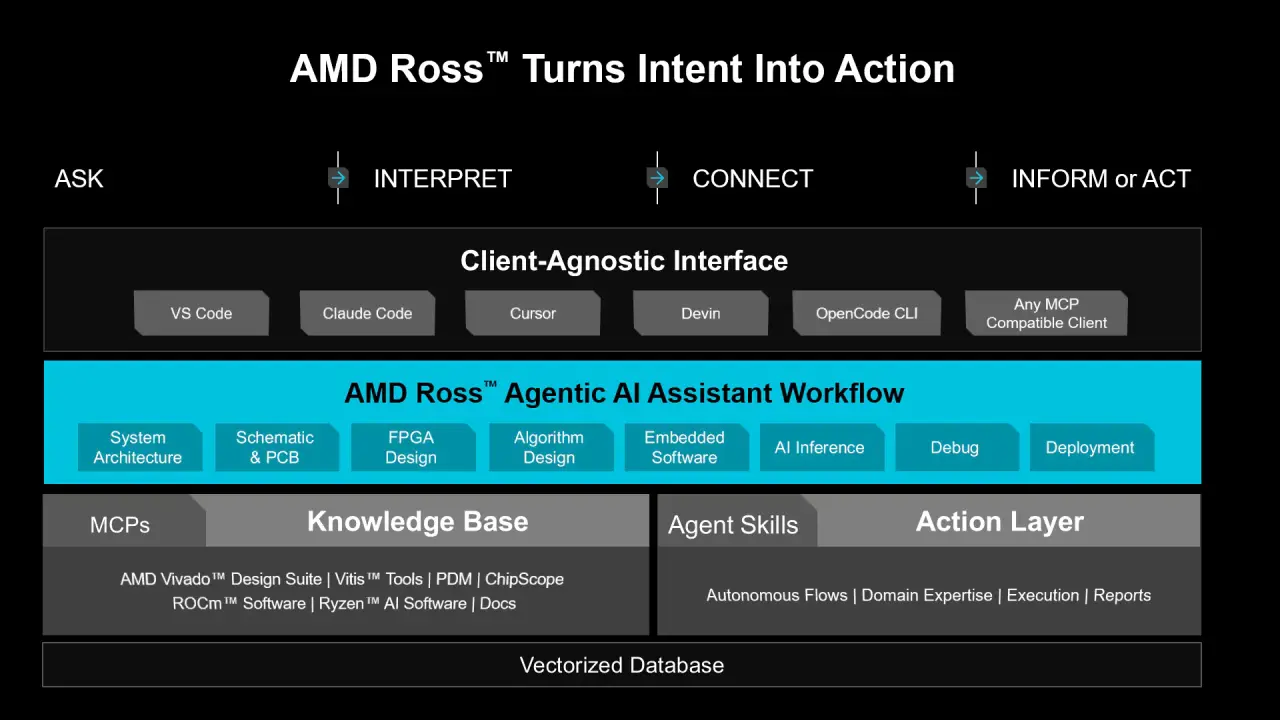
AMD Ross operates through four purpose-built components that distinguish it from generic AI assistants. Model Context Protocol (MCP) servers connect AI agents to AMD embedded tools, enabling the system to query information and execute commands within the design environment.
3
The AMD Knowledge Base contains vectorized databases with user guides, product guides, white papers, application notes, and answer records, accessible through cloud or local offline environments.1
Source: Guru3D
Agent skills represent open Markdown files that document repeatable engineering methods for common design tasks. These expert-authored workflows guide LLMs through structured processes such as timing optimization or C++ design restructuring for higher performance in Vitis HLS.
3
Ready-to-run design examples demonstrate how these methodologies apply to real-world embedded system development scenarios.Hardware Design and Silicon Debug Capabilities
For hardware design tasks, AMD Ross can analyze timing violations, explain probable causes, and suggest implementation changes.
1
The AI assistant provides hardware debugging assistance for signal capture, debug-core configuration, interface analysis, and root-cause identification. In Vitis HLS workflows, Ross recommends pipelining strategies, loop optimization techniques, pragma insertion, and architectural refinements to improve design performance.
Source: CXOToday
The system extends beyond coding to cover hardware and software partitioning, high-level synthesis tool-based hardware designs, machine-learning algorithm optimization, power estimation, schematic review, and board-layout guidance.
2
This comprehensive approach addresses the complete embedded development lifecycle, from initial architecture decisions through final deployment.Related Stories

Client-Agnostic Architecture Supports Developer Preferences
AMD Ross maintains flexibility by supporting client-agnostic integration with preferred large language models, IDEs, and command-line environments while connecting to AMD embedded tools.
1
This design allows engineering teams to maintain their existing workflows and tool preferences while gaining access to AMD-validated information and expert methodologies. The open architecture ensures organizations can adapt the AI assistant to their specific development processes.Early Adoption Shows Promise for Developer Productivity
The FPGA system-on-module team at iWave Global reported that AMD Ross helped with issue identification and troubleshooting during debugging and bring-up phases.
1
The agentic AI assistant aims to deliver faster time-to-prototype through workflow automation, shorter debug and optimization cycles, higher developer productivity by automating repetitive tool interactions, and accelerated onboarding of new engineers through access to proven expert workflows.3
AMD plans to expand Ross capabilities with additional tools and workflow features on a monthly basis.
1
As embedded designs grow more sophisticated across FPGAs, adaptive SoCs, x86 embedded processors, and specialized edge AI platforms, the ability to capture and scale expert methodologies as reusable agent skills could reshape how organizations approach embedded system development challenges and maintain consistent execution of best practices across distributed teams.References
Summarized by

Navi
Related Stories
AMD Ryzen AI Max PRO 400 Series Brings Local Agentic AI to Business PCs with 192GB Memory
25 Sept 2026•Technology
AMD Unveils ROCm 7: A Game-Changer for AI Performance and Accessibility
13 Jun 2025•Technology

AMD Ryzen AI Embedded X100 brings Zen 5 power to autonomous robots and physical AI applications
23 Jul 2026•Technology
Recent Highlights
1
Meta Unveils Muse Wonder Frontier AI Models, Claims Performance Matching OpenAI and Anthropic
Technology

2
IMF Report Warns AI Market Correction Could Spark Global Financial Crisis With $1.4T at Risk
Business and Economy

3
OpenAI Releases 722 AI-Generated Math Solutions, Triggering Existential Crisis in Mathematics
Technology

Recent Highlights
Today's Top Stories









Don’t drown in AI news. We cut through the noise - filtering, ranking and summarizing the most important AI news, breakthroughs and research daily. Follow topics that matter to you and stay ahead.


