Bee-inspired navigation robot uses neural network to find home from 600 meters away


2 Sources
[1]
Bee-inspired navigation robot pinpoints its home using a neural network
You have full access to this article via Jozef Stefan Institute. Conventional robots navigate much like humans do, relying on detailed maps of the area they are in to get around. This allows the robot to maintain an accurate estimate of its own location, but comes at a high computational cost. But
[2]
Tiny robot drones learn to navigate the world like honeybees
Insect-size drones are too small to lug around complex navigation systems. To help tiny autonomous fliers find their way home, researchers are taking their cues from honeybees with the Bee-Nav, described today in Nature. A honeybee leaving the hive first takes a short learning flight to memorize
Share
Copy Link
Researchers developed Bee-Nav, a system that lets tiny robot drones navigate like honeybees using lightweight neural networks. The breakthrough allows drones to return within half a meter of their starting position after flights up to 600 meters, using just 3.4 to 42.3 kilobytes of memory—thousands of times less than conventional systems.
Bee-Inspired Navigation Robot Transforms Drone Capabilities
A bee-inspired navigation robot developed by researchers at Delft University of Technology demonstrates how nature's solutions can revolutionize AI-powered robotics. Published in Nature, the study by Ou et al. introduces Bee-Nav, a system that enables robot drones to navigate the world like honeybees using remarkably compact neural network algorithms
1
. The breakthrough addresses a fundamental challenge: conventional robots rely on detailed maps that demand high computational power, limiting the potential for miniaturization in autonomous drones.How Honeybees Solve Navigation Challenges
The navigation system for insect-sized drones draws directly from honeybee behavior. When leaving their hive, honeybees perform exploratory flights, facing their nest and flying in arcs of gradually increasing radius
1
. Lead author Guido de Croon explains that during these learning flights, bees track the direction and speed of their movements through path integration, while simultaneously memorizing nearby landmarks2
. This dual approach compensates for navigational errors that accumulate during extended journeys, allowing insect brains to maintain accurate location estimates despite their tiny size.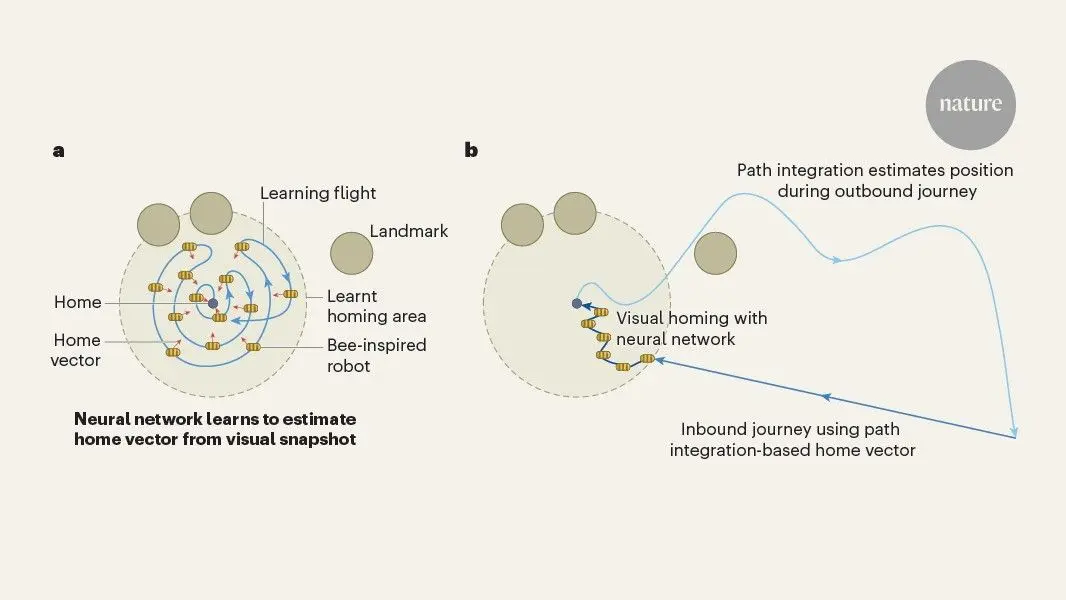
Source: Nature
Neural Network Architecture Mimics Insect Intelligence
The onboard neural network operates through self-supervised learning, progressively improving its ability to link visual scenes with home vector calculations. During training, the algorithm receives views from a learning flight and estimates the home vector at corresponding points in space. The system also generates simulated rotated views to enhance training data
1
. This creates a "Learned Homing Area"—a safe zone where the drone can generate accurate home vector estimates purely from visual input. The neural network requires only 3.4 to 42.3 kilobytes of memory, thousands of times less than conventional mapping systems, while billions of parameters power state-of-the-art image-recognition systems2
.Real-World Performance Validates Approach
Field tests confirm the drone navigation capabilities extend far beyond laboratory conditions. The flying robot, equipped with an omnidirectional camera and running on a credit card-sized Raspberry Pi 4 computer, successfully returned to within half a meter of its starting position after circuitous flights of up to 600 meters
1
2
. The system maintained performance despite wind gusts and camera-blinding sun glares during outdoor testing. Simulations demonstrated that the neural network could navigate home even when encountering unfamiliar views at distances up to 2.5 times the radius of the learnt homing area1
.Related Stories

Implications for Miniaturization and Future Deployment
Sarah Bergbreiter, a mechanical engineer at Carnegie Mellon University, notes that the minimal computation required makes serious outdoor deployments plausible for small-scale robots
2
. De Croon claims the Bee-Nav system could easily operate on drones weighing just 50 grams, or even 30 grams, making autonomous drones significantly smaller and more power-efficient2
. However, Sean Humbert from the University of Colorado Boulder points out that platforms running Bee-Nav will need additional local obstacle avoidance and planning capability in cluttered or dynamic environments2
.Challenges and Long-Term Vision
The research team continues addressing key limitations, including navigation between multiple memorized locations and operation from landmark-free starting points. Scaling autonomous drones down to actual bee size requires solving fundamental problems like miniaturizing batteries
2
. Yet the lightweight algorithm already extends the navigational capabilities of small, low-power drones while advancing scientific understanding of how insect brains process spatial information1
. The research demonstrates that bee-inspired navigation can deliver practical solutions for autonomous systems where size, weight, and power consumption constrain conventional approaches.🟡,References
Summarized by

Navi
[2]
Related Stories
EPFL Researchers Look to Fruit Fly Brains for Next-Gen Robot Controllers
05 Apr 2025•Science and Research
AI-Powered Navigation Breakthrough: Robots Learn to Stay on Track Without Maps
28 Aug 2025•Technology

Bat-Inspired Drones Could Revolutionize Search and Rescue Operations in Dark and Dangerous Conditions
30 Oct 2025•Science and Research

Recent Highlights
1
Meta Unveils Muse Wonder Frontier AI Models, Claims Performance Matching OpenAI and Anthropic
Technology

2
IMF Report Warns AI Market Correction Could Spark Global Financial Crisis With $1.4T at Risk
Business and Economy

3
OpenAI Releases 722 AI-Generated Math Solutions, Triggering Existential Crisis in Mathematics
Technology

Recent Highlights
Today's Top Stories








Don’t drown in AI news. We cut through the noise - filtering, ranking and summarizing the most important AI news, breakthroughs and research daily. Follow topics that matter to you and stay ahead.


