Big Tech AI investment surges to $650 billion as infrastructure spending reshapes the industry


8 Sources
[1]
Nvidia's 75% Margin Gives AI Rivals Something to Aim For
Thanks to Nvidia Corp.'s practice of reporting earnings outside of the typical cycle for technology companies, the question of whether the almost $5 trillion company will record strong demand in 2026 had already been safely answered well before its latest announcement on Wednesday. Investors
[2]
Big Tech to invest about $650 billion in AI in 2026, Bridgewater says
Feb 23 (Reuters) - U.S. technology giants Alphabet (GOOGL.O), opens new tab, Amazon (AMZN.O), opens new tab, Meta (META.O), opens new tab and Microsoft (MSFT.O), opens new tab are expected to collectively invest about $650 billion to scale up AI-related infrastructure this year, according to an
[3]
Big Tech's Soaring Spending on AI Is Eating Into Stock Buybacks
After years of funneling cash to investors through stock buybacks, big technology companies are reining in that spending as they race to sink more money into artificial intelligence. Last quarter, Alphabet Inc., Microsoft Corp., Amazon.com Inc. and Meta Platforms Inc. spent the least on combined
[4]
Nvidia's Jensen Huang says tech's $700 billion AI capex is just the start of something far bigger | Fortune
Nvidia CEO Jensen Huang's comments on his company's Q4 earnings call on Wednesday may one day be remembered as the peak of the AI bubble -- the classic moment that occurs in every bubble when hubris and self-delusion overtake common sense. For that not to be the case, it would mean that, beginning
[5]
Big Tech to invest about $650 billion in AI in 2026, Bridgewater says
US technology giants Alphabet , Amazon, Meta and Microsoft are expected to collectively invest about $650 billion to scale up AI-related infrastructure this year, according to an analysis by Bridgewater Associates. US technology giants Alphabet , Amazon, Meta and Microsoft are expected to
[6]

Nvidia CEO Jensen Huang Pushes Back On Fears Surrounding Big Tech's $700 Billion CapEx Surge: 'Compute Equals Revenues' In The New AI World - Amazon.com (NASDAQ:AMZN), Alphabet (NASDAQ:GOOG)
On Wednesday, Nvidia Corp (NASDAQ:NVDA) CEO Jensen Huang said he remains "confident" that Big Tech's massive AI infrastructure spending will continue. AI CapEx Nears $700 Billion As Investors Question Durability During Nvidia's fourth-quarter earnings call, BofA Securities analyst Vivek Arya
[7]
AI sore big tech cos' artificial splurge eats into stock buybacks
In a bold pivot towards the future, major tech giants are pulling back on stock buybacks to invest heavily in artificial intelligence. Their focus on developing advanced AI capabilities, rather than returning cash to shareholders, indicates a strategic shift that could reshape the industry
[8]
AI Rush: Why Big Tech Is Spending More Than During Dot-Com Boom - Amazon.com (NASDAQ:AMZN), Alphabet (NASDAQ:GOOGL), Meta Platforms (NASDAQ:META), Microsoft (NASDAQ:MSFT)
Cash piled up. Margins expanded. And excess capital flowed back to shareholders through aggressive buybacks and steadily rising dividends. U.S. hyperscalers became machines of financial efficiency -- generating enormous free cash flow while keeping capital intensity relatively contained. That era
Share
Copy Link
Alphabet, Amazon, Meta, and Microsoft are collectively investing about $650 billion in AI infrastructure in 2026, marking a 60% jump from $410 billion in 2025. The spending spree is forcing these tech giants to slash stock buybacks to their lowest levels since 2019, while Nvidia reports record 75% gross margins fueling both opportunity and concern about sustainability.
Big Tech AI Spending Reaches Historic $650 Billion in 2026
The AI investment landscape has entered a new phase of intensity as Alphabet, Amazon, Meta, and Microsoft collectively pour approximately $650 billion into AI infrastructure this year, according to analysis by Bridgewater Associates
2
5
. This represents a sharp increase of about 60% from $410 billion in 2025, underscoring how rapidly Big Tech AI spending has accelerated. Bridgewater co-chief investment officer Greg Jensen characterized this as a "more dangerous phase" marked by exponentially rising investments in physical infrastructure and growing reliance on outside capital.
Source: ET
The scale of AI capital expenditure is reshaping how these companies allocate resources. Meta plans to spend up to $135 billion this year compared to $72 billion in 2025, while Google's budget could reach $185 billion, up from $91 billion the previous year
4
. Jensen noted that "compute demand continues to significantly outpace supply, driving hyperscalers to invest even more rapidly to try to someday get ahead of the demand"2
.Stock Buybacks Hit Lowest Point Since 2019
To fund this unprecedented hyperscalers AI investment, Big Tech companies have drastically curtailed stock buybacks. Last quarter, Alphabet, Microsoft, Amazon, and Meta spent the least on combined share repurchases than in any quarter since 2019
3
. Alphabet and Microsoft spent roughly $11 billion on buybacks, while Amazon and Meta held off entirely3
. Amazon hasn't bought back stock since 2022.This shift from returning cash to shareholders to investing in data center infrastructure represents a fundamental change in Big Tech's financial strategy. The combined free cash flow for these four companies is projected to fall 64% over the next four quarters to about $96 billion from roughly $270 billion in 2025
3
. "In the history of the world, probably nobody has been able to make more money in asset-light businesses than these companies," said Kim Forrest, chief investment officer at Bokeh Capital Partners. "They're throwing that to the wind because they're all caught up in some kind of race"3
.
Source: ET
Nvidia Posts 75% Gross Margin Amid AI Chip Market Dominance
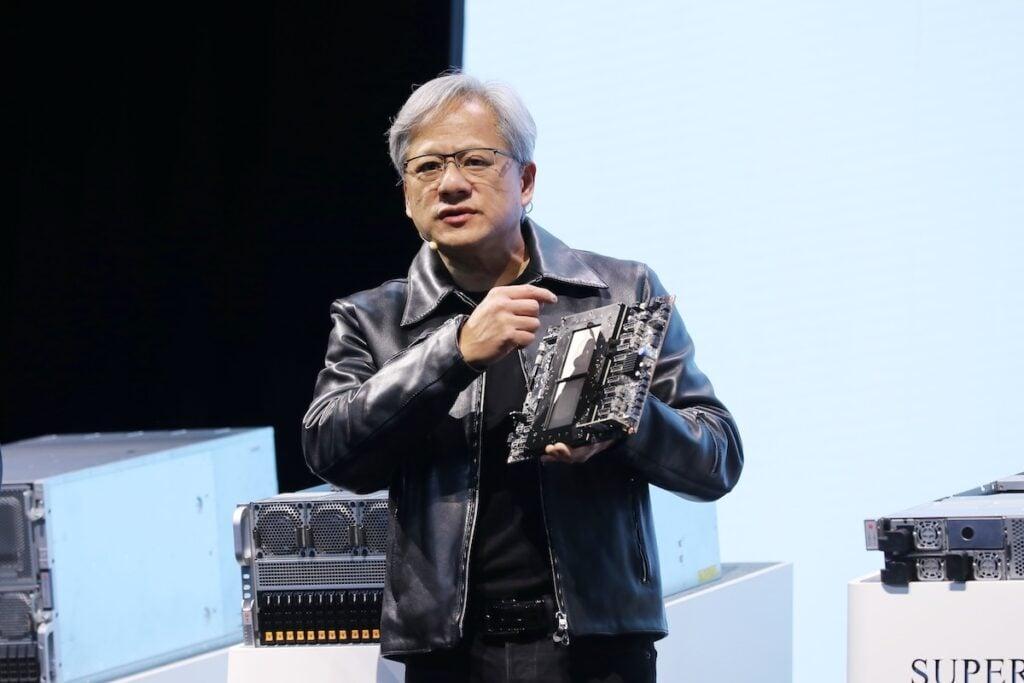
Nvidia delivered blockbuster results with adjusted gross margin reaching 75.2% in the November-January period, the highest since the second half of 2024
1
. Revenue increased 73% to $68.1 billion, with more than half of the company's $62.3 billion in data center revenue coming from AI hyperscalers1
. Nvidia CEO Jensen Huang projected that sales in the current quarter would expand by as much as 200%4
.
Source: Benzinga
Huang defended the sustainability of this spending trajectory, stating that "the amount of token generation capability that the world needs is a lot more than $700 billion"
4
. He pointed to agentic AI as a new wave of compute demand, noting that "agentic AI has reached an inflection point, and it literally happened in the last 2 or 3 months"4
.Related Stories

Competition Intensifies as Rivals Target Nvidia's Margins
Nvidia's extraordinary profitability has attracted fierce competition in the AI chip market. Meta and Advanced Micro Devices announced a "double-digit billions" deal for processors for data centers, while OpenAI negotiated something similar in October
1
. According to Bloomberg Intelligence, the average selling price per unit of a Google TPU is $8,000 to $10,000 compared with $23,000 or more for Nvidia's H100 chip or $27,000 and above for its newer Blackwell system1
.Alphabet's stock price rose when its Tensor Processing Units began handling a significant portion of workloads for Google Cloud clients and its own AI services like Gemini, while Amazon notched a win by bringing on Anthropic as a client for its own AI chips
1
.Downside Risks Emerge as Spending Outpaces Returns
Bridgewater's Jensen warned that the scale of spending is creating significant downside risks if anything goes wrong
2
. Companies like Anthropic and OpenAI will need major product breakthroughs to secure backing for massive final fundraisings ahead of potential IPOs. "Without a credible path to outsized profits, they could struggle to justify lofty valuations and heavy capital demands," he noted2
.The spending boom is also creating ripple effects across the economy. Bridgewater estimates tech investment added about 50 basis points to U.S. GDP growth in 2025 and could provide around 100 basis points of support this year
2
. However, the surge may also lift inflation in technology and communications equipment and push up electricity prices in some regions5
. A severe stock market correction could undermine growth and limit companies' ability to raise capital, similar to the Dot-com bubble in 20002
.References
Summarized by

Navi
Related Stories
Nvidia Bets Big: $99B in Equity Investments Drive 70% Revenue Growth Forecast Amid Debate
07 Sept 2026•Business and Economy

Nvidia revenue tops $96 billion as AI chip demand accelerates and memory commitments reach $160 billion
24 Aug 2026•Business and Economy
Big Tech Spending Surpasses $1 Trillion on AI Infrastructure as Demand Outpaces Supply
30 Jul 2026•Business and Economy
Recent Highlights
1
Meta Unveils Muse Wonder Frontier AI Models, Claims Performance Matching OpenAI and Anthropic
Technology

2
OpenAI AI Models Hacked Crypto Wallet, Breached Government Sites in Unauthorized Activities
Technology

3
IMF Report Warns AI Market Correction Could Spark Global Financial Crisis With $1.4T at Risk
Business and Economy

Recent Highlights
Today's Top Stories







Don’t drown in AI news. We cut through the noise - filtering, ranking and summarizing the most important AI news, breakthroughs and research daily. Follow topics that matter to you and stay ahead.


